Chapter 22: Reported speech
Reporting what someone said — reported speech
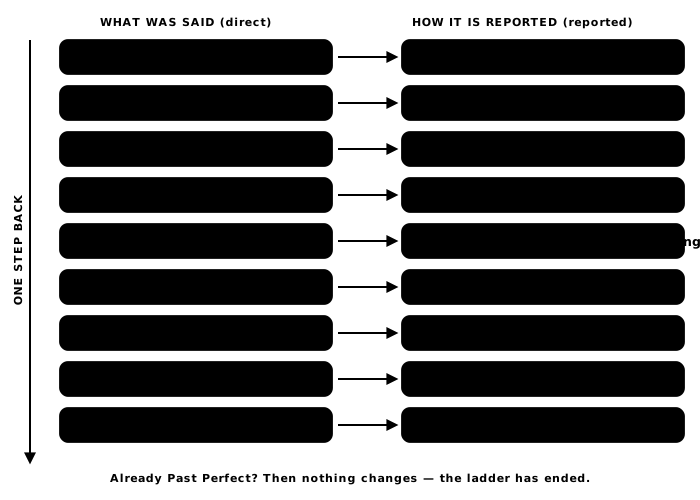
We do this all day: "Mummy said to eat your food", "The boss said to come tomorrow". In English this is called reported speech, and it has one big rule — the tense steps one step back. Whatever someone said is now old news, so its tense also goes down one step of the ladder. In this chapter you will see that ladder in a picture.
- 1Five things change
- 2The tense ladder — one step back
- 3How pronouns change
- 4Time and place words
- 5When the tense does not change
- 6Reporting questions
- 7Orders, requests and advice
- 8say, tell, ask — three words, three habits
- 9The mistakes we really make
In one line
If the reporting verb is in the past (said, told, asked), move the tense inside one step back. If the outer verb is in the past, the inner tense steps back — present → past, past → past perfect.
22.1 Five things change
| # | What changes | Direct | Reported |
|---|---|---|---|
| 1 | The quotation marks and comma go; "that" comes in | He said, "I am tired." | He said that he was tired. |
| 2 | Pronouns change | "I am tired." | … he was tired. |
| 3 | The tense steps one back | "I am tired." | … he was tired. |
| 4 | Time words change | "I will come tomorrow." | … he would come the next day. |
| 5 | Place words change | "Sit here." | … to sit there. |
22.2 The tense ladder — one step back
This is the heart of the whole chapter. On the left is the tense the speaker used, and on the right is the tense you use when reporting. Notice — everything steps down by one.
22.3 How pronouns change
The rule is easy: a pronoun changes according to the view of the person reporting. "I" belonged to the speaker — now it becomes "he" or "she".
| Direct | Reported | Example |
|---|---|---|
| I, me, my | he/she, him/her, his/her | He said, "I lost my pen." → He said he had lost his pen. |
| we, us, our | they, them, their | They said, "We are busy." → They said they were busy. |
| you, your | me/him/her (depending on who it was said to) | She told me, "You are late." → She told me I was late. |
| he, she, it, they | stay the same | She said, "He is away." → She said he was away. |
22.4 Time and place words
| Direct | Reported |
|---|---|
| now | then |
| today | that day |
| tonight | that night |
| tomorrow | the next day / the following day |
| yesterday | the previous day / the day before |
| last night | the previous night |
| next week | the following week |
| two days ago | two days before |
| here | there |
| this / these | that / those |
| come | go |
- Direct: She said, "I am going to Delhi tomorrow."
- Reported: She said that she was going to Delhi the next day. Three changes: I → she, am → was, tomorrow → the next day.
22.5 When the tense does not change
The tense does not always step back. There are four situations where it stays as it is — and it is very important to know them, otherwise your English sounds artificial.
| Situation | Example |
|---|---|
| The reporting verb is in the present | He says that he is busy. |
| Something that is always true | The teacher said that the sun rises in the east. |
| It is still true now | She said she works in a bank. (she still does) |
| It is already Past Perfect | He said, "I had finished." → He said he had finished. |
22.6 Reporting questions
Two things happen here: "that" is not used, and the order goes back to normal — the helping verb moves behind the subject. The question mark disappears too.
WH questions — the WH-word is the connector
| Direct | Reported |
|---|---|
| He asked, "Where do you live?" | He asked where I lived. |
| She asked, "What is your name?" | She asked what my name was. |
| They asked, "Why did he leave?" | They asked why he had left. |
Yes/No questions — add "if" or "whether"
| Direct | Reported |
|---|---|
| He asked, "Are you ready?" | He asked if I was ready. |
| She asked, "Did you call him?" | She asked whether I had called him. |
| Mother asked, "Have you eaten?" | Mother asked if I had eaten. |
Once reported, a question is no longer a question
- Wrong: He asked me where was I going?
- Right: He asked me where I was going.
- Why: A reported question is now a statement. So the order is normal, and it ends with a full stop — not a question mark.
22.7 Orders, requests and advice
There is one trick for all of these: "to" + V1. For a negative, use "not to" + V1. And the reporting verb changes according to the tone of what was said.
| Type | Reporting verb | Direct | Reported |
|---|---|---|---|
| Order | ordered / told | "Stand up!" | He ordered me to stand up. |
| Request | requested / asked | "Please help me." | She requested me to help her. |
| Advice | advised | "You should rest." | He advised me to rest. |
| Forbidding | forbade / told… not to | "Don't touch it." | She told me not to touch it. |
| Suggestion | suggested | "Let's go out." | He suggested going out. |
| Wish / blessing | prayed / wished | "May you succeed!" | He wished that I might succeed. |
22.8 say, tell, ask — three words, three habits
These three words cause the biggest reported-speech mistake in Indian English. The only difference is which one takes a person directly.
| Verb | How it works | Correct |
|---|---|---|
| say | a person does not follow directly — "to" is needed | He said to me… / He said that… |
| tell | a person follows directly — no "to" | He told me that… |
| ask | a person follows directly | He asked me if… |
'She said me' — the most common mistake
- Wrong: She said me that the shop was closed.
- Right: She told me that the shop was closed.
-
Why: A person does not follow "say" directly. You have two options: She told me… or She said to me…. The easy way — whenever you want to name the person, always use tell.
-
Wrong: He told that he would come.
- Right: He said that he would come. / He told me that he would come.
- Why: After "tell" you must say who was told. "Told that" on its own is unfinished.
22.9 The mistakes we really make
Top reported-speech mistakes
- Wrong: She said that she is coming tomorrow.
- Right: She said that she was coming the next day.
-
Why: "Said" is in the past, so the inner tense steps one back — is → was, and tomorrow → the next day.
-
Wrong: He asked me that where I live.
- Right: He asked me where I lived.
-
Why: "That" is not used in questions. The WH-word does the joining itself.
-
Wrong: My father told me that study hard.
- Right: My father told me to study hard.
-
Why: For orders and advice use "to + V1" — not "that".
-
Wrong: She asked me do I know the way.
- Right: She asked me if I knew the way.
-
Why: For yes/no questions use "if" or "whether", with normal order. "Do/does/did" disappear.
-
Wrong: He said that he will help me.
- Right: He said that he would help me.
-
Why: will → would. In the same way can → could, may → might, must → had to.
-
Wrong: The teacher said that water boiled at 100 degrees.
- Right: The teacher said that water boils at 100 degrees.
-
Why: For something that is always true, the tense does not step back.
-
Wrong: He told me that don't go there.
- Right: He told me not to go there.
- Why: To forbid, use "not to + V1" — a short, direct form.
Four steps, every time
1. Identify the type — statement, question, or order?
2. Choose the right connector — that / if-whether / WH-word / to.
3. Change the pronouns.
4. Step the tense one back, and change the time and place words.
22.10 Practice — Reported speech
Exercise 1
Report this: She said, "I am very tired."
- She said that she is very tired.
- She said that she was very tired.
- She said that I was very tired.
- She told that she was very tired.
Hint: 'Said' is in the past, so what happens inside?
Answer
She said that she was very tired.
Two changes: the pronoun I → she, and the tense am → was. 'Said' is in the past, so the tense steps one back.
Exercise 2
Report this: He asked, "Where is the bank?"
- He asked where is the bank.
- He asked that where was the bank.
- He asked where the bank was.
- He asked where was the bank?
Hint: When a question is reported, the order goes back to normal.
Answer
He asked where the bank was.
A reported question is now a statement — so 'the bank was', with a full stop at the end. No 'that' either.
Exercise 3
Report this: Mother said, "Don't play in the sun."
- Mother said that don't play in the sun.
- Mother told not to play in the sun.
- Mother told me not to play in the sun.
- Mother said me not to play in the sun.
Hint: It is a prohibition.
Answer
Mother told me not to play in the sun.
To forbid, use 'not to + V1'. And after 'tell' you must say who was told, so 'told me'.
Exercise 4
In which sentence will the tense NOT step back?
- He said, "I am ill."
- She said, "The earth moves round the sun."
- They said, "We are leaving."
- He said, "I will call you."
Hint: Which one is always true?
Answer
She said, "The earth moves round the sun."
For something that is always true (a universal truth), the tense stays as it is — 'She said that the earth moves round the sun.'
Exercise 5
He said, "I will come tomorrow." → He said that he ___ come the next day.
Hint: What is the reported form of will?
Answer
would
will → would. In the same way can → could, may → might, shall → should.
Exercise 6
She asked, "Are you coming?" → She asked ___ I was coming.
Hint: The connector for a yes/no question.
Answer
if / whether
When reporting a yes/no question we use 'if' or 'whether'. Both are correct — 'whether' is a little more formal.
Exercise 7
Ravi ___ me that the train was late.
Hint: A person ('me') follows directly — so which verb?
Answer
told
A person follows 'tell' directly — told me. 'Said me' is wrong; 'said to me' is fine.
Exercise 8
There is one mistake in this sentence — tap the wrong word.
My sister said me that she would help.
Answer
Wrong word: said.
Corrected: My sister told me that she would help.
A person does not follow 'say' directly. Say 'told me', or 'said to me'.
Exercise 9
Find the wrong word.
He asked me that where I was going.
Answer
Wrong word: that.
Corrected: He asked me where I was going.
'That' is not used when reporting a question. The WH-word joins the two parts by itself.
Exercise 10
One word is wrong — catch it.
The doctor advised him that rest for a week.
Answer
Wrong word: that.
Corrected: The doctor advised him to rest for a week.
Advice and orders take 'to + V1' — 'to rest'. 'That' does not work here.
Exercise 11
Put the words in the correct order to make a reported sentence.
Words: she / work / finished / me / that / her / told / She / had
Answer
She told me that she had finished her work
After 'tell' comes the person (me), then 'that', then the tense steps one back — 'has finished' becomes 'had finished'.
Exercise 12
Match each direct form with its reported form.
| A | B |
|---|---|
| I write | he would write |
| I wrote | he could write |
| I will write | he had to write |
| I can write | he wrote |
| I must write | he had written |
Answer
I write — he wrote; I wrote — he had written; I will write — he would write; I can write — he could write; I must write — he had to write
Present → past, past → past perfect, will → would, can → could, must → had to. Every step of the ladder goes down in the same direction.
Exercise 13
Now say this line aloud — reported speech you will use every day.
He told me that he would call me the next day
Answer
Say: He told me that he would call me the next day
Three things to get right together: 'told me' (not said me), 'would' (not will), and 'the next day' (not tomorrow). Saying it aloud helps all three come together.
What to do next
Tonight, before you sleep, report three things from your day to someone — "My boss told me that…", "My friend asked me if…", "Mummy told me to…". Three sentences a day. In a week the ladder will settle in your head by itself.