Chapter 55: Everyday stories
Everyday stories — English at the office, at home and on the road
English in real life is not as tidy as in short stories. In a meeting people sum things up quickly, the customer care agent reads from a script, and a friend swallows half the words in a voice note. This chapter has five longer pieces (100–200 words). Here you don't just catch "what happened" — you also catch why it happened and how the speaker feels. And new words? You will learn to work out their meaning from context.
- 1Listening between the lines — what is inference?
- 2A team meeting summary
- 3A customer care call — the internet is down
- 4A journey gone wrong — three past tenses
- 5A podcast — talking about working from home
- 6A friend's WhatsApp voice note
- 7Meaning from context — and listening traps
55.1 Listening between the lines — what is inference?
People often don't say "I am angry" or "I am worried" directly. They show it through their words, their tone of voice and their situation. Joining these three clues to work out the meaning = inference. Intermediate-level listening questions ("How does she feel?", "Why does he say…?") are all about this.
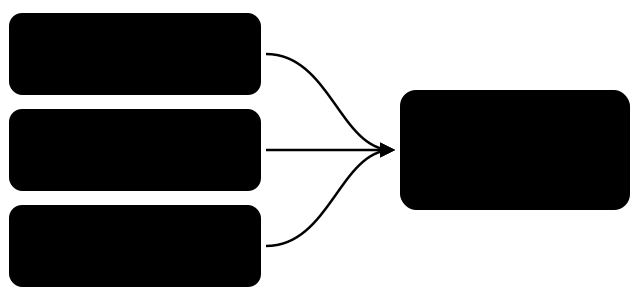
Feeling = words + tone + situation
The answer to "How does she feel?" comes not from one word but from three clues: what was said, how it was said, and in what situation. First understand the situation, then the words, then the tone.
- Rohit, I know that's frustrating, but it's the safer choice. The speaker knows Rohit will be annoyed, and she is trying to calm him down: this is the safer decision.
- Honestly, I don't blame her. To be honest, I think she is not at fault. It means "what she does is fair" — the mistake was mine.
- And please don't be late this time, okay? Don't be late this time. "this time" gives away a hidden fact — she was late last time.
55.2 A team meeting summary
Kavita leads a software team. At the end of the meeting she quickly repeats everything. In a summary like this, signpost words make the map: First, Second, Third, And finally. Listen: why did the launch date change, and what time is the stand-up now?
| Phrase | Meaning (in this context) |
|---|---|
| sum up | to give the main points briefly |
| launch date | the date a product goes live |
| stand-up | a short daily meeting of 10–15 minutes |
| take over | to start doing someone else's work |
| have a think | think about it (British, friendly) |
🎧 Listen to the whole summary (2 parts)
- Part 1 — good news and a new date Catch two numbers: the old date and the new date.
- Part 2 — the stand-up and Sana's work When you hear "instead of", know that something is changing.
Transcript
Kavita: Okay, everyone, let me quickly sum up today's meeting. First, the good news: the new billing app is almost ready, and the client loved the demo on Tuesday. Second, we've moved the launch date from the tenth of March to the seventeenth, because the testing team needs one more week. Rohit, I know that's frustrating after all those late nights, but honestly, it's the safer choice.
Third, from next Monday, our daily stand-up will start at nine forty-five instead of ten, so please don't be late. And finally, Sana is moving to the design team next month, so someone will need to take over her weekly reports. Have a think and let me know by Friday. Any questions? No? Great. Thanks, everyone, and well done on the demo.
- We've moved the launch date from the tenth of March to the seventeenth. The launch has moved from 10 March to 17 March. "from … to …" = old → new. The reason comes right after "because".
- After all those late nights. After working late on so many nights. Inference: Rohit worked very hard — so he may be upset.
Signposts = the map of a summary
The moment you hear First… Second… Third… And finally…, write 1, 2, 3, 4 in your notes. Next to each number put one or two words — not a full sentence. "And finally" = the last point is coming; pay attention again.
55.3 A customer care call — the internet is down
Mrs Lata Iyer works from home, and her internet has been down since last night. She phones the BlueRiver Broadband customer care line. Here one voice reads both parts — work out who is speaking from the names ("Hi, Deepak", "Thank you, Mrs Iyer") and from the questions and answers. Listen: why is this so urgent for her, and what will she get if it is not fixed by two o'clock?
| Phrase | Meaning (in this context) |
|---|---|
| down | (of a machine or network) not working at all |
| fault | a technical problem |
| arrange | to organise, to set up |
| complaint number | the reference number for your complaint |
| patience | the ability to wait calmly (PAY-shuns) |
🎧 Listen to the whole call (2 parts)
- Part 1 — what is the problem ID letters and digits are said one by one — B R seven two zero five.
- Part 2 — when will it be fixed Listen carefully to the condition and the promise after "If it isn't…".
Transcript
Deepak: Good morning, thank you for calling BlueRiver Broadband. My name is Deepak. How may I help you today?
Mrs Iyer: Hi, Deepak. My internet has been down since last night, and I work from home, so this is really urgent.
Deepak: I'm very sorry to hear that, ma'am. May I have your customer ID, please?
Mrs Iyer: Yes, it's BR7205.
Deepak: Thank you, Mrs Iyer. I can see there's a fault in your area, and our engineers are already working on it.
Mrs Iyer: How long will it take?
Deepak: It should be fixed by 2 p.m. today. If it isn't, I'll arrange a technician visit, and you'll get a 50% discount on this month's bill.
Mrs Iyer: Okay, but please make sure it's done. I have an important client call at three.
Deepak: Absolutely, ma'am. Your complaint number is SR4481. Is there anything else I can help you with?
Mrs Iyer: No, that's all. Thank you.
Deepak: Thank you for your patience. Have a good day.
- I work from home, so this is really urgent. I work from home, which is why this matters so much. The reason comes before "so", the result after.
- Okay, but please make sure it's done. Fine, but be certain it gets done. "Okay, but…" = she accepts it, but she doesn't fully trust it. Inference: she is worried and a little impatient.
- It should be fixed by two p.m. today. It ought to be fixed by 2 p.m. today. "should" = we expect so, not a guarantee. "by 2" = at any time up to 2 o'clock.
Customer care English — easy to misunderstand
- Wrong: "It should be fixed by two" = it will definitely be fixed at two.
- Right: "It should be fixed by two" = we hope so, before two o'clock.
- Why: "should" is a guess, not a promise. That is why Deepak immediately gives a plan B: "If it isn't, …".
55.4 A journey gone wrong — three past tenses
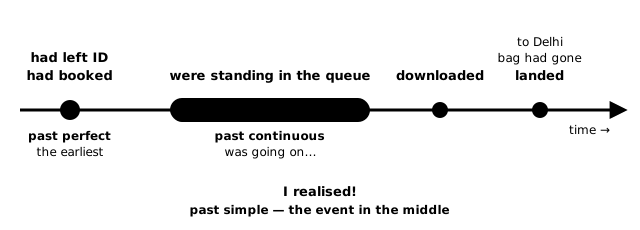
A brother tells the story of travelling with his sister to a wedding in Jaipur. The story uses three kinds of past — the past simple (one event after another), the past continuous (something that was going on) and the past perfect (something even earlier). If you understand the tenses, you understand the order of time. (The full rules are in All 12 tenses.)
| Phrase | Meaning (in this context) |
|---|---|
| security queue | the line for the security check (queue = "kyoo") |
| realised | suddenly understood or noticed |
| furious | extremely angry |
| got through | passed through (the check) |
| I don't blame her | I think she is not at fault |
🎧 Listen to the whole story (2 parts)
- Part 1 — a shock at the airport His sister said nothing — that silence is a clue too.
- Part 2 — another problem "But the adventure wasn't over" = there is more trouble to come.
Transcript
Last December, my sister and I were travelling to Jaipur for our cousin's wedding. We had booked an early flight from Bengaluru, so we left home at four in the morning. While we were standing in the security queue, I suddenly realised that I had left my ID card at home. I couldn't believe it. My sister was furious, and for a minute she didn't say a word.
Luckily, a staff member told me that I could show a digital copy of my ID on my phone. I downloaded it in five minutes, and we got through just in time. But the adventure wasn't over. When we landed in Jaipur, we discovered that our suitcase had gone to Delhi! We spent the first evening of the wedding in our travel clothes. Now, whenever we travel, my sister checks my bag twice. Honestly, I don't blame her.
- While we were standing in the security queue, I suddenly realised that I had left my ID card at home. We were in the line, and suddenly it hit me that I had left my ID at home. One sentence, three tenses — the background, the event, and what came before.
- Luckily, a staff member told me that I could show a digital copy. By good luck, a staff member said a digital copy would do. "Luckily" = the story turned in a good direction.
- Now, whenever we travel, my sister checks my bag twice. These days, every time we travel, my sister checks my bag two times. Present simple = a new habit, the lesson of the story.
Turning-point words in a story
suddenly (a sudden shock) · luckily (good news) · but (the opposite) · when we landed (a new scene). The moment these words appear, the story changes direction. When you hear a turning-point word, listen even more closely to the next sentence.
55.5 A podcast — talking about working from home
In a podcast called "Chai and Careers", two hosts — Nikhil and Aisha — talk about the pros and cons of working from home. In a podcast people give opinions, so words like mostly, but, to be honest, for me matter most. Listen: what does Nikhil like, what does he dislike, and what is his solution?
| Phrase | Meaning (in this context) |
|---|---|
| remotely | away from the office, from home or elsewhere |
| commute | to travel to work and back every day |
| overhear | to hear something by accident |
| hidden cost | a disadvantage you don't notice at first |
| best of both worlds | the advantages of two different things together |
🎧 Listen to the podcast (2 parts)
- Part 1 — Nikhil's experience "Mostly, yes" — yes, but not completely. Now wait for the "but".
- Part 2 — a listener's story and a solution "For me, it's…" = his own opinion is coming now.
Transcript
Nikhil: Welcome back to Chai and Careers. I'm Nikhil.
Aisha: And I'm Aisha. Today we're talking about working from home. Nikhil, you've been working remotely for three years now. Do you still enjoy it?
Nikhil: Mostly, yes. I save almost two hours a day because I don't have to commute. I cook a proper lunch, and I see much more of my kids. But to be honest, I sometimes feel a bit lonely. There's no chat by the coffee machine, you know?
Aisha: That's interesting, because a lot of our listeners say the same thing. One listener, Pooja from Indore, wrote in to say that she works better at home, but she misses learning from senior colleagues.
Nikhil: Yes, I think that's the hidden cost. You don't overhear how experienced people solve problems.
Aisha: So what's the answer?
Nikhil: For me, it's a hybrid model. Two days in the office for teamwork, and three days at home for focused work.
Aisha: That sounds like the best of both worlds.
- I see much more of my kids. I spend a lot more time with my children. "see more of someone" = to meet or be with them more often.
- But to be honest, I sometimes feel a bit lonely. But, truthfully, I sometimes feel lonely. After "to be honest" you often get the thing that is a little hard to say.
- You don't overhear how experienced people solve problems. You can't pick up how skilled people solve difficult problems. Here "you" = anyone, people in general — not just Aisha.
55.6 A friend's WhatsApp voice note
Tanvi sends her friend Riya a voice note. This is informal English — fast, half-sentences, "kind of", "six-ish", "anyway". In real life this is what you will hear most. Listen: why isn't Karan coming, what is the new plan, and what does Riya need to bring?
🎧 Listen to the voice note
- Voice note — Tanvi → Riya Catch three useful facts: who isn't coming, where to meet, what to bring.
Transcript
Hey Riya! Sorry, sorry, I know I didn't reply yesterday. It was a crazy day at work. Listen, about Saturday. The plan's changed a bit. Karan can't make it, because his flight got cancelled, so it's just the four of us now. Instead of the movie, how about that new café in Bandra, the one with all the board games? I'm kind of bored of movies anyway. Oh, and can you bring your speaker? Mine's broken. Let's meet at six-ish outside the station. And please don't be late this time, okay? I'm joking. Well, mostly! Anyway, text me when you get this. Bye!
| Voice note (informal) | Formal version | Meaning |
|---|---|---|
| Karan can't make it. | Karan is unable to attend. | Karan won't be able to come |
| I'm kind of bored of movies. | I'm rather tired of films. | I'm a bit fed up with them |
| at six-ish | at around six o'clock | at about six |
| Mine's broken. | Mine is not working. | mine doesn't work |
| Anyway, text me. | Please reply when you can. | so, send me a message |
- Karan can't make it, because his flight got cancelled. Karan can't come; his flight was cancelled. In "can't" the "t" almost disappears — "kaan(t) make it". The context (because… cancelled) confirms that it means "no".
- I'm joking. Well, mostly! I'm kidding. Well, mostly! Inference: she really does want Riya to come on time.
- Let's meet at six-ish outside the station. Let's meet outside the station at about six. "-ish" = approximately (six-ish, tallish, greenish).
can vs can't — catch it from context
In fast speech can becomes a weak "kn" and can't a longer "kaant" — but the "t" is often not heard. Look at the next words: because… cancelled = can't. Sound + context = the right meaning.
55.7 Meaning from context — and listening traps
In longer English, a new word will turn up every time. Don't stop. Ask three questions: 1) is this good news or bad? 2) what do the words around it tell me? 3) what does the next part of the story say? Often that is enough. (For a full list of phrasal verbs, see the Phrasal verbs chapter.)
Phrases that are misunderstood when taken word for word
- Wrong: "My internet is down" = the internet is low / slow.
- Right: "down" = completely off, not working.
-
Why: For a machine, website, server or network, "down" = not working. The opposite: "It's up again" = it is working again.
-
Wrong: "I don't blame her" = I hold her responsible.
- Right: "I don't blame her" = I don't think she is at fault; she is right.
-
Why: "don't" sounds short and is easily missed. One "not" reverses the whole meaning — always listen out for negatives.
-
Wrong: "Karan can't make it" = Karan can't build anything.
- Right: "can't make it" = he won't be able to come (to a party or meeting).
-
Why: "make it" = to manage to get there. "Can you make it on Friday?" = are you able to come on Friday?
-
Wrong: "Take over her reports" = carry away the reports.
- Right: "take over" = you will now look after her work.
- Why: Sana is moving to the design team — the context itself says that someone else has to do her work.
A new word? Don't stop
Keep listening to the next sentence — it often explains the word before it. First decide whether it is good or bad, then work out the meaning from context. furious → "didn't say a word" → very angry.
55.8 Practice — Everyday stories
Exercise 1
Why has the launch date been moved?
Read this aloud or have someone read it to you:
Second, we've moved the launch date from the tenth of March to the seventeenth, because the testing team needs one more week.
- The testing team needs more time.
- The client didn't like the demo.
- Rohit is on leave.
- The app is already finished.
Answer
The testing team needs more time.
Transcript: “Second, we've moved the launch date from the tenth of March to the seventeenth, because the testing team needs one more week.”
'because the testing team needs one more week' — the reason comes after 'because'.
Exercise 2
How does Kavita think Rohit feels about the new date?
Read this aloud or have someone read it to you:
Rohit, I know that's frustrating after all those late nights, but honestly, it's the safer choice.
- frustrated
- relieved
- excited
- bored
Answer
frustrated
Transcript: “Rohit, I know that's frustrating after all those late nights, but honestly, it's the safer choice.”
'I know that's frustrating after all those late nights' — Rohit worked late, and now the date has moved. Kavita understands that he will be annoyed.
Exercise 3
What time will the daily stand-up start from next Monday?
Read this aloud or have someone read it to you:
Third, from next Monday, our daily stand-up will start at nine forty-five instead of ten, so please don't be late.
- 9:45
- 10:00
- 10:15
- 9:15
Answer
9:45
Transcript: “Third, from next Monday, our daily stand-up will start at nine forty-five instead of ten, so please don't be late.”
'nine forty-five instead of ten' — the new time comes first, the old time after 'instead of'.
Exercise 4
Why is the problem really urgent for Mrs Iyer?
Read this aloud or have someone read it to you:
Hi, Deepak. My internet has been down since last night, and I work from home, so this is really urgent.
- She works from home.
- Her children have online exams.
- She is moving house.
- She has already paid twice.
Answer
She works from home.
Transcript: “Hi, Deepak. My internet has been down since last night, and I work from home, so this is really urgent.”
'I work from home, so this is really urgent' — the reason comes before 'so'.
Exercise 5
What will happen if the internet is not fixed by 2 p.m.?
Read this aloud or have someone read it to you:
It should be fixed by two p.m. today. If it isn't, I'll arrange a technician visit, and you'll get a fifty percent discount on this month's bill.
- a technician visit and a 50% discount
- a free new router
- a full refund for the year
- a call from the manager
Answer
a technician visit and a 50% discount
Transcript: “It should be fixed by two p.m. today. If it isn't, I'll arrange a technician visit, and you'll get a fifty percent discount on this month's bill.”
After 'If it isn't' come two promises: a technician visit + a 50% discount.
Exercise 6
How does Mrs Iyer probably feel at the end of the call?
Read this aloud or have someone read it to you:
Okay, but please make sure it's done. I have an important client call at three.
- still worried and a little impatient
- completely relaxed
- angry with Deepak personally
- very happy
Answer
still worried and a little impatient
Transcript: “Okay, but please make sure it's done. I have an important client call at three.”
'Okay, but…' + 'please make sure' + a client call at three = she agrees, but she is still anxious.
Exercise 7
What had the speaker forgotten?
Read this aloud or have someone read it to you:
While we were standing in the security queue, I suddenly realised that I had left my ID card at home. I couldn't believe it.
- his ID card
- his phone
- the flight tickets
- his suitcase
Answer
his ID card
Transcript: “While we were standing in the security queue, I suddenly realised that I had left my ID card at home. I couldn't believe it.”
'I had left my ID card at home' — past perfect: he had left it behind even before setting out.
Exercise 8
How did his sister react?
Read this aloud or have someone read it to you:
I couldn't believe it. My sister was furious, and for a minute she didn't say a word.
- She was very angry and silent.
- She laughed at him.
- She cried loudly.
- She went home alone.
Answer
She was very angry and silent.
Transcript: “I couldn't believe it. My sister was furious, and for a minute she didn't say a word.”
furious = extremely angry; 'didn't say a word' = completely silent.
Exercise 9
What does the speaker mean by 'I don't blame her'?
Read this aloud or have someone read it to you:
Now, whenever we travel, my sister checks my bag twice. Honestly, I don't blame her.
- She is right to check his bag.
- He is angry with his sister.
- She made the mistake.
- He doesn't want her help.
Answer
She is right to check his bag.
Transcript: “Now, whenever we travel, my sister checks my bag twice. Honestly, I don't blame her.”
'I don't blame her' = I think she is not at fault — the mistake was mine, and her checking is fair.
Exercise 10
How much time does Nikhil save every day?
Read this aloud or have someone read it to you:
Mostly, yes. I save almost two hours a day because I don't have to commute. I cook a proper lunch, and I see much more of my kids.
- almost two hours
- about thirty minutes
- three hours
- one day a week
Answer
almost two hours
Transcript: “Mostly, yes. I save almost two hours a day because I don't have to commute. I cook a proper lunch, and I see much more of my kids.”
'almost two hours a day' — he does not have to commute.
Exercise 11
What is Nikhil's solution?
Read this aloud or have someone read it to you:
So what's the answer? For me, it's a hybrid model. Two days in the office for teamwork, and three days at home for focused work.
- two days in the office, three at home
- five days at home
- five days in the office
- working only at weekends
Answer
two days in the office, three at home
Transcript: “So what's the answer? For me, it's a hybrid model. Two days in the office for teamwork, and three days at home for focused work.”
'For me, it's a hybrid model' — 2 days in the office (teamwork), 3 days at home (focused work).
Exercise 12
Why can't Karan come on Saturday?
Read this aloud or have someone read it to you:
Listen, about Saturday. The plan's changed a bit. Karan can't make it, because his flight got cancelled, so it's just the four of us now.
- His flight got cancelled.
- He is ill.
- He has to work.
- He doesn't like movies.
Answer
His flight got cancelled.
Transcript: “Listen, about Saturday. The plan's changed a bit. Karan can't make it, because his flight got cancelled, so it's just the four of us now.”
'can't make it, because his flight got cancelled' — make it = to be able to come.
Exercise 13
What does Tanvi ask Riya to bring?
Read this aloud or have someone read it to you:
Oh, and can you bring your speaker? Mine's broken. Let's meet at six-ish outside the station.
- her speaker
- board games
- movie tickets
- snacks
Answer
her speaker
Transcript: “Oh, and can you bring your speaker? Mine's broken. Let's meet at six-ish outside the station.”
'can you bring your speaker? Mine's broken.' The board games are already at the cafe.
Exercise 14
What can we guess about Riya?
Read this aloud or have someone read it to you:
Let's meet at six-ish outside the station. And please don't be late this time, okay? I'm joking. Well, mostly!
- She was late last time.
- She lives far from the station.
- She doesn't like cafes.
- She is Tanvi's sister.
Answer
She was late last time.
Transcript: “Let's meet at six-ish outside the station. And please don't be late this time, okay? I'm joking. Well, mostly!”
'this time' + 'Well, mostly!' — she was late last time, and Tanvi is half serious.
Exercise 15
Match each phrase to its meaning in context.
| A | B |
|---|---|
| sum up | to be unable to come |
| take over | the advantages of both things |
| can't make it | to give the main points briefly |
| the best of both worlds | to start doing someone else's work |
Answer
sum up — to give the main points briefly; take over — to start doing someone else's work; can't make it — to be unable to come; the best of both worlds — the advantages of both things
Understand these phrases by their whole meaning, not word for word — context is the key.
Exercise 16
Which line is informal (like a friend's voice note)?
- I'm kind of bored of movies, so six-ish?
- Thank you for your patience.
- May I have your customer ID, please?
- Let me quickly sum up today's meeting.
Hint: Look for -ish and kind of.
Answer
I'm kind of bored of movies, so six-ish?
'kind of' and 'six-ish' are signs of informal chat. The other three are office or customer care English.
Exercise 17
Listen and write.
Dictation. Have someone read the sentence aloud, then write it down.
The testing team needs one more week.
Answer
The testing team needs one more week.
'team' is singular → 'needs' (with -s).
Exercise 18
Listen and write.
Dictation. Have someone read the sentence aloud, then write it down.
My internet has been down since last night.
Answer
My internet has been down since last night.
'has been … since' = present perfect, from last night until now.
Exercise 19
Listen and write.
Dictation. Have someone read the sentence aloud, then write it down.
While we were standing in the queue, I realised that I had left my ID card at home.
Answer
While we were standing in the queue, I realised that I had left my ID card at home.
Three tenses together: were standing (going on), realised (the event), had left (earlier still).
Exercise 20
Say this to your team, like Kavita — friendly, but clear.
Have a think and let me know by Friday
Answer
Say: Have a think and let me know by Friday
'let me know' runs together like 'lemme know'; 'by Friday' = on or before Friday.
Next step
Shadow each piece once — speak along with the audio, half a second behind. When you can say Kavita's summary and Tanvi's voice note without stopping, move on to Real-world English: station announcements, news and interviews.