Chapter 3: The eight parts of speech
The 8 parts of speech — the full map
English has hundreds of thousands of words, but only eight jobs. Every word goes into one of these eight boxes. The day these eight boxes make sense, you stop memorising grammar and start seeing it. This chapter is the map of the whole book; every other chapter opens one of these eight boxes.
- 1First, one sentence with all the jobs
- 2The eight boxes, one line each
- 3One word, two jobs — this is the real game
- 4Noun and Pronoun — the name and the name's shortcut
- 5Verb — the heart of the sentence
- 6Adjective and Adverb — a confusing pair
- 7Preposition, Conjunction, Interjection — three small helpers
- 8Break a sentence apart yourself
- 9The mistakes we really make
- 10A two-minute exercise
In one line
A part of speech is the job a word does in a sentence. Not what the word is, but what it is doing in the sentence.
3.1 First, one sentence with all the jobs
Below is a short sentence that shows seven of the eight jobs together. Look at the colours — the same colours are used for the same jobs all through the book, so your eye will get used to them.
Noun
Pronoun
Verb
Adjective
Adverb
Preposition
Conjunction
Interjection
- Wow! She quickly opened the old box under the bed, and we laughed. = What a surprise! She opened the old box under the bed in a hurry, and we laughed.
3.2 The eight boxes, one line each
| Type | What it does | Question to ask | Example |
|---|---|---|---|
| Noun | The name of a thing, person, place or idea | Who? What? | My sister lives in Pune. |
| Pronoun | A word that takes the place of a noun | Who is being talked about? | She called me. |
| Verb | An action, a state of being, or a condition | What is happening? | Ravi reads every night. |
| Adjective | Tells you something about a noun | What kind? How many? Which one? | A heavy bag. |
| Adverb | Tells you about a verb, an adjective or another adverb | How? When? Where? How much? | He walks slowly. |
| Preposition | Shows how a noun is related to another word | Where? When? How? | The pen is on the desk. |
| Conjunction | Joins two words or two sentences | What is it joined to? | Tea or coffee? |
| Interjection | A sudden feeling | What is the feeling? | Oh! I forgot. |
Split the eight into two groups
First, the four big players — noun, pronoun, verb, adjective — without them a sentence cannot be built.
Then the four joiners and decorators — adverb, preposition, conjunction, interjection — they make a sentence better. The first four are the walls; the other four are the paint and the curtains.
3.3 One word, two jobs — this is the real game
The biggest misunderstanding is that a word is always one type. It is not. The sentence decides the job, not the word. Look — the same word "water" is sometimes a noun and sometimes a verb:
- The water is cold. Here "water" is the name of a thing — a noun.
- Please water the plants. Here "water" is an action — giving water — so it is a verb.
| Word | In one job | In another job |
|---|---|---|
| book | noun — I lost my book. | verb — Let's book the tickets. |
| fast | adjective — a fast car | adverb — He runs fast. |
| light | noun — Switch on the light. | adjective — This bag is light. |
| before | preposition — before lunch | conjunction — Call me before you leave. |
| that | pronoun — That is mine. | conjunction — I know that he came. |
A three-step way to identify a word
1. Take the word out — does the sentence fall apart? If yes, the word is essential (noun / verb).
2. Ask what it is telling you about — a noun? Then it is an adjective. A verb? Then it is an adverb.
3. Is a noun coming right after it, and does it show place or time? Then it is a preposition.
3.4 Noun and Pronoun — the name and the name's shortcut
The noun is the foundation of every sentence. The pronoun is its shortcut, so that you don't have to say the same name again and again.
- Repeated: Meera said Meera would bring Meera's books. It hurts the ear, doesn't it? That is why pronouns exist.
- Clear: Meera said she would bring her books. The name once, then a pronoun — this is natural English.
3.5 Verb — the heart of the sentence
If you have to pick just one thing, pick the verb. No complete sentence can be made without a verb. A verb does three kinds of work:
| What the verb is telling you | Example |
|---|---|
| Action — something is happening | She writes poems. |
| Being — existence | He is a teacher. |
| Condition — a state | The soup tastes salty. |
3.6 Adjective and Adverb — a confusing pair
People mix these two up a lot, but the difference is one line: an adjective touches a noun, an adverb touches a verb.
- She is a careful driver. "careful" tells you what kind of driver she is — it is about a noun, so it is an adjective.
- She drives carefully. "carefully" tells you how she drives — it is about a verb, so it is an adverb.
Careful — -ly is not always an adverb
friendly, lovely, costly, silly — these are all adjectives, even though they end in -ly. And fast, hard, late, early are adverbs without any -ly. So don't identify a word by its look — identify it by its job.
3.7 Preposition, Conjunction, Interjection — three small helpers
Preposition — the relationship
It comes before a noun and tells you place, time or manner. The keys are inside the drawer.
Conjunction — the glue
It joins two parts. I wanted tea, but there was no milk.
Interjection — a sudden feeling
It stands apart from the rest of the sentence, and often takes a !. Oh no! The bus has left.
What about articles? (a, an, the)
Some books treat a / an / the as a ninth type — the "determiner". In this book we keep them in the adjective family, because they too tell you something about a noun. They have a whole chapter of their own.
3.8 Break a sentence apart yourself
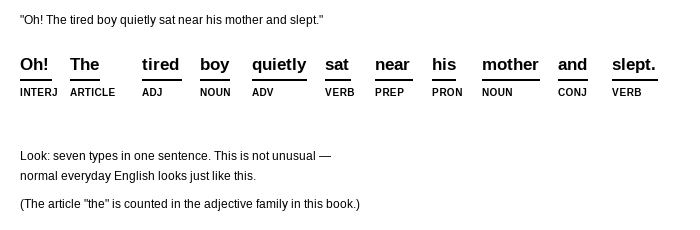
In the sentence below, the job of every word is written under it. First think for yourself, then match the colours.
3.9 The mistakes we really make
Mistakes that come from choosing the wrong part of speech
- Wrong: Myself Ravi.
- Right: I am Ravi. / My name is Ravi.
-
Why: "Myself" is a reflexive pronoun — it can never take the place of the subject. When you introduce yourself you need a subject: I. This mistake comes from translating the Hindi "main Ravi" word for word.
-
Wrong: She drives very careful.
- Right: She drives very carefully.
-
Why: "drives" is a verb, and a verb needs an adverb. An adjective (careful) only goes with a noun — a careful driver.
-
Wrong: He don't know the answer.
- Right: He doesn't know the answer.
-
Why: "He" is third person singular, so the helping verb must be singular too — does. The verb has to agree with the subject; in Hindi this agreement is not so strict, so it gets missed.
-
Wrong: I need some informations.
- Right: I need some information.
-
Why: "Information" is an uncountable noun — it has no plural. If you need to count, say two pieces of information.
-
Wrong: Let us discuss about this topic.
- Right: Let us discuss this topic.
-
Why: "Discuss" does not need a preposition — the object comes straight after it. In Hindi we say "iske baare me baat karein" (talk about this), which is why "about" sneaks in.
-
Wrong: She is my cousin brother.
- Right: He is my cousin.
- Why: "Cousin" is a complete noun by itself — there is no need to add brother or sister. In English a cousin can be a boy or a girl.
3.10 A two-minute exercise
Do this today: take any English sentence — from a newspaper, a YouTube caption, anywhere — and point at each word and say "noun… verb… adjective…". At first it will be slow. After a week it will start to happen by itself, and you will begin to spot your own mistakes while writing.
3.11 Practice — Parts of speech
Exercise 1
Which part of speech is 'quickly' in this sentence? — 'He quickly finished his homework.'
- adverb
- adjective
- verb
- noun
Hint: Ask: what is it telling you about?
Answer
adverb
'quickly' tells you the manner of finishing — so it is about the verb. A word that tells you about a verb is an adverb.
Exercise 2
'Please book two tickets.' — what is 'book' here?
- verb
- noun
- adjective
- preposition
Hint: Forget the word, look at the job.
Answer
verb
Here 'book' is an action — to reserve. The same word becomes a noun in 'I lost my book', because the sentence decides the part of speech, not the word.
Exercise 3
Which word takes the place of a noun?
- pronoun
- adverb
- conjunction
- interjection
Answer
pronoun
Pro + noun means 'in place of a noun'. That is why we say 'she' instead of repeating Meera.
Exercise 4
'I waited, but she never came.' — what is 'but'?
- conjunction
- preposition
- adverb
- pronoun
Answer
conjunction
'but' is joining two whole sentences, and joining is the job of a conjunction. If it were a preposition, a noun would come right after it.
Exercise 5
She is a ___ singer. (adjective form of 'beauty')
Hint: It tells you about the noun 'singer', so you need an adjective.
Answer
beautiful
A noun takes an adjective — beautiful singer. 'beautifully' is an adverb, and goes with a verb: she sings beautifully.
Exercise 6
He sings ___. (adverb form of 'beauty')
Hint: Now it is about the verb 'sings'.
Answer
beautifully
To tell you about a verb you need an adverb. That is why it is beautifully here, and beautiful with singer.
Exercise 7
One word in this sentence is the wrong part of speech — tap it.
She speaks English very fluent.
Answer
Wrong word: fluent.
Corrected: She speaks English very fluently.
'speaks' is a verb, so to tell you about it you need an adverb — fluently. 'fluent' is an adjective, and goes with a noun: fluent English.
Exercise 8
Find the wrong word.
Myself Ravi from Jaipur.
Answer
Wrong word: Myself.
Corrected: I am Ravi from Jaipur.
The reflexive pronoun 'myself' cannot be a subject — you need 'I'. This mistake comes from translating the Hindi 'main Ravi' word for word.
Exercise 9
Match each part of speech to its job.
| A | B |
|---|---|
| Noun | tells you about a noun |
| Verb | shows a noun's relationship |
| Adjective | a sudden feeling |
| Preposition | the name of a thing or person |
| Interjection | an action or being |
Answer
Noun — the name of a thing or person; Verb — an action or being; Adjective — tells you about a noun; Preposition — shows a noun's relationship; Interjection — a sudden feeling
Every word does one job, and that job is its part of speech. Once you get used to the colours, you will start to see it by yourself.
Exercise 10
Make the sentence in the right order — the normal order of article, adjective, noun, verb, adverb.
Words: The / old / walked / slowly / man
Answer
The old man walked slowly
The basic English order is: article + adjective + noun (the subject), then the verb, then the adverb. With the adverb after the verb, the sentence sounds natural.
Exercise 11
Which word is an adjective even though it ends in -ly?
- friendly
- quickly
- slowly
- loudly
Hint: Ask: does it go with a noun?
Answer
friendly
'friendly' tells you about a noun — a friendly dog — so it is an adjective. This is why you should identify words by their job, not by -ly.
Exercise 12
Now say this sentence aloud. Careful — say both l's in 'carefully' clearly.
She drives carefully every day
Answer
Say: She drives carefully every day
When speaking, the adverb comes after the verb, so 'drives carefully' flows together. Saying 'careful' makes the English sound odd.
What next?
Keep this map in mind — in the next eight chapters we will open the boxes one by one. The next chapter is Noun, because every sentence starts there.