Chapter 38: Topic words: daily life
Everyday topics — health, money, shopping, travel, home
You know the grammar, but your mind goes blank when you have to say "my throat is sore" in English at the chemist? This chapter gives you the words and full sentences for five everyday topics — health, money and banks, shopping and returns, travel, and home repairs. Each topic has a table, some ready-made lines, a mini-dialogue, and the Indian English mistakes we really make. Every line has a 🔊 — listen and say it along.
- 1Remember chunks, not single words
- 2Health and doctors — describing a problem in English
- 3Money and banks — from an account to UPI
- 4Shopping and returns — fit, exchange, refund
- 5Travel — from booking to the platform
- 6Home and repairs — something has broken
- 7Small but common mistakes — and what next
38.1 Remember chunks, not single words
Learning the single word "fever" is not enough — you need the whole chunk: I've got a fever. That is why every word in this chapter comes with a chunk (a short sentence). When the time comes to speak, your brain doesn't have to join anything together; the chunk simply comes out.
The chunk rule
Always learn a word together with its partner words: a sore throat, make a payment, a connecting flight, the tap is leaking. There is a whole chapter on fixed pairs: Which word goes with which.
This chapter is about words. For full conversations with a doctor, a shopkeeper and an auto driver, see Everyday conversations, and for saying numbers like ₹1,25,000, see Number, date, time, paise.
38.2 Health and doctors — describing a problem in English
The first thing to tell a doctor or chemist is what the problem is. English has two easy patterns: I've got a … (British, spoken) or I have a … (correct everywhere). And for a feeling in the whole body: I feel …
| In Hindi | In English | Note |
|---|---|---|
| Gala kharab / gale me dard | I've got a sore throat. | sore = painful |
| Bukhaar hai | I've got a fever / a temperature. | "temperature" is common in the UK |
| Sar dard | I've got a headache. | don't forget "a" |
| Zukaam, naak beh rahi | I've got a cold / a runny nose. | a blocked nose = naak band |
| Khaansi | I've got a cough. | dry cough = a cough without phlegm |
| Chakkar aa rahe | I feel dizzy. | feel + adjective |
| Ulti jaisa lag raha | I feel sick. | US: nauseous |
| Pet kharab | I've got an upset stomach. | loose motions = diarrhoea |
| Kamzori | I feel weak and tired. | — |
| Pair mud gaya (moch) | I've sprained my ankle. | sprain = a twisted joint |
| Khujli, daane | I've got an itchy rash. | rash = red spots on the skin |
- I've got a sore throat and a slight fever. = My throat hurts and I have a mild fever.
- I've had a temperature since Monday. = I have had a fever since Monday. (Use I've had with "since".)
- I feel dizzy every time I stand up. = Whenever I stand up, my head spins.
- My back hurts when I bend down. = Bending down gives me back pain. The verb for pain is hurt.
At the chemist — getting medicine
In India we say "medical store", and everyone here understands it. In British English it is a chemist or a pharmacy; in American English a drugstore. A note written by a doctor = a prescription; medicine you can get without one is over the counter.
- Can you suggest something for a sore throat? = Asking the chemist to recommend something for your throat.
- Do I need a prescription for this? = Can I buy this without a doctor's note?
- What's the dose for a ten-year-old? = How much medicine should a ten-year-old child take?
- Does it have any side effects? Will it make me sleepy? = Are there any unwanted effects? Will I feel drowsy?
Mini-dialogue — at the chemist's
Situation: you have had a cough for two days. You are at the chemist's.
- You: Hi. Can you give me something for a cough? = State the problem directly — "something for a …".
- Chemist: Is it a dry cough, or is there phlegm? = phlegm (flem) is the thick mucus from your chest.
- You: It's dry. And my throat's a bit sore. = "a bit" means "a little" — very common in speech.
- Chemist: Try this syrup. Two spoons, three times a day, after meals. = Take it three times each day, after eating.
- You: Great, thanks. How much is it? = Asking the price.
✗
I am having fever since two days.
✓
I've had a fever for two days.
have / have got
a fever
for
I've had
✗
My stomach is paining.
✓
My stomach hurts. / I've got a stomach ache.
hurt
…ache
38.3 Money and banks — from an account to UPI
Banking English doesn't need many words, just the right partner for each: you withdraw money, deposit it, transfer it, and make a payment — not "do" a payment.
| Word | Meaning | Partner / example |
|---|---|---|
| account | your record of money at a bank | open a savings account |
| balance | how much money is in the account | check your balance |
| deposit | to put money in | deposit cash |
| withdraw | to take money out | withdraw ₹2,000 from an ATM |
| transfer | to move money from one account to another | transfer money to a friend |
| loan | money you borrow and pay back | take out / repay a loan |
| interest | the extra money charged (or earned) on money | an interest rate of 9% |
| EMI | a fixed instalment paid every month | pay an EMI of ₹8,500 |
| credited / debited | money came in / went out | ₹500 was debited |
| statement | a list of all transactions | download a bank statement |
- I need to withdraw some cash. Is there an ATM nearby? = I want to take out some cash. Is there a cash machine close by?
- My salary is credited on the first of every month. = My salary reaches my account on the 1st of each month.
- The interest rate on this loan is nine per cent a year. = The loan charges 9% interest every year. (UK: per cent; US: percent.)
- Money was debited from my account, but the payment failed. = The money left my account, but the payment didn't go through. (The first line of a bank complaint.)
EMI and UPI — explaining them to a foreigner
We say both of these words every day in India, but people abroad don't know them. If you ever have to explain, keep these lines ready:
- An EMI is a fixed amount you pay every month to repay a loan, including the interest. = EMI stands for Equated Monthly Instalment — the same amount each month, interest included.
- UPI is a system that lets you send money instantly from your phone, straight from one bank account to another. = UPI stands for Unified Payments Interface — instant bank-to-bank payment from a phone.
- You just scan the QR code, enter the amount and your PIN, and it's done. = Three simple steps: scan, enter the amount and PIN, finished.
- Can I pay by UPI, or is it cash only? = Do you accept UPI, or only cash? (pay by card / UPI / cheque, pay in cash.)
pay by, pay in
To name the method, use pay by card / UPI / cheque, and for cash pay in cash (or just pay cash). Don't say "I'll pay from card" — say "I'll pay by card."
✗
Please do the payment by Friday.
✓
Please make the payment by Friday.
make
Please pay by Friday.
✗
Do you have change of 500?
✓
Do you have change for a 500-rupee note?
change for
38.4 Shopping and returns — fit, exchange, refund
Trying on clothes in a shop, changing a size, sending an online order back — ten or twelve words cover all of these. The most important verb is fit: whether clothes are the right size.
| Word | Meaning | Example |
|---|---|---|
| try on | to wear something to see how it looks | Can I try this on? |
| fitting room | the room for trying on clothes (trial room) | Where's the fitting room? |
| fit | to be the right size | It doesn't fit. |
| suit | to look good on you (colour, style) | Blue really suits you. |
| receipt | the paper that proves you paid | Keep the receipt. |
| exchange | to swap for something else | Can I exchange it? |
| refund | money given back | I'd like a refund. |
| out of stock | none left in the shop | It's out of stock. |
| on sale | sold at a lower price | These are on sale. |
- Do you have this in a bigger size? = Is there a larger size of this?
- Do you have it in any other colour? = Does it come in a different colour? (UK: colour, US: color.)
- The jacket fits well, but the colour doesn't really suit me. = The size is right, but the colour doesn't look good on me.
- What's your return policy? = What are your rules for returning things?
- The parcel arrived damaged, so I'd like to return it. = The parcel came broken, so I want to send it back. (A line for online returns.)
- When will I get my refund? = When will my money come back?
Mini-dialogue — the return counter
Situation: you bought a shirt yesterday and found it too small at home.
- You: Hi, I bought this shirt yesterday, but it's too tight. = When you bought it + what the problem is.
- Staff: No problem. Would you like to exchange it or get a refund? = Do you want a swap or your money back?
- You: I'd like to exchange it for a large, please. = exchange X for Y.
- Staff: Sure. Do you have the receipt? = receipt — the "p" is silent: ri-SEET.
- You: Yes, here you go. = Said when you hand something over — "here it is".
✗
This shirt is not fitting me. Give one size big.
✓
This shirt doesn't fit. Could I try a size bigger?
fit
it fits / it doesn't fit
Could I try…?
✗
I want to return back this phone.
✓
I'd like to return this phone.
return
38.5 Travel — from booking to the platform
Whether by train or flight, a journey follows a straight line: book, check in, board, arrive. Each step has its own words — and so do the problems: delayed, cancelled, missed.
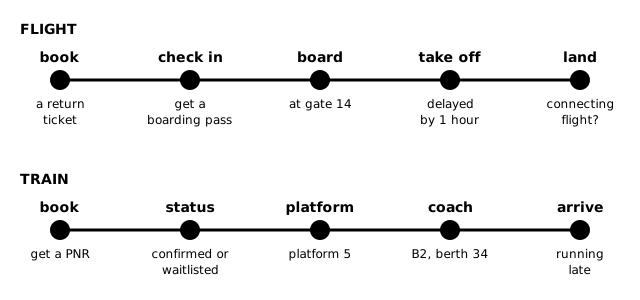
| Word | Meaning | Example |
|---|---|---|
| book (verb) | to reserve a ticket | I booked a seat. |
| one-way / return | one direction / there and back | a return ticket |
| boarding pass | the paper (or phone pass) to get on the plane | Show your boarding pass. |
| board | to get on a plane, train or ship | Boarding starts at 6:40. |
| delayed | late | The flight is delayed. |
| connecting flight | a second flight that continues your journey | I have a connecting flight. |
| layover | a stop between two flights | a three-hour layover |
| platform | the place where you board a train | It leaves from platform 5. |
| waitlisted | WL — your seat is not yet confirmed | My ticket is waitlisted. |
- Which platform does the Shatabdi leave from? = Asking which platform the Shatabdi train departs from.
- The train is running forty minutes late. = The train is 40 minutes behind schedule.
- My flight was delayed, and I missed my connecting flight. = My first flight was late, so I couldn't catch the next one.
- Could I have a window seat, please? = A polite request for a seat by the window. (aisle seat = next to the walkway)
- Is this flight on time? = Is the flight running as scheduled?
Mini-dialogue — the airport check-in counter
Situation: Pune to Delhi, then Delhi to Guwahati.
- Staff: Good morning. May I see your ID and booking, please? = Please show your identity proof and your booking.
- You: Here you are. I have a connecting flight to Guwahati. = Mention the onward flight early.
- Staff: Your bag will be checked through to Guwahati. Boarding is at gate 9. = Your bag will go straight to Guwahati.
- You: The layover is only fifty minutes. Is that enough? = The gap between flights is only 50 minutes — is that enough time?
✗
I will get down at Pune.
✓
I'll get off at Pune.
get off
get on
get in / get out of
✗
My flight got preponed to 6 am.
✓
My flight has been moved earlier / brought forward to 6 am.
Indian English habits
38.6 Home and repairs — something has broken
A tap is dripping, the lights have gone out, the AC isn't cooling — when you tell your landlord, plumber or society office, the pattern is simple: the thing + what is happening. The tap is leaking. The fan isn't working.
| Problem (in Hindi) | In English | Who to call |
|---|---|---|
| Nal tapak raha | The tap is leaking. | plumber |
| Naali band | The drain is blocked. | plumber |
| Bijli chali gayi | The power's gone. / There's a power cut. | — |
| Fuse ud gaya | A fuse has blown. | electrician |
| Plug point kharab | The socket isn't working. | electrician |
| AC thanda nahi | The AC isn't cooling. | AC technician |
| Deewar me seelan | There's damp on the wall. | landlord |
| Darwaza atak raha | The door is stuck. | carpenter |
- The kitchen tap has been leaking since last night. = The kitchen tap started dripping last night and still is. (US: faucet)
- The power's gone again. Is it just our building? = The electricity has failed again. Is it only in our building?
- Could you turn on the fan, please? = A polite request to switch the fan on. (turn on / switch on — both are fine)
- We need to get the geyser fixed before winter. = We must have the geyser repaired (by someone) before winter. ("get something fixed" — see Powerful sentences.)
- The rent includes maintenance, but not electricity. = Maintenance is covered by the rent; the electricity bill is separate.
Mini-dialogue — phoning the landlord
Situation: the bathroom tap has been leaking for a day.
- You: Hi Mr Sharma, it's Neha from flat 302. The bathroom tap is leaking quite badly. = Who you are + what the problem is. "quite badly" = fairly seriously.
- Landlord: Oh, sorry about that. I'll send a plumber tomorrow morning. = A plumber will come tomorrow morning.
- You: Thanks. Could he come before ten? I leave for work at half past ten. = Fix the time — with a polite question.
✗
Please on the fan and off the light.
✓
Please turn on the fan and turn off the light.
on / off
turn on / switch on
turn off / switch off
✗
Light has gone.
✓
The power's gone. / There's a power cut.
power
electricity
38.7 Small but common mistakes — and what next
Some words don't belong to one topic but come up in everyday talk — family, taking leave from work, being out of the house. These are the three you will hear most.
✗
He is my cousin brother.
✓
He's my cousin.
cousin
my cousin, Rahul
my male cousin
my brother
✗
The doctor gave me a medicine for three days.
✓
The doctor gave me some medicine / some tablets for three days.
medicine
some medicine
tablets, capsules
✗
I have less balance in my account.
✓
My balance is low. / I don't have enough money in my account.
low / high
not enough
low balance
Your topic, your list
For each topic, make a note on your phone: 5 chunks you will say this week. Going to the chemist? Say the first 3 lines aloud, then go. A word you don't use is forgotten in two weeks. A word you have spoken stays.
38.8 Practice — Everyday topics
Exercise 1
Doctor: What seems to be the problem? You: I've got a sore ___.
- throat
- neck
- voice
- mouth
Hint: Your throat hurts.
Answer
throat
Pain in the throat = a sore throat. Neck is the outside of the body.
Exercise 2
I've ___ a fever since last night.
Hint: since + present perfect; the third form of have.
Answer
had
It is still going on and there is 'since' → I've had a fever since last night.
Exercise 3
Tap the wrong word.
My head is paining since morning.
Answer
Wrong word: paining.
Corrected: I've had a headache since morning.
For pain use 'hurt' or '...ache': My head hurts / I've got a headache.
Exercise 4
Match each banking word to its meaning.
| A | B |
|---|---|
| withdraw | a fixed monthly instalment |
| deposit | extra money charged on a loan |
| EMI | take money out |
| interest | put money in |
Answer
withdraw — take money out; deposit — put money in; EMI — a fixed monthly instalment; interest — extra money charged on a loan
withdraw = take out, deposit = put in, EMI = monthly instalment, interest = the extra charge on money.
Exercise 5
Do you have change ___ a 500-rupee note?
- for
- of
- to
- in
Answer
for
To break a note we say 'change for': change for a 500-rupee note.
Exercise 6
One word is wrong — find it.
Please do the payment by Friday.
Answer
Wrong word: do.
Corrected: Please make the payment by Friday.
The partner of payment is 'make': make a payment.
Exercise 7
This shirt doesn't ___. Do you have it in a bigger size?
Hint: Being the right size.
Answer
fit
Use 'fit' for size; use 'suit' when colour or style looks good on you.
Exercise 8
Why do the passengers have to wait?
Read this aloud or have someone read it to you:
Attention please. Flight 452 to Kolkata is delayed by forty minutes. The new departure time is seven fifteen pm. Passengers are requested to wait near gate twelve.
- The flight is delayed
- The flight is cancelled
- The gate has changed
- Boarding has started
Answer
The flight is delayed
Transcript: “Attention please. Flight 452 to Kolkata is delayed by forty minutes. The new departure time is seven fifteen pm. Passengers are requested to wait near gate twelve.”
'is delayed by forty minutes' = forty minutes late.
Exercise 9
What is the new departure time?
Read this aloud or have someone read it to you:
Attention please. Flight 452 to Kolkata is delayed by forty minutes. The new departure time is seven fifteen pm. Passengers are requested to wait near gate twelve.
- 7:15 pm
- 6:35 pm
- 7:50 pm
- 6:15 pm
Answer
7:15 pm
Transcript: “Attention please. Flight 452 to Kolkata is delayed by forty minutes. The new departure time is seven fifteen pm. Passengers are requested to wait near gate twelve.”
'seven fifteen pm' = 7:15 pm.
Exercise 10
Leaving a train: 'I'll get ___ at Pune.'
- off
- down
- out
- away
Answer
off
Train, bus, plane: get on / get off. Car, auto: get in / get out of.
Exercise 11
Where is the mistake?
Please on the fan, it is very hot.
Answer
Wrong word: on.
Corrected: Please turn on the fan, it's very hot.
'on' is not a verb on its own — turn on / switch on.
Exercise 12
The electricity has failed — which is natural English?
- There's a power cut.
- Light has gone.
- Current is not there.
- Electric went off.
Answer
There's a power cut.
Electricity for the whole house = power: There's a power cut / The power's gone.
Exercise 13
How many times a day should the syrup be taken?
Read this aloud or have someone read it to you:
Can you suggest something for a cough? Is it a dry cough? Yes, and my throat is a bit sore. Try this syrup. Two spoons, three times a day. If it doesn't get better in three days, please see a doctor.
- Three times a day
- Twice a day
- Once at night
- Every three hours
Answer
Three times a day
Transcript: “Can you suggest something for a cough? Is it a dry cough? Yes, and my throat is a bit sore. Try this syrup. Two spoons, three times a day. If it doesn't get better in three days, please see a doctor.”
'Two spoons, three times a day' — two spoonfuls, three times each day.
Exercise 14
What should you do if it doesn't get better in three days?
Read this aloud or have someone read it to you:
Can you suggest something for a cough? Is it a dry cough? Yes, and my throat is a bit sore. Try this syrup. Two spoons, three times a day. If it doesn't get better in three days, please see a doctor.
- See a doctor
- Buy a new syrup
- Take four spoons
- Come back to the shop
Answer
See a doctor
Transcript: “Can you suggest something for a cough? Is it a dry cough? Yes, and my throat is a bit sore. Try this syrup. Two spoons, three times a day. If it doesn't get better in three days, please see a doctor.”
'please see a doctor' — go and consult a doctor.
Exercise 15
Write what you hear.
Dictation. Have someone read the sentence aloud, then write it down.
The kitchen tap is leaking. Could you send a plumber today?
Answer
The kitchen tap is leaking. Could you send a plumber today?
tap = the water outlet, leaking = dripping; 'Could you…?' is a polite request.
Exercise 16
Put the words in order.
Words: a / I / to / would / like / it / exchange / large / for
Answer
I would like to exchange it for a large
exchange X for Y — 'I would like to' is a polite opening.
Exercise 17
What is the natural way to say 'He is my cousin brother'?
- He's my cousin.
- He's my cousin-brother.
- He's my brother cousin.
- He's my real cousin brother.
Answer
He's my cousin.
In English 'cousin' covers both — don't add brother/sister.
Exercise 18
Now try saying it to the chemist.
I've had a sore throat since yesterday
Answer
Say: I've had a sore throat since yesterday
I've had + since — a problem that is still going on.
What to read next
Now the words of the office and the wider world: Work and the world. And to use these words in full conversations, go back to Everyday conversations.