Chapter 59: Exams & your level
IELTS, TOEFL and your level — from A1 to C2
"How good is my English?" — the answer is not "good" or "okay", it is a level. All over the world English is measured on a six-step ladder: A1 to C2. In this chapter you will see what you can do at each level (with a list to check yourself), a straightforward introduction to the big exams — IELTS, TOEFL, PTE, Cambridge — how many hours it takes, and which chapters of this book to read for each level.
- 1CEFR — six steps
- 2A1 and A2 — the beginning
- 3B1 and B2 — on your own
- 4C1 and C2 — expert
- 5The big exams — at a glance
- 6Which exam should you choose?
- 7How long will it take? — a study plan
- 8Your level, and the chapters of this book
- 9Exam English — mistakes we make when talking about it
59.1 CEFR — six steps
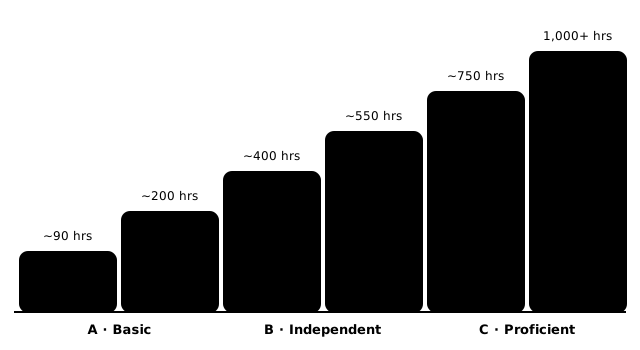
CEFR (Common European Framework of Reference) is an international scale. It has three big parts: A = beginner (basic user), B = on your own (independent user), C = expert (proficient user). Each part has two levels. Most jobs and universities ask for B2 or C1.
Levels in one line
A = survive · B = manage on your own · C = say what you want, the way you want. Each next level takes more time than the one before. The journey from B1 to B2 often feels as long as A1 to B1 — don't panic, it is normal.
- My English is at B2 level, but my speaking is closer to B1. The right way to state your level — "at B2 level".
- I'd like to reach C1 by the end of next year. A goal — reach + level + by + a time.
- Which level do I need for this job? How good does my English need to be for this job?
59.2 A1 and A2 — the beginning
Each level is described with "can-do" statements — that is, what you can do. Read the list below and tick honestly. If most of your answers are "yes", you are at that level.
A1 — Beginner
- ☐ I can say my name, age, city and job.
- ☐ I can ask and understand simple questions: What's your name? Where do you live?
- ☐ I can understand numbers, prices and times when someone speaks slowly.
-
☐ I can fill in a short form (name, address, phone).
-
Hi, I'm Pooja. I'm from Indore. I'm a nurse. A1 — short, fixed sentences.
- How much is this? Can you say that again, please? A1 — asking a price, asking someone to repeat.
A2 — Elementary
- ☐ I can say a few lines about my family, my work and my daily routine.
- ☐ I can manage ordinary tasks at a shop, bank or station.
- ☐ I can write a short message or note: I'm late. See you at 6.
-
☐ I can talk simply about yesterday or last week: Last Sunday I went to…
-
I work in a hospital. I usually start at eight and finish at four. A2 — a routine, "usually", two linked sentences.
- Last weekend I visited my aunt in Bhopal. We went to the lake. A2 — a short story in the simple past.
59.3 B1 and B2 — on your own
B1 — Intermediate
- ☐ I can handle most situations that come up when I travel.
- ☐ I can talk in connected sentences about my experiences, dreams and plans.
- ☐ I can give a short reason for my opinion: I prefer trains because…
- ☐ I can write a simple email or short paragraph on familiar topics.
-
☐ I understand the main points of clear, normal-speed English.
-
I prefer working in a team because I learn a lot from other people. B1 — an opinion + a reason with "because".
- When I was in college, I wanted to be a pilot, but I changed my mind. B1 — experiences and plans, in connected speech.
B2 — Upper-intermediate
- ☐ I can talk with native speakers fairly smoothly, without strain on either side.
- ☐ I can explain my view on an issue, with its advantages and disadvantages.
- ☐ I can follow the main point of news, long articles and technical texts in my field.
- ☐ I can write clear, detailed text — such as an essay or a report.
-
☐ I often notice my own mistakes and correct them myself.
-
Working from home saves time, but it can make teamwork harder, especially for new joiners. B2 — an advantage + a disadvantage + fine detail with "especially".
- The article argues that cities should ban cars, although it doesn't really explain how. B2 — the main point of a long text + your own criticism.
The real difference between B1 and B2
B1 = you get by. B2 = you are comfortable — you follow fast speech, and you back up an opinion with reasons and examples. Most Indian graduates are somewhere between B1 and B2. A large part of this book is for that jump.
59.4 C1 and C2 — expert
C1 — Advanced
- ☐ I can speak fluently, without searching for words.
- ☐ I understand long, difficult texts — and also what is not said directly (implied meaning).
- ☐ I use English flexibly in meetings, presentations and studies.
-
☐ I can write well-structured, connected text on a difficult subject.
-
I take your point, but I'm not convinced the savings would outweigh the risks. C1 — polite disagreement, and a precise word like "outweigh".
- What she didn't say was more telling than what she did. C1 — understanding what is left unsaid (implied meaning).
C2 — Proficient
- ☐ I understand almost everything I hear or read, with ease.
- ☐ I can summarise information from different sources and explain it in connected speech.
-
☐ I can express fine shades of meaning accurately — including humour, irony and hints.
-
It's not that the plan is wrong, exactly; it's more that it's been oversold. C2 — a fine distinction: not wrong, just described as better than it is.
- Taken together, the three reports suggest a slowdown rather than a crisis. C2 — a summary of several sources, with a precise conclusion.
Each skill can be at a different level
Many people are B2 in reading and B1 in speaking. This is completely normal. That is why exams give a separate score for each skill — and why you should work most on your weakest skill.
59.5 The big exams — at a glance
Below is a rough introduction to each exam. Format, fees, scores and rules change from time to time — always check the current details on the official website before you book an exam, and also check the requirement of the place you are applying to (university, visa, company).
| Exam | Format (roughly) | Score |
|---|---|---|
| IELTS Academic | Listening, Reading, Writing, Speaking · about 2 hours 45 minutes · speaking is face to face with an examiner | Band 0–9 (half bands too) |
| IELTS General Training | The same four parts; Reading and Writing use everyday and work texts | Band 0–9 |
| TOEFL iBT | Reading, Listening, Speaking, Writing · on a computer · speaking is recorded on a mic | A new 1–6 scale from 2026 (the old 0–120 runs alongside for a while) |
| PTE Academic | Speaking & Writing, Reading, Listening · on a computer, about 2 hours · scored by computer | 10–90 |
| Cambridge B2 First / C1 Advanced | Reading & Use of English, Writing, Listening, Speaking (often in pairs) | Cambridge English Scale + grade |
IELTS — Academic or General Training?
Academic = studying at a university or professional registration (for example doctors, nurses). General Training = work, migration, or school-level study. Listening and Speaking are the same in both; Reading and Writing are different. In Writing Task 1 you describe a graph or chart in Academic, and write a letter in General.
- I'm taking IELTS Academic next month. I need a band seven overall. You "take" an exam; "band seven overall" — 7 as the total score.
- The speaking test is a face-to-face conversation with an examiner. IELTS speaking — a face-to-face talk with an examiner (about 11–14 minutes).
- Most universities accept scores that are less than two years old. IELTS, TOEFL and PTE scores are usually valid for 2 years. A Cambridge certificate does not expire — but an institution may ask for a recent result.
An exam is not pass or fail
IELTS, TOEFL and PTE have no pass or fail — only a score. The question is how high a score your destination asks for. So instead of "I want to clear IELTS", say: "I need a band 7 in IELTS."
59.6 Which exam should you choose?
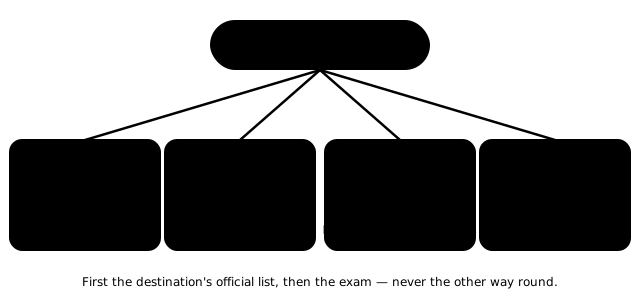
The first question in choosing an exam is not English, it is your destination: where do you want to go and why? That institution will tell you which exams it accepts.
The rule for choosing an exam
Destination → its list → your comfort. If you are comfortable typing on a computer and speaking into a mic, go for TOEFL/PTE; if you would rather talk to a person, choose IELTS speaking. Don't prepare for two exams at once — pick one and take its sample tests.
- Which English tests does your university accept? The first line to ask a university.
- What's the minimum score for each skill? Many places set a separate minimum for each skill.
- I'm aiming for at least a seven in writing. aim for = to have something as your target.
- I've booked the computer-delivered test for the fifteenth of March. computer-delivered = a test taken on a computer.
59.7 How long will it take? — a study plan
Moving up one level usually takes 150 to 250 hours, and more at the higher levels. One hour a day = about 30 hours a month. So B1 to B2 takes about 6 to 8 months, if you study every day.
| Day | What to do | Time |
|---|---|---|
| Every day | One section of this book, everything said aloud | 15–20 min |
| Every day | Listen to English — a podcast, the news, YouTube (English subtitles) | 20 min |
| Every day | 5 new chunks in your phone notes | 5 min |
| 3 days a week | Writing — an email, a paragraph or an essay | 20–40 min |
| 2 days a week | Speak with someone, or record yourself and listen back | 15 min |
| Once a month | One mock test, or redo a chapter quiz | 1 hour |
- I study for an hour every day, and I take a mock test once a month. Saying your routine in English is practice too.
- My weakest skill is speaking, so I record myself twice a week. Most time goes to the weakest skill.
- I've improved a lot, but I still make mistakes with articles. Describing your progress honestly.
Count hours, not days
"IELTS in three months" means nothing unless you know how many hours a day. Keep a small diary: date + minutes + what you did. 5 hours a week x 30 weeks = 150 hours = about one level.
59.8 Your level, and the chapters of this book
Pick your level from the lists above, then focus on the chapters for that level below. Go back over the chapters of the lower levels once — they are the foundation.
| Level · focus | Read these chapters |
|---|---|
| A1 · Sounds, words, simple sentences | How to Use This Book · English Sounds · The 8 Parts of Speech · Sentence Structure · Noun · Articles — a, an, the · Pronoun · Verb |
| A2 · Managing daily life | All 12 Tenses · Adjective · Adverb · Preposition · Conjunction · Interjection · Determiners (some, any, much, many) · Asking questions · Subject-verb agreement · Everyday conversations · Number, date, time, paise · Everyday topics |
| B1 · Speaking and writing in connected sentences | Modal Verbs · Gerunds & Infinitives · If sentences · Fix your pronunciation · Small talk and giving opinions · Phone and video calls · Punctuation · Spelling rules · From sentence to paragraph · Writing emails · Applications and messages · Phrasal verbs · Which word goes with which · Short Stories · Indian English habits |
| B2 · Fast English, opinions, work writing | Clauses · Active and Passive voice · Reporting what someone said · used to, wish, had better · Rhythm and stress · Native speed English · Interview and office · Giving a presentation · One word, ten words · Work and the world · Look-alike words · CV and LinkedIn · Everyday Stories · The 50 most common mistakes |
| C1 · Precise words, flexible style | Powerful sentences · Fluency and filler words · Essays and Reports · Idioms · From Basic to Native · Verb upgrades · Choosing the right adjective · Real-World English |
| C2 · Fine shades and style | Advanced words · Final Test — and then real books, podcasts, debates |
Use the book like a ladder
Take the quizzes of the chapters at your level. Above 80% = the next level. Below = the same chapter once more, this time saying everything aloud. The mixed test for the whole book is in the Final Test.
59.9 Exam English — mistakes we make when talking about it
Even when talking about the exam, some common Indian English habits creep in. Say the clean version in an interview or to a visa officer.
✗
I have given IELTS last month.
✓
I took IELTS last month. / I sat the IELTS test last month. (UK)
give
take
sit
✗
I got 7 bands in IELTS.
✓
I got a band 7 / an overall band score of 7.
I got 6.5 in writing.
✗
I want to clear IELTS.
✓
I need a band 7 in IELTS for my university.
✗
A memorised answer in speaking: "Well, that's a very interesting question. Since my childhood…"
✓
A direct, personal answer: "I'd say my favourite place is the old market near my house, mainly because…"
structure
- I'd say my favourite place is the old market near my house, mainly because of the food. "I'd say…" + "mainly because…" — a natural start in the speaking test.
- Sorry, could you repeat the question, please? If you don't understand the question, it is perfectly fine to ask.
- That's not something I've thought about much, but I suppose… Buying thinking time on a hard question — better than staying silent.
59.10 Practice — Exams and levels
Exercise 1
Which is the highest level in CEFR?
- C2
- C1
- B2
- A1
Answer
C2
A1 → A2 → B1 → B2 → C1 → C2. C2 = proficient.
Exercise 2
'I can handle most situations when I travel, and I can describe my experiences in connected speech.' — which level is this?
- B1
- A1
- C1
- C2
Answer
B1
B1 = the start of the independent user — travel, experiences, short reasons.
Exercise 3
Match each level to its big group.
| A | B |
|---|---|
| A1, A2 | Independent user |
| B1, B2 | Proficient user |
| C1, C2 | Basic user |
Answer
A1, A2 — Basic user; B1, B2 — Independent user; C1, C2 — Proficient user
A = beginner, B = on your own, C = expert.
Exercise 4
What is different between IELTS Academic and General Training?
- Reading and Writing
- Listening and Speaking
- Only Speaking
- Nothing
Answer
Reading and Writing
Listening and Speaking are the same in both; Reading and Writing differ.
Exercise 5
What scale is the IELTS score on?
- Band 0–9
- 10–90
- 0–100 percent
- A to F grade
Answer
Band 0–9
IELTS: band 0–9, with half bands (6.5). PTE: 10–90.
Exercise 6
Tap the wrong word.
I have given IELTS last month.
Answer
Wrong word: given.
Corrected: I took IELTS last month.
You 'take' an exam (UK: sit). Last month = simple past.
Exercise 7
Find the mistake about the score.
I got 7 bands in IELTS.
Answer
Wrong word: bands.
Corrected: I got a band 7 in IELTS.
A band is a score — 'a band 7' or 'an overall band score of 7'.
Exercise 8
I'm ___ IELTS Academic next month. (to do an exam)
Hint: Not give.
Answer
taking / sitting
take an exam (in the UK, sit an exam too).
Exercise 9
Which exam is scored by computer and gives a result on a 10–90 scale?
- PTE Academic
- IELTS
- Cambridge B2 First
- None of them
Answer
PTE Academic
PTE Academic is computer-based with automated scoring, and a score of 10–90.
Exercise 10
What is the very first step in choosing an exam?
- Check the official list of your destination (university / visa)
- The cheapest exam
- Whatever a friend took
- The one that seems easiest
Answer
Check the official list of your destination (university / visa)
First the destination's list, then the exam — it tells you which score is accepted.
Exercise 11
Who do you do the IELTS speaking test with?
Read this aloud or have someone read it to you:
The IELTS test has four parts: listening, reading, writing and speaking. The speaking test is a face-to-face conversation with an examiner, and it lasts between eleven and fourteen minutes.
- With an examiner
- With a computer
- With another candidate
- On the phone
Answer
With an examiner
Transcript: “The IELTS test has four parts: listening, reading, writing and speaking. The speaking test is a face-to-face conversation with an examiner, and it lasts between eleven and fourteen minutes.”
'a face-to-face conversation with an examiner'.
Exercise 12
How long does the speaking test last?
Read this aloud or have someone read it to you:
The IELTS test has four parts: listening, reading, writing and speaking. The speaking test is a face-to-face conversation with an examiner, and it lasts between eleven and fourteen minutes.
- 11 to 14 minutes
- 40 minutes
- 2 hours
- 5 minutes
Answer
11 to 14 minutes
Transcript: “The IELTS test has four parts: listening, reading, writing and speaking. The speaking test is a face-to-face conversation with an examiner, and it lasts between eleven and fourteen minutes.”
'it lasts between eleven and fourteen minutes'.
Exercise 13
Which level does Arjun seem to be at?
Read this aloud or have someone read it to you:
Hi, I'm Arjun. I can talk about my work and my family, and I can handle most situations when I travel. But in meetings, when people speak fast, I often get lost.
- B1
- A1
- C1
- C2
Answer
B1
Transcript: “Hi, I'm Arjun. I can talk about my work and my family, and I can handle most situations when I travel. But in meetings, when people speak fast, I often get lost.”
He manages travel and everyday talk (B1), but gets lost in fast speech — not B2 yet.
Exercise 14
Where does Arjun have the most trouble?
Read this aloud or have someone read it to you:
Hi, I'm Arjun. I can talk about my work and my family, and I can handle most situations when I travel. But in meetings, when people speak fast, I often get lost.
- In meetings when people speak fast
- When he travels
- Talking about his family
- Writing emails
Answer
In meetings when people speak fast
Transcript: “Hi, I'm Arjun. I can talk about my work and my family, and I can handle most situations when I travel. But in meetings, when people speak fast, I often get lost.”
'in meetings, when people speak fast, I often get lost' — see the 'Native speed English' chapter for this.
Exercise 15
Listen and write.
Dictation. Have someone read the sentence aloud, then write it down.
I need an overall band score of seven to study in Canada.
Answer
I need an overall band score of seven to study in Canada.
an overall band score of seven — the right way to say a score.
Exercise 16
With one hour of study a day, about how long does it take to get from B1 to B2?
- 6 to 8 months
- 2 weeks
- 1 month
- 5 years
Answer
6 to 8 months
One level ≈ 150–250 hours; 1 hour a day ≈ 30 hours a month.
Exercise 17
Put the words in the right order.
Words: every / weakest / is / I / skill / speaking / so / practise / My / day
Answer
My weakest skill is speaking so I practise every day
Your weakest skill + what you do about it — a natural line about your preparation.
Exercise 18
Now say it aloud.
I need a band seven in IELTS
Answer
Say: I need a band seven in IELTS
Not 'clear IELTS' — state the score.
What to do next
Today, count the ticks on your self-check list and write down your level. Then pick two chapters for that level and finish them this week. At the end of the month take the Final Test — and see how far up you have climbed.