Chapter 2: The sounds of English
English sounds — the ones Hindi doesn't have
English has 26 letters, but about 44 sounds. This is where all the trouble starts: we read the letters, and we assume that what is written is what we should say. In Hindi, that assumption works — you say what is written in Devanagari. In English, it doesn't. In this chapter we will work on the sounds that your tongue has never made until now — because Hindi never needed them.
- 1Written ≠ spoken
- 2Eight sounds that Hindi doesn't have
- 3Where is the tongue — a map of three positions
- 4Short and long vowels — one mistake, a hundred words
- 5Schwa — the biggest secret of English
- 6Hindi habits that English catches immediately
- 7Silent letters — written but not spoken
- 8The daily 5-minute drill
In one line
Your pronunciation is not wrong because something is "missing" in you — it is wrong because your mouth has only learnt Hindi positions so far. Learn the new position, and the sound will come by itself. This is a skill, not luck. A muscle just needs to be taught.
2.1 Written ≠ spoken
First, listen to these three sets. The words look alike, but they sound completely different:
| Words | Listen | What people wrongly say | What it really is |
|---|---|---|---|
| put / but | both "ut" | put = "puut", but = "bat" | |
| come / home | both "ome" | come = "kum", home = "hoam" | |
| though / through / tough | all three "ough" the same | tho, throo, taf — three different sounds |
So, one rule
When you see a new word, first listen, then speak. Don't guess from the spelling. That is why every line in this book has a 🔊.
2.2 Eight sounds that Hindi doesn't have
These are the eight that make or break your pronunciation. For each one, the mouth position is written down — read it and try it right away. It is better if you have a mirror in front of you.
| Sound | Words | Where to put your mouth | Listen |
|---|---|---|---|
| /θ/ TH without voice | think, three, mouth | Put the tip of your tongue just out between your upper and lower front teeth. Blow air out; no sound from the throat. It is not the Hindi "थ" — in that one the tongue stays behind the teeth. | |
| /ð/ TH with voice | this, they, mother | Same tongue position — between the teeth. But now add a buzz in the throat. Put a finger on your throat; you should feel it vibrate. | |
| /v/ | very, van, love | Put your upper teeth on your lower lip, and make a sound from the throat. The lips are not rounded. The teeth must touch. | |
| /f/ | fan, phone, laugh | Exactly the same position as /v/ — upper teeth on the lower lip — but no sound from the throat, only air. It is not the Hindi "फ"; that one uses both lips. | |
| /z/ | zoo, buzz, is, was | Make an /s/ — tongue behind the upper teeth, thin air — and add a buzz in the throat. Like the buzzing of a bee. | |
| /æ/ | cat, man, bad | Open your mouth wide, jaw down, as if showing your throat to a doctor. A sound between "अ" and "ऐ". It is not "कैट". | |
| /ə/ schwa | about, doctor, sofa | Leave your mouth completely relaxed and let out a light "uh". No effort at all. This is the most common sound in English — and the most ignored. | |
| /ʒ/ | vision, measure, usual | Make a "sh", then add a voice from the throat in the same position. "zh" — not like "झ", but a long, buzzing "sh". |
2.3 Where is the tongue — a map of three positions
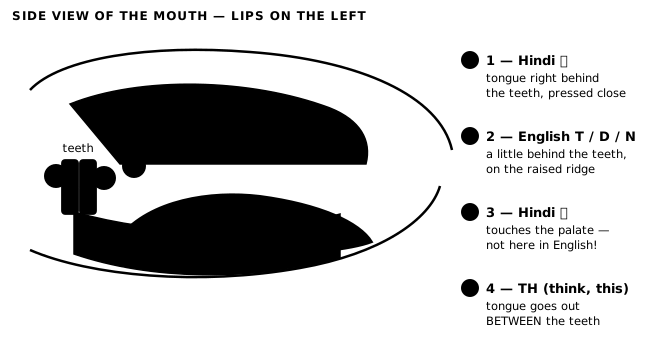
In Hindi, "त" puts the tongue behind the teeth, and "ट" touches the palate (the roof of the mouth). The English T is in between the two — on the raised ridge just behind the teeth. And TH goes out between the teeth. Look at this map:
Try it now — 10 seconds
Say "टाइम". Then move your tongue slightly back and say "time". You will hear the difference clearly.
2.4 Short and long vowels — one mistake, a hundred words
In Hindi we know the difference between "इ" and "ई". English has the same difference, but the spelling doesn't show it — so we ignore it. The result: "ship" and "sheep" sound the same. A long vowel is not just longer; the mouth shape is also a little different.
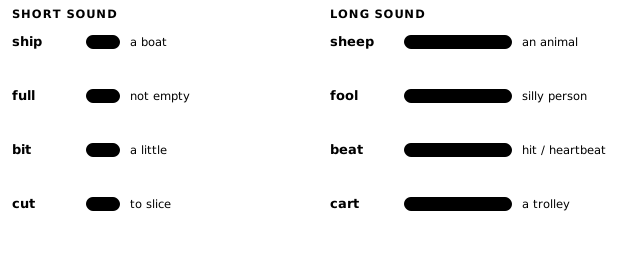
- The ship is big. / The sheep is big. = A boat is big / an animal is big. One small slip, and the meaning changes.
- My glass is full. / He is a fool. = My glass is not empty / he is a silly person. Stretching "full" can be dangerous!
2.5 Schwa — the biggest secret of English
The most common sound in English is not a, e, i, o or u — it is /ə/ schwa: a completely relaxed, effortless "uh". A syllable that is not stressed almost disappears in English and turns into a schwa. We Indian speakers say every syllable in full — that is why our English sounds flat and a bit robotic.
| Word | What we say | What it really is | Listen |
|---|---|---|---|
| doctor | dok-TOR | DOK-tuh (relaxed ending) | |
| about | E-BAUT | uh-BOWT (relaxed beginning) | |
| computer | KOM-PYU-TAR | kuhm-PYOO-tuh | |
| banana | BA-NA-NA | buh-NAA-nuh | |
| support | SUP-PORT | suh-PORT |
The schwa rule
Don't say the unstressed part fully — swallow it. In a word only one part shines; the other parts stay in the background. There is a whole "Rhythm and stress" chapter on this — but start here.
2.6 Hindi habits that English catches immediately
Five habits, five cures
- Wrong: "iskool", "istation", "ispeak"
- Right: school, station, speak — straight from "s"
-
Why: Hindi words don't begin with two consonants, so we add an "i" in front. Cure: first say only "sssss", then add "kool" in the same breath — "sss-kool".
-
Wrong: "filim" (film), an extra sound inside "homewark"
- Right: film — "l" and "m" together, nothing in between
-
Why: Between two consonants we slip in a small "i" without noticing. Say it slowly: "fi—lm".
-
Wrong: "wery" or "vindow" — mixing up V and W
- Right: very (teeth on lip) / window (rounded lips)
-
Why: Hindi has one "व"; English has two different sounds. The full cure is in the next chapter.
-
Wrong: "is" with an "s" sound — buzz as "bus"
- Right: is, was, buzz — with a buzz in the throat
-
Why: /z/ is not in Hindi, so we slip back to /s/. Put a finger on your throat and say "zzzz" — you should feel it vibrate.
-
Wrong: Giving every word equal stress — "I AM GO-ING TO MAR-KET"
- Right: I'm GOing to the MARket — two words shine, the rest are relaxed
- Why: English rhythm is uneven. Speaking in a flat, even way is the biggest "accent" that people notice.
2.7 Silent letters — written but not spoken
| Silent letter | Words | Say | Listen |
|---|---|---|---|
| K (kn-) | know, knife, knee | no, naif, nee | |
| W (wr-) | write, wrong, wrist | rait, rong, rist | |
| B (-mb) | comb, climb, thumb | koam, klaim, tham | |
| L | talk, walk, half, could | tok, wok, haaf, kud | |
| T | listen, castle, often | lisun, kaasul, ofun | |
| H | hour, honest, honour | aawar, onist, onar |
A small, sure gain
Just remembering these six lines will make an immediate difference to your speaking — because these words come up every day. In "I don't know" you don't say the K at all.
2.8 The daily 5-minute drill
Say these five lines once every day. All the new sounds come together in them:
- I think these three things are true. The TH drill — "think/these/three/things" has two kinds of TH.
- Very few of my friends have a van. V and F — in both, the upper teeth touch the lower lip.
- The zoo was closed because of the rain. The /z/ drill — zoo, was, closed, because: all four have a buzz in the throat.
- The school bus stops at the station. The "s" start drill — never "iskool", "istop", "istation".
- The doctor asked about my computer. The schwa drill — DOK-tuh, uh-BOWT, kuhm-PYOO-tuh. Keep the unstressed parts relaxed.
2.9 Practice — English Sounds
Exercise 1
How many sounds are there in English?
- About 44
- Exactly 26
- About 33
- Exactly 52
Hint: There are 26 letters — the sounds are more than that.
Answer
About 44
26 letters, but about 44 sounds. That is why guessing pronunciation from spelling is wrong.
Exercise 2
What happens in your mouth when you say /v/?
- Upper teeth on the lower lip, buzz in the throat
- Both lips rounded together
- Tongue between the teeth
- Tongue pressed to the palate
Hint: Where are the teeth?
Answer
Upper teeth on the lower lip, buzz in the throat
For /v/ the teeth must touch the lip. If you round your lips, it becomes /w/.
Exercise 3
What is the difference between the TH in 'think' and in 'this'?
- 'this' has a buzz in the throat, 'think' does not
- In 'this' the tongue stays behind
- 'think' uses both lips
- No difference, they are the same sound
Answer
'this' has a buzz in the throat, 'think' does not
The tongue position is the same in both — between the teeth. The only difference is voice: think = only air, this = buzz.
Exercise 4
Which is the most common sound in English?
- Schwa /ə/ — a relaxed 'uh'
- The long /iː/ as in 'sheep'
- /t/
- /æ/ as in 'cat'
Hint: The one that needs no effort from the mouth.
Answer
Schwa /ə/ — a relaxed 'uh'
Unstressed parts turn into a schwa: DOK-tuh, kuhm-PYOO-tuh. Saying every letter in full is what creates a 'flat' accent.
Exercise 5
Why do we say 'iskool' for 'school'?
- Hindi words don't begin with two consonants
- 'sch' means 'isk'
- English speakers say it that way too
- 's' is a silent letter
Answer
Hindi words don't begin with two consonants
The tongue adds a vowel in front for comfort. Cure: first stretch 'sss', then say 'kool' in the same breath.
Exercise 6
Remove the silent letter — which letter in 'know' is never spoken? ___
Hint: The first letter.
Answer
k / K
The K in kn- is always silent: know = no, knife = naif, knee = nee.
Exercise 7
Which letter is silent in 'listen'? ___
Answer
t / T
listen = li-sun. In the same way, castle = kaa-sul, and the T in 'often' is almost silent too.
Exercise 8
Match each sound to its mouth position.
| A | B |
|---|---|
| /θ/ think | both lips rounded, teeth don't touch |
| /v/ very | the /s/ position + a buzz in the throat |
| /w/ wet | tongue between the teeth, only air |
| /z/ zoo | upper teeth on the lower lip |
Answer
/θ/ think — tongue between the teeth, only air; /v/ very — upper teeth on the lower lip; /w/ wet — both lips rounded, teeth don't touch; /z/ zoo — the /s/ position + a buzz in the throat
Every sound is a position. Get the position right, and the sound comes right by itself.
Exercise 9
One word in this sentence is spelled wrongly — tap it.
I go to iskool every morning.
Answer
Wrong word: iskool.
Corrected: I go to school every morning.
'school' — straight from s. The extra 'i' sound in front is a Hindi habit, not English.
Exercise 10
The TH drill — slowly, with the tongue between the teeth.
I think these three things are true
Answer
Say: I think these three things are true
think and three have only air; these has a buzz. Both kinds of TH in one sentence.
Exercise 11
The V and F drill. Your teeth should be on the lower lip.
Very few of my friends have a van
Answer
Say: Very few of my friends have a van
very, few, friends, have, van — the same teeth-and-lip position five times.
Exercise 12
Start with 's' — don't add 'i'.
The school bus stops at the station
Answer
Say: The school bus stops at the station
school, stops, station — all straight from s. Practise by stretching 'sss' first.
Exercise 13
The /z/ drill — a buzz in the throat.
The zoo was closed because of the rain
Answer
Say: The zoo was closed because of the rain
zoo, was, closed, because — /z/ in all four. Keep a finger on your throat; it should vibrate.
Exercise 14
The schwa drill — leave the unstressed parts relaxed.
The doctor asked about my computer
Answer
Say: The doctor asked about my computer
DOK-tuh, uh-BOWT, kuhm-PYOO-tuh. Don't try to say every letter in full.
What next?
This chapter is a foundation — don't try to "finish" it in one go. Come back twice a week and repeat the sounds in the tables. The next step: the Fix your pronunciation chapter, where you'll find separate drills and minimal pairs for each sound.