Chapter 28: Connected speech
Native speed English
You understand the English in books, but the English of Netflix, YouTube or a foreign colleague feels "too fast"? In fact they are not speaking fast — they join, squeeze and wear down their words. "Did you eat?" becomes "didja eat?". In this chapter we will learn the five rules behind this. The goal: to catch it when you listen, and to use it when you speak only as much as feels natural.
- 1Why does it sound fast? — five rules
- 2Weak forms — small words, small sounds
- 3Linking — words stick to each other
- 4Elision — the sound that disappears
- 5Assimilation — didja, doncha, gotcha
- 6gonna, wanna, gotta — when to say them, when to write them
- 7The melody of questions and lists
- 8A strategy for listening to fast English
- 9In real life — the office canteen
In one line
Native speech = weak forms + contractions + linking + elision + assimilation. The words are the same; only their edges get worn down. Don't think of it as "fast" — think of it as "joined up".
28.1 Why does it sound fast? — five rules
In Hindi we say almost every syllable in full. English is stress-timed: stressed words are long and clear, and the small words in between are quick and squashed (the basics are in the Rhythm and stress chapter). When small words are squashed, they stick to the words around them. These are the five ways:
| Rule | What happens | Example |
|---|---|---|
| Weak forms | the vowel of a small word becomes "uh" | for → fuh |
| Contractions | two words become one | I would → I'd |
| Linking | the end of one word joins the next | turn it off → tur-ni-toff |
| Elision | a sound disappears | last night → las' night |
| Assimilation | two sounds blend into a new one | did you → didja |
- What do you want to do? = What would you like to do? — it sounds like "Whaddaya wanna do?"
- I don't know. = I have no idea. — often said as "I dunno."
28.2 Weak forms — small words, small sounds
Function words like to, for, of, and, can, was, them have two forms: strong (alone or stressed) and weak (in the middle of a sentence, with the schwa /ə/ "uh"). In a sentence, 90% of the time the weak form is used. If you say every "to" as "too", your English will sound heavy and stop-start.
| Word | Weak | In a sentence | Listen |
|---|---|---|---|
| to | /tə/ tuh | I need to go. | |
| for | /fə/ fuh | It's for you. | |
| of | /əv/ uhv, uh | a lot of work | |
| and | /ən/ un, n | rice and dal | |
| can | /kən/ kun | I can help. | |
| was | /wəz/ wuz | It was late. | |
| them | /ðəm/, /əm/ uhm | Tell them. | |
| from | /frəm/ fruhm | She's from Kochi. | |
| her | /ə/, /hə/ | Ask her. |
When is it strong?
The full (strong) form is used in three places: at the end of a sentence (Where are you from?), for stress/contrast, and when the word is said on its own. Everywhere else it is weak.
- Who's it for? — It's fuh my mother. = The first "for" is strong, the second is weak: Who is it meant for? — It is meant for my mother.
- What are you looking at? = What are you looking at? — "at" is said in full at the end.
can or can't? — the biggest listening trap
In fast speech the "t" of can't is often not heard at all. So how do you tell the difference? Don't look for the "t" — listen to the vowel. can is weak and short (kun), and the stress falls on the next verb. can't is strong and long (British "kaant", American "kænt"), and it carries the stress itself.
| Sentence | What you hear | Listen |
|---|---|---|
| I can come. | I kun COME. | |
| I can't come. | I KAANT come. | |
| She can drive, but she can't park. | kun DRIVE … KAANT park |
Contractions — the default English of speech
In speech, I am, do not, we will are almost always joined. Saying the full form is not wrong, but it sounds like emphasis: "I do not want it" = "I absolutely don't want it".
| Full | Contraction | Listen |
|---|---|---|
| I would / I had | I'd | |
| we will | we'll | |
| they are | they're | |
| should have | should've ("shuduv") | |
| it has / it is | it's |
✗
You should of told me.
✓
You should have told me. (said: should've)
have
28.3 Linking — words stick to each other
Native speakers talk without stopping between words. When one word ends in a consonant and the next begins with a vowel, the consonant becomes part of the next word. When two vowels meet, a light w or y slips in between. In the map below, each arc is one link.
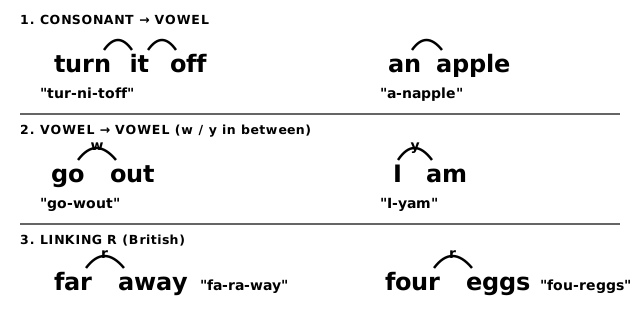
- Turn it off. = Switch it off. — "tur-ni-toff"
- Pick it up. = Lift it. — "pi-ki-tup"
- Come on in. = Please enter. — "ku-mo-nin"
- Check it out. = Have a look at this. — "che-ki-tout"
- Go out and see. = Go outside and have a look. — "go-wou-tun see"
- The idea is good. = It's a good idea. — "the-yidea-ris good" (British)
How to do it when speaking
Say a phrase as one long word: turnitoff, pickitup. Don't put a "glottal stop" (a little jerk) between words — let the air keep flowing. This makes your English smooth at once.
28.4 Elision — the sound that disappears
When a t or d is trapped between two consonants, it often vanishes in speech. To say the "t" in next day the tongue has to stop — so people simply say "nex day". Nothing changes in writing.
| Written | What you hear | Listen |
|---|---|---|
| next day | nex' day | |
| last night | las' night | |
| must be | mus' be | |
| old man | ol' man | |
| handbag | hanbag | |
| I don't know | I dunno | |
| first thing | firs' thing |
- I went to bed late last night. = I went to bed late yesterday night. — "las' night"
- She left the next day. = She left on the following day. — "nex' day"
- I walked to the station. = I went to the station on foot. — the "t" of "-ed" and the "t" of "to" merge into one: "walk-tuh"
The past tense '-ed' seems to vanish
I walked to work and I walk to work sound almost the same in fast speech. So when listening, catch the tense from the context — words like yesterday, last week help. And in writing, never leave out "-ed". A vowel that disappears inside a single word (vegetable, comfortable) is covered in the Fix your pronunciation chapter.
28.5 Assimilation — didja, doncha, gotcha
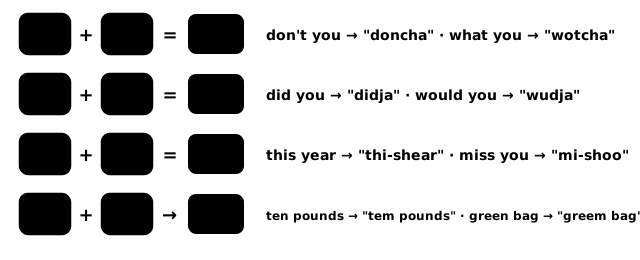
Sometimes two sounds blend into a third sound. The most common case is when t, d, s, z is followed by the "y" of you / your / year. This is familiar to Hindi speakers — we also say "ye to" quickly as "yetto".
| Written | What you hear | Listen |
|---|---|---|
| Did you eat? | Didja eat? | |
| Don't you think so? | Doncha think so? | |
| What are you doing? | Wotcha doing? | |
| Would you like some tea? | Wudja like some tea? | |
| I got you. | Gotcha. | |
| Nice to meet you. | Nice tuh meechoo. | |
| See you this year. | See ya thi-shear. |
A rule for your ears
t + you = ch, d + you = j, s + you = sh. Whenever you hear "-cha", "-ja" or "-shoo", think: a hidden you is behind it.
28.6 gonna, wanna, gotta — when to say them, when to write them
These are not "slang" but the real forms of speech — even news anchors say "gonna". But they have no place in writing (email, reports, exams). The simple rule: speak — fine; WhatsApp to a friend — fine; write at the office — never.
| Spoken | Full form | Example | Listen |
|---|---|---|---|
| gonna | going to (+ verb) | I'm gonna call her. | |
| wanna | want to / want a | Do you wanna come? | |
| gotta | have got to | I gotta go. | |
| hafta | have to | We hafta wait. | |
| lemme | let me | Lemme see. | |
| gimme | give me | Gimme a minute. | |
| kinda | kind of | It's kinda cold. | |
| outta | out of | Get outta here! |
✗
I'm gonna Delhi tomorrow.
✓
I'm going to Delhi tomorrow. / I'm gonna visit Delhi tomorrow.
going to + verb
✗
Dear Sir, I wanna apply for the post.
✓
Dear Sir, I would like to apply for the post.
Writing emails
Should you say them yourself?
Learn to hear them first. When speaking, "gonna" and "wanna" are natural in casual talk — but in an interview or presentation, going to and want to (with a weak "tuh") are the safest. Forcing "gotcha, wanna, lemme" into every line sounds like a film actor.
28.7 The melody of questions and lists
The basic rules (statement ↘, yes/no question ↗, WH-question ↘) are in the Rhythm and stress chapter. Here are two cases where the melody changes the meaning itself.
A choice or yes/no?
| How it is said | Meaning | Listen |
|---|---|---|
| Tea ↗ or coffee ↘? | Choose one of the two. | |
| Tea or coffee ↗? | Would you like something to drink? (yes/no) |
Question tags — sure, or really asking?
- It's hot today, isn't it ↘ = A falling voice means "right?" — you only want agreement.
- The meeting is at three, isn't it ↗ = A rising voice means you are really checking — you aren't sure.
- I bought milk ↗, bread ↗, eggs ↗ and butter ↘. = In a list, the voice rises on each item and falls on the last = the list is finished.
Is the list finished or not?
When listening, if the voice stays up on the last item, the speaker still has more to add — don't cut in. When it falls, it is your turn.
28.8 A strategy for listening to fast English
Knowing the rules is half the work. The other half is training your ear. These five methods really work:
| Method | How |
|---|---|
| 1. Catch the big words | Not every word — only the stressed ones (nouns, verbs). "…MEET…STAtion…SIX" gives you the whole message. |
| 2. Predict first | Think from the situation about what is coming. In a shop, "wudja like a bag?" is almost certain. |
| 3. Shadowing | Play the audio and repeat half a second behind, with the same melody. |
| 4. Dictation | Listen to one line, write it, and compare. What you got wrong is your next rule. |
| 5. Slow → fast | 🐢 Understand it at slow speed, then at normal speed. Use English subtitles first, then switch them off. |
Don't translate while listening
If you translate into Hindi in your head, you will miss the next sentence. Catch the stressed words and fill in the rest from context — native speakers do exactly the same.
✗
You missed one word → you stopped → you lost the whole message.
✓
You missed one word → keep listening → fill in from context → ask if you need to: "Sorry, did you say Tuesday?"
Phone and video calls
28.9 In real life — the office canteen
First play the 🔊 of each line without reading. Then look at the "what you hear" column — which rules were used?
| Written | What you hear | Listen |
|---|---|---|
| Hey, did you eat yet? | Hey, didja eat yet? | |
| Not yet. I've got to finish this first. | Not yet. I gotta finish this firs'. | |
| What are you working on? | Wotcha workin' on? | |
| The report for Monday. It's kind of a mess. | The report fuh Monday. It's kinda-uh mess. | |
| Do you want me to help? | Dya wan' me tuh help? | |
| Let me look at it after lunch. | Lemme look a-tit after lunch. | |
| Thanks! I'm going to get a sandwich and a cup of tea. | Thanks! I'm gonna ge-ta sandwich un-a cuppa tea. |
The daily 5-minute drill
Pick one line from the canteen conversation above. Listen three times, then shadow it, then write it without looking. Seven lines in a week — and your ear will start to hear "fast" English as "normal".
28.10 Practice — Native speed English
Exercise 1
Can the speaker stay for lunch?
Read this aloud or have someone read it to you:
I can come to the meeting, but I can't stay for lunch.
- No
- Yes
- Only on Friday
- It isn't mentioned
Answer
No
Transcript: “I can come to the meeting, but I can't stay for lunch.”
can (kun) is short and squashed; can't is long and stressed. 'can't stay' = cannot stay.
Exercise 2
What is the speaker asking about?
Read this aloud or have someone read it to you:
What are you going to do this weekend?
- weekend plans
- last weekend
- work today
- a holiday booking
Answer
weekend plans
Transcript: “What are you going to do this weekend?”
'Wotcha gonna do' = What are you going to do — a future plan.
Exercise 3
What is the speaker offering?
Read this aloud or have someone read it to you:
Did you eat? I've got some leftover biryani if you want it.
- leftover biryani
- a cup of tea
- a lift home
- some money
Answer
leftover biryani
Transcript: “Did you eat? I've got some leftover biryani if you want it.”
'Didja eat?' + 'I've got some leftover biryani' — the speaker is offering leftover biryani.
Exercise 4
What must they turn off?
Read this aloud or have someone read it to you:
We need to leave at half past six. Don't forget your ticket, and turn off the lights.
- the lights
- the fan
- the AC
- the phone
Answer
the lights
Transcript: “We need to leave at half past six. Don't forget your ticket, and turn off the lights.”
'tur-noff the lights' — the consonant n joined the next vowel.
Exercise 5
What are they going to do?
Read this aloud or have someone read it to you:
Let me know if you want to come with us. We're going to grab a cup of coffee.
- have coffee
- have lunch
- go shopping
- go home
Answer
have coffee
Transcript: “Let me know if you want to come with us. We're going to grab a cup of coffee.”
'gonna grab a cuppa coffee' = going to grab a cup of coffee.
Exercise 6
When will the speaker call back?
Read this aloud or have someone read it to you:
I've got to go now. I'll call you back in an hour.
- in an hour
- tonight
- tomorrow
- in ten minutes
Answer
in an hour
Transcript: “I've got to go now. I'll call you back in an hour.”
'i-na-nour' — three words joined by linking: in an hour.
Exercise 7
Write what you hear (in full, with correct spelling).
Dictation. Have someone read the sentence aloud, then write it down.
What do you want to do tonight?
Answer
What do you want to do tonight?
'Whaddaya wanna do' — but in writing it is in full: What do you want to do.
Exercise 8
Write what you hear.
Dictation. Have someone read the sentence aloud, then write it down.
I don't know what he's going to say.
Answer
I don't know what he's going to say.
'I dunno what he's gonna say' — in writing it is don't know and going to.
Exercise 9
Write what you hear.
Dictation. Have someone read the sentence aloud, then write it down.
Could you turn it off, please?
Answer
Could you turn it off, please?
'Cudja tur-ni-toff' — assimilation (could you) + linking (turn it off).
Exercise 10
Write what you hear.
Dictation. Have someone read the sentence aloud, then write it down.
We left the next day.
Answer
We left the next day.
'nex' day' — the t seems to vanish, but it is written: next.
Exercise 11
Write what you hear.
Dictation. Have someone read the sentence aloud, then write it down.
Did you tell them about the party?
Answer
Did you tell them about the party?
'Didja tell-uhm' — did you = didja, and them becomes a weak 'uhm'.
Exercise 12
Write what you hear.
Dictation. Have someone read the sentence aloud, then write it down.
She has got to finish it by Friday.
Answer
She has got to finish it by Friday.
'She's gotta finish it' — in writing: has got to.
Exercise 13
Which sentence can naturally become 'gonna' in speech?
- I'm going to call you later.
- I'm going to Mumbai tomorrow.
- She's going to the office.
- We're going to the market.
Answer
I'm going to call you later.
gonna = going to + verb (future). Not with 'going to' that means travelling to a place.
Exercise 14
In fast speech, how do you tell 'can' from 'can't'?
- the vowel of can't is long and stressed
- listen only for the 't' sound
- can is always said loudly
- there is no difference
Answer
the vowel of can't is long and stressed
The 't' often disappears. can = kun (weak), can't = KAANT (strong, long).
Exercise 15
Which is right for a formal email?
- I would like to apply for the post.
- I wanna apply for the post.
- I'm gonna apply for the post.
- I gotta apply for the post.
Answer
I would like to apply for the post.
wanna/gonna/gotta are spoken forms, not for formal writing.
Exercise 16
Match the spoken form to the full form.
| A | B |
|---|---|
| gonna | have got to |
| wanna | let me |
| gotta | did you |
| lemme | going to |
| didja | want to |
Answer
gonna — going to; wanna — want to; gotta — have got to; lemme — let me; didja — did you
In listening you hear the short form; in writing, always the full form.
Exercise 17
Say it as one smooth phrase — don't pause between the words.
Turn it off and pick it up
Answer
Say: Turn it off and pick it up
tur-ni-toff un pi-ki-tup — the consonant joins the next vowel, and 'and' becomes a weak 'un'.
What to do next
Choose a 2-minute YouTube clip you like and apply the 5-step strategy above. Then work on your speaking speed in the Fluency and filler words chapter, and give your ear a daily workout with the stories in the Listen and understand section.