Chapter 26: Pronunciation
Fix your pronunciation
You do not need to change your accent — there is nothing wrong with an Indian accent. What needs fixing is the six or seven sounds that come out from the wrong place, because those are the sounds that make people misunderstand some words. This chapter gives clear instructions for each sound: where the lips go, where the tongue goes, and whether it is voiced or just air. Read, and do it right away. Reading and then leaving it is useless.
- 1V and W — the biggest battle
- 2TH — two sounds, one position
- 3P and F — Hindi "फ" sits in the middle
- 4S and SH — how far back the tongue goes
- 5Z and J — a buzz vs a jerk
- 6"school" — not "iskool"
- 7Silent letters — not said at all
- 8Ten words Indian speakers mispronounce most
- 9Today's drill — a one-week plan
The three-step method — the same for every sound
1. Press 🔊 and listen. 2. Read the instructions and put your mouth in that position — with no voice, just the position. 3. Now make the sound, slowly, five times. Speaking fast is not the goal. Speaking clearly is the goal. Speed comes by itself.
26.1 V and W — the biggest battle
Hindi has only one "व". English has two completely different sounds, and each one uses a different mouth shape. Fix just this one thing and your English will sound clearer at once — because these sounds come up a hundred times a day.
V — how to make it
Put your upper teeth on your lower lip — press lightly, as if you were biting the lip, but very gently. Now make a sound from the throat: vvvvv. The air rubs out between the teeth and the lip. The lips are not round. Put a finger on your throat — you should feel a vibration.
W — how to make it
The teeth do not touch anything. Make both lips round — as if you were about to say "oo", or about to blow out a candle. Then start the sound from that round shape and open your lips as you go: oo-wet. W is a gliding sound, not a rubbing sound.
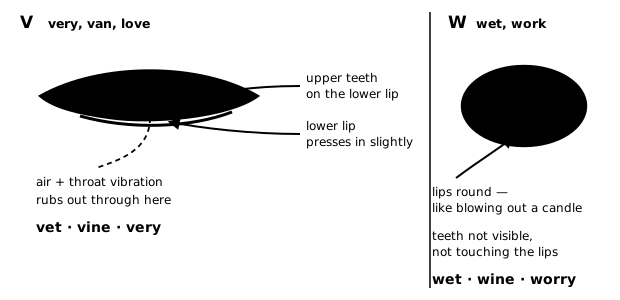
Minimal pairs — V versus W
Play both, hear the difference, then say them yourself. This is the real test.
| V | Listen | W | Listen | Meaning |
|---|---|---|---|---|
| vet | wet | animal doctor / not dry | ||
| vine | wine | a climbing plant / an alcoholic drink | ||
| vest | west | undershirt / the direction | ||
| veil | whale | a face covering / a huge sea animal | ||
| verse | worse | a line of poetry / more bad | ||
| vary | wary | to change / careful |
- We were very worried about the weather. Three W sounds and one V in the same line. Teeth on the lip for "very", round lips for the other three.
- The vet gave the dog water. Teeth for "vet" and "gave"; round lips for "water". Both sounds in one sentence.
Careful — the opposite mistake happens too
Many people try so hard to fix V that they use their teeth everywhere — "vater" for "water", "vindow", "ve are". This sounds even stranger than the first mistake. The rule is simple: where the spelling has W, say W. Where it has V, say V.
26.2 TH — two sounds, one position
For TH the tongue has to come out a little — this feels odd to many people, but it is correct. Hindi "थ" and "ध" are both made behind the teeth; English TH is made between the teeth.
TH — step by step
1. Put the thin tip of your tongue just out past your upper front teeth — only 2-3 millimetres, do not let the tongue hang out.
2. Let the teeth touch the tongue lightly.
3. Now blow air out: thhh — this is the think TH (air only).
4. Keep the same position, but now add voice from the throat: dhhh — this is the this TH (vibration).
A sure test
Hold your hand in front of your mouth. Say "think" — you should feel a puff of air. If you do not, you are saying "tink" or "sink", not "think".
| TH (air only) | Listen | What comes out by mistake | Listen |
|---|---|---|---|
| think | sink (basin) | ||
| three | tree (a plant) | ||
| thin | tin (a metal can) | ||
| thank | tank (water tank) | ||
| mouth | mouse (the animal) | ||
| path | pass |
| TH (with vibration) | Listen | Note |
|---|---|---|
| this, that, these, those | The four most common words, every day — work on these first. | |
| the | Not "da" — tongue between the teeth, then a light "uh". | |
| they, them, their | "de, dem, der" is the most common Indian pattern. Put your tongue out. | |
| mother, father, brother, other | The TH in the middle of a word is the one most often dropped. |
- I think this is the third thing. Four TH sounds in one line — two with air only (think, third, thing) and two with vibration (this, the).
- My brother and my mother both thanked them. A drill for the TH in the middle of words. Say it slowly — tongue out on every TH.
26.3 P and F — Hindi "फ" sits in the middle
Hindi "फ" is made with both lips. English F is made with the teeth and lip. That is why "coffee" sometimes sounds like "copy", and "phone" sometimes sounds like "pone".
F vs P — the difference in position
P: close both lips completely, hold the air back, then release it suddenly — pop! You feel a push of air.
F: upper teeth on the lower lip (exactly like V), but with no voice — just a long, thin stream of air: ffff. The lips do not close, and the air never stops.
| P | Listen | F | Listen | Meaning |
|---|---|---|---|---|
| pan | fan | a cooking pan / a ceiling fan | ||
| pin | fin | a pin / a fish's fin | ||
| copy | coffee | to copy / the drink | ||
| pool | fool | a pond or swimming pool / a silly person | ||
| supper | suffer | the evening meal / to feel pain or trouble |
- Please put the fan near the phone. Both lips for "please" and "put"; teeth and lip for "fan" and "phone". All three in one line.
26.4 S and SH — how far back the tongue goes
S vs SH
S: the tongue tip is just behind the upper teeth, the lips are wide (like a slight smile). Thin, sharp air: ssss — like a snake.
SH: move the tongue back a little (towards the roof of the mouth) and round the lips, pushing them forward. Thick, heavy air: shhh — like asking someone to be quiet.
| S | Listen | SH | Listen | Meaning |
|---|---|---|---|---|
| sea | she | the ocean / that woman | ||
| sip | ship | a small mouthful of a drink / a big boat | ||
| save | shave | to rescue or keep / to cut off hair | ||
| sort | short | to arrange in groups / not long | ||
| seat | sheet | a place to sit / a bed sheet or sheet of paper |
26.5 Z and J — a buzz vs a jerk
/z/ does not exist in Hindi, so we say either "s" or "j". Both are wrong.
Z vs J — one continuous, one sudden
Z: exactly the same position as /s/ — tongue behind the teeth — but add the throat vibration. The sound keeps going: zzzzzz, as long as your breath lasts.
J: press the tongue against the roof of the mouth to stop the air, then release it suddenly — there is a jerk. You cannot stretch the sound. Test: you can stretch "zzzz" for 5 seconds. You cannot stretch "j".
| Z | Listen | J / S | Listen | Note |
|---|---|---|---|---|
| zoo | Jew | Z can be stretched, J is a jerk | ||
| buzz | bus | to hum like a bee / a bus | ||
| prize | price | a reward / what something costs — used every day | ||
| eyes | ice | what you see with / frozen water | ||
| rise | rice | to go up / the grain |
A small rule that helps a lot
The plural and third-person "s" is very often /z/, not "s": dogs = dogz, jobs = jobz, plays = playz, comes = comz, is = iz, was = woz. If the sound before it has a throat vibration, the "s" becomes /z/ too.
26.6 "school" — not "iskool"
Hindi words do not start with two consonants, so our tongue adds a small "i" in front to make it easier. The cure is simple, and it works in 5 minutes:
The three-step cure
Step 1: Say just ssssssss for 3 seconds — no vowel.
Step 2: Without breaking the breath, add the rest: sssss-kool.
Step 3: Slowly make the "sss" shorter: sss-kool → ss-kool → school. The real trick is not to break the breath in the middle. Breath broken = an "i" sneaks in.
| Wrong | Right | Listen |
|---|---|---|
| iskool | school | |
| istation | station | |
| istudy | study | |
| ispeak / isport | speak / sport | |
| istreet | street | |
| iskin | skin | |
| filim | film | |
| pleeze / pilees | please |
- I study at a school near the station. Three "s" clusters — study, school, station. Not a single "i" added.
- The street is small but the sky is clear. street, small, sky — all three have joined consonants. Do not break the breath.
26.7 Silent letters — not said at all
| Word | Silent letter | Say it like | Listen |
|---|---|---|---|
| know, knife, knock | K | no, naif, nok | |
| write, wrong | W | rait, rong | |
| thumb, climb, bomb | B | tham, klaim, bom | |
| talk, walk, calm, half | L | tok, wok, kaam, haaf | |
| Wednesday | D + the middle e | WENZ-day | |
| vegetable | the middle e | VEJ-tuh-bul (three parts, not four) | |
| comfortable | the middle o | KUMF-tuh-bul | |
| business | the middle i | BIZ-nis | |
| receipt | P | ri-SEET | |
| island, aisle | S | AI-land, ail |
26.8 Ten words Indian speakers mispronounce most
Fix them once, fix them for life
| Word | Common mistake | Right | Listen |
|---|---|---|---|
| determine | de-ter-MINE | di-TER-min | |
| develop | DEV-lup | di-VEL-up | |
| jewellery | joo-la-REE | JOOL-ri | |
| mischievous | mis-CHEE-vi-us | MIS-chi-vus | |
| pronunciation | pro-NOUN-ciation | pruh-nun-si-AY-shun | |
| often | OFF-ten (strong T) | OF-un (T almost silent) | |
| salmon | SAL-mon | SAM-un (silent L) | |
| colonel | ko-lo-NEL | KER-nul | |
| schedule | SHED-yool / ske-DYOOL | SKEJ-ool (US) / SHED-yool (UK) — both are fine | |
| February | FEB-u-ary | FEB-roo-ri |
26.9 Today's drill — a one-week plan
| Day | Focus | Drill line |
|---|---|---|
| Mon | V / W | We were very worried about the weather. |
| Tue | TH | I think this is the third thing. |
| Wed | P / F | Please put the fan near the phone. |
| Thu | S / SH | She sells sheets by the sea. |
| Fri | Z | The prize is zero rupees. |
| Sat | s- clusters | I study at a school near the station. |
| Sun | All together | Three of those women work in a very small school. |
26.10 Practice — Pronunciation
Exercise 1
When you say W, where are your teeth?
- They touch nothing — the lips are round
- Upper teeth on the lower lip
- Tongue between the teeth
- Both lips closed
Hint: What would you see in a mirror?
Answer
They touch nothing — the lips are round
W does not use the teeth. The moment the teeth touch the lip, it turns into V.
Exercise 2
When you say 'think' with your hand in front of your mouth, what should you feel?
- A puff of air
- Nothing
- Only a throat vibration
- A push from the lips
Answer
A puff of air
For /θ/ the air comes out between the teeth and the tongue. No air = you said 'tink' or 'sink'.
Exercise 3
What is the difference between English F and Hindi 'फ'?
- F uses teeth on the lip; 'फ' uses both lips
- There is no difference
- F puts the tongue between the teeth
- F has a throat vibration
Answer
F uses teeth on the lip; 'फ' uses both lips
That is why 'coffee' sometimes sounds like 'copy'. F has the same position as V, just with no voice — only air.
Exercise 4
What is the easiest test to tell Z and J apart?
- You can stretch Z for 5 seconds, but not J
- J has a throat vibration, Z does not
- Z has round lips
- J puts the tongue between the teeth
Hint: You can stretch one sound but not the other.
Answer
You can stretch Z for 5 seconds, but not J
Z is a continuous buzz; J is a jerk where the air stops first.
Exercise 5
What sound is the last 's' of 'dogs' really?
- /z/ — dogz
- /s/ — dogs
- It is silent
- /sh/
Answer
/z/ — dogz
The sound before it (g) has a throat vibration, so the 's' becomes /z/ too: jobz, playz, comz.
Exercise 6
What is the right way to lose the 'iskool' habit?
- Stretch 'sss', then add 'kool' without breaking the breath
- Say 'school' faster
- Say 'i' first, then drop it
- Keep the 'k' silent
Answer
Stretch 'sss', then add 'kool' without breaking the breath
A vowel sneaks in the moment the breath breaks. Join it in one breath: sss-kool, then make it shorter.
Exercise 7
One word in this sentence is written with a wrong pronunciation — tap it.
My brother studies in a iskool near my house.
Answer
Wrong word: iskool.
Corrected: My brother studies in a school near my house.
school — starts straight with 's'. The extra 'i' in front is a Hindi habit.
Exercise 8
Find the word that is written wrongly.
We are going to see a filim tonight.
Answer
Wrong word: filim.
Corrected: We are going to see a film tonight.
film — 'l' and 'm' together, with no 'i' in between. Say it slowly: fi-lm.
Exercise 9
Match the minimal pairs to their meanings.
| A | B |
|---|---|
| vet | the number 3 |
| wet | a tall plant |
| three | animal doctor |
| tree | not dry |
Answer
vet — animal doctor; wet — not dry; three — the number 3; tree — a tall plant
One sound of difference, and the whole meaning changes. That is why these pairs need practice.
Exercise 10
Match each word to how it sounds with its silent letter.
| A | B |
|---|---|
| know | wok |
| thumb | ri-seet |
| walk | no |
| receipt | tham |
Answer
know — no; thumb — tham; walk — wok; receipt — ri-seet
K, B, L and P — all four are silent. You do not have to say every letter that is written.
Exercise 11
V and W together. Look in the mirror — where should you see the teeth?
We were very worried about the weather
Answer
Say: We were very worried about the weather
On 'very', upper teeth on the lower lip. On 'we, were, worried, weather', round lips and no teeth.
Exercise 12
TH drill. Tongue out between the teeth.
I think this is the third thing
Answer
Say: I think this is the third thing
think, third, thing = air only. this, the = throat vibration. The position is the same for both.
Exercise 13
V and F — both use teeth on the lip, but one has voice.
Very few of my friends have a van
Answer
Say: Very few of my friends have a van
very, have, van have vibration (V). few, friends have air only (F).
Exercise 14
The S and SH difference. Move the tongue back and round the lips for SH.
She sells sheets by the sea
Answer
Say: She sells sheets by the sea
She, sheets have SH (round lips). sells, sea have S (wide lips, thin air).
Exercise 15
/z/ drill. Put a finger on your throat while you speak.
The prize is zero rupees
Answer
Say: The prize is zero rupees
prize, is, zero, rupees — all four have /z/. If you said 'price', the meaning changed.
Exercise 16
Joined consonants — do not add any 'i' at all.
I study at a school near the station
Answer
Say: I study at a school near the station
study, school, station — all start straight with 's'. Join them in one breath.
Exercise 17
The final exam — all the sounds together.
Three of those women work in a very small school
Answer
Say: Three of those women work in a very small school
Three (air TH), those (voiced TH), women (W), very (V), small and school (s- clusters). Say it slowly and say all of it.
What next?
One thing to remember: even when your sounds are right, if you say every word with equal force, your English will still sound robotic. The next chapter — Rhythm and stress — is the part that gives you the real "fluent" feeling.