Chapter 34: Interview & office English
Interview and office English
In an interview, structure matters more than English. People who get stuck do not have bad English — they do not have a pattern for their answer, so they think while they speak and get nervous. This chapter gives you ready patterns: your introduction, answers to common questions, the language of meetings, and email phrases. All of it is worth practising aloud.
- 1Your introduction — a three-part pattern
- 2Common interview questions — ready answers
- 3If you get stuck in the interview
- 4The language of the office and meetings
- 5Ready phrases for email
- 6Last preparation before the interview
The one real rule of interviews
An answer should be 30 to 60 seconds. Shorter = it looks like you did not prepare. Longer = you start to wander and your English gets tangled. Three or four sentences. That is all. Then stop and let the next question come.
34.1 Your introduction — a three-part pattern
"Tell me about yourself" is the first question and the one that goes wrong most often. People tell their whole life story — where they were born, how many brothers and sisters. The interviewer does not want that. They only need three things: what you do today → what you did before → what you want next.
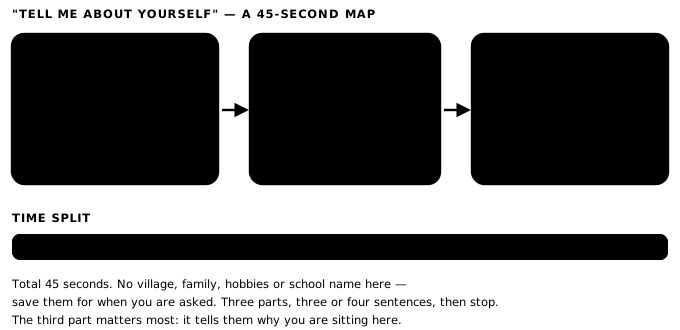
A ready introduction — for someone with experience
- Thanks for having me. I'm Ravi, and I currently work as a support engineer at a telecom company in Pune. Part 1 — now. "Thanks for having me" is a polite opening.
- I've been there for about three years, mostly handling customer issues and billing problems. Part 2 — before. "for about three years" — "about" makes the voice sound natural.
- Last year I also trained two new team members, which I really enjoyed. One solid example — this line sets you apart from the others.
- Now I'm looking for a role where I can work more directly with clients, and that's why this job caught my eye. Part 3 — next, and why here. "caught my eye" = I noticed it and it interested me.
A ready introduction — for a fresher
- Good morning. I'm Priya, and I finished my commerce degree from a university in India this year. For a fresher, "now" means your studies.
- During my final year I did a three-month internship at a small accounting firm, where I worked on GST filings. An internship, a project, part-time work — whatever you have, name one solid thing.
- I'm comfortable with Excel and I'm learning Tally at the moment. "I'm comfortable with…" sounds better and more honest than "I know".
- I'm looking for my first full-time role, and I'd like to start in a team where I can learn quickly. For a fresher, "wanting to learn" is the most honest and the best answer.
Five mistakes in introductions
- Wrong: Myself Ravi Kumar.
- Right: I'm Ravi Kumar.
-
Why: "Myself" is a pronoun, not a sentence. This is the mistake that gets noticed fastest.
-
Wrong: I am belonging to Jaipur.
- Right: I'm from Jaipur.
-
Why: "Belong" does not take -ing. And "I'm from…" is short and natural.
-
Wrong: I have did my graduation in 2021.
- Right: I graduated in 2021.
-
Why: "Graduation" is an event; "graduate" is the verb. Use the verb directly.
-
Wrong: I am having 4 years experience.
- Right: I have four years of experience.
-
Why: "have", not "am having". And "of" goes in the middle.
-
Wrong: My father is a businessman and I have two sisters…
- Right: No family details in the introduction at all.
- Why: The interviewer wants an introduction to your work, not your life. Share it only if they ask.
34.2 Common interview questions — ready answers
The story pattern — for every 'example' question
Situation → your task → what you did → the result. Four sentences, in that order. Whenever you are asked "tell me about a time when…", just fill in this pattern. Do not forget the result — it is what completes the answer.
| Question | Ready answer | Listen |
|---|---|---|
| Why do you want to leave your current job? | I've learnt a lot where I am, but the work has become quite repetitive. I'm looking for something with more responsibility. | |
| What are your strengths? | I'm patient with people, which helps a lot in support work. I also stay calm when things go wrong. | |
| What is your weakness? | I used to take on too much and then struggle with deadlines. I've started saying no more often, and planning my week on Monday. | |
| Why should we hire you? | You need someone who can handle angry customers without losing patience. That's exactly what I've been doing for three years. | |
| Where do you see yourself in five years? | I'd like to be leading a small team by then. For now my focus is on getting really good at the work itself. | |
| Tell me about a difficult situation at work. | Last Diwali two people were on leave and our tickets doubled. I rearranged the queue by urgency and asked a colleague to help with calls. We cleared everything in two days. | |
| What are your salary expectations? | Based on my experience and the market, I'm looking at somewhere between eight and ten lakhs. But I'm open to discussing it. | |
| Do you have any questions for us? | Yes — could you tell me what a typical week looks like in this role? And how is the team structured? |
The 'weakness' trap
"I have no weakness" or "I am a perfectionist" — every interviewer has heard both a thousand times, and both make it sound like you are not telling the truth.
The right pattern: one real weakness + what you are doing to fix it. That sounds both honest and sensible.
You must ask questions at the end
The answer to "Do you have any questions?" should never be "No" — it makes you look uninterested. Keep two questions ready: What does a typical week look like in this role?
What would you want me to achieve in the first three months?
34.3 If you get stuck in the interview
It will happen — it happens to everyone. There is no need to panic, just have a ready line come out.
| Situation | Line | Listen |
|---|---|---|
| You did not understand the question | Sorry, could you rephrase that? | |
| You need a little time | That's a good question. Let me think for a second. | |
| You do not know the answer | I haven't worked on that, but I'd be happy to learn it. | |
| Your sentence got tangled | Sorry, let me start that again. | |
| Checking you understood correctly | Just to make sure I understood — you're asking about…? | |
| The interview is over | Thank you for your time. I enjoyed talking to you. |
Saying 'I do not know' does no harm
Lying does far more harm. "I haven't worked on that, but I'd be happy to learn it" is a solid, professional answer — and most interviewers like it.
34.4 The language of the office and meetings
| Purpose | Line | Listen |
|---|---|---|
| Starting to speak in a meeting | Can I add something here? | |
| Sorry to interrupt, but I think there's an issue with the timeline. | ||
| If I could just jump in for a second… | ||
| Agreeing / disagreeing | That makes sense to me. | |
| I see your point, but I'd do it slightly differently. | ||
| I'm not sure that will work. Can I explain why? | ||
| Time and work | I'll have it ready by Thursday. | |
| I'm a bit stretched this week — could we push it to Monday? | ||
| Let me check and get back to you in an hour. | ||
| Asking for help and clarity | Could you walk me through it once? | |
| Just to confirm — you want the report before the call, right? | ||
| I'll need a bit of help with this part. | ||
| Mistakes and apologies | That was my mistake. I'll fix it today. | |
| Sorry for the delay — I got held up in another call. | ||
| Let me look into it and come back with an answer. | ||
| Ending a meeting | So, to sum up — I'll send the draft and you'll review it by Friday. | |
| Shall we take this offline and discuss it after? |
A full mini-dialogue — a team meeting
- Manager: So, where are we on the client report? "Where are we on…" = what is the progress on that work?
- You: I've finished the first half. The numbers for March are still pending from finance. First what is done, then what is stuck — and who it is stuck with.
- Manager: Can you have it done by Thursday? = Will it be finished by Thursday?
- You: If I get the numbers by tomorrow, yes. Otherwise Friday would be safer. Saying yes with a condition — "Friday would be safer" sounds very professional.
- Manager: Fair enough. I'll chase finance today. "Fair enough" = OK, that is reasonable. "Chase" = to keep reminding someone.
- You: Thanks. Just to confirm — you want the full report, not just the summary? "Just to confirm" shows you are paying attention. You can use this line every day.
34.5 Ready phrases for email
| Purpose | Phrase |
|---|---|
| Opening (friendly) | Hi Anita, Hope you're doing well. |
| Opening (formal) | Dear Mr Sharma, I hope this email finds you well. |
| Giving the reason | I'm writing to ask about… / I'm following up on my last email. |
| Sending something | Please find the report attached. / I've attached the file below. |
| Asking for something | Could you please share the figures for March? / Would you be able to review this by Friday? |
| A gentle reminder | Just a gentle reminder about the pending approval. |
| Apologising for a delay | Apologies for the delay in replying. |
| Acknowledging a task | Noted, I'll take care of it. / Thanks, that's clear now. |
| Asking for more time | Would it be possible to extend the deadline to Monday? |
| Closing (friendly) | Thanks, Ravi |
| Closing (formal) | Best regards, Ravi Kumar |
Email lines you should drop
- Wrong: Please do the needful and revert back at the earliest.
- Right: Could you review this and let me know by Friday?
-
Why: Three problems: "do the needful" does not say what to do; "revert" means to go back, not to reply; and instead of "at the earliest" give a real date.
-
Wrong: Respected Sir, I beg to state that…
- Right: Dear Mr Sharma, I'm writing to…
-
Why: This is very old, school-letter language. It sounds odd in today's office.
-
Wrong: Kindly intimate me the same.
- Right: Please let me know.
-
Why: "Intimate" and "the same" are old office language. Short words sound more professional.
-
Wrong: Thanking you in advance for the same.
- Right: Thanks in advance. / Thanks for your help.
- Why: "For the same" simply has to go. Short lines read best in email.
34.6 Last preparation before the interview
The day before — five jobs
1. Say your 45-second introduction aloud 10 times. In front of a mirror.
2. Prepare answers to three questions: why you are leaving, a weakness, and one difficult situation.
3. Prepare two questions that you will ask.
4. Record your introduction on your phone and listen — wherever it sounds tangled, make it shorter.
5. On the day, speak slower than everyday speech. Nervousness makes you fast, and speed tangles your English.
34.7 Practice — Interview and office
Exercise 1
What is the right structure for 'Tell me about yourself'?
- What you do now → what you did before → what you want next
- Where you were born → studies → family
- Family → hobby → job
- Only your degree and marks
Hint: Three parts, three times.
Answer
What you do now → what you did before → what you want next
Three parts, about 15 seconds each. Mention family and village only when asked.
Exercise 2
How long should an interview answer be?
- 30 to 60 seconds
- 5 to 10 seconds
- 3 to 4 minutes
- As long as possible
Answer
30 to 60 seconds
A short answer shows lack of preparation; in a long answer you start to wander and your English gets tangled.
Exercise 3
What is the right pattern for 'What is your weakness?'
- One real weakness + what you are doing to fix it
- I have no weakness
- I am a perfectionist
- A weakness that is really a compliment
Answer
One real weakness + what you are doing to fix it
Honesty + good sense. Every interviewer has heard 'no weakness' and 'perfectionist' a thousand times.
Exercise 4
You are asked a technical thing you do not know. What do you do?
- I haven't worked on that, but I'd be happy to learn it
- Lie and say you know it
- Go silent
- Change the subject
Answer
I haven't worked on that, but I'd be happy to learn it
A lie gets caught later. Most interviewers like an honest answer.
Exercise 5
What is the worst answer to 'Do you have any questions for us?'
- No, everything is clear
- A question about the role
- A question about the team
- A question about the goals for the first three months
Answer
No, everything is clear
'No' makes you look uninterested. Keep two questions ready.
Exercise 6
What is the pattern for 'Tell me about a difficult situation'?
- Situation → your task → what you did → result
- Only the result
- Who was to blame
- Situation → whose fault it was
Hint: Four parts.
Answer
Situation → your task → what you did → result
Four sentences in that order. Do not forget the result — it is what completes the answer.
Exercise 7
Fix it: I have ___ years of experience. (four years)
Hint: A number in words, and not 'am having'.
Answer
four / 4
'I have four years of experience' — 'am having' is wrong, and 'of' goes in the middle.
Exercise 8
Confirming in a meeting: ___ to confirm — you want the full report?
Hint: The first word of the phrase, starting with 'J'.
Answer
Just / just
'Just to confirm…' is a line you can use at the office every day — it shows you are paying attention.
Exercise 9
Email: Please find the report ___.
Hint: The file is sent along with the email.
Answer
attached
'Please find the report attached' or 'I've attached the report'. Both are fine.
Exercise 10
There is a mistake in this sentence — tap the word.
Myself Ravi Kumar from Jaipur.
Answer
Wrong word: Myself.
Corrected: I'm Ravi Kumar, from Jaipur.
'Myself' is a pronoun, not a word to start a sentence with. In an interview this is noticed fastest.
Exercise 11
Find the wrong word.
I am belonging to a small town near Nashik.
Answer
Wrong word: belonging.
Corrected: I'm from a small town near Nashik.
'Belong' does not take -ing. And 'I'm from…' is short and natural.
Exercise 12
Tap the word in this email that should be dropped.
Please review this and revert at the earliest.
Answer
Wrong word: revert.
Corrected: Please review this and let me know by Friday.
'Revert' means to go back to an earlier state, not to reply. And instead of 'at the earliest' give a real date.
Exercise 13
Match each office situation to its line.
| A | B |
|---|---|
| Starting to speak in a meeting | I'm a bit stretched this week. |
| Disagreeing, but politely | That was my mistake. I'll fix it today. |
| Too much work | Can I add something here? |
| Admitting a mistake | I see your point, but I'd do it differently. |
Answer
Starting to speak in a meeting — Can I add something here?; Disagreeing, but politely — I see your point, but I'd do it differently.; Too much work — I'm a bit stretched this week.; Admitting a mistake — That was my mistake. I'll fix it today.
A ready line for every situation. In a meeting there is no time to think — that is why memorising helps.
Exercise 14
Build the opening line of an interview.
Words: for / Thanks / having / me
Answer
Thanks for having me
A short, polite opening. After it, go straight to part 1 — what you do now.
Exercise 15
Introduction, part 1 — what you do now.
I currently work as a support engineer at a telecom company
Answer
Say: I currently work as a support engineer at a telecom company
'currently' makes it clear this is about today. Speak slowly — this is the first impression.
Exercise 16
Introduction, part 2 — experience.
I've been there for about three years, mostly handling customer issues
Answer
Say: I've been there for about three years, mostly handling customer issues
'for about three years' — 'about' makes your voice sound natural, not memorised.
Exercise 17
Introduction, part 3 — what you want next.
Now I'm looking for a role where I can work more directly with clients
Answer
Say: Now I'm looking for a role where I can work more directly with clients
This part tells them why you are sitting here. Skipping it is the biggest mistake.
Exercise 18
Name your strength — without big words.
I'm patient with people and I stay calm when things go wrong
Answer
Say: I'm patient with people and I stay calm when things go wrong
It sounds solid and true. Much better than 'I am a hard worker'.
Exercise 19
Why you are leaving your job — without speaking badly of the old company.
I've learnt a lot where I am but I'm looking for more responsibility
Answer
Say: I've learnt a lot where I am but I'm looking for more responsibility
Never criticise the old place. Talk about what is ahead, not what is behind.
Exercise 20
You did not understand the question. Ask politely.
Sorry, could you rephrase that
Answer
Say: Sorry, could you rephrase that
'Rephrase' = say it again in other words. This is perfectly fine in an interview.
Exercise 21
A technical question you cannot answer. Give an honest reply.
I haven't worked on that but I'd be happy to learn it
Answer
Say: I haven't worked on that but I'd be happy to learn it
Clear, professional and true. Much better than a lie.
Exercise 22
The question you will ask at the end.
What does a typical week look like in this role
Answer
Say: What does a typical week look like in this role
This question makes you look serious, and also gives you real information.
Exercise 23
The interview is over. The parting line.
Thank you for your time. I enjoyed talking to you
Answer
Say: Thank you for your time. I enjoyed talking to you
Short and warm. The last impression is also remembered.
Exercise 24
Saying yes with a condition in a meeting.
If I get the numbers by tomorrow yes. Otherwise Friday would be safer
Answer
Say: If I get the numbers by tomorrow yes. Otherwise Friday would be safer
A yes with a condition is better than a false yes. 'Would be safer' sounds very professional.
Exercise 25
You have too much work at the office. Ask for time.
I'm a bit stretched this week. Could we push it to Monday
Answer
Say: I'm a bit stretched this week. Could we push it to Monday
'A bit stretched' = under some pressure. 'Push it to' = move it later.
Exercise 26
Admit a mistake — without making excuses.
That was my mistake. I'll fix it today
Answer
Say: That was my mistake. I'll fix it today
Two short sentences: you admit the mistake and give the fix. Much better than a long explanation.
What next?
Write your 45-second introduction today — no more than five sentences — and record it on your phone and listen. Wherever a sentence tangled as you spoke, make it shorter. Then say it 10 times.
Before an interview, two chapters will help you most: Fluency and filler words (the cure for getting stuck) and Indian English habits (the mistakes that get noticed at once).