Chapter 44: Normal → advanced verbs
Verb upgrades — one word instead of three
In English, the verb is the engine of the sentence. When the engine is weak — make better, get rid of, give permission — the whole sentence feels slack, even if the grammar is perfect. One precise verb does the work of two or three words, and the sentence at once sounds clear and educated. In this chapter: five upgrades in depth, then a full list of more than twenty, their rules, and the most important question — when not to use them.
- 1Five upgrades, one by one
- 2One weak verb, several right verbs
- 3The big upgrade table
- 4Fifteen more upgrades — make, give, get, have, take
- 5Three questions — before you upgrade
- 6Mistakes people make with these verbs
- 7One paragraph, two versions
In one line
Wherever two or three words together describe one action, there is often a single verb that describes the same action more clearly. Fewer words, more impact — this is the first rule of writing English.
44.1 Five upgrades, one by one
show clearly → demonstrate
Demonstrate does not only mean to show — it means to prove by doing or by giving evidence. That is why it fits in a lab, a class, a product demo and a report. If you are just pointing out a place with your finger, show is the right verb.
- The trial demonstrated that the cheaper design works just as well. = The trial proved that the cheaper design works equally well.
- Let me demonstrate the new feature before we discuss pricing. = Before we talk about pricing, let me show the new feature in action.
When not to
"Demonstrate me the way to the station" — this is odd. To point out a route, use show. Remember: demonstrate needs evidence or a process behind it.
make better → enhance
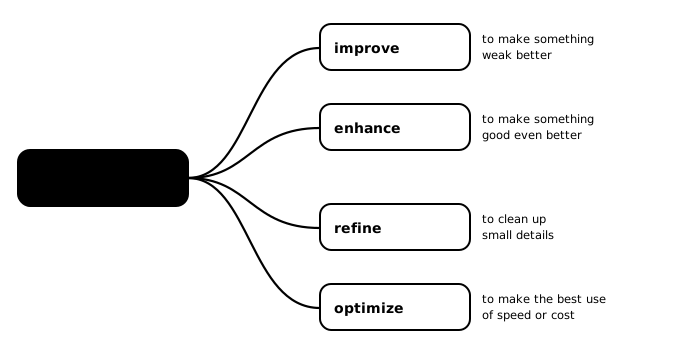
Enhance means to make something that is already good even better. So you do not "enhance" something that is broken — you fix it. Something weak you improve. Enhance carries a feeling of adding polish on top.
- Better lighting would really enhance these photos. = Better lighting would make these photos look even nicer.
- We added search to enhance the reading experience. = We added search to make reading better.
Three different 'betters'
fix = repair something broken · improve = make something weak better · enhance = make something good even better. You do not say "enhance the bug" — a bug is fixed.
get rid of → eliminate
Eliminate means to remove completely, leaving not even one. It is a heavy verb — it sounds good with numbers, process, risk and waste. You do not "eliminate" your old clothes; they are simply got rid of.
- The new form eliminated almost all data-entry errors. = The new form removed almost every data-entry error.
- We can eliminate two steps and still get the same result. = We can remove two steps and the result will stay the same.
give permission → authorize
Authorize is not just "saying yes" — it carries authority. The one who authorizes must have official power: a manager, a bank, the government, a system. A mother who allows her child to go out lets him go — she does not authorize it.
- Only the finance head can authorize a refund above fifty thousand. = Only the finance head can approve a refund of more than fifty thousand.
- I'm not authorized to share those figures — let me check with my manager. = I do not have the authority to share those numbers — let me ask my manager.
A very useful line
"I'm not authorized to do that" works in interviews, support calls and the office — all three. It is a polite and professional way to say no, and it does not make you look at fault.
take into account → consider
Consider does two jobs: (1) to think about something carefully and (2) to keep something in mind. In both, it is shorter and cleaner than take into account. Note: about never comes after consider.
- We should consider the delivery cost before choosing a vendor. = We should keep the delivery cost in mind before choosing a vendor.
- Have you considered doing it the other way round? = Have you thought about doing it the opposite way?
Two firm rules for consider
- Wrong: Please consider about my request.
- Right: Please consider my request.
-
Why: The thing comes straight after consider — no preposition.
-
Wrong: Have you considered to change the design?
- Right: Have you considered changing the design?
- Why: After consider, a verb always takes the -ing form, not the "to" form.
44.2 One weak verb, several right verbs
The biggest mistake is to always replace a weak phrase with one and the same big word. The truth is that every weak phrase opens in several directions — which one you choose depends on the meaning.
44.3 The big upgrade table
It is not only the words here — the third column tells you where each upgrade fits. Without that column, this table is dangerous.
| Slack phrase | One verb | Where it fits |
|---|---|---|
| show clearly / prove by doing | demonstrate | Report, presentation, class, product demo |
| make better (something already good) | enhance | Product, design, experience, taste |
| get rid of (completely) | eliminate | Risk, waste, error, step, cost |
| give permission (with authority) | authorize | Office, bank, payment, access |
| take into account | consider | Everywhere — speaking and writing |
| make smaller / cut down | reduce | Cost, time, size — very common |
| make bigger / increase | expand | Business, team, scope |
| find out | determine | Investigation, report, official writing |
| put in place | implement | Office, software, policy |
| say sorry formally | apologize | Email, customer support |
| make sure | ensure | Email, process, instructions |
| give out | distribute | Stock, salary, files |
| look into | examine / investigate | Investigation, audit, problem |
| keep up | maintain | Machine, record, standard |
| cut down slowly | taper | Medicine, spending — a bit technical |
| take part in | participate | Event, survey, training |
44.4 Fifteen more upgrades — make, give, get, have, take
These are the same "light verb + noun" phrases we use every day. Each has a real sentence (press 🔊) and the last column gives the register — because some of these words sound heavy or odd in speech.
make ___ phrases
| Normal → Advanced | Example | Meaning | When to use it |
|---|---|---|---|
| make worse → aggravate | Skipping physio will only aggravate the injury. | To make something already bad even worse. | Formal — injury, illness, quarrel, problem. In casual speech "make it worse" is better. |
| make possible → enable | The new app enables farmers to check prices instantly. | To make something possible for someone. | Neutral, very common in office and tech. Pattern: enable + someone + to + verb. |
| make certain → ensure | Please ensure that all files are backed up by Friday. | To make certain that something happens. | Email and instructions. In speech "make sure" is the natural one. |
| make clear → elucidate | The professor elucidated the theory with two simple diagrams. | To open up a difficult idea and explain it clearly. | Very bookish — research papers, lectures. In daily life say "explain" or "clarify". |
| make use of → utilize | The plant now utilizes waste heat to warm the offices. | To put something to work. | Technical/report. In 90% of cases plain "use" is better — "utilize" sounds heavy for no reason. |
give / get / find phrases
| Normal → Advanced | Example | Meaning | When to use it |
|---|---|---|---|
| give information → provide | Could you provide details of the payment? | To supply information or something else. | Safe in the office and in email. Pattern: provide something, provide someone with something. |
| give an example → exemplify | This project exemplifies what a small team can do. | To be a perfect example of something. | Formal writing. In speech "is a great example of" is more natural. |
| get involved → participate | Over two hundred students participated in the survey. | To take part in an activity. | Neutral. Always participate in. Among friends "get involved" or "join in" is fine. |
| find a solution → resolve | The support team resolved the issue within an hour. | To settle a problem. | Office, support, disputes. Very useful. For a small thing "sort out" also works. |
have / come / reach / take / keep phrases
| Normal → Advanced | Example | Meaning | When to use it |
|---|---|---|---|
| have an effect → influence | Reviews strongly influence what people buy online. | To have an effect on someone or something. | Safe everywhere. Note: no on after influence — "influence people", but "have an influence on people". |
| have a need → require | This role requires three years of experience. | To need something. | Rules, job posts, instructions. In conversation use "need" — "I require water" sounds robotic. |
| come to a decision → determine | The committee will determine the final budget next week. | To decide after careful thought. | Official. In speech "decide" is more common. The other meaning of determine: to find out. |
| reach an agreement → reconcile | The mediator helped them reconcile their differences. | To end a disagreement and bring two sides together. | Reconcile = to settle relationships or differences, or to match accounts. For simply "we agreed" use reach a consensus or agree. |
| take control → assume authority | The deputy will assume authority while the director is away. | To take over command officially. | Very formal — notices, reports. In daily life and at the office use take charge: "She took charge of the project." |
| keep safe → safeguard | Strong passwords help safeguard your data. | To protect from harm. | Formal and policy language — data, rights, interests. For a child or a bag, "keep safe" is fine. |
Where the simple verb wins
use > utilize · explain > elucidate · need > require · decide > determine · make sure > ensure · take charge > assume authority — all of this in conversation. Keep the heavy forms for reports, policies and formal emails. If you ask a friend "Can you elucidate?", they will laugh. Big verbs are for writing, not for the tea stall.
44.5 Three questions — before you upgrade
A bigger word is not always better. Before replacing any weak phrase, ask yourself three questions:
The upgrade test
1. Does the meaning stay the same? — "eliminate the poor" means something completely different. Changing a word can change the meaning.
2. Can the setting carry it? — at a tea stall, "Could you authorize one more cup?" sounds like a joke.
3. Can I say it comfortably? — if your tongue stumbles while speaking, that word is not yours yet.
The truth about interviews
An interviewer likes clear thinking more than big words. One right verb sounds good; three heavy verbs in every line make you look memorised. In one paragraph, one or two upgrades are plenty. Add spice only as much as the dish can take.
44.6 Mistakes people make with these verbs
Be careful
- Wrong: He demonstrated me his new phone.
- Right: He showed me his new phone.
-
Why: Demonstrate means to prove by doing or by evidence. To show a phone, simply use "show".
-
Wrong: Please enhance this broken link.
- Right: Please fix this broken link.
-
Why: Something broken is fixed. Enhance is only for something that already works.
-
Wrong: My father authorized me to go to the party.
- Right: My father let me go to the party.
-
Why: Authorize carries official authority. At home say "let", "allowed me to", or "gave me permission".
-
Wrong: We will eliminate the old sofa this weekend.
- Right: We will get rid of the old sofa this weekend.
-
Why: For everyday objects, "get rid of" is the natural choice. Eliminate is for abstract things like risk, error and cost.
-
Wrong: Kindly consider about my application.
- Right: Please consider my application.
-
Why: No preposition comes after consider — and "please" is more natural than "kindly".
-
Wrong: We implemented a new chair in the office.
- Right: We got a new chair for the office.
- Why: Implement is for processes, systems and policies — not for objects.
44.7 One paragraph, two versions
Below is a short office update. First the slack version, then the upgraded one. Notice that the second version is also shorter — that is the real benefit.
Before
We made the checkout page better and we got rid of two steps. The data shows clearly that people finish faster now. Before we do it on the live site, the manager has to give permission, and we should also take into account the extra server cost.
After
We enhanced the checkout page and eliminated two steps. The data demonstrates that people finish faster now. Before we go live, the manager has to authorize it, and we should also consider the extra server cost.
44.8 Practice — Verb upgrades
Exercise 1
In a report you want to say that the figures proved the point. Which verb?
- demonstrate
- enhance
- authorize
- maintain
Hint: Showing with evidence.
Answer
demonstrate
Demonstrate = to prove by doing or by evidence. This is what fits the language of reports and presentations.
Exercise 2
The website already works well, but we want to make it even better.
- enhance
- fix
- eliminate
- demonstrate
Answer
enhance
Making something good even better = enhance. If it were broken, it would be 'fix'.
Exercise 3
Which sentence is wrong?
- We will eliminate the old sofa this weekend.
- The new form eliminated most errors.
- We eliminated two unnecessary steps.
- This change eliminates the risk of double billing.
Hint: In one of them, a big word is in the wrong place.
Answer
We will eliminate the old sofa this weekend.
For an everyday object, use 'get rid of'. Eliminate goes with things like risk, error, step and cost.
Exercise 4
Only the finance head can ___ a refund above fifty thousand.
Hint: Giving permission with authority.
Answer
authorize / authorise
Authorize = to approve with official power. For permission at home use 'let' or 'allow'.
Exercise 5
Have you ___ changing the layout instead?
Hint: A one-word form of take into account.
Answer
considered
After consider, a verb takes -ing: considered changing, not 'considered to change'.
Exercise 6
One word here is unnecessary — find it.
Please consider about my application carefully.
Answer
Wrong word: about.
Corrected: Please consider my application carefully.
No preposition comes after consider. The same mistake happens with 'discuss about'.
Exercise 7
The verb has been chosen wrongly — tap it.
He demonstrated me his new bike yesterday.
Answer
Wrong word: demonstrated.
Corrected: He showed me his new bike yesterday.
Showing a bike is just 'show'. Demonstrate needs a process or evidence behind it.
Exercise 8
Match each slack phrase with its right one-word form.
| A | B |
|---|---|
| get rid of completely | consider |
| give permission officially | demonstrate |
| take into account | eliminate |
| show by proving | authorize |
Answer
get rid of completely — eliminate; give permission officially — authorize; take into account — consider; show by proving — demonstrate
Remember the real meaning of all four upgrades — not the word, but the feeling behind it.
Exercise 9
Choose the right 'better'.
| A | B |
|---|---|
| to repair something broken | enhance |
| to make something weak better | optimize |
| to polish something good | fix |
| to make the best use of speed | improve |
Answer
to repair something broken — fix; to make something weak better — improve; to polish something good — enhance; to make the best use of speed — optimize
The one Hindi idea of 'making better' becomes four different verbs in English. Choose by the condition of the thing.
Exercise 10
Build the upgraded line.
Words: all / eliminated / almost / errors / process / The / new / data / entry
Answer
The new process eliminated almost all data entry errors
This sentence is shorter and cleaner than 'got rid of almost all errors in data entry'.
Exercise 11
How many heavy verbs are fine in one paragraph?
- One or two
- One in every sentence
- The more the better
- At least five
Answer
One or two
Too many heavy verbs make writing look memorised. Clear thinking has more impact than big words.
Exercise 12
Two teams had an old disagreement. A mediator brought them together again. Which verb?
- reconcile
- aggravate
- utilize
- exemplify
Hint: Settling differences.
Answer
reconcile
Reconcile = to end a disagreement and bring people together (reconcile their differences). Aggravate is the opposite — it makes things worse.
Exercise 13
You are talking to a friend: 'We utilize this app for groceries.' What would sound more natural?
- We use this app for groceries.
- We elucidate this app for groceries.
- We safeguard this app for groceries.
- We require this app for groceries.
Answer
We use this app for groceries.
In daily life 'use' is the right verb. 'Utilize' is a technical-report word — in conversation it sounds heavy for no reason.
Exercise 14
Please ___ that the door is locked before you leave.
Hint: A one-word form of make certain.
Answer
ensure / make sure
Ensure = to make certain. Use ensure in instructions and email, 'make sure' in conversation — both are correct.
Exercise 15
One verb is far too heavy for this setting — find it.
Hey, can you elucidate where the washroom is?
Answer
Wrong word: elucidate.
Corrected: Hey, can you tell me where the washroom is?
Elucidate is a lecture and research word. To ask for directions use 'tell me' or 'show me'.
Exercise 16
Match each normal phrase with its advanced verb.
| A | B |
|---|---|
| make worse | safeguard |
| make possible | resolve |
| keep safe | aggravate |
| find a solution | enable |
Answer
make worse — aggravate; make possible — enable; keep safe — safeguard; find a solution — resolve
All four are useful in formal writing. In speech the simple forms are perfectly fine.
Exercise 17
Say this line. Stress the second part of 'authorized' — a-THO-rized.
I am not authorized to share those figures
Answer
Say: I am not authorized to share those figures
This line works on support calls and in the office, and it does not point at you as being at fault — only at the rule.
What to do next
Open one of your old emails and mark only the verbs. Wherever two or three words together describe one action, try putting in a single verb. This fifteen-minute exercise teaches more than any vocabulary list.