Chapter 50: Writing emails
Writing emails — clear, short, and useful
At work, your reputation is often built by your emails — many people read your email before they ever meet you. A good email is not long or heavy. It saves the reader's time: in the first two lines it says who you are, why you are writing, and what you need from them.
- 1Formal or informal — know your reader first
- 2The subject line — it decides whether the email gets opened
- 3Beginning and end — greeting, opener, sign-off
- 4Body and call to action — getting to the point
- 5Model: one complete formal email
- 6Model: one complete informal email
- 7Old phrases to retire
- 8The mistakes we really make
In one line
A good email tells the reader, in the first two lines, why you are writing and what you need from them — and by when. Purpose first, story later. The reader should not have to guess.
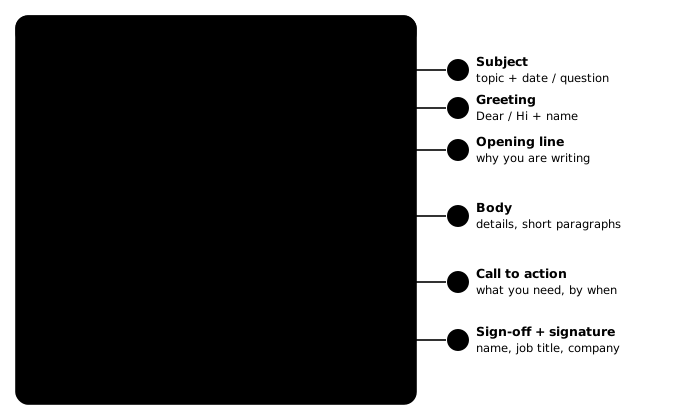
The six parts of an email
Subject → Greeting → Opening line → Body → Call to action → Sign-off. Each part does one job. If even one is missing, the email feels unfinished or blunt.
50.1 Formal or informal — know your reader first
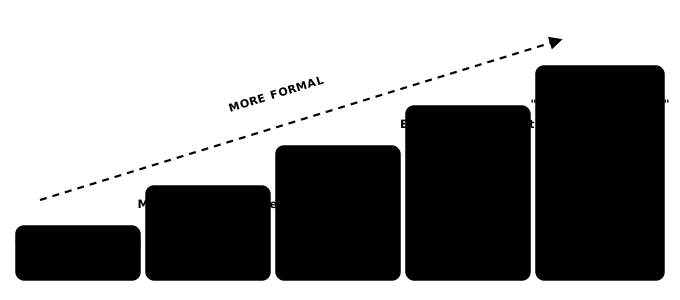
The same message is written differently to a boss, a client and a friend. The wrong tone — too blunt or too friendly — leaves a bad impression even when the grammar is right.
A simple test
Do you call this person by their first name? Yes → "Hi Priya". No, or you are not sure → "Dear Mr Sharma". If in doubt, it is safer to be a bit more formal — if they reply with "Hi Arjun", you can change your style too.
| Part | Formal (boss, client, new contact) | Informal (colleague, friend) |
|---|---|---|
| Greeting | Dear Mr Sharma, | Hi Priya, |
| Opener | I am writing to… · Thank you for your email. | Hope you're well! · Quick one — |
| Wording | I would like to… · Could you please… | Can you… · I'd love to… |
| Contractions | Few: I am, do not | Fine: I'm, don't |
| Emoji, "!!!" | Never | Sometimes, with care |
| Sign-off | Kind regards, · Best regards, | Thanks, · Cheers, · Best, |
50.2 The subject line — it decides whether the email gets opened
When there are a hundred emails in the inbox, people decide from the subject alone which one to open now. A subject line like "Regarding" or "Urgent!!!" says nothing — and is often left for later.

The subject-line formula
Topic + action or date, in 4–8 words. The reader should understand, without opening the email, what it is about and what they must do, and by when.
| Weak subject | Clear subject |
|---|---|
| Regarding leave | Leave request: 12–14 March (family wedding) |
| URGENT!!! | Approval needed by Friday: vendor invoice |
| Hi | Notes from Q3 sales review, 4 October |
| Query | Question about delivery date for order 4521 |
| Meeting | Can we move Monday's review to 3 pm? |
| Fwd: Fwd: Re: Re: update | Updated budget — final figures attached |
50.3 Beginning and end — greeting, opener, sign-off
The first and last lines of an email set the tone. "Respected Sir" sounds like a school application, and an email with no sign-off feels blunt. Business email has its own plain rules.
The greeting rule
In business email, not "Respected Sir" but "Dear Mr Sharma" or "Dear Ms Rao". After Mr/Ms comes the surname, not the first name: "Dear Mr Verma", not "Dear Mr Rahul". If you call them by first name, go straight to "Hi Rahul".
| Greeting | When |
|---|---|
| Dear Mr Sharma, | Formal, you know the name |
| Dear Ms Rao, | Formal, a woman — Ms; Mrs/Miss only if she uses it herself |
| Dear Dr Iyer, | A doctor or PhD — Dr + surname |
| Dear Hiring Manager, | You don't know the name, but you know the role |
| Dear Sir or Madam, | No name, no role — the last option |
| Hi Priya, · Hello Priya, | A colleague, or anyone you call by first name |
| Hi team, · Hi all, | A whole group |
- I am writing to request a short meeting next week. The clearest opener — the purpose is in the very first line.
- Thank you for your quick reply. Use it when replying — it is both warm and direct.
- Following up on our call this morning, here are the next steps. Use it to connect the email to an earlier conversation.
| Sign-off | When |
|---|---|
| Kind regards, · Best regards, | Almost every professional email |
| Yours sincerely, | A formal letter that began with a name (Dear Ms Rao) |
| Yours faithfully, | A formal letter that began with "Dear Sir or Madam" |
| Thanks, · Many thanks, | When you have asked for something |
| Best, · Cheers, | A colleague, informal |
50.4 Body and call to action — getting to the point
In the body, write only as much as the reader needs to make a decision. And end the email with a clear request — otherwise the answer comes back, "Fine, but what should I do?"
- One email, one purpose Two separate matters (leave and budget)? Send two separate emails — you will get both answers faster.
- Short paragraphs — 2 to 3 lines On a phone, a long paragraph looks like a wall. If there are more than three items, use bullet points.
- The day with the date "Tuesday, 13 October" — there is no room left for a mistake.
Call to action = who + what + by when
"Could you please send the signed copy by Friday, 5 pm?" — the reader does not have to think about what to do next. Keep one main request per email.
| Weak ending | Clear call to action |
|---|---|
| Please do the needful. | Could you please approve the invoice by Thursday? |
| Waiting for your reply. | Please let me know by Friday if 3 pm suits you. |
| Revert ASAP. | Could you send the figures by 4 pm? The client call is at 5. |
| Let me know. | Which of the two dates works better for you? |
- Could you please send the signed copy by Friday? Polite (could you please), clear (signed copy), and with a deadline (by Friday).
50.5 Model: one complete formal email
Now all the parts together. Arjun works at an interior design company and wants a client to agree to a new date for a site visit. Notice what job each line does.
Model: formal email — to a client
Subject: Site visit — can we move it to Tuesday, 13 October?
Dear Mr Deshpande,
I am writing to ask if we can move Thursday's site visit to Tuesday, 13 October, at the same time (11 am).
The kitchen cabinets for your flat will now reach us on Monday. If we visit on Tuesday, you can see them installed rather than in boxes, and approve the finish on the spot.
Could you please confirm by Friday whether Tuesday works for you? If it does not, Wednesday morning is also free.
Kind regards,
Arjun Nair
Project Coordinator, Brightline Interiors
- Subject — question + new date Mr Deshpande understands what is being asked right in the inbox.
- Dear Mr Deshpande, He is a client and the relationship is formal — Dear + Mr + surname, with a comma at the end.
- I am writing to ask… The purpose is in the first line. No "Greetings of the day" and no self-introduction.
- Body — the reason, and the client's benefit Not just "our problem" but "what you get" — this brings a yes faster.
- Could you please confirm by Friday… Call to action: what (confirm) + by when (Friday) + a backup option.
- Kind regards + full name + job title The reader knows who is writing and from which company.
50.6 Model: one complete informal email
An email to a colleague is still an email — but the tone is lighter. See how the request stays just as clear even though the style is friendly.
Model: informal email — to a colleague
Subject: Your slides for Monday + lunch on Friday?
Hi Priya,
Hope your week's going well!
Quick one: could you send me your three slides for Monday's review by Thursday evening? I'll put the full deck together on Friday morning.
Also, a few of us are trying the new dosa place near the office for lunch on Friday. Want to join?
Thanks,
Kabir
- Hi Priya, · Hope your week's going well! First name, a contraction (week's), one exclamation mark — perfectly fine for a colleague.
- Quick one: could you send… Friendly, but the business comes first — and with a deadline (Thursday evening).
- Also, … Want to join? A small second topic is fine in an informal email — but after the work matter, not before.
- Thanks, Kabir First name only. No job title or company needed — Priya knows him.
50.7 Old phrases to retire
These phrases have been used in Indian offices for decades, and they are not even wrong English — they are just old. In today's international offices, and in newer Indian ones, they sound heavy, unfinished or a little blunt.
| Old phrase | The problem | Today's version |
|---|---|---|
| Please do the needful. | Doesn't say what has to be done | Could you please approve the leave by Friday? |
| Kindly revert back. | revert = go back; "back" is said twice | Please reply. · Please let me know. |
| PFA | A short form, sounds blunt | I have attached the report. |
| Please find attached herewith… | "herewith" is unnecessary and old | Please find the report attached. |
| Thanks and regards (in every email) | Thanks twice, along with Thanking you | Best regards, — or just Thanks, |
| Greetings of the day! | Says nothing, takes up space | I hope you are well. — or go straight to the point |
| Respected Sir, | Sounds like a school application | Dear Mr Sharma, |
| Thanking you in anticipation. | Old, puts a little pressure on the reader | Thank you for your help. |
Instead of the old phrase — a direct request
There is one cure for all of these: write what you really need instead of the phrase. Instead of "do the needful", write the actual task. Instead of "revert", write "reply". If a senior person still uses these phrases, don't correct them — just use the new version in your own emails.
50.8 The mistakes we really make
These mistakes appear in Indian inboxes every day. Most of them come from translating directly from Hindi — and once you recognise them, they will not happen again.
Real email mistakes
- Wrong: Myself Rahul from the accounts team.
- Right: I am Rahul from the accounts team.
-
Why: "Myself" cannot be the subject on its own — it appears only in sentences like "I did it myself".
-
Wrong: Dear Mr Rahul,
- Right: Dear Mr Verma, · Hi Rahul,
-
Why: Mr/Ms goes with the surname. If you want the first name, drop Mr and use "Hi".
-
Wrong: I have send the file yesterday.
- Right: I sent the file yesterday.
-
Why: "Yesterday" = a specific time in the past → simple past (sent). "have" takes V3: have sent — but not with yesterday.
-
Wrong: Waiting for your positive reply.
- Right: I look forward to hearing from you.
-
Why: "Positive reply" puts pressure on the reader, and "waiting" sounds impatient.
-
Wrong: Hi Sir, please send the details asap!!!
- Right: Dear Mr Kumar, could you please send the details by 3 pm today?
- Why: "Hi Sir" is neither formal nor informal. "ASAP" says nothing, and "!!!" reads like shouting — write the time.
50.9 Practice — Emails
Exercise 1
An email to your manager asking for leave — which is the best subject line?
- Leave
- Leave request: 12–14 March (family wedding)
- URGENT!!! Please read
- Regarding leave matter kindly see
Answer
Leave request: 12–14 March (family wedding)
The subject has the topic + dates + a short reason — the manager knows what is needed and when without opening the email.
Exercise 2
You have never met the client Anil Kapoor. What should the greeting be in the first email?
- Dear Mr Kapoor
- Respected Sir
- Hey Anil
- Dear Mr Anil
Answer
Dear Mr Kapoor
You know the name and the relationship is new — so 'Dear' + Mr + surname. 'Mr Anil' is wrong: Mr is followed by the surname, not the first name.
Exercise 3
Which of these is the clearest call to action?
- Please do the needful.
- Waiting for your reply.
- Could you please approve the invoice by Thursday?
- Revert ASAP.
Answer
Could you please approve the invoice by Thursday?
A good call to action says what to do (approve), with what (invoice) and by when (Thursday). None of the other three says this.
Exercise 4
When do you write 'Yours faithfully'?
- When the greeting is 'Dear Sir or Madam', that is, you don't know the name
- In an informal email to a friend
- At the end of every email
- When you know the boss's name
Answer
When the greeting is 'Dear Sir or Madam', that is, you don't know the name
The British rule: if you know the name (Dear Ms Rao), use Yours sincerely or Kind regards. If you don't (Dear Sir or Madam), use Yours faithfully.
Exercise 5
What is the most natural sign-off for a short informal email to a colleague?
- Thanks
- Yours faithfully
- Thanking you in anticipation
- Yours obediently
Answer
Thanks
With a colleague, 'Thanks,' or 'Cheers,' + first name is enough. The other three belong to formal letters — or are simply out of date.
Exercise 6
One word is completely unnecessary — tap it.
Kindly revert back with your comments by Monday.
Answer
Wrong word: back.
Corrected: Please reply with your comments by Monday.
'Revert' already means to come back — 'back' says it twice. In today's business English, 'reply' or 'let me know' is clearer.
Exercise 7
Find the wrong word.
I have send the invoice to your team yesterday.
Answer
Wrong word: send.
Corrected: I sent the invoice to your team yesterday.
'Yesterday' = a specific time in the past, so simple past: sent. 'have send' is never right — 'have' takes V3, 'sent'.
Exercise 8
Write PFA in full: Please find the report ___.
Answer
attached
Not everyone understands short forms like PFA. 'Please find the report attached' — or even more directly: 'I have attached the report.'
Exercise 9
A formal greeting when you don't know the name: Dear Sir or ___,
Answer
Madam
'Dear Sir or Madam' — because the reader could be anyone. 'Dear Sir' alone assumes the reader is a man.
Exercise 10
Match each old phrase to today's version.
| A | B |
|---|---|
| Please do the needful | I have attached the file |
| Kindly revert back | I hope you are well |
| PFA | Dear Mr Rao |
| Greetings of the day | Could you please approve it by Friday? |
| Respected Sir | Please reply |
Answer
Please do the needful — Could you please approve it by Friday?; Kindly revert back — Please reply; PFA — I have attached the file; Greetings of the day — I hope you are well; Respected Sir — Dear Mr Rao
Every new version is direct: say clearly what you need, drop the short forms, and don't bring school-style formal language into the office.
Exercise 11
Put the words in the right order to make a call to action.
Words: the / Friday? / copy / please / send / by / you / Could / signed
Answer
Could you please send the signed copy by Friday?
Could you please + verb (send) + what (the signed copy) + by when (by Friday) — polite and clear.
Exercise 12
Say the opening line of an email aloud.
I am writing to request a short meeting next week.
Answer
Say: I am writing to request a short meeting next week.
'I am writing to…' is the clearest opener — it states the purpose of the email in the very first line. On the phone the same job is done by: 'I am calling to…'
What to do next
Before sending your next email, ask three questions: does the subject make the task clear? Is the purpose in the first line? Is there a clear request and a date at the end? If all three are yes — press Send.