Chapter 43: Basic → native English
From Basic to Native — the same message, a new style
Your English is not wrong. I am very tired is a perfectly correct sentence — grammar perfect, meaning clear. Still, a native speaker would probably not say it. They would say I'm running on fumes. In this chapter we learn exactly that difference: the short journey from correct English to natural English. And, most important of all — knowing where to say which phrase, because a natural phrase used in the wrong place sounds worse than a basic one.
- 1Four pairs you can use from today
- 2The everyday upgrade table
- 3Feeling upgrades — anger, fear, joy, tiredness
- 4Work and daily talk — 12 more upgrades
- 5Register — a map of where a phrase belongs
- 6Small habits that make an instant difference
- 7Mistakes people make with native phrases
- 8A short script — what to say every day
In one line
Sounding native does not come from difficult words — it comes from putting the right phrase in the right setting. You do not need to memorise big words; learn a few phrases and use them correctly.
43.1 Four pairs you can use from today
First understand these four properly. Make a picture in your mind for each one — that is the only way the real meaning of a phrase sinks in.
I'm very tired → I'm running on fumes
"Fumes" are the vapour of petrol — the car has run out of petrol, only fumes are left, and it is still moving. That is the picture: the energy is gone but the work continues. So this phrase is not just for feeling sleepy; it is for when you are still sitting at your laptop after a three-day deadline.
- Honestly, I'm running on fumes — can we finish this tomorrow morning? = To be honest, I have no energy left. Can we finish this tomorrow morning?
More options, from light to heavy: I'm beat (casual, with friends), I'm wiped out (a bit more tired), I'm exhausted (safe everywhere — office, interview, doctor).
I don't understand → I'm not following
I don't understand can make the listener think "I can't get it, I am weak". I'm not following means "I have lost the thread of what you are saying" — nobody is blamed, neither you nor the speaker. For offices and meetings, this is the best one.
- Sorry, I'm not following — could you walk me through that part again? = Sorry, I can't keep up — could you explain that part once more?
- You've lost me. What happens after the payment fails? = I can't follow you any more. What happens after the payment fails?
I need to leave → I should get going
I need to leave sounds like you are forced to, as if there is an emergency. I should get going is soft and polite, and leaving feels like your own choice. When leaving someone's house or ending a call — this is the line.
- This was lovely, but I should get going — it's a long drive back. = I enjoyed this, but I ought to leave now — the drive back is long.
- I'd better head out before the traffic starts. = I should leave before the traffic begins.
I made a mistake → I dropped the ball
Pay attention here, because this pair is not equal. I dropped the ball is not for every mistake — it is for when the job was yours and you let it slip. Saying it about a typo would sound over-dramatic. Forgot to send a follow-up email to a client — now that is fine.
- I dropped the ball on the vendor follow-up. I'm fixing it today. = I forgot to do the vendor follow-up that was my job. I will fix it today.
- That one's on me — I misread the deadline. = That was my mistake — I read the deadline wrongly.
The native formula for admitting a mistake
Own it + a plan to fix it, not excuses. "I dropped the ball on this. Here's what I'm doing about it." In native English, after a mistake you do not say "sorry sorry"; you say what happens next. That sounds professional.
43.2 The everyday upgrade table
On the left is what we usually say; on the right is what sounds natural to the ear. The third column is the most important — when.
| Plain | Native | When it is fine to say |
|---|---|---|
| I am very busy | I'm swamped | Office, colleagues, WhatsApp. Fine with your boss too. Not in a first email to a client. |
| I will think about it | Let me sleep on it | When the decision can wait until tomorrow. Works in meetings and with friends. |
| Tell me about it later | Fill me in later | Casual and office. "Fill me in" = tell me what I missed. |
| I agree completely | Couldn't agree more | Safe everywhere — meetings, interviews, friends. |
| It is not a problem | No worries | Casual and normal office talk. In a formal email write "That's absolutely fine". |
| I am confused | I'm a bit lost here | Meetings and class — it sounds honest, not weak. |
| Please wait a little | Bear with me | When you are sharing your screen or looking for something. Very natural. |
| I did it very fast, so it is rough | It's a first pass | Office. To set expectations when you send work. |
| We have very little time | We're cutting it close | With the team. With a client it is better to say "the timeline is tight". |
| I understood | Got it / Makes sense | Every day, everywhere. Much better than "Noted with thanks". |
| Let us start | Let's dive in | The start of a presentation or a meeting. |
| I will do it later | I'll circle back on this | Office only. Among friends it sounds corporate and makes people laugh. |
43.3 Feeling upgrades — anger, fear, joy, tiredness
When talking about feelings, I'm very ___ is the most common habit. A native speaker replaces "very" with a picture phrase. Press 🔊 on every line and listen to the rhythm — these phrases are said in one breath.
| Basic | Native | Meaning | When to use it |
|---|---|---|---|
| I'm very angry | I'm seeing red right now | So angry that everything looks red. | Casual, with friends and family. It means very strong anger — said at the office, it will alarm people. There, say I'm really frustrated. |
| I'm very scared | I'm freaking out right now | In a bad state from fear or panic. | Casual only. It covers panic as well as fear. In formal settings say I'm really worried. |
| I'm very confused | I'm totally thrown off | Something suddenly changed and I lost my balance. | Casual and office both. Especially when a plan or an answer changes suddenly. |
| I'm very nervous | I'm a little worked up | Restless and tense inside. | Casual. Note — worked up can also include some anger or agitation. For nerves alone people also say I've got butterflies. |
| I'm very surprised | I'm completely caught off guard | I was not ready at all; the news startled me. | Safe everywhere — even in meetings. For good or bad surprises alike. |
| I'm very happy | I'm feeling great about it | I feel very happy and confident about this. | Safe everywhere. For happiness about a decision, result or plan — for mood alone say I'm in a great mood. |
| I'm very tired | I'm running on fumes | No energy left, yet the work goes on. | Casual and with the team. The full story is in Section 1 above — not in front of a doctor. |
Three phrases that sound odd in the wrong place
seeing red = very strong anger, not for small irritation · freaking out = slang, not for an interview or in front of a client · worked up = nervousness or agitation — make it clear from the context. Feeling idioms are most natural with friends; at the office, choose the neutral version.
43.4 Work and daily talk — 12 more upgrades
These are lines that come up ten times a day — money, work, plans and saying no. Most of them are in the neutral zone, which means they work both at the office and with friends.
| Basic | Native | Meaning | When to use it |
|---|---|---|---|
| I need to leave | I need to get going | I have to go now. | Safe everywhere. I should get going (Section 1) is softer; need to has a little more hurry. |
| I don't understand | I'm not catching your drift | I can't grasp what you are trying to say. | Casual, a little old-fashioned. For a hinted or indirect point. In a meeting I'm not following is better. |
| That's expensive | That's gonna cost me big time | This will hurt my pocket badly. | Spoken only. Never write gonna. To a client: That's above our budget. |
| I'm very busy | I've got a lot on my plate | My plate is already full of work. | Safe everywhere — even with your boss. A little softer than I'm swamped. |
| I don't want it | I think I'll pass on that | Thank you, but not this time. | A polite no — food, an offer, an invitation. I don't want it sounds rude. |
| That's very difficult | That's a tough nut to crack | A hard nut — difficult to break. | Office and casual. For a problem, a question or a difficult person. The idiom is fixed — only crack works. |
| I don't know yet | I haven't figured it out yet | I haven't worked it out or decided yet. | Safe everywhere. It carries the feeling of "still trying". |
| I made a mistake | I dropped the ball on that | That job was mine and I let it slip. | Team and manager. Not for a small typo — see Section 1. |
| Let's talk later | Let's touch base later | Let's have a short chat later. | Office language. Among friends it sounds corporate — there say Let's catch up later. |
| I'm ready to start | I'm ready to get started | I am ready to begin. | Safe everywhere — meetings, class, interviews. |
| That's very annoying | That's getting on my nerves | This thing is driving me crazy. | Casual. Nerves is always plural. Saying it to someone's face sounds rude. |
| I'll handle it | I'll take care of it | Don't worry, I'll manage it. | Safe everywhere — with clients too. I'll handle it is also correct, just a little blunter. |
Three that work everywhere
If you only want to take three from this table, take these: I've got a lot on my plate, I'll take care of it, I think I'll pass on that. All three are neutral — say them without worry to a friend, a manager or a client.
43.5 Register — a map of where a phrase belongs
English phrases sit on a line: very casual at one end, very formal at the other. The middle part is the most useful — phrases there work with friends and with your manager. If you are unsure, pick from the middle.
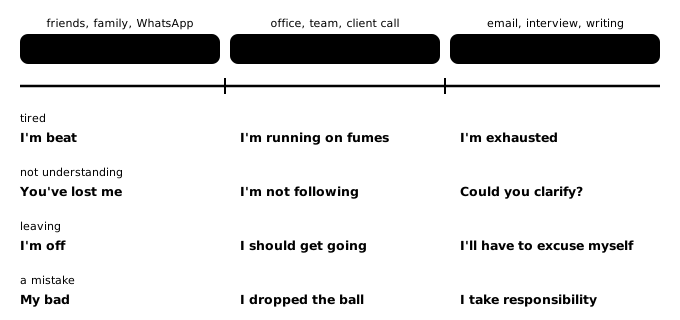
Over-correction — the real danger
The most common mistake is learning a new phrase and stuffing it in everywhere. If you tell a doctor "I'm running on fumes", they will not understand how sleepy you really are. Say it plainly there: "I've been sleeping badly for a week". A natural phrase in the wrong place is worse than a basic phrase. Look at the setting first, then choose the words.
43.6 Small habits that make an instant difference
Besides phrases, there are three habits that can make your English sound natural within a single week.
a) Speak in contractions
Natives do not say I am, do not, it is in full — they say I'm, don't, it's. The full form is only for emphasis: "I am listening!" English without contractions sounds bookish, not wrong — just a little stiff.
b) Add a softener
Native English avoids being too direct. Add a small word: a bit, kind of, maybe, I think, actually.
"This is wrong" → "I think there's a small issue here." A softener makes you sound less aggressive — very useful at the office.
c) Make your answer longer than two words
The answer to "How was your weekend?" is not "Fine". "Pretty quiet, actually — I just caught up on sleep. You?" One small detail plus a question back. That is what keeps a conversation going.
43.7 Mistakes people make with native phrases
Right phrase, wrong use
- Wrong: I am running in fumes.
- Right: I'm running on fumes.
-
Why: Change a small word of an idiom and it breaks. Remember the phrase whole, exactly as it is — on fumes, because a car runs "on petrol".
-
Wrong: I dropped the ball — I made one spelling mistake.
- Right: Sorry, typo. Fixed it.
-
Why: A big idiom for a small mistake sounds dramatic. Use "dropped the ball" only when a job you were responsible for slipped.
-
Wrong: I am not following your.
- Right: I'm not following.
-
Why: This phrase is complete by itself — it needs no object. If you want to add one: I'm not following your point.
-
Wrong: I should get going now itself.
- Right: I should get going right now.
-
Why: "Now itself" is a habit of Indian English — it is not understood abroad. The correct forms: right now or right away.
-
Wrong: Let me sleep over it.
- Right: Let me sleep on it.
- Why: "Sleep over" is when children stay the night at a friend's house. To put off a decision, say sleep on it.
43.8 A short script — what to say every day
Below is a standard office exchange in both versions. Read it aloud twice — first the left side, then the right. Your ear will notice the difference.
| Textbook English | What people actually say |
|---|---|
| Good morning. How are you? | Morning! How's it going? |
| I have completed the report. | I've wrapped up the report. |
| I did not understand the second point. | I'm not following the second point. |
| Please give me some time. | Bear with me for a minute. |
| I will inform you afterwards. | I'll let you know. |
| I am very tired today. | I'm running on fumes today. |
| I have to go now. | I should get going. |
43.9 Practice — Basic to native
Exercise 1
In an office meeting you did not understand someone's point. Which line is the most natural?
- Sorry, I'm not following.
- I am not understanding.
- I have a doubt in your talk.
- Please repeat it again.
Hint: Nobody should be blamed.
Answer
Sorry, I'm not following.
'I'm not following' is neutral — you do not look weak and the speaker is not blamed. 'I am not understanding' is also grammatically wrong, and in 'repeat it again' the 'again' is unnecessary.
Exercise 2
You forgot to send an important client follow-up email. What do you tell your manager?
- I dropped the ball on the client follow-up.
- I am running on fumes.
- Let me sleep on it.
- I'm swamped so it is not my fault.
Answer
I dropped the ball on the client follow-up.
A job you were responsible for slipped = dropped the ball. The other phrases do not fit here, and the last line is making excuses — which never sounds good.
Exercise 3
You have to describe your tiredness to a doctor. What should you say?
- I've been exhausted for two weeks and sleeping badly.
- I'm running on fumes, doc.
- I'm beat.
- I'm totally wiped.
Hint: Clear information is needed here, not style.
Answer
I've been exhausted for two weeks and sleeping badly.
A doctor needs details, not an idiom. This is the danger of over-correction — a natural phrase in the wrong place does harm.
Exercise 4
This was fun, but I should get ___ — it's getting late.
Hint: A soft way to leave.
Answer
going
'I should get going' = I ought to leave now. It is more polite and more natural than 'I need to leave'.
Exercise 5
Give me a minute to find the file — please ___ with me.
Hint: Not the animal — it's a phrase: ___ with me.
Answer
bear
'Bear with me' = please be patient. Natives say this while sharing a screen or looking for something.
Exercise 6
The idiom is broken in this sentence — tap the wrong word.
After three night shifts I am running in fumes.
Answer
Wrong word: in.
Corrected: After three night shifts I'm running on fumes.
The small words of an idiom are fixed — 'on fumes', not 'in'. Change one word inside an idiom and the whole phrase sounds foreign.
Exercise 7
One word is an Indian English habit that is not understood abroad — find it.
I should get going now itself.
Answer
Wrong word: itself.
Corrected: I should get going right now.
'Now itself' works only in India. On an international call say 'right now' or 'right away'.
Exercise 8
Match each plain line with its natural version.
| A | B |
|---|---|
| I am very busy | Got it |
| I will think about it | Couldn't agree more |
| I understood | I'm swamped |
| I agree completely | Let me sleep on it |
Answer
I am very busy — I'm swamped; I will think about it — Let me sleep on it; I understood — Got it; I agree completely — Couldn't agree more
All four on the right belong to the neutral zone — they work at the office and with friends.
Exercise 9
Match each phrase with the right setting.
| A | B |
|---|---|
| My bad | in writing, a formal email |
| I dropped the ball | office language only |
| I take full responsibility | with a friend, fully casual |
| I'll circle back on this | with a team or a manager |
Answer
My bad — with a friend, fully casual; I dropped the ball — with a team or a manager; I take full responsibility — in writing, a formal email; I'll circle back on this — office language only
Remember the register map: one message, three versions, each with its own place.
Exercise 10
Put the words in the right order — a line for admitting a mistake to a manager.
Words: the / today / it / am / this / and / on / I / I / ball / fixing / dropped
Answer
I dropped the ball on this and I am fixing it today
The native formula: own the mistake first, then give the plan. Excuses do not come in between.
Exercise 11
Which habit makes your English sound natural straight away?
- Speaking in contractions — I'm, don't, it's
- Putting a big word in every sentence
- Always saying the full form — I am, do not
- Giving every answer in two words
Answer
Speaking in contractions — I'm, don't, it's
Contractions fix the rhythm. The full form sounds bookish, and two-word answers kill a conversation.
Exercise 12
Your manager gives you a new task, but your plate is already full. What is the most natural and polite line?
- I've got a lot on my plate right now.
- I am having many works today.
- I'm seeing red right now.
- That's gonna cost me big time.
Answer
I've got a lot on my plate right now.
'A lot on my plate' = already a lot of work. It is safe with a manager too. 'Seeing red' is anger, and 'cost me big time' is about money.
Exercise 13
You are writing a formal email to a client. Which line should you NOT write here?
- That's gonna cost me big time.
- I'll take care of it.
- I'm ready to get started.
- I haven't figured it out yet.
Hint: One line is for speaking only.
Answer
That's gonna cost me big time.
'Gonna' and 'big time' are spoken language only. To a client write 'That's above our budget'. The other three lines are safe everywhere.
Exercise 14
This bug has taken three days — it's a tough nut to ___.
Hint: Which verb goes with a nut?
Answer
crack
'A tough nut to crack' = a hard problem. The idiom is fixed — 'break' or 'open' ruins it.
Exercise 15
One word in the idiom is in the wrong form — find it.
The drilling next door is getting on my nerve.
Answer
Wrong word: nerve.
Corrected: The drilling next door is getting on my nerves.
In 'getting on my nerves', 'nerves' is always plural. 'Nerve' on its own changes the meaning (courage).
Exercise 16
Match each basic feeling with its native version.
| A | B |
|---|---|
| I'm very angry | I'm caught off guard |
| I'm very scared | I'm totally thrown off |
| I'm very surprised | I'm seeing red |
| I'm very confused | I'm freaking out |
Answer
I'm very angry — I'm seeing red; I'm very scared — I'm freaking out; I'm very surprised — I'm caught off guard; I'm very confused — I'm totally thrown off
All four phrases are picture phrases — a red colour, panic, no preparation, losing your balance. The first three are mostly casual.
Exercise 17
Now try saying this line. 'I'm' in a single sound, and stress 'foll' in 'not following'.
Sorry I'm not following could you walk me through that again
Answer
Say: Sorry I'm not following could you walk me through that again
When speaking, there is no pause inside 'I'm not following' — it flows together. That rhythm is what sounds native.
What to do next
Do not try to memorise the whole table. This week pick just three phrases — I'm not following, I should get going, bear with me — and say them every day. Three phrases that have settled in your mouth are worth more than thirty memorised ones.