Chapter 17: Subject-verb agreement
Subject-verb agreement — "He go" or "He goes"?
Agreement means a match — the subject and the verb must match. Hindi has this match too, but in a different way (ladka jaata hai / ladke jaate hain), so you already know the idea. There are only two trouble spots. First, in English the -s goes with the singular (it feels backwards!). Second, sometimes the real subject hides behind the words in between. This chapter clears up both for good.
- 1The basic chart
- 2Find the real subject — words in between don't count
- 3Always singular — remember these
- 4"A number of" vs "The number of"
- 5Two subjects joined together — what then?
- 6Collective nouns — one or many?
- 7Looks plural, but is singular
- 8There is / There are
- 9The mistakes we really make
In one line
A singular subject takes a singular verb; a plural subject takes a plural verb. One subject → a singular verb. Many subjects → a plural verb. And remember: an -s on a verb means singular.
17.1 The basic chart
| Subject | Present Simple | be (present) | be (past) | have |
|---|---|---|---|---|
| I | go | am | was | have |
| You | go | are | were | have |
| He / She / It | goes | is | was | has |
| We | go | are | were | have |
| They | go | are | were | have |
The double trick of -s
An -s on a noun makes it plural: boy → boys.
An -s on a verb makes it singular: go → goes.
So in one sentence the -s goes either on the noun or on the verb — not on both. The boy runs ✓ The boys run ✓ The boys runs ✗
17.2 Find the real subject — words in between don't count
This is where most mistakes happen. A long phrase comes between the subject and the verb, and your brain takes the last word of that phrase as the subject. The trick: put an imaginary glass over the middle part and forget it.
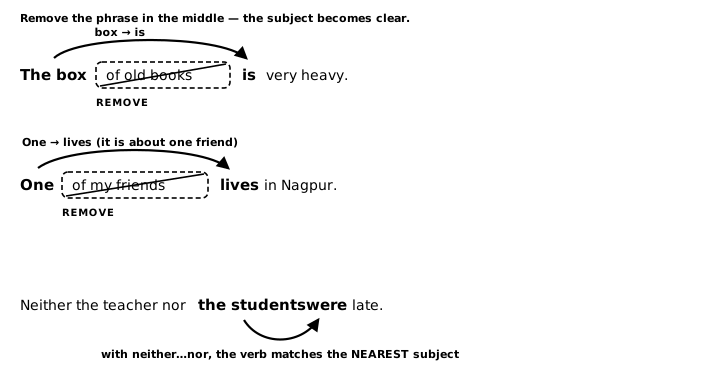
None of these in-between words change the verb
of, with, along with, together with, as well as, including, besides, in addition to, accompanied by
The minister, along with his officers, has arrived. The subject is "the minister" — one person. The "officers" make no difference.
17.3 Always singular — remember these
| Subject | Correct | Wrong |
|---|---|---|
| each | Each boy has a book. | Each boy have… |
| every | Every student was present. | Every student were… |
| everyone / everybody | Everyone knows it. | Everyone know it. |
| someone / somebody | Somebody is at the door. | Somebody are… |
| nobody / no one | Nobody came. | — |
| anyone / anybody | Does anybody know him? | Do anybody know… |
| either / neither (on their own) | Neither is correct. | Neither are correct. |
| one of + plural | One of my friends is a doctor. | One of my friend is… |
| the number of | The number of cases is rising. | The number of cases are… |
| each of / every one of | Each of the girls sings well. | Each of the girls sing… |
'one of my friend' — two mistakes at once
- Wrong: One of my friend are coming today.
- Right: One of my friends is coming today.
- Why: Think: "one of my friends". "Friends" is plural, but the sentence is about one person — so the verb is singular (is). The same rule works for "one of the best players", "one of my sisters" and so on.
17.4 "A number of" vs "The number of"
| Phrase | Meaning | Verb | Example |
|---|---|---|---|
| a number of | several, many | plural | A number of students are absent. |
| the number of | the count, the total | singular | The number of students is falling. |
| a lot of / plenty of | depends on the noun | look at the noun | A lot of water is wasted. · A lot of people are waiting. |
| 50% of / half of | depends on the noun | look at the noun | Half of the cake is gone. · Half of the boys are here. |
17.5 Two subjects joined together — what then?
| Joining word | Rule | Example |
|---|---|---|
| and | plural | Ravi and Sita are friends. |
| and (one single thing) | singular | Bread and butter is my breakfast. |
| or / nor | matches the nearer subject | Ravi or his brothers are coming. |
| either… or | matches the nearer subject | Either the boys or the teacher is wrong. |
| neither… nor | matches the nearer subject | Neither the teacher nor the boys are wrong. |
| not only… but also | matches the nearer subject | Not only the players but also the coach was blamed. |
A smart tip
In either/or and neither/nor sentences, if you can, put the plural subject last. Then the verb is plural and the sentence sounds more natural.
Neither the manager nor the workers were happy.
17.6 Collective nouns — one or many?
Team, family, class, committee, government, jury, staff — these are groups. When the group acts as one unit, use a singular verb; when the people in the group act separately, use a plural verb.
- The team is playing well today. The whole team as one unit — singular.
- The team are arguing among themselves. The members are arguing with each other — separate people, so plural.
Three words that are always plural
police, people, cattle — the verb is always plural with these.
The police have arrested him. ✓ The police has arrested him. ✗
Many people were waiting. ✓
17.7 Looks plural, but is singular
| Type | Words | Example |
|---|---|---|
| Names of subjects | mathematics, physics, economics, politics, statistics | Mathematics is my favourite subject. |
| Diseases | measles, mumps, diabetes | Measles is contagious. |
| Reports | news | The news is good. |
| Uncountable | information, advice, furniture, luggage, work, money | This information is useful. |
| Distance, money, time — seen as one unit | — | Ten kilometres is a long walk. · Five hundred rupees is too much. |
| Name of a book / film | — | "Three Idiots" is a great film. |
And the opposite — looks singular, but is plural
scissors, trousers, jeans, spectacles, pliers, scales — things with two parts are plural: My spectacles are broken.
But with "a pair of" the verb becomes singular: A pair of scissors is missing.
17.8 There is / There are
"There" is not the subject — the subject comes after it. So the verb matches the noun that comes after it.
- There is a problem with the laptop. One problem — singular.
- There are three problems in this file. Three problems — plural.
17.9 The mistakes we really make
Top agreement mistakes
- Wrong: He don't know my name.
- Right: He doesn't know my name.
-
Why: With he/she/it we use "does". "Don't" is only for I, you, we, they.
-
Wrong: My parents is very supportive.
- Right: My parents are very supportive.
-
Why: "Parents" is plural — are. For one person, say "My father is".
-
Wrong: Everyone have their own problems.
- Right: Everyone has their own problems.
-
Why: "Everyone" looks like it means many people, but grammatically it is singular — has. (Using "their" afterwards is fine; it is normal English today.)
-
Wrong: The police is looking for him.
- Right: The police are looking for him.
-
Why: "Police" is always plural. For one officer, say "a policeman is".
-
Wrong: Mathematics are difficult for me.
- Right: Mathematics is difficult for me.
-
Why: Subjects that end in -s (mathematics, physics, economics) are singular.
-
Wrong: One of my cousin works in Dubai.
- Right: One of my cousins works in Dubai.
-
Why: After "one of" the noun is plural, but the verb is singular. Remember both together.
-
Wrong: The list of items are on the table.
- Right: The list of items is on the table.
-
Why: The subject is "the list" — one list. "Of items" is a phrase in between; remove it.
-
Wrong: My brother and I is going to Goa.
- Right: My brother and I are going to Goa.
- Why: Two subjects joined by "and" = plural. Also mind the order — "My brother and I", not "I and my brother".
Four steps, every time
1. Find the verb.
2. Ask "who or what?" — the answer is the subject.
3. Remove everything between the subject and the verb.
4. Now see whether the subject is one or many — and choose the verb to match.
17.10 Practice — Subject-verb agreement
Exercise 1
One of my cousins ___ in Canada.
- live
- lives
- are living
- have lived
Hint: How many people is the sentence about?
Answer
lives
'One of my cousins' means 'ONE of my cousins'. The sentence is about one person, so the verb is singular — lives.
Exercise 2
The box of chocolates ___ on the fridge.
- are
- is
- were
- have
Hint: What is the real subject — the box or the chocolates?
Answer
is
The subject is 'the box' — one box. 'Of chocolates' is a phrase in between; remove it and 'The box is' is left.
Exercise 3
Neither the principal nor the teachers ___ present.
- was
- were
- is
- has
Hint: Which subject is nearest to the verb?
Answer
were
With neither…nor, the verb matches the nearest subject. The nearest is 'the teachers' — plural, so 'were'.
Exercise 4
The police ___ already caught the thief.
- has
- have
- is
- was
Hint: Is 'police' singular or plural?
Answer
have
'Police' is always plural in English — have. For one officer we say 'a policeman has'.
Exercise 5
Every student ___ (have) a separate roll number.
Hint: Which form comes after 'every'?
Answer
has
'Every' and 'each' are always singular, however many people come after — so 'has'.
Exercise 6
There ___ two pens and a pencil in my bag.
Hint: What comes after 'There'?
Answer
are
'There' is not the subject — the noun after it is. 'Two pens' is plural, so 'are'.
Exercise 7
Mathematics ___ my favourite subject.
Hint: Ending in -s does not make a word plural.
Answer
is
Mathematics, physics, economics, politics end in -s but are singular, so 'is'.
Exercise 8
There is one mistake in this sentence — tap the wrong word.
My younger brother don't like sweets.
Answer
Wrong word: don't.
Corrected: My younger brother doesn't like sweets.
The subject 'my younger brother' = he. With he/she/it we use 'doesn't', not 'don't'.
Exercise 9
Find the wrong word.
One of my friend works in a bank.
Answer
Wrong word: friend.
Corrected: One of my friends works in a bank.
After 'one of' the noun is always plural — friends. The verb is still singular — works.
Exercise 10
One word is wrong — catch it.
The quality of these mangoes are very poor.
Answer
Wrong word: are.
Corrected: The quality of these mangoes is very poor.
The subject is 'the quality', one thing. Remove 'of these mangoes' and 'The quality is' is left.
Exercise 11
Match each subject with the correct verb.
| A | B |
|---|---|
| Everyone | is |
| My parents | are |
| The news | were |
| My spectacles | knows |
| A number of boys | know |
Answer
Everyone — knows; My parents — know; The news — is; My spectacles — are; A number of boys — were
Everyone is singular → knows. Parents is plural → know. News is singular → is. Spectacles is plural → are. 'A number of' is plural → were.
Exercise 12
Put the words in the correct order.
Words: this / thirty / number / class / is / of / in / The / students
Answer
The number of students in this class is thirty
'The number of' always takes a singular verb — is. 'A number of students' would take 'are'.
Exercise 13
Now say this line aloud — there are three agreements to handle.
One of my friends has a shop and his brothers work there
Answer
Say: One of my friends has a shop and his brothers work there
'One of my friends' is singular → has. 'His brothers' is plural → work. Two kinds of agreement in one sentence — saying it aloud builds the habit.
What to do next
When you write, read your text once with your finger on the verbs only — stop at each verb and ask "who is its subject?". This one-minute check will catch 90% of your agreement mistakes by itself.