Chapter 13: Conjunctions
Conjunction — the words that join
A conjunction is a word that joins two words, two phrases or two whole sentences. Without conjunctions, English turns into short, choppy lines — "I was tired. I went to work." Add a conjunction and the same idea flows — "I was tired, but I went to work." There are three families, and all three are in this chapter.
- 1Three families — one map
- 2Coordinating conjunctions — FANBOYS
- 3Subordinating conjunctions — the ones that make one part lean
- 4Correlative conjunctions — the ones that come in pairs
- 5Conjunctive adverbs — they look like conjunctions but aren't
- 6The mistakes we really make
- 7A short summary
In one line
A conjunction joins words, phrases, or clauses together. A word that joins two parts is a conjunction. In Hindi, "aur, par, kyunki, agar, jab" do the same job.
- Tea and biscuits. Two words are joined.
- I called her, but she did not pick up. Two whole sentences are joined, on equal terms.
- Because it was raining, we stayed home. One part depends on the other — this is a different family.
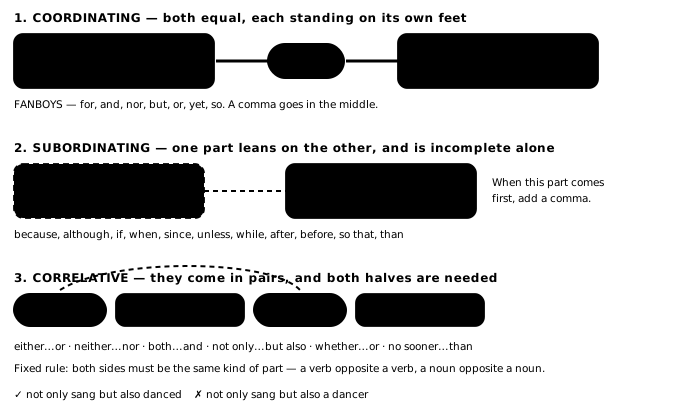
13.1 Three families — one map
13.2 Coordinating conjunctions — FANBOYS
These seven words join two equal parts. Each part is complete on its own. To remember them, use FANBOYS — a word made from their first letters.
| Word | Meaning | Example |
|---|---|---|
| F — for | because (formal) | He stayed in, for it was raining. |
| A — and | adding | She cooked and he cleaned. |
| N — nor | and not either | He did not call, nor did he write. |
| B — but | contrast | It is small but comfortable. |
| O — or | a choice | Tea or coffee? |
| Y — yet | even so | She was tired, yet she kept working. |
| S — so | as a result | It was late, so we left. |
When to use a comma
When you join two complete sentences, put a comma before the conjunction — I called her, but she was busy.
When you join only two words or short parts, no comma — I called her but got no reply. Test: does a new subject come after the conjunction? If yes, use a comma.
After 'nor', the word order flips
✓ He did not call, nor did he write.
✗ He did not call, nor he wrote. After "nor" the order is like a question — the helping verb comes first, then the subject.
13.3 Subordinating conjunctions — the ones that make one part lean
These are the words that make one part depend on another. The part they introduce can't stand alone — it needs the other part to be complete.
- Although he was ill, he came to class. "Although he was ill" on its own feels unfinished — you want to hear more. That is what dependence means.
| What it shows | Words | Example |
|---|---|---|
| Reason (because) | because, since, as | I left early because I was tired. |
| Contrast (even so) | although, though, even though, whereas, while | Though she is young, she is wise. |
| Condition (if) | if, unless, provided that, in case | Unless you study, you will fail. |
| Time (when) | when, while, before, after, until, as soon as, since | Call me when you reach. |
| Purpose (so that) | so that, in order that, lest | He ran fast so that he could catch the bus. |
| Comparison | than, as…as | He is taller than his brother. |
| Place | where, wherever | Sit where you like. |
The position can change — just watch the comma
Because she was late, we started without her. (it comes first → use a comma)
We started without her because she was late. (it comes second → no comma)
13.4 Correlative conjunctions — the ones that come in pairs
These come in pairs — one half at the front, the other in the middle. They have one fixed rule: the same kind of part on both sides. This is called "parallel structure".
| Pair | Meaning | Example |
|---|---|---|
| either … or | this one or that one | Either you come or I go. |
| neither … nor | not this and not that | Neither Ram nor Shyam came. |
| both … and | the two together | She is both clever and kind. |
| not only … but also | not just one — and more | He not only sang but also danced. |
| whether … or | this possibility or that one | I don't know whether he will come or not. |
| no sooner … than | the moment that | No sooner did he arrive than it started raining. |
| as … as | equal to | She is as tall as her mother. |
Which subject does the verb agree with — the nearer one
With either…or and neither…nor, the verb agrees with the subject closest to the verb:
✓ Neither the boys nor the teacher was present. (teacher is nearer → was)
✓ Neither the teacher nor the boys were present. (boys are nearer → were)
Breaking parallel structure
- Wrong: She not only plays the piano but also a good singer.
- Right: She not only plays the piano but also sings beautifully.
-
Why: A verb came after "not only", so a verb must also come after "but also". A verb on one side and a noun on the other makes the sentence lopsided.
-
Wrong: He is interested in reading and to write.
- Right: He is interested in reading and writing.
- Why: Both sides of "and" need the same form — both gerunds, or both infinitives. Not a mix.
13.5 Conjunctive adverbs — they look like conjunctions but aren't
however, therefore, moreover, nevertheless, otherwise, hence, besides, meanwhile — these are adverbs, not conjunctions. So they can't join two sentences with just a comma. They need a semicolon or a full stop.
Comma splice — the most common mistake with 'however'
- Wrong: I was tired, however I finished the work.
- Right: I was tired; however, I finished the work.
- Why: "however" isn't a conjunction, so it can't join two sentences by itself. There are two ways out: use a semicolon, or simply use "but". The second way is both easier and clearer.
13.6 The mistakes we really make
Common Indian-English mistakes with conjunctions
- Wrong: Although he was ill, but he came to work.
- Right: Although he was ill, he came to work.
-
Why: One conjunction for one meaning. Hindi uses both in "halaanki… lekin", so both end up in the English sentence. In English, choose one: either "although" or "but". In the same way ✗ "Because he was late, so we left" is wrong too.
-
Wrong: As she was busy, so she didn't attend.
- Right: As she was busy, she didn't attend.
-
Why: The same repetition — "as" has already given the reason, so "so" isn't needed. It comes straight from the Hindi "kyunki… isliye".
-
Wrong: Unless you don't study, you will fail.
- Right: Unless you study, you will fail.
-
Why: "Unless" itself means "if not" — it already contains the negative. Adding another "don't" reverses the meaning.
-
Wrong: Neither he or his brother came.
- Right: Neither he nor his brother came.
-
Why: Don't break the pair — "neither" goes with "nor", and "either" goes with "or". Swapping the partner is wrong.
-
Wrong: I don't know that she will come or not.
- Right: I don't know whether she will come or not.
-
Why: "or not" goes with "whether", not "that". "if" also works, but "whether…or not" is clearer.
-
Wrong: She is more taller than her sister, but still she plays well.
- Right: She is taller than her sister, but she plays well.
-
Why: Two mistakes: "more taller" is a double comparison, and "but still" repeats the idea — use "but" or "still", not both.
-
Wrong: She is my cousin brother and also my neighbour.
- Right: He is my cousin and also my neighbour.
-
Why: "Cousin" is a complete word by itself — there is no need to add brother. The rest of the sentence was fine; "and also" works, although "and" alone would do the job.
-
Wrong: He don't have money and time.
- Right: He doesn't have money or time.
- Why: Two mistakes: "doesn't" is needed with "he", and in a negative sentence "or" replaces "and". In a negative, "and" joins the two things together, which changes the meaning.
13.7 A short summary
| Family | The two parts | Words | Comma |
|---|---|---|---|
| Coordinating | equal | for, and, nor, but, or, yet, so | yes, if joining two complete sentences |
| Subordinating | one leans on the other | because, although, if, when, unless, since | yes, if the dependent part comes first |
| Correlative | in pairs, parallel | either…or, neither…nor, both…and, not only…but also | usually not |
Three fixed rules
1. One conjunction for one meaning — although or but, not both.
2. The same kind of part on both sides of a correlative pair.
3. however, therefore, moreover are not conjunctions — put a semicolon or a full stop before them.
13.8 Practice — Conjunctions
Exercise 1
Which sentence is correct?
- Although he was tired, he kept working.
- Although he was tired, but he kept working.
- Although he was tired, so he kept working.
- Although he was tired but so he kept working.
Hint: How many conjunctions for one meaning?
Answer
Although he was tired, he kept working.
'Although' has already shown the contrast, so adding 'but' repeats it. Hindi uses both in 'halaanki… lekin', which is why both slip into English.
Exercise 2
Neither Ravi ___ his friends were invited.
- nor
- or
- and
- but
Hint: Don't break the pair.
Answer
nor
'Neither' always has 'nor' as its partner, just as 'either' has 'or'. Swapping the partner makes the sentence wrong.
Exercise 3
___ you apologise, she will not talk to you.
- Unless
- If
- Although
- Because
Hint: The negative is already hidden inside this word.
Answer
Unless
'Unless' means 'if not' — the negative is already in it. That is why 'unless you don't apologise' would reverse the meaning.
Exercise 4
Which word is not in FANBOYS?
- because
- but
- yet
- nor
Hint: FANBOYS are the coordinating conjunctions.
Answer
because
'because' is subordinating — it makes one part lean on another. FANBOYS (for, and, nor, but, or, yet, so) join equal parts.
Exercise 5
I was very tired, ___ I finished the report. (a word showing contrast)
Hint: Two equal sentences, and the idea turns the other way.
Answer
but
Two complete sentences are joined on equal terms and the meaning turns the other way, so 'but'. 'however' gives the same meaning, but it would need a semicolon before it.
Exercise 6
She studied hard ___ she could clear the exam. (in order that)
Hint: You need to show a purpose.
Answer
so that
'so that' is used to show purpose. Plain 'so' would show a result, not a purpose — they are two different ideas.
Exercise 7
One word in this sentence is extra — tap it.
Because it was raining so we cancelled the match.
Answer
Wrong word: so.
Corrected: Because it was raining, we cancelled the match.
'Because' has already given the reason, so 'so' is extra. This comes straight from the Hindi 'kyunki… isliye'.
Exercise 8
Find the wrong word.
Unless you don't hurry you will miss the train.
Answer
Wrong word: don't.
Corrected: Unless you hurry, you will miss the train.
'Unless' already has a negative in it, so adding 'don't' makes two negatives and flips the meaning.
Exercise 9
One word is wrong.
I was tired, however I completed the task.
Answer
Wrong word: however.
Corrected: I was tired; however, I completed the task.
'however' is an adverb, not a conjunction — it can't join two sentences with just a comma. Use a semicolon, or simply use 'but'.
Exercise 10
Match each conjunction to its job.
| A | B |
|---|---|
| because | shows a condition |
| although | shows a purpose |
| unless | shows time |
| so that | shows a reason |
| as soon as | shows contrast |
Answer
because — shows a reason; although — shows contrast; unless — shows a condition; so that — shows a purpose; as soon as — shows time
You choose a subordinating conjunction by its meaning — reason, contrast, condition, purpose or time. Choosing the wrong one changes the whole meaning.
Exercise 11
Put the words in the right order — it uses a correlative pair.
Words: but / guitar / plays / only / sings / the / not / She / also
Answer
She not only sings but also plays the guitar
A verb came after 'not only', so a verb must also come after 'but also' — that is parallel structure. A verb on one side and a noun on the other makes the sentence lopsided.
Exercise 12
Say this line aloud — don't say 'but' after 'although'.
Although it was raining we went out
Answer
Say: Although it was raining we went out
When speaking, the Hindi habit makes 'but' slip out. Deliberately practising without 'but' breaks that habit.
What to do next
Take five of your own short sentences today and join them with conjunctions. Then read them back — notice how much better they sound. The last chapter of this section is Interjection.