Chapter 11: Adverbs
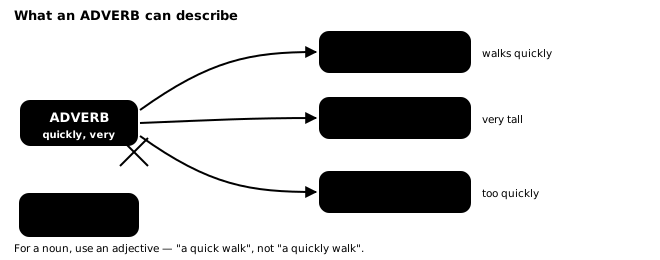
Adverb — how, when, where, how much
An adverb is a word that tells you more about a verb, an adjective or another adverb. An adjective works on a noun; an adverb works on everything else. Two things trip people up most — first, forgetting to add -ly ("she speaks good"), and second, putting the adverb in the wrong place ("I always am late"). Both get fixed in this chapter.
- 1Types of adverb
- 2Rules for forming adverbs
- 3Where to put an adverb — the most common mistakes happen here
- 4Comparative and superlative of adverbs
- 5Adverb or adjective — a one-second test
- 6The mistakes we really make
- 7A short summary
In one line
An adverb modifies a verb, an adjective, or another adverb. If a word describes anything other than a noun, that is an adverb's job.
- He drove carefully. About the verb — how did he drive?
- The exam was very easy. About the adjective — how easy was it?
- She sings quite beautifully. About another adverb — how beautifully does she sing?
11.1 Types of adverb
| Type | Question | Examples | In a sentence |
|---|---|---|---|
| Manner | How? | slowly, carefully, well, badly, loudly | She writes neatly. |
| Time | When? | now, then, today, yesterday, soon, already, yet | He left yesterday. |
| Place | Where? | here, there, outside, upstairs, everywhere, nearby | Wait outside. |
| Frequency | How often? | always, usually, often, sometimes, rarely, never | I always walk to work. |
| Degree | How much? | very, too, so, quite, almost, enough, hardly | It is too hot. |
| Affirmation / negation | Yes or no? | certainly, surely, definitely, not, never | I certainly agree. |
| Reason | Why? | therefore, hence, thus, consequently | He was ill; therefore he stayed home. |
| Interrogative | asking a question | when, where, why, how | Why are you late? |
| Relative | joining two parts | where, when, why | This is the place where we met. |
Interrogative and relative adverbs — the same word, different jobs
where, when, why (and how in questions) can be used in two ways. At the start of a question, it is an interrogative adverb. Right after a noun (a place, a time, a reason), where it adds a whole extra clause about that noun, it is a relative adverb.
| Word | Interrogative (question) | Relative (joining) |
|---|---|---|
| where | Where do you live? | the place where we met |
| when | When does the film start? | the day when I joined |
| why | Why is she crying? | the reason why he left |
| how | How did you do it? | (rarely used as a relative — say "the way" instead) |
- This is the café where we first met. "where" = in which — it adds a whole clause about the place (the café).
- I still remember the day when I got my first job. "when" = on which — it comes after a time word (day).
- Tell me the reason why you are upset. "why" = for which — it comes after "reason".
A short rule for relative adverbs
where = in which / at which (place) · when = on which / in which (time) · why = for which (reason).
✓ the house where I was born = the house in which I was born. A relative adverb is followed by a full clause (subject + verb), without the reversed question order: ✗ "the place where did we meet" → ✓ "the place where we met".
'the way how' — don't use both
- Wrong: I like the way how she speaks.
- Right: I like the way she speaks. / I like how she speaks.
- Why: "the way" and "how" mean the same thing — use one of them, not both.
Think of frequency as a scale
always (100%) → usually → often → sometimes → occasionally → rarely / seldom → hardly ever → never (0%). In an interview, "I sometimes make mistakes" sounds more believable than "I never make mistakes".
11.2 Rules for forming adverbs
| How the adjective ends | What to do | Example |
|---|---|---|
| Normal | + ly | quick → quickly |
| consonant + y | y → ily | happy → happily, easy → easily |
| -le | e → y | simple → simply, gentle → gently |
| -ic | + ally | basic → basically, tragic → tragically |
| -ll | + y | full → fully, dull → dully |
| -ue | drop the e, + ly | true → truly, due → duly |
These adverbs don't take -ly — the form stays the same
| Word | As an adjective | As an adverb |
|---|---|---|
| fast | a fast train | drives fast |
| hard | hard work | works hard |
| late | a late train | came late |
| early | an early bus | woke up early |
| straight | a straight line | go straight |
| high | a high wall | flew high |
"fastly" and "hardly work" are both wrong — "hardly" means almost not at all: He hardly works = he almost never works!
Pairs where adding -ly changes the meaning
| Without -ly | With -ly |
|---|---|
| hard = with great effort (He works hard.) | hardly = almost not at all (He hardly works.) |
| late = after the expected time (She came late.) | lately = recently (I haven't seen her lately.) |
| near = close by (He lives near.) | nearly = almost (I nearly fell.) |
| short = not long (Cut it short.) | shortly = soon (He will arrive shortly.) |
| high = at a great height (Birds fly high.) | highly = very (She is highly qualified.) |
11.3 Where to put an adverb — the most common mistakes happen here
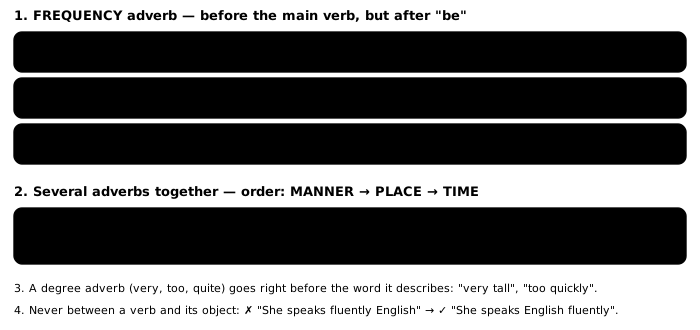
The position of an adverb depends on its type. There are four fixed patterns, and once you know them your everyday speech improves by itself.
The fixed rule for frequency adverbs
Before the main verb — I always wake up early.
After the verb "be" — She is always busy.
After a helping verb — They have never been to Kerala. In one line: after "be", before everything else.
Mistakes with position
- Wrong: I always am ready on time.
- Right: I am always ready on time.
-
Why: A frequency adverb comes after the verb "be" (am) — this is the one exception.
-
Wrong: She speaks fluently English.
- Right: She speaks English fluently.
-
Why: An adverb doesn't go between a verb and its object. Finish the action first (speaks English), then say how.
-
Wrong: He went yesterday to the market.
- Right: He went to the market yesterday.
- Why: Place first, time after — the order is manner → place → time.
An adverb at the start — for emphasis
An adverb can also go at the start of a sentence, where it affects the whole sentence: Suddenly, the lights went off. / Honestly, I didn't know. It's better to put a comma after it.
11.4 Comparative and superlative of adverbs
It works like adjectives, with one difference: adverbs ending in -ly always take more / most.
| How it is formed | Positive | Comparative | Superlative |
|---|---|---|---|
| ending in -ly → more / most | carefully | more carefully | most carefully |
| ending in -ly → more / most | quickly | more quickly | most quickly |
| Short (no -ly) → er / est | fast | faster | fastest |
| Short (no -ly) → er / est | hard | harder | hardest |
| Short (no -ly) → er / est | late | later | latest |
| Irregular | well | better | best |
| Irregular | badly | worse | worst |
| Irregular | little | less | least |
| Irregular | much | more | most |
| Irregular | far | farther / further | farthest / furthest |
- Ravi runs faster than his brother. "fast" is short, so it takes -er.
- She explained it more clearly than the teacher. "clearly" ends in -ly, so it takes more.
- Of all the students, he writes the most neatly. Superlative — comparing three or more.
11.5 Adverb or adjective — a one-second test
Ask: what is it describing?
Describing a noun → adjective. Describing a verb → adverb.
a loud noise (noun) · shouted loudly (verb)
After a linking verb, use an adjective, not an adverb
✓ The food smells good. ✗ smells well
✓ She looks tired. ✗ looks tiredly
These verbs describe the subject, not an action. One exception: He looks well = he looks healthy.
11.6 The mistakes we really make
Common Indian-English mistakes with adverbs
- Wrong: She speaks English very good.
- Right: She speaks English very well.
-
Why: "speaks" is a verb, so you need an adverb — well. "good" goes only with a noun: her English is good. This good/well pair is the most common slip.
-
Wrong: He is more taller and runs more faster.
- Right: He is taller and runs faster.
-
Why: The -er in "taller" and "faster" already makes the comparison. Adverbs ending in -ly take more (more slowly), but short adverbs take -er.
-
Wrong: I always am late for meetings.
- Right: I am always late for meetings.
-
Why: A frequency adverb goes after the verb "be" — am always, is never, are usually. With all other verbs it goes before: always come, never eat.
-
Wrong: He drives his car fastly.
- Right: He drives his car fast.
-
Why: "fastly" isn't an English word. "fast" is an adverb itself. Same list: hard, late, early, straight, high — none of these take -ly.
-
Wrong: She explained very nicely the problem.
- Right: She explained the problem very nicely.
-
Why: Don't squeeze an adverb between the verb and its object. First "explained the problem", then say how.
-
Wrong: He hardly works, that's why he got promoted.
- Right: He works hard, that's why he got promoted.
-
Why: "hardly" means almost not at all — the meaning flips! To talk about effort, say "works hard".
-
Wrong: I am very much tired today.
- Right: I am very tired today.
-
Why: With an adjective, use only "very". "very much" goes with a verb: I like it very much.
-
Wrong: He don't come here never.
- Right: He doesn't come here. / He never comes here.
- Why: Two mistakes: "doesn't" is needed with "he", and one sentence can't have two negatives (doesn't + never). "never" is already negative, so the verb after it is a normal positive one.
11.7 A short summary
| Type of adverb | Position | Example |
|---|---|---|
| Manner | after the object, at the end of the sentence | She read the letter slowly. |
| Frequency | before the main verb / after "be" | He often calls. · He is often busy. |
| Time | at the end (or at the start for emphasis) | We met yesterday. |
| Place | after manner, before time | He sat quietly in the corner. |
| Degree | right before the word it describes | It is too cold. |
11.8 Practice — Adverbs
Exercise 1
She speaks English very ___.
- well
- good
- better
- goodly
Hint: What part of speech is 'speaks'?
Answer
well
'speaks' is a verb, and to describe a verb you need an adverb. The adverb of 'good' is 'well' — 'good' goes only with a noun: her English is good.
Exercise 2
Which sentence is correct?
- She is always on time.
- She always is on time.
- Always she is on time.
- She is on time always.
Hint: The rule for frequency adverbs and the verb 'be'.
Answer
She is always on time.
A frequency adverb goes after the verb 'be' — is always, am never, are usually. With all other verbs it goes before: always comes, never eats.
Exercise 3
He drives ___ than his father.
- faster
- more fast
- more faster
- fastly
Hint: Does 'fast' have an -ly?
Answer
faster
'fast' is a short adverb with no -ly, so it takes -er. Adverbs ending in -ly take 'more': more carefully, more slowly.
Exercise 4
'He hardly works.' — what does it mean?
- He almost never works
- He works very hard
- He works sometimes
- He works properly
Hint: hard and hardly are two different words.
Answer
He almost never works
'hardly' means almost not at all — it is not the adverb of 'hard'. To talk about effort, say 'works hard', without -ly.
Exercise 5
The child was crying ___. (adverb of 'loud')
Hint: What do you normally add to an adjective?
Answer
loudly
Adding -ly to a normal adjective makes the adverb — loud becomes loudly. Here 'crying' is a verb, so an adverb is needed.
Exercise 6
She solved the puzzle ___ than I did. (comparative of 'easily')
Hint: What goes with adverbs that end in -ly?
Answer
more easily
Adverbs ending in -ly take 'more', not -er. There is no such word as 'easilier'.
Exercise 7
One word in this sentence is in the wrong place — tap it.
She speaks fluently Hindi and Marathi.
Answer
Wrong word: fluently.
Corrected: She speaks Hindi and Marathi fluently.
An adverb doesn't go between a verb and its object. Finish the action first — speaks Hindi and Marathi — then say how.
Exercise 8
Find the wrong word.
He drives his new car very fastly.
Answer
Wrong word: fastly.
Corrected: He drives his new car very fast.
'fastly' isn't an English word — 'fast' is an adverb itself. Same list: hard, late, early, straight.
Exercise 9
One word is in the wrong place.
I always am ready before eight.
Answer
Wrong word: always.
Corrected: I am always ready before eight.
A frequency adverb goes after the verb 'be' (am) — this is the one exception. With other verbs it goes before: I always wake up early.
Exercise 10
'This is the school where my father studied.' — what is 'where' here?
- relative adverb
- interrogative adverb
- adverb of place
- preposition
Hint: Is it asking a question, or joining a clause to a noun?
Answer
relative adverb
'where' comes after the noun 'school' and adds a whole clause about it — a relative adverb. In 'Where did he study?' it asks a question — that is interrogative.
Exercise 11
I will never forget the day ___ we won the cup.
Hint: Which relative adverb follows a time word (day)?
Answer
when
After a time noun (day, year, time) use 'when'. After a place use 'where', and after a reason use 'why'.
Exercise 12
One word is extra — tap it.
I love the way how my mother cooks.
Answer
Wrong word: how.
Corrected: I love the way my mother cooks.
'the way' and 'how' mean the same thing — they don't go together. Say 'the way my mother cooks' or 'how my mother cooks'.
Exercise 13
Match each adverb to its type.
| A | B |
|---|---|
| slowly | place — where |
| yesterday | frequency — how often |
| outside | degree — how much |
| rarely | manner — how |
| almost | time — when |
Answer
slowly — manner — how; yesterday — time — when; outside — place — where; rarely — frequency — how often; almost — degree — how much
An adverb's type is decided by the question it answers. And the type decides where it goes in the sentence.
Exercise 14
Put the words in the right order — remember manner, place, time.
Words: concert / the / at / last / beautifully / played / He / night
Answer
He played beautifully at the concert last night
When several adverbs come together, the order is manner (how) → place (where) → time (when). Breaking this order makes the sentence sound odd.
Exercise 15
Say this line aloud — say 'well' clearly, not 'good'.
She speaks English very well
Answer
Say: She speaks English very well
We are used to saying 'very good', so we skip 'well'. Practising 'well' out loud breaks the habit.
What to do next
From today, whenever you want to say "good", ask yourself — "am I describing an action?" If yes, say "well". The next chapter is Preposition, and after that comes Conjunction.