Chapter 37: Collocations
Which word goes with which — collocations
"I did a mistake" — there is no grammar error, and yet it sounds wrong. Why? Because in English some words travel as a pair, just like in Hindi you "make tea" and "cook food" — nobody says "cook tea". These fixed pairs are called collocations. They have no logic, only habit — and that habit is what turns your English from "correct" into "natural".
- 1What is a collocation — fixed word pairs
- 2make or do?
- 3have, take, give, get — four small verbs, hundreds of pairs
- 4Adjective pairs — heavy rain, strong tea, high fever
- 5Verb + preposition — depend on, listen to
- 6Verbs of speaking — say, tell, speak, talk
- 7The mistakes we really make
- 8How to learn collocations — build a word web
37.1 What is a collocation — fixed word pairs
If a collocation is wrong, people still understand you, but they can tell at once that you are translating. It is not enough for the dictionary meaning to be right — the partner word has to be right too.
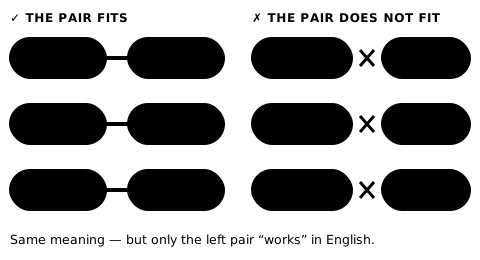
Learn the pair, not the word
A collocation = two words that habitually go together: strong tea, heavy rain, make a mistake. They have no logic — so always write and say a new word together with its partner. Don't write "mistake"; write "make a mistake".
37.2 make or do?
In Hindi both are "karna", which makes this the biggest trap. A rough rule is very useful — and whatever does not fit the rule, you simply learn as a pair.

- I made a few mistakes, but I did my best. A mistake is "created" (make); trying hard is an activity (do).
- Could you do me a favour and make a quick call to the bank? Both in one sentence — favour = do, phone call = make.
make vs do
make = create or produce something new (a decision, a mistake, money, a noise, a call). do = work, duty or an activity (homework, the dishes, exercise, a favour, your best). "Do a mistake" is the most common Indian error — a mistake is always made.
37.3 have, take, give, get — four small verbs, hundreds of pairs
These four verbs are so small that they almost lose their own meaning — the meaning comes from the pair. So never learn them alone; always learn them with their partner.
| Verb | Fixed pairs | Listen |
|---|---|---|
| have | a meal · a bath · a good time · a look · a party · a chat | |
| take | a photo · a break · a seat · a bus · a chance · medicine | |
| give | a speech · advice · an example · a hand · a call · a smile | |
| get | ready · a job · home · lost · better · married |
Exams and medicine — 'take'
A student takes an exam (British: sits it) — a teacher gives or sets it. Medicine is also taken, not "eaten": take your medicine. Everyone in India understands "I gave my exam", but abroad it sounds like the opposite — as if you were the one who set the exam.
37.4 Adjective pairs — heavy rain, strong tea, high fever
In Hindi we use one word, "tez", for rain, tea and fever alike. In English every noun has its own adjective. These are the pairs that get noticed most.
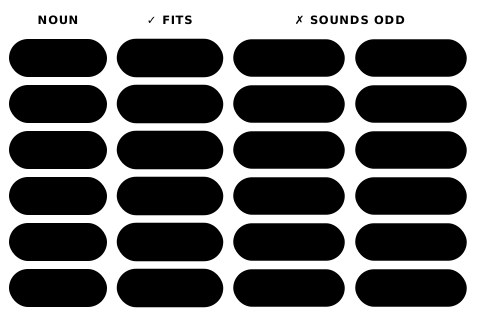
- There was heavy traffic because of the heavy rain. Both traffic and rain are "heavy" — meaning there is a lot of it.
- She has a high fever, so she's in deep sleep now. A fever is "high", sleep is "deep".
- I need a cup of strong tea and some fresh air. = I want a cup of strong tea and some clean, cool air.
Six faces of 'tez'
heavy rain / traffic · strong tea / coffee / wind · high fever / price / temperature · deep sleep. One Hindi "tez" changes in English depending on the noun. Avoid "big rain", "big fever" and "expensive price" — all three.
37.5 Verb + preposition — depend on, listen to
Some verbs bring a particular preposition with them — and the wrong preposition can even change the meaning. Remember them as one unit: depend-on, listen-to.
| Pair | Example | Listen |
|---|---|---|
| depend on | It depends on the weather. | |
| listen to | Listen to me carefully. | |
| wait for | I'm waiting for the bus. | |
| agree with (a person) | I agree with you. | |
| agree to (a proposal) | They agreed to our plan. | |
| apologise for | I apologise for the delay. | |
| look forward to + -ing | I look forward to meeting you. | |
| believe in | She believes in hard work. |
Verbs that take nothing
Some verbs take no preposition: discuss the plan, enter the room, reach Delhi, marry someone, answer the question. "discuss about", "reach at", "answer to the question" — all three are wrong. And after "look forward to" comes -ing: "looking forward to meeting you", not "to meet you".
37.6 Verbs of speaking — say, tell, speak, talk
All four mean "to speak", but they have different partners. This is where mistakes like "say a lie" and "tell me sorry" are born. First understand the pattern of say and tell.
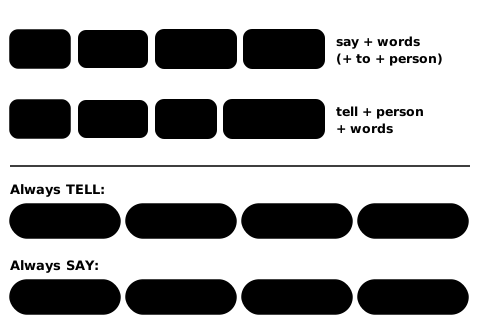
- Always tell the truth, even when it's hard. The truth is "told" — and so is a lie: tell a lie.
- He said sorry and told us what happened. say sorry · tell + us + the news.
- Do you speak Tamil? Let's talk about it later. You "speak" a language; you "talk about" a topic.
say vs tell
tell + person (tell me, tell her) — and always tell the truth / a lie / a story / a joke. say + words (say hello, say sorry, say thank you) — if you need the person, use say … to me. You speak a language, and talk about a topic.
37.7 The mistakes we really make
These pairs are so common in India that they start to feel right. But in a client call, an interview or IELTS, these small pairs make your English sound "translated".
Common collocation mistakes
- Wrong: I did a big mistake.
- Right: I made a big mistake.
-
Why: A mistake is always made. "Do" is for work.
-
Wrong: My son has big fever.
- Right: My son has a high fever.
-
Why: A fever has a number, so it is high. And don't forget "a": a high fever.
-
Wrong: Don't say a lie.
- Right: Don't tell a lie.
-
Why: Both lies and the truth are told: tell a lie, tell the truth.
-
Wrong: I gave my exam yesterday.
- Right: I took my exam yesterday. / I sat my exam yesterday.
-
Why: A student takes an exam. Abroad, "give an exam" sounds like the teacher's job.
-
Wrong: Please close the light.
- Right: Please switch off the light. / Please turn off the light.
- Why: A translation of the Hindi "light band karo". Lights, fans and TVs are switched on / switched off; a door is closed.
Also watch out — and one piece of good news
eat medicine → take medicine · do a party → have / throw a party · strong rain → heavy rain.
Good news: take a decision is perfectly correct (British and Indian English), and so is make a decision — you can say either.
37.8 How to learn collocations — build a word web
There is no formula for collocations, so your method is everything. Around every new important noun, write its partners — which verbs, which adjectives, which preposition. One web, one page.
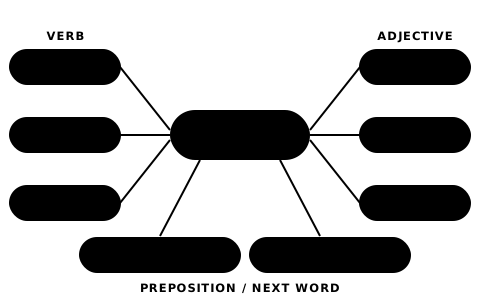
Three daily habits
1. While reading, underline the pair, not the word — "heavy traffic", "made a decision".
2. In your notebook, draw a small web for every noun, like the one above.
3. If in doubt, search the pair in quotes — "big fever" vs "high fever" — whichever gives more results is the natural one.
37.9 Practice — Collocations
Exercise 1
I need to ___ a phone call to the bank.
- make
- do
- give
- say
Answer
make
A phone call is 'made' — you create something new. 'Give me a call' is fine too, but the person calling 'makes a call'.
Exercise 2
We had very ___ rain last night.
- heavy
- strong
- big
- high
Answer
heavy
Rain is 'heavy'. 'Strong' is for wind (strong wind), and 'big rain' is never used.
Exercise 3
My son has a ___ fever. I'm taking him to the doctor.
- high
- big
- heavy
- strong
Answer
high
A fever has a number — so 'high fever', like high temperature or high price.
Exercise 4
Can you do me a ___? Please pick up my parcel.
Hint: Help for a friend — a fixed pair with 'do'.
Answer
favour / favor
'Do someone a favour' = help someone. A favour is 'done', not 'made'.
Exercise 5
It depends ___ the weather.
Hint: Which preposition goes with depend?
Answer
on
Always 'depend on' — 'depend upon' is also correct but sounds old-fashioned. 'depend of' is wrong.
Exercise 6
Tap the wrong verb in this sentence.
I did a big mistake in the exam.
Answer
Wrong word: did.
Corrected: I made a big mistake in the exam.
A mistake is always 'made' — make a mistake.
Exercise 7
One word is making a wrong pair — find it.
Never say a lie to your parents.
Answer
Wrong word: say.
Corrected: Never tell a lie to your parents.
Both lies and the truth are 'told' — tell a lie, tell the truth.
Exercise 8
Match each verb with its fixed partner.
| A | B |
|---|---|
| make | a photo |
| do | a speech |
| take | a mistake |
| give | your homework |
Answer
make — a mistake; do — your homework; take — a photo; give — a speech
make = produce something, do = work, take a photo, give a speech — learn them as pairs.
Exercise 9
Match each adjective with the right noun.
| A | B |
|---|---|
| heavy | temperature |
| strong | sleep |
| high | traffic |
| deep | coffee |
Answer
heavy — traffic; strong — coffee; high — temperature; deep — sleep
The Hindi 'tez / zyada' changes in English depending on the noun — heavy traffic, strong coffee, high temperature, deep sleep.
Exercise 10
Put the words in the right order — the last line of an email.
Words: forward / you / I / to / meeting / looking / am
Answer
I am looking forward to meeting you
After 'look forward to' comes -ing: meeting. 'to meet you' is wrong here.
Exercise 11
Say this sentence — two fixed pairs together.
I made a mistake, but I told the truth
Answer
Say: I made a mistake, but I told the truth
make a mistake + tell the truth. Join 'made a' when you speak — 'may-da'.
What to do next
This week, keep a "pair diary". Every day, write down three pairs from anything you read or hear in English. By the end of the month you will have ninety pairs — and half of them will be on your tongue.