Chapter 45: Precise adjectives
Choosing the right adjective — give "very" a holiday
Very is the hardest-working and most useless word in English. It tells you nothing — it just raises the volume. When you hear very hot, you cannot tell whether it is 43 degrees or 33. But the moment you hear sweltering, you can feel the sweat. This chapter has just one aim: wherever you say very + adjective, learn to use one precise word — and know where that word fits and where it does not.
- 1Five real swaps
- 2The intensity ladder — where do you stand
- 3The big swap table
- 4Fourteen more one-word swaps
- 5Three rules that save you
- 6The mistakes people really make
- 7One paragraph, two versions
In one line
very + adjective means you have not found the right word yet. Find it, and the "very" disappears by itself. One right word is always stronger than two slack words.
45.1 Five real swaps
very upset → distraught
Distraught means so sad or distressed that the person cannot cope — hands shaking, unable to finish a sentence. It is a very heavy word. If you miss a train you are annoyed or upset — not distraught. If a child goes missing, then distraught.
- She was distraught when she heard about the accident. = She was completely broken when she heard about the accident.
Odd in casual chat
Writing "I'm distraught, the cafe was closed" to a friend on WhatsApp would sound like a joke. There, gutted (casual, disappointed), annoyed or even bummed will do. Using a big word for a small matter turns it into a joke.
very hot → sweltering
Sweltering is for heat that is sticky and suffocating — Mumbai in May, or a crowd in a closed room. Remember: it is only for weather and places. Never for tea — tea is scalding or piping hot.
- It was sweltering on the platform — no fan, no breeze. = The platform was unbearably hot and sticky — no fan, no breeze.
Three different words for heat
sweltering = sticky heat (weather) · scorching = sun that burns the skin · scalding = hot water or tea that can burn you.
very rude → boorish
Boorish means coarse, ill-mannered, with no thought for others — talking loudly, interrupting, pushing into a queue. This word is a bit bookish, and is heard less in speech. In writing, in a review, or when writing a complaint about someone, it is very strong. In ordinary conversation, obnoxious or incredibly rude sounds more natural.
- His boorish behaviour at the dinner embarrassed everyone. = His coarse, rude behaviour at the dinner embarrassed everyone.
very big → mammoth
Mammoth (from the ancient woolly elephant) means enormous and hard to handle. It mostly goes with a job, project, task, effort — it speaks about scale more than size.
- Shifting the whole office in one weekend was a mammoth task. = Moving the whole office in one weekend was a huge job.
Four forms of 'big'
mammoth = a big job or scale · colossal = huge to look at (building, statue) · vast = stretching far (a field, an ocean, a difference) · hefty = heavy (a bill, a fine, a book).
very hungry → ravenous
Ravenous means desperate with hunger, ready to eat anything. The good news is that, though heavy, this word also works in casual talk — with humour and exaggeration. Starving is its more common form.
- We skipped lunch, so by eight we were ravenous. = We missed lunch, so by eight o'clock we were extremely hungry.
45.2 The intensity ladder — where do you stand
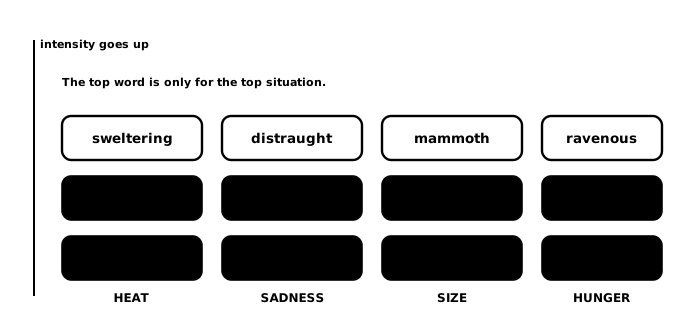
Adjectives climb a ladder. The mistake happens when we take the top word and stick it on a bottom-rung situation. Look closely at the picture below — this is what stops overcorrection.
45.3 The big swap table
The third column is again the most important. Remembering the word is easy; remembering where it belongs is the real skill.
| very + … | One word | When it is fine, when it is not |
|---|---|---|
| very upset | distraught | Only for deep shock. For small disappointment it sounds like a joke. |
| very hot (weather) | sweltering | For heat and places. Never for food or tea. |
| very rude | boorish | Strong in writing and complaints. In speech obnoxious is natural. |
| very big (a job) | mammoth | Task, project, effort. For a room or a book use large. |
| very hungry | ravenous | Also works in casual talk, even as a joke. |
| very tired | exhausted | Safe everywhere — office, doctor, friends. |
| very cold | freezing | Very common and perfectly natural. The first choice in daily life. |
| very happy | thrilled | For good news. Good in email too: "I'm thrilled to…" |
| very scared | terrified | Works everywhere. Petrified is even stronger. |
| very surprised | astonished | A little formal. In casual talk stunned. |
| very dirty | filthy | Everyday. Clothes, a room, hands — all fine. |
| very tasty | delicious | Everywhere. Mouth-watering is for before you taste it. |
| very boring | tedious | For work and processes. For a film use dull. |
| very important | crucial | Strong and clear in both office talk and writing. |
| very interested | keen | Gold in interviews: "I'm keen to learn." |
| very expensive | exorbitant | In complaints or reports. In casual talk pricey. |
| very poor (quality) | shoddy | For work and goods. Not for people. |
| very busy (a place) | bustling | Market, station, city. For a person use swamped. |
45.4 Fourteen more one-word swaps
This list is in two parts. You can use the first group from today. The second group is bookish or rare — recognise them when reading, use them occasionally in writing, but be careful in speech. Press 🔊 on every line.
Useful every day
| very + … → one word | Example | Meaning | When to use it |
|---|---|---|---|
| very wet → drenched | We got drenched walking back from the station. | Completely wet, wet enough to wring out. | Everywhere, very natural. Soaked is similar. |
| very angry → incensed | Residents were incensed by the sudden fare hike. | Anger that flares up over something unfair. | Strong in news and writing. In speech furious is more common. |
| very happy → jubilant | The jubilant crowd danced outside the stadium. | Joy that bursts out after a win or a success. | For crowds, teams, celebrations. For quiet happiness on your own use delighted. |
| very scared → terror-stricken | The terror-stricken passengers ran for the exits. | Frozen and numb with terror. | Very heavy — an accident, a fire, an attack. In speech terrified is enough. |
| very friendly → affable | Our new manager is affable and easy to talk to. | Pleasant and easy to talk to. | In praise — a reference letter, a review. A little formal; for a friend say really friendly. |
| very empty → desolate | After midnight the highway looked desolate. | Deserted and bleak — empty and sad. | For places (a road, a village, a field). It carries sadness — an empty box is not desolate. |
| elegant → sophisticated | She has a sophisticated taste in music. | Refined and worldly; or (of a machine) very advanced. | Safe everywhere. Elegant = graceful simplicity; sophisticated = knowledge and refinement. |
| talented → consummate | He is a consummate professional — always prepared. | Completely skilled at what you do, an expert. | Only before a noun: a consummate professional / musician. People do not say "He is consummate" on its own. |
Bookish or rare — recognise them, use with care
| very + … → one word | Example | Meaning | When to use it |
|---|---|---|---|
| very tired → enervated | The long heatwave left everyone enervated. | With the strength drained out of you, weakened. | Literary and rare. Don't be fooled — it does not mean energized, it means the opposite. In speech say drained. |
| very wise → sagacious | Her sagacious advice saved the company. | Far-sighted, with deep understanding. | Very bookish — it would sound odd in speech. Wise or shrewd is more natural. |
| very rich → opulent | They stayed in an opulent palace hotel in Udaipur. | Royal, full of wealth and grandeur. | For things and lifestyles (a hotel, a wedding, an interior). For a person use wealthy or affluent. |
| very funny → jocular | He kept the meeting light with his jocular remarks. | Joking, in a light-hearted way. | Formal/literary — for a person or a tone. If a joke or a film is very funny, say hilarious. |
| very confused → nonplussed | I was nonplussed when he suddenly resigned. | So surprised and puzzled that you don't know what to say. | True meaning: confused, stumped. But in American speech people also use it to mean "unbothered", the opposite — so it can cause misunderstanding. To be clear, say baffled. |
| very noisy → cacophonous | The cacophonous traffic made it hard to think. | Harsh, ear-splitting, tuneless noise. | A writing word, rare in speech. In daily life say deafening or really loud. |
Three traps in this list
enervated ≠ energized — it means drained of energy, not full of it · opulent is for things; a person is wealthy / affluent · jocular describes a person's manner — a joke is hilarious. Using a rare word with the wrong meaning sounds much worse than using a simple word.
45.5 Three rules that save you
a) Never 'very' + the strongest word
Exhausted, freezing, terrified, delicious — these are already at the top. Putting "very" in front is like saying "completely completely".
✗ very exhausted · ✓ utterly exhausted or just exhausted. If you must add force, use 'absolutely', 'utterly', 'completely'.
b) Words for people and for things are different
A place is bustling, a person is swamped. Work is shoddy, a person is careless. Before you pick a word, check what it is used for.
c) One strong word per sentence
✗ It was a sweltering, mammoth, tedious day. — three strong words together, and the effect is zero.
✓ It was a sweltering day, and the work was tedious.
45.6 The mistakes people really make
Pay attention
- Wrong: The tea was sweltering, I burnt my tongue.
- Right: The tea was scalding, I burnt my tongue.
-
Why: Sweltering is only for weather and places. For a hot liquid that burns, use scalding.
-
Wrong: I was distraught because the shop was closed.
- Right: I was annoyed because the shop was closed.
-
Why: Distraught is for deep shock. Using it for a small matter makes you sound over-dramatic.
-
Wrong: He is a very exhausted man today.
- Right: He is exhausted today.
-
Why: Exhausted is already at the top — "very" is useless. For more force say "utterly exhausted".
-
Wrong: The market was very swamped on Sunday.
- Right: The market was bustling on Sunday.
-
Why: A person is swamped (buried in work), a place is bustling (full of crowds).
-
Wrong: My room is mammoth dirty.
- Right: My room is filthy.
-
Why: Mammoth is not an adverb — it cannot take the place of "very". For dirt there is one word: filthy.
-
Wrong: She was very keen interested in the role.
- Right: She was keen to take on the role.
- Why: Keen itself means "very interested" — the two do not go together.
45.7 One paragraph, two versions
Before — five 'very'
It was a very hot day. The road was very dirty, the auto driver was very rude, and by the time I reached the office I was very tired. The meeting was very boring, but the news at the end made me very happy.
After — not a single 'very'
It was a sweltering day. The road was filthy, the auto driver was obnoxious, and by the time I reached the office I was exhausted. The meeting was tedious, but the news at the end left me thrilled.
45.8 Practice — Precise adjectives
Exercise 1
Mumbai in May — sticky, suffocating heat. Which word?
- sweltering
- scalding
- piping hot
- warm
Hint: A special word for weather.
Answer
sweltering
Sweltering = sticky, heavy heat, only for weather and places. Scalding is for hot liquid.
Exercise 2
Which sentence is wrong?
- I was distraught because my pen stopped working.
- She was distraught after the accident.
- He was distraught when his dog went missing.
- They were distraught at the news.
Answer
I was distraught because my pen stopped working.
Distraught is for deep shock. Saying it about a pen that stopped working is over-dramatic — 'annoyed' is right there.
Exercise 3
Moving the whole office in a single weekend — what kind of job was it?
- a mammoth task
- a colossal task
- a hefty task
- a vast task
Answer
a mammoth task
Mammoth is for jobs and scale. Colossal is for things that look huge, hefty for a heavy bill or fine, vast for a field that stretches far.
Exercise 4
Why is 'very exhausted' wrong?
- Exhausted is already the strongest word
- Exhausted is not an adjective
- Exhausted is only used in writing
- -ed words cannot follow 'very'
Hint: How strong is the word already?
Answer
Exhausted is already the strongest word
A word that is already 'at the top' does not need 'very' in front of it. For more force add 'utterly' or 'absolutely'.
Exercise 5
We skipped lunch, so by eight we were ___.
Hint: One word for very hungry.
Answer
ravenous / starving
Ravenous = desperate with hunger. Though heavy, it works in casual talk too.
Exercise 6
The Sunday market was ___ with shoppers.
Hint: A word for places, not for people.
Answer
bustling
A place is bustling (full of crowds), a person is swamped (buried in work).
Exercise 7
One word is in the wrong place — find it.
Careful, the soup is sweltering hot.
Answer
Wrong word: sweltering.
Corrected: Careful, the soup is scalding hot.
Sweltering is only for weather and places. For hot food or drink that burns, use scalding.
Exercise 8
One word is useless — tap it.
I am very freezing in this room.
Answer
Wrong word: very.
Corrected: I am freezing in this room.
Freezing is already at the top, so 'very' is not needed.
Exercise 9
Match each quality with its strongest word.
| A | B |
|---|---|
| very hungry | distraught |
| very rude | mammoth |
| very upset | ravenous |
| very big a task | boorish |
Answer
very hungry — ravenous; very rude — boorish; very upset — distraught; very big a task — mammoth
Remember: these are all top-of-the-ladder words — don't use them for small matters.
Exercise 10
Match each word with its right use.
| A | B |
|---|---|
| bustling | work — poor quality |
| swamped | a price — extremely high |
| shoddy | a place — full of crowds |
| exorbitant | a person — buried in work |
Answer
bustling — a place — full of crowds; swamped — a person — buried in work; shoddy — work — poor quality; exorbitant — a price — extremely high
Each strong adjective goes with one kind of thing. Using it on the wrong thing makes the sentence sound odd.
Exercise 11
Build the sentence without 'very'.
Words: tedious / the / was / sweltering / and / meeting / day / a / was / It
Answer
It was a sweltering day and the meeting was tedious
One strong word per sentence, each in its place. Stuffing in three strong words together kills the effect.
Exercise 12
You had no umbrella in the rain — wet enough to wring out your clothes. Which word?
- drenched
- desolate
- opulent
- affable
Answer
drenched
Drenched = completely wet. It is an everyday, perfectly natural word — it works in any setting.
Exercise 13
'The heat left us enervated.' What does this mean?
- The heat drained all our strength
- The heat filled us with energy
- The heat made us angry
- The heat made us scared
Hint: The word looks like 'energy', but it is a trap.
Answer
The heat drained all our strength
Enervated = weakened, with no strength left. It is the opposite of 'energized' — and it is a bookish word; in speech 'drained' is better.
Exercise 14
This word is for things or lifestyles, not for people — find it.
My uncle is an opulent businessman from Surat.
Answer
Wrong word: opulent.
Corrected: My uncle is a wealthy businessman from Surat.
Opulent is for a hotel, a wedding, a palace. A rich person is wealthy or affluent.
Exercise 15
When India won the final, the crowd outside was ___.
Hint: very happy — celebration joy, one word.
Answer
jubilant / ecstatic / elated / overjoyed
Jubilant = joy that bursts out after a win, especially for a crowd or a team.
Exercise 16
Match each very + adjective with its one-word form.
| A | B |
|---|---|
| very angry | sagacious |
| very friendly | cacophonous |
| very wise | incensed |
| very noisy | affable |
Answer
very angry — incensed; very friendly — affable; very wise — sagacious; very noisy — cacophonous
Incensed and affable are comfortable in writing. Sagacious and cacophonous are rare — recognise them, speak them less.
Exercise 17
Say this line. Stress the first part of 'ravenous' — RA-ve-nus.
We skipped lunch so by eight we were ravenous
Answer
Say: We skipped lunch so by eight we were ravenous
It has three parts, but only the first takes stress. The word is not hard to say — it only needs a little practice.
What to do next
A one-week challenge: whenever you are about to say "very", pause for a moment and think — what single word could replace it? If no answer comes, go ahead and say "very"; no harm done. But that one-moment pause is what grows your vocabulary.