Chapter 49: Sentences & paragraphs
From sentence to paragraph — one idea, said clearly
Your grammar is right, your spelling is right, and yet your writing is often tiring to read. The reason is usually the same: the sentences are either very short and jerky, or one long train that keeps running on "and… and… so…". In this chapter we will learn how to join sentences, and how to arrange them into a paragraph that the reader understands the first time.
- 1From choppy bits to flowing sentences
- 2The paragraph burger — topic, support, closing
- 3The topic sentence — the whole point in the first line
- 4One paragraph, one idea
- 5Linking words — however, therefore, for example
- 6Before and after — fixing a weak paragraph
- 7The mistakes we really make
In one line
A paragraph is a group of sentences about one idea: the first sentence states it, the middle sentences support it, and the last sentence closes it. One paragraph = one idea. The first line announces it, the middle lines give proof, and the last line wraps it up.
49.1 From choppy bits to flowing sentences
Very short sentences sound like a robot; in a very long sentence the reader keeps looking for a place to breathe. Good writing sits between the two.
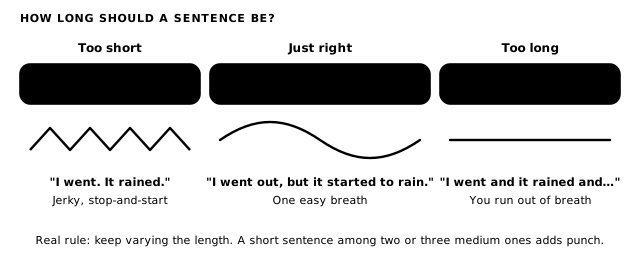
Join or split
Two short sentences are about the same thing → join them (and, but, because, when, which). A sentence has grown longer than 25 words, or has two "and"s → split it and add a full stop.
- ✗ I reached the station. The train was late. I waited. I had tea. Four pieces — all correct, but jerky to read.
- ✓ When I reached the station, the train was late, so I waited and had a cup of tea. when + so joined all four pieces into one flowing sentence.
- ✓ The new manager, who joined last week, has already cut our meeting time in half. "The manager joined last week" is tucked inside the main sentence with who.
49.2 The paragraph burger — topic, support, closing
Every good paragraph has the same shape, whether it is a college essay or an office report. Think of it as a burger: a bun on top and bottom, and plenty of filling in between.
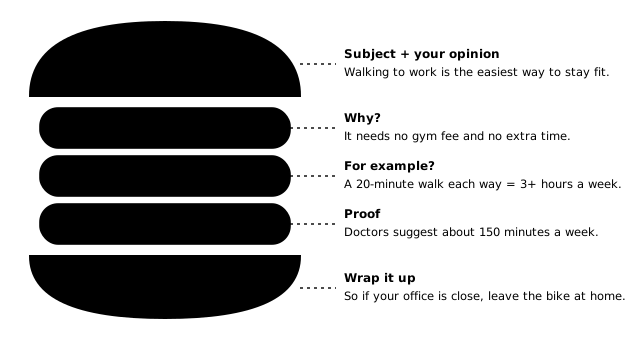
The burger formula
1 topic sentence (the subject + your opinion) → 2–4 support sentences (reason, example, number) → 1 closing sentence (wrap up the point or give the next step). Office email or essay — this is the structure.
Model: one complete paragraph
Walking to work is the easiest way to stay fit. Topic sentence — the subject (walking) + the opinion (easiest way to stay fit).
It needs no gym fee and no extra time, because you are travelling anyway. For example, a twenty-minute walk each way adds up to more than three hours a week. That is more than the 150 minutes of activity that doctors usually suggest. Three supports — a reason (because), an example (for example), proof (150 minutes).
So if your office is close, leave the bike at home. Closing — it gives the reader something to do.
49.3 The topic sentence — the whole point in the first line
Managers, teachers and examiners all read in a hurry, and often only the first line of every paragraph. If the first line says nothing, the rest of the paragraph does not get read either.
The test for a good topic sentence
A topic sentence has two things: the subject + your opinion or point about it. "Online classes" is only a subject; "Online classes save time but make it harder to ask questions" is a complete topic sentence.
| Weak opening | Strong topic sentence |
|---|---|
| In this paragraph I will tell about my city. | Pune is a city where old wadas and new IT parks stand side by side. |
| As we all know, technology is very important. | UPI has made it possible for a street vendor to accept payment from anyone. |
| Exercise is a thing which is good. | Even ten minutes of exercise a day can lift your mood. |
| I want to say something about our project. | Our project is two weeks behind because the vendor delivered late. |
| Since ancient times, man has used water. | Most Indian cities lose a large share of their water to leaking pipes. |
- Our project is two weeks behind because the vendor delivered late. The very first line says what happened (two weeks behind) and why (vendor late) — so the manager has a reason to keep reading.
49.4 One paragraph, one idea
When two or three different points get into one paragraph, the reader forgets what it began with. Hold every line up against the topic sentence.
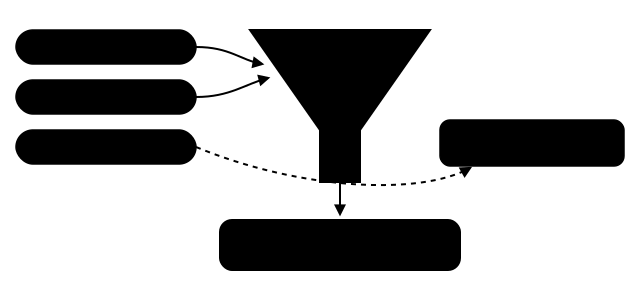
One question for every line
"Does this line support the topic sentence?" Yes → keep it. No → either delete it or start a new paragraph. Also start a new paragraph when the time, the place or the speaker changes, or when the opposite argument begins.
49.5 Linking words — however, therefore, for example
Linking words are like road signs: they tell the reader in advance which way the next line will turn — another point, the opposite point, a result, or an example.
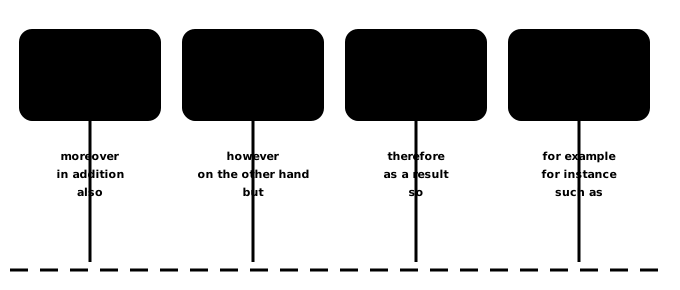
Using linking words correctly
First identify the job (adding, contrast, result, example), then choose the word. If it comes at the start of a sentence, put a comma after it: "However, the cost is high." Don't use one in every line — two or three per paragraph are enough.
| Job | Words | Example |
|---|---|---|
| Add a point | moreover, in addition, also | The flat is cheap. Moreover, it is near the metro. |
| Contrast | however, on the other hand | The flat is cheap. However, it has no lift. |
| Result | therefore, as a result | The road was closed. As a result, we were late. |
| Example | for example, for instance | Some apps save time. For example, UPI. |
| Order | first, then, finally | First, fill the form. Then, pay the fee. |
| Reason | because, since, due to + noun | We stayed in because it rained. · due to the rain |
| Summary | in short, overall | Overall, the trip was worth it. |
- The flat is cheap. However, it is on the fifth floor and has no lift. Pause slightly after However — the listener understands that a drawback is coming.
49.6 Before and after — fixing a weak paragraph
Now let's put everything together. Below is a paragraph like a real college student's — the grammar mistakes are few, but there is no structure. See how the same content becomes clear.
Before — the weak paragraph
Library is important. Our library closes at 5 pm. Many students are working in day time. And they come in evening and library is closed and they go back and they cannot study. Also canteen food is very bad. So library should open late.
After — the improved paragraph
Our college library should stay open until 9 pm. At present it closes at 5 pm, which is exactly when many students finish their part-time jobs. For example, in my class of sixty, at least fifteen students work during the day and can study only in the evening. As a result, they either crowd into small rented rooms or do not study at all. Keeping the library open for four more hours would cost little, but it would give these students a fair chance.
- A topic sentence has arrived "Library is important" is replaced by a clear demand: open until 9 pm.
- The "and… and… and…" train is broken up One long sentence became three clear ones, with the help of which and either… or.
- Proof and numbers added "Many students" became "fifteen out of sixty" — now the point has weight.
- The canteen line was removed It was a different idea — it will get its own paragraph.
- Linking words and a closing sentence For example and As a result joined the lines; the last line wrapped up the point.
49.7 The mistakes we really make
These mistakes show up rarely in grammar books, but you meet them every day in emails, reports and exam answers — often because we carry the Hindi sentence pattern straight into English.
Real mistakes in paragraphs and joining sentences
- Wrong: I reached the office at nine, my manager was not there, I waited for one hour.
- Right: I reached the office at nine, but my manager was not there. I waited for an hour.
-
Why: Three complete sentences cannot be joined by commas alone. Bring in a joining word (but) or use a full stop.
-
Wrong: Although it was raining, but we went out.
- Right: Although it was raining, we went out.
-
Why: In Hindi you use both "haalaanki… lekin"; in English "but" does not go with although. Keep only one.
-
Wrong: Due to I was ill, I could not submit the assignment.
- Right: Because I was ill, I could not submit the assignment.
-
Why: "Due to" is followed by a noun (due to my illness). When a full clause (I was ill) follows, use "because".
-
Wrong: The hotel was clean. Moreover, it was very expensive.
- Right: The hotel was clean. However, it was very expensive.
-
Why: Moreover adds one more point in the same direction. A drawback after a good point is a contrast — however.
-
Wrong: In this paragraph I am going to tell about my city. As we all know, Pune is a nice city.
- Right: Pune is a city where old wadas and new IT parks stand side by side.
- Why: Don't talk about the paragraph — just talk about the subject. "As we all know" adds nothing either; delete it.
Linking words are like salt
If you start every sentence with "Moreover…", "Furthermore…" or "Also…", your writing will feel heavy and artificial. Most sentences do not need a linking word at all — the right order joins them by itself.
49.8 Practice — Paragraphs
Exercise 1
Which is the best topic sentence for a paragraph on the benefits of cycling?
- In this paragraph I will tell about cycling.
- Cycling to work saves money, keeps you fit and cuts traffic.
- Cycling is a thing.
- As we all know, cycling is very very good.
Answer
Cycling to work saves money, keeps you fit and cuts traffic.
A good topic sentence gives both the subject and the opinion, and it hints at the three supporting points to come. 'In this paragraph I will tell' says nothing.
Exercise 2
It rained heavily all night. ___, the match was cancelled.
- As a result
- However
- For example
- Moreover
Answer
As a result
The rain is the cause and the cancelled match is the result — so 'As a result' (or Therefore).
Exercise 3
The flat is quite small. ___, it is only ten minutes from my office.
- However
- Therefore
- For example
- As a result
Answer
However
The first line gives a drawback and the second a benefit — for a contrast, use 'However'.
Exercise 4
In a paragraph about saving water at home, which line does NOT fit?
- Fix leaking taps as soon as you notice them.
- Use a bucket instead of a hose to wash the car.
- Our society also needs a new gym.
- Turn off the tap while brushing your teeth.
Answer
Our society also needs a new gym.
The gym is a different idea. One paragraph = one idea — the other three lines all support saving water.
Exercise 5
The ___ sentence tells the reader what the whole paragraph is about.
Answer
topic
The topic sentence is the first line of the paragraph — the whole point in a single sentence.
Exercise 6
A good paragraph talks about only one main ___.
Answer
idea / point
One paragraph, one idea. When a new idea comes, start a new paragraph — that way the reader does not lose the way.
Exercise 7
Many students work during the day. ___ example, fifteen students in my class have part-time jobs.
Answer
For
'For example' brings in an example, and at the start of a sentence it is followed by a comma.
Exercise 8
One word in this sentence is unnecessary — tap it.
Although the train was late, but we reached the meeting on time.
Answer
Wrong word: but.
Corrected: Although the train was late, we reached the meeting on time.
In Hindi you use both 'haalaanki… lekin', but not in English. 'But' never goes with 'Although' — keep only one.
Exercise 9
Find the wrong word.
Due to I was unwell, I missed the class.
Answer
Wrong word: Due.
Corrected: Because I was unwell, I missed the class.
'Due to' is followed by a noun (due to my illness). When a full clause (I was unwell) follows, use 'Because'.
Exercise 10
Match each linking word to its job.
| A | B |
|---|---|
| however | example |
| therefore | adding another point |
| for example | the last point |
| moreover | contrast |
| finally | result |
Answer
however — contrast; therefore — result; for example — example; moreover — adding another point; finally — the last point
however = contrast, therefore = result, for example = example, moreover = addition, finally = the end of a sequence.
Exercise 11
Put the words in the right order to make a sentence.
Words: saves / money. / time / new / plan / and / the / However, / both
Answer
However, the new plan saves both time and money.
When 'However' starts a sentence, a comma follows it. Then comes the plain subject + verb + object.
Exercise 12
Say this line — pause briefly after 'As a result'.
As a result, the project was finished on time.
Answer
Say: As a result, the project was finished on time.
A comma after a linking word means a short pause when speaking. The listener can tell that a result is coming.
What to do next
Open your last long email or assignment. Read only the first line of each paragraph — do they give you the whole story? If not, rewrite those first lines. This one habit will change your writing.