Chapter 53: Essays & reports
Essays and reports — intro, body, conclusion, IELTS style too
At school we memorised essays — starting with "Since ancient times, man has…", three pages long. The essay in the real world is the opposite: short, clear, and with one opinion. This chapter gives you the whole structure — the thesis, the PEEL paragraph, three kinds of essay, linking words for essays, a formal voice, a straightforward introduction to IELTS Writing Task 2, an annotated model essay, and the format of an office report.
- 1The map of an essay — intro, body, conclusion
- 2The thesis statement — one line for the whole essay
- 3PEEL — the formula for a body paragraph
- 4Three kinds of essay — spot the question type
- 5Linking words — by function
- 6Formal register — the voice of an essay
- 7IELTS Writing Task 2 — at a glance
- 8A model essay — understand it piece by piece
- 9Reports — headings, findings, recommendations
53.1 The map of an essay — intro, body, conclusion
Every essay has three parts. The intro starts with the big topic and moves towards your opinion (the thesis). Two or three body paragraphs give evidence for that opinion. The conclusion restates the opinion and thinks a little bigger.
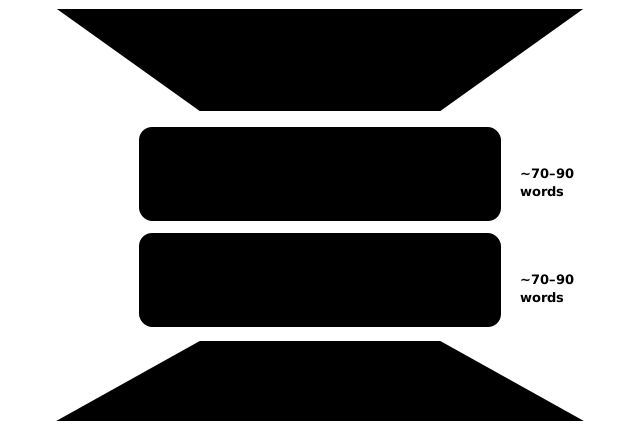
The four-paragraph essay
Intro (2–3 lines) → Body 1 → Body 2 → Conclusion (2–3 lines). This is enough for an essay of 250–300 words. Every body paragraph = one main idea. For the basics of a paragraph (topic sentence, one idea), see From sentence to paragraph.
53.2 The thesis statement — one line for the whole essay
The thesis is the last line of the intro. It tells the reader what you think and what you will prove. A weak thesis just repeats the topic; a strong thesis takes a clear position — and often gives the reason too.
| Weak | Strong |
|---|---|
| This essay will discuss online classes. | Online classes are a useful addition to school, but they cannot replace a real teacher. |
| Pollution is a big problem. | The most effective way to cut urban pollution is to make public transport faster, not just cheaper. |
| There are many advantages and disadvantages. | Although working from home saves time, its effect on teamwork outweighs that benefit. |
- While technology has made learning easier, it cannot replace a good teacher. Use "While…" to accept the other side, then give your own opinion — balance in one line.
- I firmly believe that cities should invest more in cycling lanes than in flyovers. In an opinion essay, "I believe" is perfectly fine.
✗
Since ancient times, education has been a burning question in today's modern world.
✓
In many Indian cities, students now spend more time on coaching than in school.
real and current
53.3 PEEL — the formula for a body paragraph
Every body paragraph moves in four steps. Once you remember this formula, the "what do I write?" problem is gone.
| Step | Job | Words to begin with |
|---|---|---|
| Point | The one main idea of the paragraph | Firstly, … · One major advantage is … |
| Explain | Why? How? | This is because … · This means that … |
| Evidence | Example, data, experience | For instance, … · A recent survey found … |
| Link | Tie it back to the thesis | Therefore, … · This shows that … |
One PEEL paragraph — spot the pieces
- [P] One major benefit of online classes is flexibility. Point — one idea, stated clearly.
- [E] Students can watch lessons at any time, which helps those who work part-time or live far from a college. Explain — how this is a benefit.
- [E] For instance, a student in a small town can now attend lectures from a university in Delhi without moving there. Evidence — one solid example.
- [L] This shows that online learning can widen access to higher education. Link — connect it back to the thesis.
PEEL in one line
What (Point) → why (Explain) → proof (Evidence) → so what (Link). A paragraph without evidence is just an opinion. No data in the exam? One realistic example is enough — "For instance, in my city…".
53.4 Three kinds of essay — spot the question type
Before you write, identify the type of question. If you answer the wrong type, you lose marks even with good English. The type is hidden in the last line of the question.
| Type | What the question looks like | Structure |
|---|---|---|
| Opinion | To what extent do you agree or disagree? | Opinion in the intro → 2 reasons → opinion again |
| Discussion | Discuss both views and give your opinion. | View A → View B → your opinion (in the intro and conclusion) |
| Problem–solution | What are the causes? What can be done? | Causes / problem → solution |
| Advantages–disadvantages | Do the advantages outweigh the disadvantages? | Advantages → disadvantages → which is heavier |
- Some people think that all university education should be free. To what extent do you agree? Opinion — a clear yes, no or partly, and why.
- Some believe children should start school at four, while others think seven is better. Discuss both views. Discussion — both sides, then your opinion.
- Many young people in cities feel lonely. Why is this, and what can be done about it? Problem–solution — both the causes and the solutions.
Answer every part of the question
In "Discuss both views and give your opinion", you must give your opinion. In "Why is this, and what can be done?", you must answer both questions. Miss one part = a direct loss in Task Response.
53.5 Linking words — by function
In From sentence to paragraph we saw however, therefore, for example. An essay needs a few more — especially for accepting a point and then pushing back (concession) and for reporting other people's opinions. Each word has its own grammar, and that is the most important thing.
| Function | Words | Grammar |
|---|---|---|
| Accept, then push back | although, while, whereas | + a full clause |
| Accept, then push back | despite, in spite of | + noun / -ing |
| Other people's opinions | It could be argued that…, Critics claim that… | + clause |
| Result | consequently, as a result, thus | start of the sentence + comma |
| Emphasis | in particular, indeed, above all | anywhere in the sentence |
| Ending | In conclusion, On balance, Overall | first line of the conclusion |
- Although metro fares are high, the service saves commuters a great deal of time. although + clause (subject + verb).
- Despite the high fares, many people prefer the metro. despite + noun. (Not "despite of"!)
- It could be argued that exams measure memory rather than understanding. Presents the other opinion politely — useful in a discussion essay.
- Fuel prices rose sharply. Consequently, more people switched to electric scooters. consequently = as a result of this (a little more formal than therefore).
- On balance, the benefits of the scheme outweigh its costs. On balance = after weighing everything up — a good way to begin a conclusion.
✗
Although the metro is expensive, but it is fast.
✓
Although the metro is expensive, it is fast. / The metro is expensive, but it is fast.
although
but
✗
Despite of the rain, the match continued.
✓
Despite the rain… / In spite of the rain…
despite
in spite of
53.6 Formal register — the voice of an essay
In an essay you are not talking to a friend. No contractions (don't → do not), no slang, and slightly more formal words in place of short spoken ones. But remember: formal does not mean heavy, it means clear.
| Spoken | In an essay |
|---|---|
| a lot of / lots of | many, a large number of, a great deal of |
| kids | children, young people |
| get better | improve |
| go up / go down | rise / fall, increase / decrease |
| things | factors, issues, aspects |
| really bad | serious, harmful |
| I think | I believe, In my view (in an opinion essay) |
- A large number of young people now rely on social media for news. The formal version of "Lots of kids get news from Insta".
- Air quality tends to improve when private vehicles are restricted. "tends to" — not every time, but often. Hedging sounds good in an essay.
- This issue is becoming increasingly serious in smaller cities as well. "increasingly serious" instead of "really bad".
- Several factors contribute to this problem, the most important being cost. "several factors" instead of "many things".
Hedge — don't put 'always' on everything
tend to, can, may, often, in many cases — these words make your point honest and stronger. Better than "Social media always destroys students": "Social media can distract many students."
✗
In my opinion, I think that it doesn't work.
✓
In my view, this approach does not work.
53.7 IELTS Writing Task 2 — at a glance
IELTS Writing has two tasks. Task 2 is an essay — almost the same in Academic and General Training. It carries more weight than Task 1, so spend more time on it. (For full details of the exam format, see IELTS, TOEFL and your level.)
How the band is awarded — four criteria in plain language
| Criterion | In plain language |
|---|---|
| Task Response | Did you answer every part of the question? Is your opinion clear? Did you explain your ideas and give examples? |
| Coherence & Cohesion | Is the order of paragraphs sensible? One paragraph = one idea? Are the linking words correct and used only as much as needed? |
| Lexical Resource | Do you use a range of words and correct word pairs (collocations)? Is the spelling right? |
| Grammatical Range & Accuracy | A mix of short and long sentences? Few mistakes? |
The fixed rules of IELTS Task 2
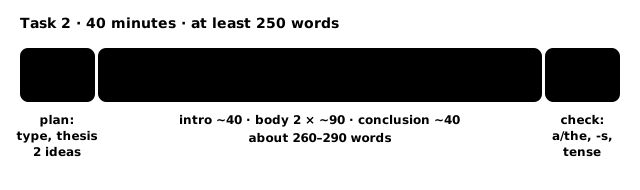
40 minutes, at least 250 words, all four criteria carry equal weight. Fewer than 250 = a penalty. Memorised lines and copying words from the question = a loss. Exam rules can change — always check the current details on the official IELTS website.
53.8 A model essay — understand it piece by piece
Below is an opinion essay (about 270 words). Under each paragraph there is a note on what it is doing. First listen with 🔊, then read.
Question
- Some people believe that public transport in cities should be free for everyone. To what extent do you agree or disagree? Type: opinion ("To what extent…"). You must give a clear opinion.
Introduction
- In many Indian cities, roads are choked with private vehicles, while buses and metro trains often run below capacity. Some argue that the best solution is to make public transport free for all. While this idea has clear benefits, I believe that free travel should be offered only to those who need it most, rather than to everyone. Line 1: background (something real and current). Line 2: the question in your own words (paraphrase). Line 3: the thesis — "While… I believe…" — a balanced but clear opinion.
Body 1 — accept the other side
- Admittedly, free public transport could significantly reduce traffic and pollution. If travel cost nothing, many commuters would leave their cars and motorbikes at home, which would mean cleaner air and shorter journeys. It would also help families on low incomes, who often spend a significant part of their earnings on daily travel. For example, Luxembourg made all public transport free in 2020, partly to tackle congestion. This suggests that, in principle, removing fares is a serious option for crowded cities. P: Admittedly… reduce traffic (the concession). E: If travel cost nothing… (second conditional). E: the Luxembourg example. L: This suggests that…
Body 2 — the reason for your own opinion
- However, offering free travel to everyone would be extremely expensive. Ticket sales pay for a large share of maintenance and new routes, so governments would have to raise taxes or cut services. In a country with limited public funds, this money might be better spent on schools or hospitals. As a result, buses might become older and more crowded, which would discourage the very people the policy aims to attract. It would therefore be more sensible to target support at students, senior citizens and low-income workers. P: However… expensive. E: where the ticket money goes. E: the result — older, more crowded buses. L: It would therefore… — back to the thesis.
Conclusion
- In conclusion, although free public transport for all is an attractive idea, its cost would be difficult to sustain. On balance, I believe that free or discounted passes for those in need, combined with more frequent and reliable services, would achieve the same goals far more effectively. The opinion again, in new words. No new reasons — just a summary and a way forward.
What to borrow from the model
Borrow the structure, not the lines: background → paraphrase → thesis, accept → push back, and the "On balance" ending. Examiners recognise memorised lines — and give no marks for them. Words copied from the question are also not counted in the word count.
53.9 Reports — headings, findings, recommendations
An essay gives an opinion; a report gives information and suggestions. You have to write reports at the office, in college projects and in some exams (such as Cambridge B2 First). A report is recognised by its headings, short paragraphs, and clear recommendations at the end.
| Heading | What goes in it | Ready-made openings |
|---|---|---|
| Title | What the report is about | Report on the staff canteen |
| Introduction | Purpose and method | The purpose of this report is to… |
| Findings | What was found (data) | It was found that… · The majority of… |
| Conclusion | A one-line summary | Overall, … |
| Recommendations | What should be done | It is recommended that… · The company should… |
Mini report — staff canteen
- Introduction. The purpose of this report is to assess staff satisfaction with the office canteen. It is based on an online survey of 120 employees conducted in March. The purpose + where the data came from.
- Findings. The majority of respondents, 68 per cent, said the food was good value. However, nearly half complained about long queues between one and two pm. Only a few mentioned hygiene. Words for numbers: the majority of, nearly half, only a few. No opinions — only facts.
- Recommendations. It is recommended that lunch be served in two shifts and that a pre-order option be added to the office app. "It is recommended that + subject + base verb (be served)" — formal. A simpler version: "The company should serve lunch in two shifts."
Ready-made report lines
- This report is based on interviews with twenty shop owners. Where the data came from — in the Introduction.
- A significant number of respondents said they would pay more for faster delivery. respondents = the people who answered the survey.
- Only a small minority were unhappy with the timings. the majority ↔ a small minority — numbers put into words.
- The management should consider extending the opening hours. The simple form of a recommendation — should + consider + -ing.
How to recognise a report
Headings + facts + suggestions. No opinions in Findings; in Recommendations use "should" or "It is recommended that…". Essay = "I believe…"; report = "It was found that…".
✗
I think the canteen is very bad and people are very angry.
✓
Nearly half of the respondents complained about long queues at lunchtime.
53.10 Practice — Essays and reports
Exercise 1
Where does the thesis statement go in an essay?
- The last line of the intro
- The last line of the conclusion
- The first line of Body 1
- In the title
Answer
The last line of the intro
The intro starts with background and ends with the thesis.
Exercise 2
Match each letter of PEEL to its job.
| A | B |
|---|---|
| Point | an example or data |
| Explain | tying it back to the thesis |
| Evidence | the main idea of the paragraph |
| Link | why and how |
Answer
Point — the main idea of the paragraph; Explain — why and how; Evidence — an example or data; Link — tying it back to the thesis
What → why → proof → so what.
Exercise 3
'Discuss both views and give your opinion.' — which type is this?
- Discussion
- Opinion
- Problem–solution
- Report
Answer
Discussion
Both views + your own opinion = a discussion essay.
Exercise 4
One word must be removed — which one?
Although the metro is expensive, but it is very fast.
Answer
Wrong word: but.
Corrected: Although the metro is expensive, it is very fast.
although and but cannot be used together — choose one.
Exercise 5
___ the heavy rain, the match continued. (not although)
Hint: A concession word that comes before a noun — without 'of'.
Answer
Despite / despite / In spite of / in spite of
despite / in spite of + noun. 'Despite of' is wrong.
Exercise 6
Find the wrong word.
Despite of the cost, many families buy smartphones.
Answer
Wrong word: of.
Corrected: Despite the cost, many families buy smartphones.
'of' does not come after despite.
Exercise 7
What is the best essay version of 'lots of kids'?
- a large number of children
- plenty kids
- a lot of kiddos
- many many kids
Answer
a large number of children
Formal register: kids → children, lots of → a large number of.
Exercise 8
What is the minimum number of words in IELTS Writing Task 2?
- 250
- 150
- 200
- 350
Answer
250
Task 2: at least 250 words, about 40 minutes. (Task 1: 150 words.)
Exercise 9
What does IELTS 'Coherence and Cohesion' check?
- Paragraph order and linking
- Spelling and vocabulary
- Whether you answered the question
- Accent
Answer
Paragraph order and linking
Coherence = order and clarity; cohesion = linking words and connection.
Exercise 10
The purpose of this ___ is to assess staff satisfaction with the canteen.
Hint: The document with headings, findings and recommendations.
Answer
report
'The purpose of this report is to…' — the standard opening of a report.
Exercise 11
What do you write in the Findings section of a report?
- What the survey found
- Your own feelings
- What should be done
- The question again
Answer
What the survey found
Findings = facts. What should be done = Recommendations.
Exercise 12
Which part of an essay is this?
Read this aloud or have someone read it to you:
In conclusion, although free public transport is an attractive idea, its cost would be difficult to sustain. On balance, targeted support would work better.
- Conclusion
- Introduction
- Body paragraph
- Title
Answer
Conclusion
Transcript: “In conclusion, although free public transport is an attractive idea, its cost would be difficult to sustain. On balance, targeted support would work better.”
'In conclusion… On balance…' — the opinion again, no new point.
Exercise 13
According to this report, how many people think the food is good value?
Read this aloud or have someone read it to you:
The majority of respondents, sixty-eight per cent, said the food was good value. However, nearly half complained about long queues at lunchtime.
- 68 per cent
- Nearly half
- A few
- All of them
Answer
68 per cent
Transcript: “The majority of respondents, sixty-eight per cent, said the food was good value. However, nearly half complained about long queues at lunchtime.”
'The majority of respondents, sixty-eight per cent' — 68%.
Exercise 14
What was people's biggest complaint?
Read this aloud or have someone read it to you:
The majority of respondents, sixty-eight per cent, said the food was good value. However, nearly half complained about long queues at lunchtime.
- Long queues at lunchtime
- The price
- Hygiene
- The taste
Answer
Long queues at lunchtime
Transcript: “The majority of respondents, sixty-eight per cent, said the food was good value. However, nearly half complained about long queues at lunchtime.”
'nearly half complained about long queues at lunchtime.'
Exercise 15
Listen and write.
Dictation. Have someone read the sentence aloud, then write it down.
Although technology has made learning easier, it cannot replace a good teacher.
Answer
Although technology has made learning easier, it cannot replace a good teacher.
Although + clause, then a comma, then the main clause — the classic thesis form.
Exercise 16
Put the report line in the right order.
Words: be / It / shifts / served / is / two / recommended / in / that / lunch
Answer
It is recommended that lunch be served in two shifts
It is recommended that + subject + base verb (be served).
Exercise 17
What is unnecessary in this line from an essay?
In my opinion, I think online exams are unfair.
Answer
Wrong word: think.
Corrected: In my opinion, online exams are unfair.
'In my opinion' and 'I think' mean the same — choose one.
Exercise 18
Say a thesis out loud with conviction.
I firmly believe that cities need better public transport
Answer
Say: I firmly believe that cities need better public transport
In an opinion essay, 'I firmly believe that…' states a clear opinion.
What to do next
This week, write one essay in 40 minutes — any of the four questions above. Then compare it with the model: is the thesis clear? Does every body paragraph have PEEL? For essay vocabulary see Work and the world, and to understand your level see IELTS, TOEFL and your level.