Chapter 57: Indian English habits
Let's make one thing clear first: nothing in this chapter is "uneducated". Indian English is a real, fully developed English — it has its own rhythm, its own words, and hundreds of millions of speakers. Prepone is a clever word: the opposite of postpone, perfectly logical. Out of station comes straight from the days of the British Raj. These are habits — not flaws, and certainly not stupidity.
- 1Where the real problem lies — a map
- 2Introducing yourself — "Myself Ravi"
- 3Two big email phrases
- 4"Prepone" — a good word that never left India
- 5Words for study, family and travel
- 6"I have a doubt" — a small word, a big difference
- 7Four small habits
- 8At a glance — the full list
- 9Finally — English with two gears
So why this chapter? Because in one particular room — an international call, an interview abroad, an email to a client overseas — the person on the other side may not understand these phrases. There it is not a question of right and wrong; it is only a question of not being understood. And when you are not understood, you also seem less capable — which is completely unfair. So the goal is not to change your English. The goal is to learn a second gear that you can shift into when you need it.
The real question of this chapter
Not "is this wrong or right?" but "which room am I in?" In a Delhi office, "out of station" is perfectly fine. With a client in London, "out of town" is better. Both are right — the places are different.
57.1 Where the real problem lies — a map
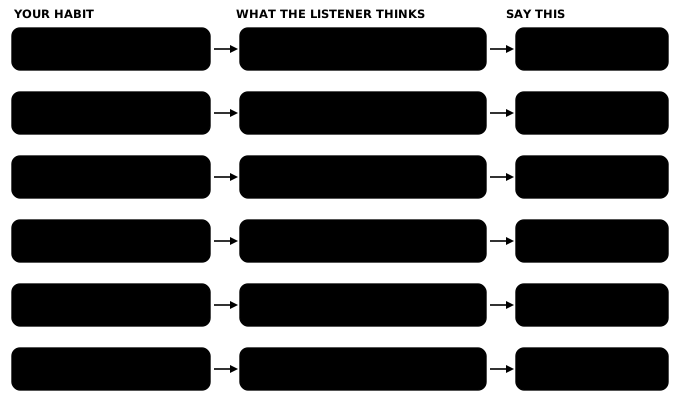
The middle column below is the most important. It shows what goes through the other person's mind when you say the phrase. They are not angry — they are confused, and they stop to think. That one moment of stopping weakens the effect of what you say.
57.2 Introducing yourself — "Myself Ravi"
This is a direct copy of Hindi: "Main Ravi" — a complete sentence with no verb. In English myself is a reflexive pronoun (I hurt myself); it cannot be the subject. That is why the listener stops when they hear "Myself Ravi".
Three ways to introduce yourself
- Wrong: Myself Ravi, I am from Pune.
- Right: I'm Ravi, and I'm from Pune.
-
Why: Casual and normal — on the phone, in a meeting, when meeting new people. This is the most common form.
-
Wrong: I am Ravi this side.
- Right: Hi, this is Ravi.
-
Why: On the phone and on video calls, "this is" is the natural form. "This side" is used only in India.
-
Wrong: What is your good name?
- Right: May I have your name?
- Why: "Good name" is a direct translation of the Hindi "shubh naam" — it is charming, but not understood outside India.
- Hi, I'm Ravi — I handle the vendor side of things. = Hello, I'm Ravi, and I look after the vendor work.
57.3 Two big email phrases
"Please revert back"
There are two things here. First: the real meaning of revert is to return to an earlier state — "The file reverted to its old version." Using it to mean "reply" works only in Indian English. Second: revert already contains "back", so adding back again is redundant. The same happens with return back and reply back.
Clear ways to ask for a reply
- Wrong: Kindly revert back at the earliest.
- Right: Please get back to me by Thursday.
-
Why: Two fixes: "revert back" → "get back to me", and "at the earliest" → a real date. Giving a date is what makes things actually happen.
-
Wrong: Please reply back soon.
- Right: Please reply when you can.
- Why: Reply, return, revert — all three already contain "back". Never add "back" to them.
"Kindly do the needful"
This phrase comes from old official English, and everyone in India understands it: "please do whatever needs to be done". But for a reader outside India it leaves the biggest question unanswered — what is the needful? The whole point of an email is that the other person knows what they have to do. "Do the needful" hides exactly that information.
Learn to write a clear request
- Wrong: Kindly do the needful and revert back.
- Right: Could you approve the invoice and forward it to accounts? Let me know once it's done.
-
Why: The other person needs two things: what to do, and by when. Write both — the email becomes half as long and ten times more useful.
-
Wrong: Kindly share the file.
- Right: Could you share the file?
- Why: "Kindly" is not wrong, but abroad it sounds old-fashioned or a bit stiff. "Could you" is the safest.
The one-line email formula
Task + who + by when.
"Could you approve the PO by Friday so we can release payment?" Three things in one line. There is no need for "kindly", "needful" or "at the earliest".
57.4 "Prepone" — a good word that never left India
Honestly: prepone is a very sensible word. Pre is the opposite of post, so why shouldn't prepone be the opposite of postpone? The logic is perfect, and some dictionaries now list it with an "Indian English" label. But an American or British colleague has probably never heard the word in their life.
| What you mean | In India | For outside India |
|---|---|---|
| Do it earlier | prepone the meeting | move the meeting up / bring it forward |
| Do it later | postpone the meeting | push the meeting back / postpone it |
| Cancel it completely | cancel | call it off / cancel |
- Could we move Thursday's call up to Tuesday? = Can we have the Thursday call earlier, on Tuesday?
Note — 'postpone' is perfectly fine
Only the partner word "prepone" is missing abroad. Postpone is used all over the world, so you do not need to give it up.
57.5 Words for study, family and travel
'Passed out from college'
- Wrong: I passed out from college in 2019.
- Right: I graduated in 2019.
-
Why: Outside India, pass out means "to faint"! People are startled to hear this line. The right form: graduated from Pune University in 2019, or finished college in 2019.
-
Wrong: I am doing my graduation.
- Right: I'm doing my bachelor's degree. / I'm an undergraduate.
-
Why: Abroad, "graduation" means the ceremony when you receive your degree (convocation), not the studying.
-
Wrong: I gave my twelfth standard exam.
- Right: I took my final school exams. / I finished high school.
- Why: Two things: you don't "give" an exam, you take it (the teacher gives it). And "grade" or "class" is better understood than "standard".
'Cousin brother' and family words
- Wrong: He is my cousin brother.
- Right: He's my cousin.
-
Why: In English "cousin" does not distinguish boy from girl, so adding brother/sister sounds odd. If you must explain the difference: "my cousin — my uncle's son".
-
Wrong: My real brother lives in Indore.
- Right: My brother lives in Indore.
-
Why: "Real brother" suggests the other brothers are fake. In English "brother" already means a brother by birth.
-
Wrong: She is my co-brother's wife.
- Right: She's my wife's sister. / My sister-in-law.
- Why: Hindi has many very precise family terms; English does not. So explain the relationship directly — "my wife's brother", "my mother's cousin".
'Out of station'
- Wrong: I will be out of station next week.
- Right: I'll be out of town next week. / I'm travelling next week.
- Why: This phrase comes from the "posting station" of the British Raj — it is clear in India, not abroad. For email the clearest is: "I'm away from the office until the 14th."
57.6 "I have a doubt" — a small word, a big difference
Saying "Sir, I have a doubt" in class is perfectly normal in India. But in English doubt = suspicion, not believing. "I doubt it" means "I don't think so". So in an international class or meeting, when a teacher hears this line, they feel you are doubting what they said.
| What you mean | Right form |
|---|---|
| You want to ask a question | I have a question. |
| You didn't understand one part | I'm not clear on the second step. |
| You are a little confused | Could you clarify that bit? |
| You really do have a suspicion | I doubt that will work. (here doubt is correct) |
- I have a question about the second step — should it run before or after the backup? = I want to ask about step two: does it run before the backup or after it?
57.7 Four small habits
'Same to same'
- Wrong: Both reports are same to same.
- Right: Both reports are exactly the same. / They're identical.
- Why: "Same to same" is very expressive, but it is an India-only form. One word does the job: identical.
'Discuss about'
- Wrong: Let's discuss about the budget.
- Right: Let's discuss the budget. / Let's talk about the budget.
- Why: Discuss already contains the meaning of "about". Other words in the same family: enter the room (not "enter into"), reach Delhi (not "reach at"), marry her (not "marry with"), consider it (not "consider about").
'Order for'
- Wrong: I ordered for two coffees.
- Right: I ordered two coffees.
-
Why: After order, the thing comes directly. "For" comes in only when it is for a person: "I ordered a coffee for you."
-
Wrong: Let me request for a copy.
- Right: Let me request a copy. / Let me ask for a copy.
- Why: Request does not take "for" either. But "ask" does need "for". These are the pairs you have to remember.
Three more you see every day
- Wrong: I will do it now itself.
- Right: I'll do it right now.
-
Why: Using "itself" for emphasis comes from the Hindi "hi" (abhi hi). In English use "right": right now, right there, right away.
-
Wrong: What all did he say?
- Right: What exactly did he say? / What did he say?
-
Why: "What all", "where all", "who all" come from the Hindi "kya kya". They are charming, but not used abroad.
-
Wrong: He is my batchmate only.
- Right: We were in the same class. / He's a classmate of mine.
- Why: "Batchmate" and "only" at the end of a sentence are both Indian English. Outside India, this use of "only" is not understood at all.
57.8 At a glance — the full list
| Common in India | International form | Why |
|---|---|---|
| Myself Ravi | I'm Ravi | "Myself" cannot be a subject |
| Please revert back | Please get back to me | Revert = return to an earlier state; "back" is redundant |
| Kindly do the needful | Could you approve and forward it? | The reader doesn't know exactly what to do |
| Prepone | Move it up / bring it forward | The word doesn't exist abroad |
| Passed out from college | Graduated in 2019 | "Pass out" = to faint |
| Cousin brother | Cousin | Cousin doesn't show gender |
| Out of station | Out of town / away | "Station" isn't clear |
| I have a doubt | I have a question | Doubt = suspicion, not a question |
| Same to same | Exactly the same / identical | An India-only form |
| Discuss about | Discuss | Discuss already includes "about" |
| Order for two teas | Order two teas | No preposition after order |
| Now itself | Right now | The English way to stress is "right" |
| What all did she say? | What exactly did she say? | A direct translation of "kya kya" |
| I am having a car | I have a car | "Have" for possession isn't used in the continuous |
| She is in my good books only | She's in my good books | A final "only" isn't understood abroad |
57.9 Finally — English with two gears
Every speaker in the world has two gears: the home form and the outside form. A Scotsman does not speak in a New York meeting the way he speaks in his village. A Texan softens his accent in London. There is no shame in this — it is a skill.
Remember this
You do not need to give up your Indian English. It is yours, and it is perfectly fine. Just keep a second gear ready — for an international call, an interview abroad, a client overseas. Once you learn to shift gears, you can talk anywhere. Two gears = two strengths. Giving up one gear to take the other is a loss.
57.10 Practice — Indian English habits
Exercise 1
How should you introduce yourself in an interview abroad?
- Hi, I'm Ravi.
- Myself Ravi.
- I am Ravi this side.
- Myself is Ravi.
Hint: Myself cannot be a subject.
Answer
Hi, I'm Ravi.
'Myself' is a reflexive pronoun, not a subject. 'This side' is used only in India — abroad, on the phone, people say 'this is Ravi'.
Exercise 2
What does a person abroad understand when they hear 'I passed out from college in 2019'?
- You fainted in college
- You got your degree
- You left college
- You failed the exam
Answer
You fainted in college
'Pass out' means to faint. To say you got a degree, use 'graduated'.
Exercise 3
Which of these statements is true?
- Indian English is a real variety; the problem arises only when the listener doesn't understand it
- Indian English is wrong English
- Indian English is spoken only in villages
- Indian English should be given up completely
Answer
Indian English is a real variety; the problem arises only when the listener doesn't understand it
The question is not 'wrong or right' but 'which room am I in?'. Keep two gears — giving up one to take the other is a loss.
Exercise 4
What is the biggest problem with 'Kindly do the needful and revert back'?
- The reader doesn't know what they are supposed to do
- The sentence is too short
- 'Kindly' is very rude
- It has no verb
Hint: What is the purpose of an email?
Answer
The reader doesn't know what they are supposed to do
An email's job is to say clearly what needs doing. 'Do the needful' hides exactly that information. The formula: task + who + by when.
Exercise 5
I'll be out of ___ next week, so let's meet after the 14th.
Hint: Not station.
Answer
town
'Out of station' is clear in India but confuses people abroad. Say 'out of town' or 'away from the office'.
Exercise 6
I have a ___ about the second step — does it run before the backup?
Hint: Doubt means suspicion.
Answer
question / query
Doubt = suspicion. To ask something, use 'question'. If you don't understand, say 'I'm not clear on…'.
Exercise 7
Could we move the Thursday call ___ to Tuesday?
Hint: Which particle replaces prepone?
Answer
up / forward
To bring something earlier = move it up / bring it forward. 'Prepone' is a logical word but does not exist abroad.
Exercise 8
One word is redundant — tap it.
Please revert back to me by Thursday.
Answer
Wrong word: back.
Corrected: Please get back to me by Thursday.
Revert, reply and return already contain 'back', so 'back' is redundant. And abroad, 'revert' means to go back to an earlier state.
Exercise 9
One word should be removed — find it.
Let us discuss about the budget tomorrow.
Answer
Wrong word: about.
Corrected: Let's discuss the budget tomorrow.
Discuss already contains 'about'. In the same family: enter the room, reach Delhi, order two teas, consider my request.
Exercise 10
One word sounds odd — tap it.
He is my cousin brother from Indore.
Answer
Wrong word: brother.
Corrected: He's my cousin from Indore.
In English 'cousin' doesn't distinguish boy from girl, so adding brother sounds odd. If necessary: 'my cousin — my uncle's son'.
Exercise 11
Match each habit to its international form.
| A | B |
|---|---|
| Myself Ravi | exactly the same |
| I have a doubt | right now |
| same to same | I'm Ravi |
| now itself | I have a question |
Answer
Myself Ravi — I'm Ravi; I have a doubt — I have a question; same to same — exactly the same; now itself — right now
All four are perfectly clear in India — they just need a second form for an ear abroad.
Exercise 12
Match each phrase to its problem.
| A | B |
|---|---|
| prepone | which station? it isn't clear |
| pass out from college | 'back' is redundant |
| out of station | the word doesn't exist abroad |
| revert back | it ends up meaning to faint |
Answer
prepone — the word doesn't exist abroad; pass out from college — it ends up meaning to faint; out of station — which station? it isn't clear; revert back — 'back' is redundant
Each habit has a different problem — sometimes the word doesn't exist, sometimes the meaning changes, sometimes one word is redundant.
Exercise 13
Build one clear email line — task, who and by when.
Words: approve / by / the / release / payment / you / so / we / can / invoice / Could / Friday
Answer
Could you approve the invoice by Friday so we can release payment
This is the formula: what to do, for whom, by when. There is no need for 'kindly', 'needful' or 'at the earliest'.
Exercise 14
Say your introduction aloud. 'I'm' should come out in a single sound at the start.
Hi I am Ravi and I graduated in 2019
Answer
Say: Hi I am Ravi and I graduated in 2019
The first two lines of an interview are the most remembered. 'I'm' and 'graduated' are both here, and both are safe.
What to do next
Open your last five sent emails and search for just three words: kindly, revert, needful. Wherever you find them, write directly what has to be done and by when. In one go, your written English will move two steps ahead — and without "learning" anything.