Chapter 18: Questions & question tags
Asking questions — the order changes, not the words
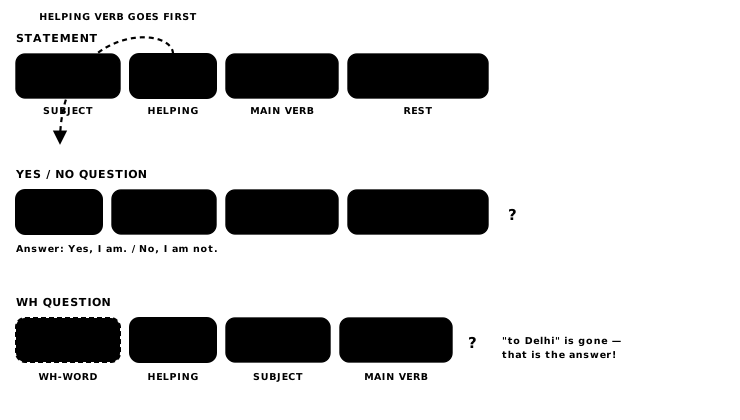
In Hindi, asking a question is very easy: "Tum ja rahe ho." and "Tum ja rahe ho?" — the words are the same, only the tone changes. This does not work in English. In English, to make a question you have to change the word order — the helping verb comes in front of the subject. That is why "Where you are going?" sounds wrong to the ear, and "Where are you going?" sounds just right.
- 1The question machine — in one picture
- 2Yes/No questions — three situations
- 3WH-words — when "yes/no" is not enough
- 4Question tags — "right?"
- 5Polite questions — the order goes back to normal
- 6The mistakes we really make
- 7A small map
In one line
In an English question, the helping verb comes before the subject. The helping verb (am/is/are/was/were/do/does/did/have/has/will/can…) moves in front of the subject. That is the whole rule.
18.1 The question machine — in one picture
Look below: there is a plain statement, and two kinds of questions made from it. Notice how the helping verb jumps in front of the subject.
18.2 Yes/No questions — three situations
(a) When the sentence already has a helping verb
Just bring it to the front. Nothing needs to be added.
| Statement | Question |
|---|---|
| She is ready. | Is she ready? |
| They were late. | Were they late? |
| He has finished. | Has he finished? |
| You can swim. | Can you swim? |
| It will rain. | Will it rain? |
(b) When there is no helping verb — bring in do / does / did
In the Present Simple and Past Simple the helping verb is hidden. When you make a question, it comes out — and the main verb goes back to V1.
| Statement | Question | Notice |
|---|---|---|
| You play cricket. | Do you play cricket? | I/you/we/they → do |
| She plays cricket. | Does she play cricket? | the -s moved into "does" |
| He went home. | Did he go home? | the past moved into "did", verb is V1 |
The tense shows in only one place
Does she plays? ✗ · Does she play? ✓
Did you went? ✗ · Did you go? ✓ do/does/did has already done the tense job — the main verb stays plain.
(c) "am / is / are" is a helping verb by itself
- Are you free tomorrow? Are you free tomorrow? — you never say "Do you are free".
- Is this seat taken? Is anyone sitting here already?
18.3 WH-words — when "yes/no" is not enough
The WH-word always comes first, and after it the order is the same as in a yes/no question: WH + helping + subject + verb.
| WH-word | What it asks | Example |
|---|---|---|
| What | a thing / an action | What do you want? |
| Who | a person (subject) | Who called you? |
| Whom | a person (object) | Whom did you call? |
| Whose | whose it is | Whose bag is this? |
| Which | which one from given options | Which shirt do you like? |
| When | time | When does the bus leave? |
| Where | place | Where are you going? |
| Why | reason | Why did she leave early? |
| How | manner / condition | How did you come? |
| How much | how much (uncountable) | How much sugar do we need? |
| How many | how many (countable) | How many brothers do you have? |
| How long | how much time / how long | How long have you worked here? |
| How often | how many times | How often do you exercise? |
| How far | how much distance | How far is the station? |
Questions about the subject — no do/does/did here
If the WH-word itself is the subject (who did it? what happened?), there is no need to change the order — because the subject is already at the front.
Who broke the window? "Who did break the window?" is wrong. Who broke the glass — "Who broke".
What happened yesterday?
18.4 Question tags — "right?"
In Hindi we add "na?", "hai na?", "theek hai?" at the end of a sentence. English does the same, but the tag is the opposite of the sentence: a negative tag after a positive sentence, and a positive tag after a negative sentence.
| Sentence | Tag | Full form |
|---|---|---|
| Positive | negative | You are tired, aren't you? |
| Negative | positive | She doesn't smoke, does she? |
| Positive, past | negative | He came late, didn't he? |
| Positive, perfect | negative | They have left, haven't they? |
| Positive, modal | negative | You can drive, can't you? |
Three steps to make a tag
1. Pick up the helping verb (if there is none, bring in do/does/did).
2. Flip it — positive → negative, negative → positive.
3. Turn the subject into a pronoun — Ravi → he, my sisters → they, this book → it.
Four special tags you must remember
| Sentence | Tag | Why |
|---|---|---|
| I am late, … | aren't I? | "amn't" does not exist in English |
| Let's go, … | shall we? | Let's = a suggestion |
| Open the door, … | will you? | used with an order / request |
| Nobody came, … | did they? | the pronoun for nobody / everybody is "they" |
| There is a problem, … | isn't there? | "there" takes the place of the subject |
'isn't it?' does not work everywhere
- Wrong: You are coming tomorrow, isn't it?
- Right: You are coming tomorrow, aren't you?
-
Why: The helping verb and the pronoun of the tag must come from the sentence. "Isn't it" is only right when the subject is "it" — It is cold, isn't it?
-
Wrong: He finished the work, no?
- Right: He finished the work, didn't he?
- Why: Hindi "na?" does not turn directly into "no?" — you have to build the full tag.
18.5 Polite questions — the order goes back to normal
When a question sits inside another sentence (a polite or indirect question), the inner part is written like a normal statement. Many people get this wrong.
| Direct question | Polite form |
|---|---|
| Where is the station? | Could you tell me where the station is? |
| What time does it start? | Do you know what time it starts? |
| Why did he leave? | I wonder why he left. |
| Can I sit here? | Would you mind if I sat here? |
- Could you please tell me where the ticket counter is? Notice: not "where is the ticket counter", but "where the ticket counter is".
18.6 The mistakes we really make
Top question mistakes
- Wrong: Where you are going?
- Right: Where are you going?
-
Why: The helping verb "are" must come before the subject "you". Copying the Hindi word order is the most common mistake here.
-
Wrong: Why you did not come yesterday?
- Right: Why didn't you come yesterday?
-
Why: WH + helping + subject + verb. "Didn't" first, "you" after it.
-
Wrong: What is your good name?
- Right: May I know your name? / What's your name?
-
Why: "Good name" is a word-for-word translation of the Hindi "shubh naam" — English speakers don't say it. To sound polite, "May I know your name?" is best.
-
Wrong: Does she knows the answer?
- Right: Does she know the answer?
-
Why: "Does" has taken the -s, so the main verb stays without -s.
-
Wrong: Tell me where is the office.
- Right: Tell me where the office is.
-
Why: Inside an indirect question the order stays normal — the helping verb goes to the back.
-
Wrong: He is your brother, isn't it?
- Right: He is your brother, isn't he?
-
Why: Take the pronoun from the sentence. The subject is "he", so the tag also has "he".
-
Wrong: What you do?
- Right: What do you do?
- Why: This is the standard question for asking someone's job, and "do" appears twice in it — once as the helping verb, once as the main verb.
18.7 A small map
| Type of question | Order |
|---|---|
| Yes / No | HELPING + subject + verb + rest? |
| WH (about the object) | WH + HELPING + subject + verb? |
| WH (about the subject) | WH + verb + rest? (no do/does/did) |
| Question tag | Sentence + opposite helping verb + pronoun? |
| Indirect / polite | Polite opening + WH + subject + verb |
18.8 Practice — Questions and question tags
Exercise 1
Which one is correct?
- Where you are going?
- Where are you going?
- Where you going are?
- Where going you are?
Hint: Where does the helping verb sit?
Answer
Where are you going?
The order is WH + helping + subject + verb. 'Are' must come before 'you'.
Exercise 2
___ she live in Delhi?
- Do
- Does
- Did
- Is
Hint: Present Simple, subject 'she'.
Answer
Does
With he/she/it we use 'Does'. And remember — the verb after it has no -s: 'Does she live', not 'lives'.
Exercise 3
You have finished the project, ___ ?
- isn't it
- haven't you
- have you
- didn't you
Hint: The sentence is positive, so what will the tag be?
Answer
haven't you
Positive sentence → negative tag. The helping verb is 'have' and the subject is 'you', so 'haven't you'.
Exercise 4
___ broke this glass?
- Who did
- Whom did
- Who
- Who does
Hint: Here the WH-word is itself the subject.
Answer
Who
When the WH-word is the subject, there is no do/does/did — 'Who broke this glass?' The verb follows directly.
Exercise 5
___ you like some tea?
Hint: The polite word for offering.
Answer
Would / would
'Would you like…?' is the polite way to offer something. It sounds more polite than 'Do you want'.
Exercise 6
How ___ brothers do you have?
Hint: Can brothers be counted or not?
Answer
many
Use 'how many' for countable things and 'how much' for uncountable ones. Brothers can be counted.
Exercise 7
Let's start the meeting, ___ we?
Hint: This is a special tag.
Answer
shall
'Let's' always takes the tag 'shall we?' — this one you have to remember.
Exercise 8
There is one mistake in this question — tap the wrong word.
Does your sister knows my address?
Answer
Wrong word: knows.
Corrected: Does your sister know my address?
'Does' has taken the -s into itself, so the main verb stays plain — 'know', not 'knows'.
Exercise 9
Find the wrong word.
Please tell me where is the railway station.
Answer
Wrong word: is.
Corrected: Please tell me where the railway station is.
Inside an indirect question the order stays normal. 'Is' has to move after the subject.
Exercise 10
There is a mistake in the tag — catch it.
She writes poems, isn't she?
Answer
Wrong word: isn't.
Corrected: She writes poems, doesn't she?
The sentence is in the Present Simple, where the hidden helping verb is 'does' — so the tag is 'doesn't she'. 'Isn't' would be right only if the sentence had 'is'.
Exercise 11
Put the words in the correct order to make a question.
Words: been / city / in / have / you / this / long / How / living
Answer
How long have you been living in this city
How long + helping verbs (have been) + subject (you) + main verb (living). 'How long you are living' is the wrong order.
Exercise 12
Match each meaning with the correct WH-word.
| A | B |
|---|---|
| Asking about distance | Whose |
| Asking how many times | Which |
| Asking who owns it | How much |
| Choosing from given options | How far |
| Asking the amount of sugar | How often |
Answer
Asking about distance — How far; Asking how many times — How often; Asking who owns it — Whose; Choosing from given options — Which; Asking the amount of sugar — How much
How far = distance, how often = number of times, whose = who owns it, which = choosing from options, how much = the amount of an uncountable thing.
Exercise 13
Now say this question aloud — your voice should rise at the end.
Could you please tell me where the bus stop is
Answer
Say: Could you please tell me where the bus stop is
This is one of the most useful sentences — at a station, at a shop, anywhere. Remember — 'where the bus stop is', not 'where is the bus stop', because this is an indirect question.
What to do next
From today, whenever you ask a question, pause for one second in your mind, find the helping verb and put it first. At the start this will feel slow — but this one habit makes your English clearer straight away.