Chapter 20: Clauses & complex sentences
Clauses — from short sentences to longer ones
If every sentence in your English is short — "I have a friend. He lives in Delhi. He is a doctor." — nothing is wrong, but it sounds childish. Learn to join clauses, and the same message fits into one clear, confident sentence. This chapter teaches that skill of joining.
- 1Independent and dependent clauses
- 2Four kinds of sentences
- 3Compound — joining two equal clauses
- 4Complex — reason, time, condition and contrast
- 5Relative clauses — who, which, that, whose, where
- 6Defining vs Non-defining — the comma game
- 7Joining short sentences into better ones
- 8The mistakes we really make
In one line
A clause is a group of words with its own subject and verb. A sentence can have one clause or many. Remember the sentence structure chapter? A phrase has no subject-verb pair; a clause does.
- I have a friend who lives in Delhi. Two clauses: "I have a friend" + "who lives in Delhi".
- She was tired, so she went to bed early. Two clauses, joined by "so".
20.1 Independent and dependent clauses
Not all clauses are the same. Some can stand alone, and some cannot. It is important to know the difference, because treating an unfinished clause as a complete sentence is the biggest mistake in writing.
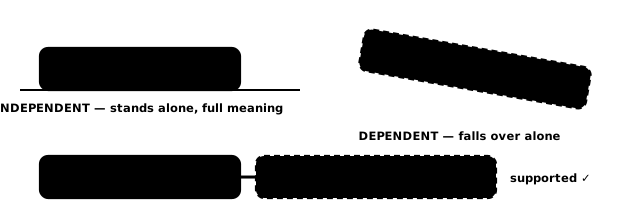
Independent vs dependent
An independent clause is a complete sentence on its own (I stayed at home.). A dependent clause begins with a word like because, when, if, although, who, which and stays unfinished on its own — join it to an independent clause.
| Words that start a dependent clause | Job | Example |
|---|---|---|
| because, since, as | reason | because he was ill |
| when, while, after, before, until | time | when the bell rang |
| if, unless | condition | if you call me |
| although, though, even though | contrast | although it was late |
| who, which, that, whose, where | about a noun | who lives next door |
20.2 Four kinds of sentences
How many clauses there are, and how they are joined, gives four types of sentence. Good English uses a mix of all four; writing only one type makes a text dull.
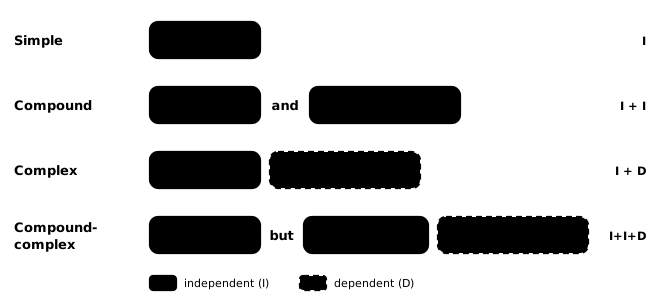
The four types
Simple = one independent clause. Compound = two independent clauses (joined by and, but, so). Complex = independent + dependent (joined by because, when, who). Compound-complex = two independent + at least one dependent.
20.3 Compound — joining two equal clauses
When two ideas are equally important, join them in a compound sentence. There are seven small words for this, with a trick to remember them — FANBOYS.
| Word | Job | Example |
|---|---|---|
| For | reason (formal) | He left early, for he was ill. |
| And | adding | I cooked, and she cleaned. |
| Nor | not this, not that | He didn't call, nor did he write. |
| But | contrast | It was cheap, but it was good. |
| Or | choice | Hurry up, or we'll miss the train. |
| Yet | even so | She was tired, yet she kept working. |
| So | result | It was raining, so we stayed in. |
The compound rule
To join two independent clauses, use a comma + FANBOYS word (for, and, nor, but, or, yet, so). A comma alone cannot join two complete sentences: I was tired, I slept. ✗ → I was tired, so I slept. ✓
When you can skip the comma
If both clauses are very short, the comma is not needed: I cooked and she cleaned.
And if the second part has no subject of its own, it is not a clause — don't add a comma: She opened the door and smiled.
20.4 Complex — reason, time, condition and contrast
When one idea is the main one and the other gives its reason, time, condition or contrast, you get a complex sentence. These are the sentences that make your English sound thoughtful and mature.
- I took an umbrella because it looked cloudy. Main idea: I took an umbrella. Reason: there were clouds.
- When the guests arrived, we served lunch. The dependent clause comes first, so there is a comma after it.
- Although the test was hard, she passed. = The test was hard, but she passed anyway. — no need for "but".
The complex rule
If the dependent clause comes first, put a comma after it (When it rained, we stayed in.); if it comes after, no comma. One linking word per pair: although or but — not both.
Hindi 'halaanki… lekin' does not work in English
- Wrong: Although he is rich, but he is not happy.
- Right: Although he is rich, he is not happy. / He is rich, but he is not happy.
- Why: Hindi uses both "halaanki… lekin" (although… but); English uses only one. In the same way, "because… so" can't be used together either.
20.5 Relative clauses — who, which, that, whose, where
A relative clause gives more information about a noun, just like an adjective — only a whole clause instead of one word. It turns two short sentences into one: I met a man. He speaks six languages. → I met a man who speaks six languages.
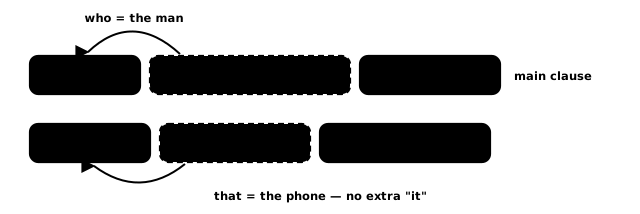
The relative clause rule
who — people, which — things, that — both, whose — belonging to, where — place. The relative word takes the place of the noun, so don't repeat that noun or pronoun.
| Word | Used for | Example |
|---|---|---|
| who | people | the girl who won the prize |
| which | things, animals | the bus which goes to Agra |
| that | people or things (no comma) | the book that I lost |
| whose | possession — "of whom" | the boy whose bike was stolen |
| where | place | the village where I was born |
| when | time | the day when we met |
You can also leave out an object relative
When who/that is the object of the clause, you can drop it: the book (that) I lost, the man (who) I met. This is very common in speech. But not when it is the subject: the man who called — "who" is needed.
20.6 Defining vs Non-defining — the comma game
Two commas can change the meaning of a sentence. The question is: does the clause say which noun you mean, or does it just add extra information that could be removed without changing much?
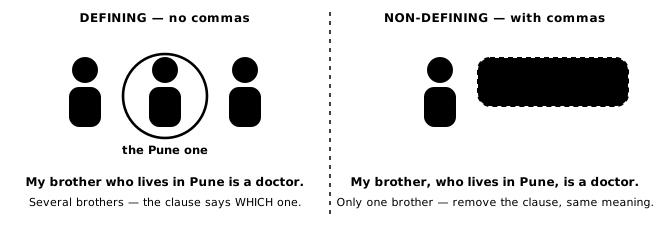
Defining vs non-defining
A defining clause says which noun is meant — no commas, and who/which/that all work. A non-defining clause only gives extra information — with commas, and it never uses "that".
- The Taj Mahal, which is in Agra, attracts millions of visitors. There is only one Taj Mahal — "which is in Agra" is extra information, so commas.
- Students who finish early can leave. Only the students who finish early — the clause is needed, so no commas.
20.7 Joining short sentences into better ones
Now let's bring it all together. When you write, first write short sentences, then see which ones you can join. Ask three questions: are these equal (FANBOYS)? Is one a reason or a time (because, when)? Is one about a noun (who, which)?
| Before (short sentences) | After (joined) |
|---|---|
| I have a cousin. She lives in Canada. She is a nurse. | I have a cousin who lives in Canada and works as a nurse. |
| The train was late. We missed the meeting. | The train was late, so we missed the meeting. |
| It was raining. The match continued. | Although it was raining, the match continued. |
| This is the school. My father studied here. | This is the school where my father studied. |
| I met a writer. Her books are famous. | I met a writer whose books are famous. |
Don't cram everything into one sentence
Joining does not mean a whole paragraph should become one sentence. Two or three clauses in a sentence are enough. If it gets long, split it again — a clear message always beats a long one.
20.8 The mistakes we really make
The most common Indian-English mistakes with clauses
- Wrong: Although I studied hard, but I failed.
- Right: Although I studied hard, I failed.
-
Why: A word-for-word translation of "halaanki… lekin". In English, use only one word for one pair — although or but.
-
Wrong: This is the man who I told you about him.
- Right: This is the man (who) I told you about.
-
Why: "Who" has already taken the place of "the man". Adding "him" makes the same man appear twice. In the same way: the book which I bought it.
-
Wrong: I was very tired, I went to bed early.
- Right: I was very tired, so I went to bed early.
-
Why: Two independent clauses can't be joined by a comma alone. Put a FANBOYS word between them, or use a full stop.
-
Wrong: My father, that is a teacher, loves reading.
- Right: My father, who is a teacher, loves reading.
-
Why: A clause with commas (non-defining) never uses "that". Use "who" for people and "which" for things.
-
Wrong: Because the shop was closed.
- Right: We came back because the shop was closed.
- Why: A "because" clause is dependent — it can't be a sentence on its own. It's fine in spoken answers, but in writing join it to a main clause.
20.9 Practice — Clauses
Exercise 1
'I called her, but she didn't answer.' — what kind of sentence is this?
- Compound
- Simple
- Complex
- Compound-complex
Hint: How many independent clauses are there?
Answer
Compound
There are two independent clauses — 'I called her' and 'she didn't answer' — joined by 'but' (a FANBOYS word). There is no dependent clause, so it is compound.
Exercise 2
'When the power went off, we lit candles.' — what kind of sentence is this?
- Complex
- Compound
- Simple
- Compound-complex
Answer
Complex
'When the power went off' is a dependent clause and 'we lit candles' is independent. Independent + dependent = complex.
Exercise 3
This is the girl ___ father is a pilot.
- whose
- who
- which
- where
Hint: Think 'the girl's father' — it shows who he belongs to.
Answer
whose
We want to show possession — 'whose father'. That needs 'whose'. 'Who father' is wrong.
Exercise 4
Which sentence is correct?
- Although it was late, we kept talking.
- Although it was late, but we kept talking.
- Although it was late, so we kept talking.
- It was late, although but we kept talking.
Answer
Although it was late, we kept talking.
One word per pair. Once you use 'Although', you don't need 'but' — Hindi 'halaanki… lekin' (although… but) doesn't work in English.
Exercise 5
Mumbai, ___ is India's financial capital, is very crowded.
- which
- that
- who
- where
Hint: Between commas — non-defining.
Answer
which
A clause between commas never uses 'that', and Mumbai is a place/thing (the subject here), not a person — so 'which'. 'Where' would be used if the clause had its own subject: where my uncle lives.
Exercise 6
This is the village ___ my grandmother was born.
Hint: It is about a place.
Answer
where / in which
Use 'where' for a place — the village where she was born. 'In which' is also correct, but a little more formal.
Exercise 7
There is one extra word — tap it.
This is the laptop which I bought it last week.
Answer
Wrong word: it.
Corrected: This is the laptop which I bought last week.
'Which' has already taken the place of 'the laptop'. Adding 'it' makes the same thing appear twice.
Exercise 8
Find the wrong word.
Although the hotel was expensive, but the food was terrible.
Answer
Wrong word: but.
Corrected: Although the hotel was expensive, the food was terrible.
'Although' and 'but' don't go together. Remove one — here, 'but'.
Exercise 9
Match each relative word with its job.
| A | B |
|---|---|
| who | of whom / possession |
| which | place |
| whose | people |
| where | things |
Answer
who — people; which — things; whose — of whom / possession; where — place
Who is for people, which for things, whose for possession, where for place. 'That' works for both people and things in a defining clause.
Exercise 10
Join into one sentence: 'I have a friend. He speaks Japanese.'
Words: friend / Japanese / I / who / speaks / a / have
Answer
I have a friend who speaks Japanese
'Who' takes the place of 'He' and the clause sits right after 'a friend'. Two short sentences become one clear sentence.
Exercise 11
Make a complex sentence.
Words: inside / stayed / We / raining / because / was / heavily / it
Answer
We stayed inside because it was raining heavily
The main idea comes first (we stayed inside), the reason after (because…). The dependent clause comes second, so no comma is needed.
Exercise 12
Say this sentence aloud — pause lightly at the commas.
My brother, who lives in Pune, is a doctor
Answer
Say: My brother, who lives in Pune, is a doctor
When speaking, commas mean a short pause. That pause tells the listener that 'who lives in Pune' is only extra information.
What to do next
Open one of your old emails or messages. Wherever three short sentences come in a row, join two of them with who, because or so. One paragraph a day — in a month your writing will be different.