Chapter 47: Punctuation
Punctuation — small marks, big difference
When we speak, we breathe, pause and raise our voice — and that makes the meaning clear to the listener. In written English, punctuation marks do this job. It is not only about "writing beautifully": move a comma and the meaning changes, and put an apostrophe in the wrong place and the reader notices at once. The good news — there are only a few rules, and they are all in this chapter.
- 1How long to pause — think of a road
- 2Full stop — the most important and the most ignored
- 3Comma — seven real jobs
- 4Semicolon and colon — used less, but useful
- 5Apostrophe — two jobs, three mistakes
- 6Capital letters — eight sure situations
- 7Quotation marks — someone's exact words
- 8Question mark and exclamation mark
- 9Hyphen and dash
- 10The mistakes we really make
In one line
Punctuation marks tell the reader where to pause, where to stop, and how to read. Punctuation marks are traffic signs for the reader — where to slow down, where to stop, and where there is a question.
47.1 How long to pause — think of a road
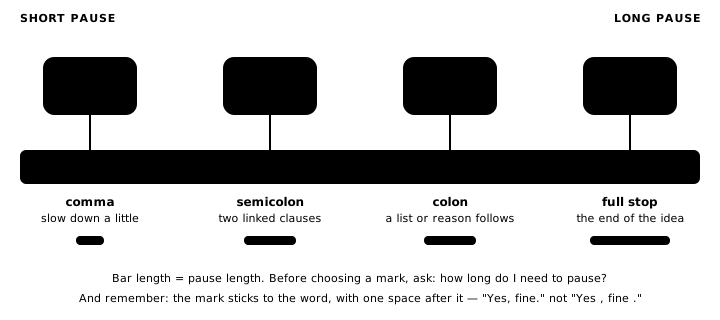
First, understand how long each mark makes you pause. This one picture clears up half the confusion.
47.2 Full stop — the most important and the most ignored
In Hindi we use "।"; in English it is a small dot. A long WhatsApp message with no full stops reads like one long breath, and the reader gets tired.
- I called him twice. He did not pick up. I will try again tomorrow. Three short sentences — easy to read. Squeezing them into one long sentence makes the message confusing.
A full stop also appears in short forms — Dr. Sharma, Mr. Khan, a.m., p.m., etc. — but in today's English names like UK, USA, NGO, IIT are written without dots.
47.3 Comma — seven real jobs
| Job | Example |
|---|---|
| In a list | I bought rice, dal, oil and sugar. |
| After an opening phrase | After the meeting, we went for tea. |
| Joining two complete sentences with and/but/so | I called him, but he did not answer. |
| Extra information in the middle | My uncle, who lives in Surat, is a tailor. |
| When calling someone | Ravi, please close the window. |
| After yes / no | Yes, I understand. |
| In dates and addresses | She was born on 14 March, 1998, in Kanpur. |
A comma changes the meaning
My brother, who lives in Pune, is a doctor. I have only one brother — and he lives in Pune (extra information). My brother who lives in Pune is a doctor. I have several brothers — the one who lives in Pune is a doctor (essential information).
Comma splice — a comma can't join two sentences
- Wrong: It was raining, we stayed at home.
- Right: It was raining, so we stayed at home.
- Why: A comma is not enough to join two complete sentences. Either use a full stop, or bring in a joining word such as and / but / so / because after the comma, or use a semicolon.
47.4 Semicolon and colon — used less, but useful
| Mark | Job | Example |
|---|---|---|
| ; | Two complete sentences that are closely linked in meaning | The road was blocked; we had to take a longer route. |
| : | A list is coming next | Bring three things: a pen, a notebook and your ID card. |
| : | A reason or explanation is coming next | There was one problem: nobody had the keys. |
47.5 Apostrophe — two jobs, three mistakes
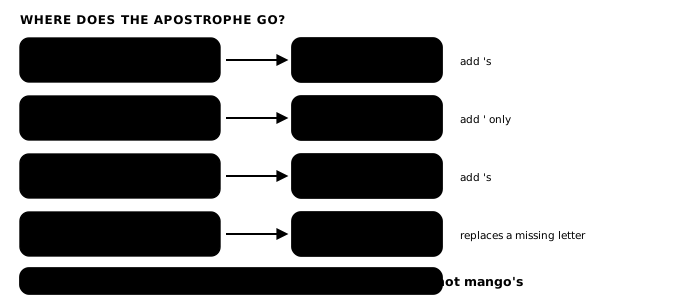
The apostrophe ( ' ) does only two jobs: it shows whose something is, or it shows a missing letter. The third job — making a plural — it never does.
its vs it's — the costliest confusion
| Form | Meaning | Example |
|---|---|---|
| it's | it is / it has | It's raining. · It's been a long day. |
| its | belonging to it (possessive) | The dog hurt its leg. |
A sure test
Wherever you see "it's", read it as "it is". If the sentence still makes sense, the apostrophe is right; if not, you need "its". The same test works for your's/yours, their's/theirs — possessive pronouns never take an apostrophe: yours, hers, ours, theirs, its.
47.6 Capital letters — eight sure situations
| Situation | Example |
|---|---|
| The first letter of a sentence | The bus was late. |
| "I" is always a capital | Ravi and I went together. |
| Names of people | Anita Sharma |
| Places, countries, rivers, cities | Mumbai, India, the Ganga |
| Days, months, festivals | Monday, August, Diwali |
| Languages and nationality words | Hindi, English, Indian |
| Names of organisations, books and films | Delhi University, The Guide |
| Titles when used with a name | Dr. Verma, Prime Minister Nehru |
Where capitals are NOT used
Seasons (summer, winter), subjects (science, history — unless it is the official name of a subject), directions (north, south), and common nouns (school, bank, doctor — when no particular one is named).
I go to school in the summer. ✓ I go to School in the Summer. ✗
47.7 Quotation marks — someone's exact words
When you write someone's words exactly as they were said, you use quotation marks. Remember two things: the first letter of what was said is a capital, and the punctuation inside goes inside the quotes.
- She said, "I will call you tomorrow." A comma after "said", a capital letter at the start of the speech, and the full stop inside the quotes.
- "Where are you going?" he asked. When the question comes first, the question mark goes inside the quotes, and "he" is lowercase.
47.8 Question mark and exclamation mark
| Mark | When | Example |
|---|---|---|
| ? | A direct question | Have you eaten? |
| . | A reported question, or a polite question that is really a request | He asked where I lived. · Could you pass the salt. |
| ! | Strong feeling — joy, surprise, warning | What a match! · Watch out! |
One is enough
Thank you so much!!! → Thank you so much!
Three exclamation marks do not make the feeling three times stronger — they just look unpolished. In a professional email, use no more than one or two exclamation marks.
47.9 Hyphen and dash
| Mark | Job | Example |
|---|---|---|
| - hyphen | Joining two words to make one adjective | a well-known singer · a five-year plan |
| - hyphen | Number words | twenty-one, sixty-five |
| — dash | A thought added suddenly | He agreed — after an hour of arguing. |
47.10 The mistakes we really make
Top punctuation mistakes
- Wrong: Fresh Mango's available here.
- Right: Fresh mangoes available here.
-
Why: An apostrophe is never used to make a plural. This mistake is seen most on shop boards.
-
Wrong: The company has lost it's way.
- Right: The company has lost its way.
-
Why: "It is lost it is way" doesn't make sense — so no apostrophe. You need the possessive "its".
-
Wrong: Please send the file , I need it today.
- Right: Please send the file. I need it today.
-
Why: These are two separate sentences. A comma can't join them — use a full stop (or add "as" / "because").
-
Wrong: Respected Sir ,
- Right: Dear Sir,
-
Why: No space before a punctuation mark, one space after. Also, in English emails today "Dear Sir" is normal — "Respected Sir" is old-fashioned official language.
-
Wrong: she lives in mumbai and speaks marathi.
- Right: She lives in Mumbai and speaks Marathi.
-
Why: The first letter of the sentence, the city name and the language name — all three are capitals.
-
Wrong: My brothers bike is new. (about one brother)
- Right: My brother's bike is new.
-
Why: To show "whose", the apostrophe is necessary. Without it the meaning becomes "my several brothers".
-
Wrong: He said that "he was busy".
- Right: He said that he was busy.
- Why: Quotes are not used in a reported sentence with "that". Use quotes only when the words are written exactly as spoken.
Three habits that improve your writing at once
1. One idea in one sentence. If it is getting long, put in a full stop.
2. Before using an apostrophe ask — "whose?" or "which letter is missing?" If neither, no apostrophe.
3. No space before a mark, one space after it.
47.11 Practice — Punctuation
Exercise 1
Which sentence is correct?
- The cat licked it's paw.
- The cat licked its paw.
- The cat licked its' paw.
- The cat licked it is paw.
Hint: it's = it is. Try the test.
Answer
The cat licked its paw.
Here the meaning is 'the cat's paw' — possessive. 'It is paw' makes no sense, so there is no apostrophe.
Exercise 2
Choose the correct form: the common room of the boys
- boy's common room
- boys's common room
- boys' common room
- boys common room
Hint: 'boys' already ends in s.
Answer
boys' common room
A plural noun ending in s takes only an apostrophe — boys'. For one boy it would be boy's.
Exercise 3
Which sentence is punctuated correctly?
- It was late, we went home.
- It was late we went home.
- It was late, so we went home.
- It was late; so we went home.
Hint: Are both parts complete sentences?
Answer
It was late, so we went home.
A comma alone cannot join two complete sentences (a comma splice). You need a joining word like 'so' after the comma, or a full stop.
Exercise 4
Which of these words does NOT need a capital letter?
- monday
- diwali
- summer
- marathi
Hint: Think about seasons and directions.
Answer
summer
Days (Monday), festivals (Diwali) and languages (Marathi) take capitals, but seasons (summer, winter) are written with a small letter.
Exercise 5
The mark that joins two closely linked complete sentences is called a ___.
Hint: A longer pause than a comma, shorter than a full stop.
Answer
semicolon
A semicolon ( ; ) joins two complete sentences whose meanings are linked — 'The road was blocked; we took another route.'
Exercise 6
The mark that opens a list that follows is called a ___.
Hint: Two dots, one above the other.
Answer
colon
A colon ( : ) opens a list or an explanation — 'Bring three things: a pen, a notebook and your ID.'
Exercise 7
Names of languages, cities and days always begin with a ___ letter.
Hint: Big or small?
Answer
capital
English, Mumbai, Monday — proper names always begin with a capital letter. But seasons and directions take small letters.
Exercise 8
One word in this sentence is written wrongly — tap it.
We sell fresh mango's and bananas.
Answer
Wrong word: mango's.
Corrected: We sell fresh mangoes and bananas.
An apostrophe is never used to make a plural. 'Mangoes' is the correct form.
Exercise 9
Find the wrong word.
My father works in a bank and he speaks english fluently.
Answer
Wrong word: english.
Corrected: My father works in a bank and he speaks English fluently.
The name of a language always begins with a capital letter — English, Hindi, Marathi, Tamil.
Exercise 10
One word is wrong — catch it.
The company changed it's name last year.
Answer
Wrong word: it's.
Corrected: The company changed its name last year.
Here the meaning is 'the company's name'. 'It is name' makes no sense, so the apostrophe has to go — 'its'.
Exercise 11
Put the words in the correct order (the comma will find its own place).
Words: meeting / the / After / for / we / out / tea / went
Answer
After the meeting we went out for tea
In writing there is a comma after the opening phrase — 'After the meeting, we went out for tea.' A phrase at the start is followed by a comma.
Exercise 12
Match each mark with its job.
| A | B |
|---|---|
| , | a list or explanation follows |
| ; | whose, or a missing letter |
| : | strong feeling |
| ' | short pause, lists and phrases |
| ! | two linked complete sentences |
Answer
, — short pause, lists and phrases; ; — two linked complete sentences; : — a list or explanation follows; ' — whose, or a missing letter; ! — strong feeling
The comma is the lightest break, the semicolon joins two sentences, the colon opens what comes next, the apostrophe shows possession or a contraction, and the exclamation mark shows feeling.
Exercise 13
Now say this line aloud — pause lightly where the commas are.
After the meeting we had tea and then we went home
Answer
Say: After the meeting we had tea and then we went home
In writing there would be two commas here — 'After the meeting, we had tea, and then we went home.' When speaking, you pause lightly in the same two places. Punctuation is really a map of your breathing.
What to do next
The best practice: read what you wrote aloud. Wherever you want to take a breath, you need a comma. Wherever the idea is complete, you need a full stop. Your ear knows more than your grammar does — listen to it.