Chapter 24: Habits, wishes & advice
used to, wish, had better
"I used to play cricket every day", "I'm used to it", "I wish I had studied", "You'd better leave soon, or…" — in Hindi we say these four things ten times a day. English has short, fixed structures for them: used to, be used to, I wish, had better, would rather. Understand them clearly once, and your English will sound much more natural straight away.
- 1The map first — which "habit" when?
- 2used to + V1 — it happened before, but not now
- 3would — the story of old memories
- 4be used to / get used to + -ing — the no. 1 confusion for Hindi speakers
- 5I wish / If only — three kinds of "if only"
- 6had better — advice with a warning inside
- 7would rather — "I'd prefer to…"
- 8It's time — "it's already time"
- 9In real life — a phone call
In one line
used to + V1 = it happened in the past, but not now. be used to + -ing = you are accustomed to it. wish + past = if only. had better + V1 = or there will be trouble. Each structure needs a fixed verb form — that is the real game in this chapter.
24.1 The map first — which "habit" when?
In Hindi, "aadat" (habit) is one word, but English has three different structures — and all three mean something completely different. This is where mistakes happen. Before you speak, ask yourself one question: Is this about the past, about a habit today, or about a new habit forming?
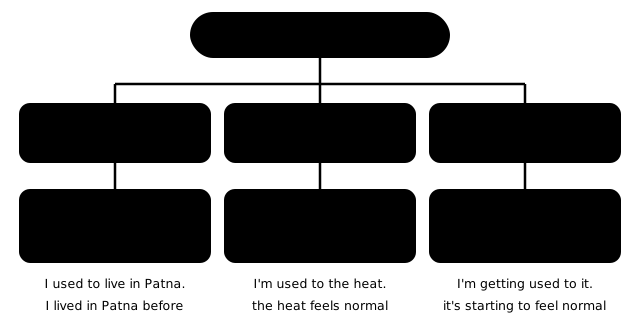
A map straight from Hindi
"pehle karta tha" → used to do · "aadat hai" → be used to doing · "aadat pad jaayegi" → get used to doing.
24.2 used to + V1 — it happened before, but not now
used to describes a habit or situation in the past that has now ended. It is always followed by the first form of the verb (V1). It works for both actions (doing things) and states (being, living, having).
- I used to live in Patna. = I lived in Patna before, but I don't live there now.
- We used to walk to school every day. = We walked to school every day in the past.
- Priya used to have very long hair. = Priya's hair was very long before (it isn't now).
- There used to be a cinema hall here. = There was a cinema hall here once, but it's gone.
Negatives and questions — the "d" disappears
When did / didn't appears, it already shows the past — so the "d" on used drops off: didn't use to, Did you use to…? It works just like didn't go, not didn't went.
| Form | Formula | Example |
|---|---|---|
| Positive | used to + V1 | I used to smoke. |
| Negative | didn't use to + V1 | I didn't use to like coffee. |
| Negative (stronger) | never used to + V1 | He never used to call. |
| Question | Did … use to + V1? | Did you use to play cricket? |
- I didn't use to like coffee, but now I love it. = I disliked coffee in the past; today I love it.
- Did you use to play cricket in college? = Was cricket something you played regularly in college?
Pronunciation: 'yoos-tuh'
Don't say used to as "yooz-d too". Say /ˈjuːstə/ — "yoos-tuh", with an "s" sound, and use to sounds exactly the same.
used to has no present form
This is the most common Indian mistake. For a habit today, don't use use to — use the present simple, often with usually (see All 12 tenses).
✗
I use to drink tea every morning.
✓
I usually drink tea every morning.
✗
I used to go to Goa three times.
✓
I went to Goa three times.
24.3 would — the story of old memories
When English speakers tell stories about the past (summers at grandma's house, school days), they set the scene once with used to, and then carry the story on with would + V1. It sounds a little bookish and nostalgic.
- Every summer, we used to go to Nani's village. = We went to our grandmother's village every summer.
- We'd climb the mango trees all afternoon. = We climbed the mango trees again and again all afternoon.
- In the evening, Nani would tell us ghost stories. = Every evening our grandmother told us ghost stories.
would = repeated actions only
would is for old actions (playing, going, listening), and never for states (be, have, live, like, know). For states, use only used to.
✗
We would have a dog called Moti.
✓
We used to have a dog called Moti.
| Verb | used to? | would? |
|---|---|---|
| play, go, visit (action) | ✓ | ✓ |
| live, be, have (state) | ✓ | ✗ |
| like, love, know, believe | ✓ | ✗ |
| First line of a story | ✓ (better) | Give the time first |
24.4 be used to / get used to + -ing — the no. 1 confusion for Hindi speakers
Here used works like an adjective (= accustomed) and to is a preposition, not the infinitive "to". After a preposition comes a noun, a pronoun or -ing — never V1. This is the same rule you saw in the to do or doing? chapter with look forward to meeting.
- I am used to waking up early. = Waking up early feels normal to me.
- She isn't used to spicy food. = Spicy food is new to her, and she finds it hard.
- Are you used to the Delhi winters yet? = Have the Delhi winters started to feel normal to you?
- I'm getting used to my new job. = My new job is slowly starting to feel normal.
- Don't worry, you'll get used to it. = It will feel normal after some time, so don't worry.
- It took me months to get used to driving in Bengaluru traffic. = Driving in Bengaluru traffic felt hard for months, and then it felt normal.
be used to vs get used to
be used to = you are accustomed (a state). get used to = you are becoming / will become accustomed (a change). Both are followed by -ing or a noun, and "be/get" can change with every tense: was used to, will get used to, have got used to.
The most common mistake
- Wrong: I am used to wake up early.
- Right: I am used to waking up early.
- Why: Here "to" is a preposition, so it is followed by -ing. If you mean "I woke up early in the past", drop "am": I used to wake up early.
✗
I used to living alone, so I don't mind it.
✓
I'm used to living alone, so I don't mind it.
| Structure | Meaning | Example |
|---|---|---|
| used to + V1 | did it in the past (not now) | I used to work nights. |
| be used to + -ing | am accustomed to it | I'm used to working nights. |
| get used to + -ing | am becoming accustomed to it | I'm getting used to working nights. |
A formal word
In writing, be accustomed to + -ing also works: The staff are accustomed to working under pressure.
24.5 I wish / If only — three kinds of "if only"
To say "kaash" (if only), English uses I wish or the more emotional If only. The trick is that after wish the verb goes one step back — because what we want is not true. This is the same backshift you saw in the second and third conditionals of the If sentences chapter.
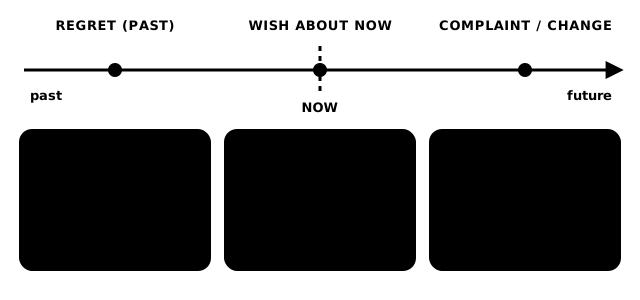
(a) A wish about now — wish + past simple
- I wish I had a car. = I don't have a car now, and I'd like one.
- I wish I knew the answer. = I don't know the answer, and I'd like to.
- I wish I could swim. = I can't swim, and I'd like to be able to.
- If only we lived closer to the office! = We live far from the office, and we wish we didn't.
- I wish I were taller. = I'm not very tall, and I'd like to be taller.
were or was?
I wish I were is formal and safe for exams; in everyday speech I wish I **was is also perfectly fine. In exams and formal writing, use were.
(b) A regret about the past — wish + had + V3
- I wish I had studied harder for the exam. = I didn't study hard enough, and I regret it.
- I wish I hadn't said that to her. = I said it, and now I'm sorry I did.
- If only we'd left ten minutes earlier! = We left too late and missed the train.
(c) A complaint about others — wish + would
Use wish + someone + would when someone else (or even the weather!) keeps doing something and you want it to change. There is a little annoyance in it.
- I wish you would stop interrupting me. = Please stop interrupting me — it annoys me.
- I wish it would stop raining. = I'm tired of this rain and want it to stop.
✗
I wish I would speak French.
✓
I wish I could speak French.
wish or hope?
For things that might happen, use hope (+ a normal tense). For things that are not true, use wish (+ past). And wish + person + noun is only for good wishes in a fixed phrase: I wish you a happy birthday.
✗
I wish you will pass the exam.
✓
I hope you pass the exam.
I wish you all the best for the exam.
- I hope you get the job. = I'm hoping you get the job — it could really happen.
- I wish you all the best. = A kind, fixed phrase: good luck to you.
24.6 had better — advice with a warning inside
had better + V1 (in speech, 'd better) means "do it, or there will be trouble". The word "had" is in the name, but it is about now or the future, not the past. And it is never followed by "to".
- You'd better leave now, or you'll miss the train. = Leave now — otherwise you'll miss the train.
- We'd better not tell Mummy about this. = It's wiser not to tell Mummy — she may get upset.
- I'd better charge my phone before the meeting. = I should charge my phone before the meeting, or I'll have a problem.
had better
'd better + V1 / 'd better not + V1 — "do it, or else…". No "to", no past meaning, and stronger than should.
✗
You had better to submit it today.
✓
You'd better submit it today.
had better not go
Don't say 'had better' to your boss
"Sir, you had better check the file." sounds like a threat. To senior people, say "You might want to check the file" or "It might be a good idea to…". For ordinary advice, should is enough (see can, could, should, must).
24.7 would rather — "I'd prefer to…"
would rather ('d rather) shows a preference or choice — "I'd choose to do this". It has two patterns, and the second one surprises even advanced learners.
(a) Your own preference — would rather + V1 (than + V1)
- I'd rather walk than take an auto. = I prefer walking to taking an auto.
- Would you rather have tea or coffee? = Which would you prefer, tea or coffee?
- I'd rather not talk about it. = A polite way to say you don't want to talk about it.
(b) Wanting someone else to act — would rather + someone + past
When you want someone else to do something, use a new subject and a verb in the past — just like wish, even though you are talking about now.
- I'd rather you didn't smoke in the car. = Please don't smoke in the car — I'd prefer that.
- I'd rather you came on Monday. = I'd like you to come on Monday.
✗
I would rather to stay at home.
✓
I'd rather stay at home. / I'd prefer to stay at home.
I prefer tea to coffee.
| Pattern | Example |
|---|---|
| would rather + V1 | I'd rather stay. |
| would rather + V1 + than + V1 | I'd rather walk than wait. |
| would rather + person + V2 | I'd rather you stayed. |
| would prefer + to + V1 | I'd prefer to stay. |
| prefer + noun/-ing + to | I prefer tea to coffee. |
24.8 It's time — "it's already time"
To simply say that the time has come, use It's time to + V1 or It's time for + noun. But if you mean "this should have happened already", use It's (high / about) time + subject + past simple.
- It's time to go. = The time to leave has come.
- It's time for lunch. = It's lunchtime now.
- It's time we left — it's nearly midnight. = We should go now — it's nearly midnight.
- It's high time you got a proper job. = You should have found a proper job already (a little critical).
- It's about time the government fixed this road. = The government should have fixed this road long ago.
✗
It's high time you get married.
✓
It's high time you got married.
One pattern, four places
I wish you came · If only you **came · I'd rather you came · It's time you **came — when something is not real, even a meaning of "now" is built with the past simple.
24.9 In real life — a phone call
Meera has joined a new job and moved to Pune. Her father calls. Listen to the whole conversation, then spot the structure in every line.
| Who | What they say | Listen |
|---|---|---|
| Papa | So, are you used to the new place yet? | |
| Meera | Slowly. I'm still getting used to cooking for myself. | |
| Papa | At home you never used to enter the kitchen! | |
| Meera | I know. I wish I'd learnt a few recipes from Mummy. | |
| Papa | Well, you'd better not live on Maggi! | |
| Meera | Honestly, I'd rather order food than cook after work. | |
| Papa | Then it's high time you found a good tiffin service. |
| Wrong | Right | Why |
|---|---|---|
| I am used to wake early. | I'm used to waking early. | to = preposition → -ing |
| I use to go to the gym. | I usually go to the gym. | used to has no present |
| Did you used to…? | Did you use to…? | no "d" after did |
| I wish you will come. | I hope you can come. | possible = hope |
| You had better to go. | You'd better go. | had better + V1 |
| I'd rather you don't. | I'd rather you didn't. | new subject → past |
24.10 Practice — used to, wish, had better
Exercise 1
I moved to Shimla last year. I'm still not used to ___ in the cold.
- drive
- driving
- drove
- driven
Hint: What comes after 'be used to'?
Answer
driving
In 'be used to', 'to' is a preposition, so it is followed by -ing: used to driving.
Exercise 2
When I was a child, I ___ to hate vegetables. Now I love them.
Hint: It happened before, but not now.
Answer
used
An old habit that has ended = used to + V1.
Exercise 3
Did you ___ to play cricket in school?
Hint: Does the 'd' stay after 'did'?
Answer
use
did / didn't already show the past, so it is 'use to' — 'Did you used to' is wrong.
Exercise 4
We ___ a dog called Moti when we lived in Lucknow.
- would have
- used to have
- are used to having
- got used to have
Answer
used to have
'have' (to own) is a state. With states we use only 'used to', not 'would'.
Exercise 5
Tap the wrong word.
After ten years in the army, he is used to wake up at five.
Answer
Wrong word: wake.
Corrected: After ten years in the army, he is used to waking up at five.
'is used to' = is accustomed, and after the preposition 'to' comes -ing: waking.
Exercise 6
I wish I ___ more free time. (I don't have it now)
- have
- had
- will have
- am having
Answer
had
A wish about now that isn't true: wish + past simple.
Exercise 7
I wish I ___ (not / eat) that street food last night. My stomach hurts!
Hint: A regret about the past.
Answer
hadn't eaten / had not eaten
A regret about the past = wish + had (not) + V3.
Exercise 8
My neighbour plays loud music every night. I wish he ___ it.
- stops
- would stop
- will stop
- had stop
Answer
would stop
Annoyance at someone else's behaviour = wish + someone + would + V1.
Exercise 9
Your friend has an interview tomorrow. You say: 'I ___ you get the job!'
- wish
- hope
- would rather
- had better
Answer
hope
Getting the job is possible — hope + a normal tense. 'wish' is for unreal things.
Exercise 10
Tap the extra word.
You had better to leave now or you will miss the bus.
Answer
Wrong word: to.
Corrected: You had better leave now or you will miss the bus.
had better is followed directly by V1, not 'to'.
Exercise 11
I'd rather you ___ (not / smoke) inside the house.
Hint: would rather + another subject → past
Answer
didn't smoke / did not smoke
would rather + someone + past simple, even when the meaning is about now.
Exercise 12
Put the words in order.
Words: time / it's / we / money / high / saving / started
Answer
it's high time we started saving money
It's high time + subject + past simple = this should have happened already.
Exercise 13
Match each structure to its meaning.
| A | B |
|---|---|
| used to + V1 | becoming accustomed to it |
| be used to + -ing | do it, or there's trouble |
| get used to + -ing | did it before, not now |
| had better + V1 | am accustomed to it |
Answer
used to + V1 — did it before, not now; be used to + -ing — am accustomed to it; get used to + -ing — becoming accustomed to it; had better + V1 — do it, or there's trouble
Three 'used to' structures — three different meanings. And had better has a warning hidden inside.
Exercise 14
What does the speaker do now?
Read this aloud or have someone read it to you:
When I was in college, I used to take the bus everywhere. Now I drive to work, but I'm still not used to the traffic.
- drives to work
- takes the bus
- walks to work
- works from home
Answer
drives to work
Transcript: “When I was in college, I used to take the bus everywhere. Now I drive to work, but I'm still not used to the traffic.”
'used to take the bus' = in the past. 'Now I drive to work' = now.
Exercise 15
How does the speaker feel about the traffic?
Read this aloud or have someone read it to you:
When I was in college, I used to take the bus everywhere. Now I drive to work, but I'm still not used to the traffic.
- it still feels difficult
- they enjoy it
- they never notice it
- it was worse in college
Answer
it still feels difficult
Transcript: “When I was in college, I used to take the bus everywhere. Now I drive to work, but I'm still not used to the traffic.”
'still not used to' = it hasn't become normal yet — so it feels difficult.
Exercise 16
Write what you hear.
Dictation. Have someone read the sentence aloud, then write it down.
I wish I had listened to my mother.
Answer
I wish I had listened to my mother.
A regret about the past: wish + had + V3 (listened).
Exercise 17
Write what you hear.
Dictation. Have someone read the sentence aloud, then write it down.
You had better take an umbrella. It is going to rain.
Answer
You had better take an umbrella. It is going to rain.
had better + V1 (take) — with the feeling of 'or you'll get wet'.
Exercise 18
Say it aloud — the 's' sound in 'used'.
I'm getting used to my new job
Answer
Say: I'm getting used to my new job
get used to + noun = becoming accustomed. 'used to' = 'yoos-tuh'.
What to do next
Tonight, write five sentences: two with used to (childhood habits), one with I'm used to, one with I wish I had… and one with I'd rather…. Then say them aloud. The next chapter, Powerful sentences, will add emphasis and weight to your sentences.