Chapter 12: Prepositions
Preposition — the words that show relationships
A preposition is a small word that shows the relationship between one thing and another — where it is, when it is, how it happens. In Hindi this job is done by "me, par, se, tak, ke paas", and that is where the biggest confusion starts: one Hindi word can turn into three different prepositions in English.
- 1Prepositions of place — in one picture
- 2Prepositions of time — at, on, in
- 3The eight types of preposition
- 4Important differences — five pairs that always cause confusion
- 5The mistakes we really make
- 6An easy way to remember
In one line
A preposition is a word placed before a noun or pronoun to show its relationship with another word in the sentence. A word that comes before a noun and shows how it is related to something else.
- The book is on the table. = The book is resting on top of the table.
- She went to school. = School was her destination.
- The cat is under the chair. = The cat is below the chair.
12.1 Prepositions of place — in one picture
The easiest trick is to remember these not as words but as a picture. Look at the picture below carefully once — and you won't be confused again.
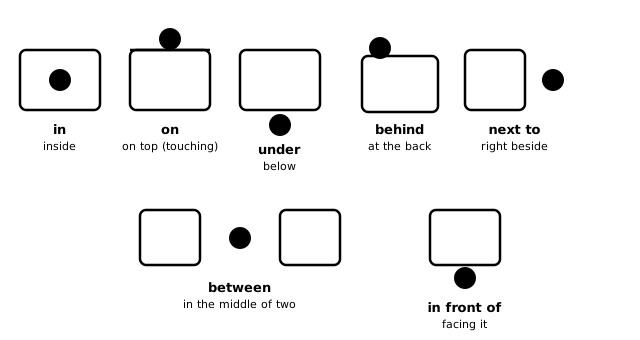
From big to small
When giving a place, remember the order — in → on → at:
in the country → in the city → on the street → at the address. The bigger the place, the more likely "in"; the more exact the point, the more likely "at".
12.2 Prepositions of time — at, on, in
The same three words are used for time, and the rule is the same: from specific to big.
| Preposition | When | Examples |
|---|---|---|
| at | Exact time | at 6 o'clock · at noon · at midnight · at night |
| on | Day / date | on Monday · on 15 August · on my birthday · on Diwali |
| in | Month, year, season, longer periods | in July · in 2026 · in winter · in the morning |
All three in one sentence: The meeting is at 4 pm on Monday in July.
Other time prepositions
| Word | Meaning | Example |
|---|---|---|
| before | earlier than | before lunch |
| after | later than | after school |
| during | throughout a period | during summer |
| since | from a starting point | since Monday |
| for | how long (duration) | for two hours |
| until / till | up to a point in time | until evening |
since vs for — this is caught very often
- Wrong: I am working here since three years.
- Right: I have been working here for three years.
- Why: for = how long (duration) → for three years. since = starting from when (a point) → since 2023.
12.3 The eight types of preposition
Besides place and time, prepositions show other relationships too. Each type answers one question:
| Type | Question | Common words | Example |
|---|---|---|---|
| 1. Place | Where? | in, on, at, under, near, behind, beside, between | The pen is in the box. |
| 2. Time | When? | at, on, in, before, after, since, for, during | I wake up at six. |
| 3. Direction / Movement | Where to? | to, into, onto, from, through, across, towards, along | She walked into the room. |
| 4. Manner / Instrument | How? With what? | by, with, in, on | He wrote it with a pen. · We went by bus. |
| 5. Agent | Who did it (in the passive)? | by | The poem was written by Tagore. |
| 6. Purpose | What for? | for, to | He went for vegetables. |
| 7. Possession | Whose? Who has it? | of, with | The colour of the sky is blue. · a girl with long hair |
| 8. Source | Where from? | from, of, out of | We get milk from cows. |
Eight direction words — which way are we going
Prepositions of direction go with verbs of moving, going and coming (go, walk, run, jump, come). Note — here the thing is not still; it is moving.
| Word | Meaning | Example |
|---|---|---|
| to | as far as the destination (towards it, and arriving) | She goes to school. |
| into | from outside to inside | He jumped into the pool. |
| onto | from below to on top, onto a surface | The cat climbed onto the roof. |
| from | the starting point | I came from Patna. |
| through | passing inside something, from one end to the other | The train went through a tunnel. |
| across | from one side to the other, over the surface | They swam across the river. |
| towards | in the direction of (not necessarily arriving) | The dog ran towards me. |
| along | following the length of something, beside it | We walked along the beach. |
- The children ran towards the gate. = They ran in the direction of the gate — we don't know if they got there.
- There are shops along the road. = The shops stand all the way down the length of the road.
to vs towards — a small difference
to = arriving at the destination — He walked to the station. (he got there)
towards = only the direction — He walked towards the station. (he was heading that way) British English uses "towards", American English often uses "toward" — both are correct.
across vs through vs along
across = over a surface, from one side to the other — across the road
through = passing inside something — through the forest
along = following the length, not crossing — along the river
12.4 Important differences — five pairs that always cause confusion
in vs into
in = position (already inside) — He is in the room.
into = movement (from outside to inside) — He walked into the room.
between vs among
between = two things — The pen is between Ram and Shyam.
among = more than two — He was sitting among his friends.
beside vs besides
beside = next to — Sit beside me.
besides = in addition to — Besides English, I know Hindi.
on vs onto
on = position — The book is on the table.
onto = movement — The cat jumped onto the table.
by vs with
by = the doer (agent) or the means (bus, train, email) — The letter was written by Ravi. · I came by train.
with = a tool held in the hand — He cut the cake with a knife. Trick: a person or a means of travel → by; a tool in your hand → with. "Written by a pen" is wrong — it is "written with a pen".
12.5 The mistakes we really make
The most common preposition mistakes
- Wrong: Let us discuss about the plan.
- Right: Let us discuss the plan.
-
Why: No preposition comes after "discuss". Same with enter the room, not "enter into".
-
Wrong: He is good in English.
- Right: He is good at English.
-
Why: Being skilled at something = good at. Remember: good at maths, good at cricket.
-
Wrong: I will reach at Delhi tomorrow.
- Right: I will reach Delhi tomorrow.
-
Why: "Reach" is followed directly by the place. But "arrive" takes a preposition: arrive in Delhi.
-
Wrong: She is married with a doctor.
- Right: She is married to a doctor.
-
Why: Marriage is always "married to".
-
Wrong: I am afraid from dogs.
- Right: I am afraid of dogs.
-
Why: Fear is always "afraid of".
-
Wrong: Please explain me this.
- Right: Please explain this to me.
- Why: After "explain" comes the thing first, then "to" + the person.
12.6 An easy way to remember
Before choosing a preposition, ask yourself one question — the answer tells you which box to take the word from.

The most common prepositions — learn these first
of · in · to · for · with · on · at · from · by · about · into · through · over · under · after · before · between · among · during · without · against · around · near · behind · across · along · towards · since · until · like The first ten (of to about) appear on almost every page of English — get those right and you've won half the battle.
12.7 Practice — Prepositions
Exercise 1
The class starts ___ 9 am.
- at
- on
- in
- for
Hint: Which one is for an exact time?
Answer
at
Use 'at' with an exact time — at 9 am, at noon, at midnight.
Exercise 2
My birthday is ___ December.
- at
- on
- in
- to
Answer
in
Use 'in' with months — in December, in 2026, in winter.
Exercise 3
The medical store is ___ the bank and the school.
- between
- among
- near
- beside
Hint: There are two things.
Answer
between
In the middle of two things = between. With more than two it would be 'among'.
Exercise 4
There is one mistake in this sentence — tap that word.
Let us discuss about the budget tomorrow.
Answer
Wrong word: about.
Corrected: Let us discuss the budget tomorrow.
'Discuss' isn't followed by 'about' — the thing comes straight after it.
Exercise 5
Find the wrong word.
She is very good in mathematics.
Answer
Wrong word: in.
Corrected: She is very good at mathematics.
Being skilled in a subject = good at.
Exercise 6
I have been waiting ___ two hours.
Hint: Is it a duration or a point in time?
Answer
for
How long = for. If it were 'since 3 o'clock', that would be a point in time.
Exercise 7
The keys are ___ the table.
Hint: They are lying on top of the table.
Answer
on
On a surface = on.
Exercise 8
The dog ran ___ me, but stopped halfway.
- towards
- into
- onto
- at
Hint: You need the direction, not arriving.
Answer
towards
'towards' shows only the direction — heading that way, without necessarily arriving. 'to' would suggest it got there.
Exercise 9
We took a long walk ___ the beach. (following its edge)
Hint: Walking beside something long.
Answer
along
Walking beside something long (a road, river, beach) = along. To cross it, it would be 'across'.
Exercise 10
He opened the lock ___ a hairpin.
- with
- by
- from
- of
Hint: A tool held in the hand.
Answer
with
Use 'with' for a tool (instrument) — with a key, with a knife. 'by' is for the doer (agent) or a means of travel: by Ravi, by bus.
Exercise 11
Which type of preposition answers the question 'Where to?'
- Direction / Movement
- Place
- Time
- Purpose
Hint: Look at the grid you learned.
Answer
Direction / Movement
Where? = place, When? = time, Where to? = direction (to, into, through, across, towards, along), How? = manner, Why? = purpose.
Exercise 12
Match each preposition to its meaning.
| A | B |
|---|---|
| into | right next to |
| among | in addition to |
| beside | moving from outside to inside |
| besides | in the middle of more than two |
Answer
into — moving from outside to inside; among — in the middle of more than two; beside — right next to; besides — in addition to
into = movement, among = between more than two, beside = next to, besides = in addition to.
Exercise 13
Put the words in the right order.
Words: stop / shop / The / is / to / bus / the / next
Answer
The shop is next to the bus stop
Subject + verb + prepositional phrase — that is the straightforward English order.
Exercise 14
Now say this line aloud — join 'next to' together.
The shop is next to the bus stop
Answer
Say: The shop is next to the bus stop
When spoken, 'next to' sounds almost like one word — 'nekstu'.
What to do next
Prepositions come from listening, not from memorising. From today, whenever you hear English, notice where the small words fall. You'll see the difference in a week.