Chapter 23: Conditionals
If sentences — condition and result
A conditional sentence means: if this, then that. We say it in Hindi every day — "agar baarish hogi to match nahi hoga". English has four kinds of "if" sentences, and the only difference between them is one thing: how possible the idea is. A certain thing, a likely thing, an unlikely thing, and a thing that can never happen now. Four levels of possibility, four formulas. And one golden rule that gets broken more than any other: never "will" after "if".
- 1Four branches — with their likelihood
- 2Zero conditional — what always happens
- 3First conditional — a real possibility
- 4Second conditional — imagination and advice
- 5Third conditional — what could not happen
- 6Mixed conditional — two times in one sentence
- 7Other forms of "if"
- 8The mistakes we really make
In one line
A conditional sentence has two parts: the if-clause (the condition) and the main clause (the result). The order can be switched. If the "if" part comes first, a comma goes in the middle; if it comes second, no comma.
- If it rains, we will stay home. "If" came first — so a comma.
- We will stay home if it rains. "If" came second — no comma. The meaning is exactly the same.
23.1 Four branches — with their likelihood
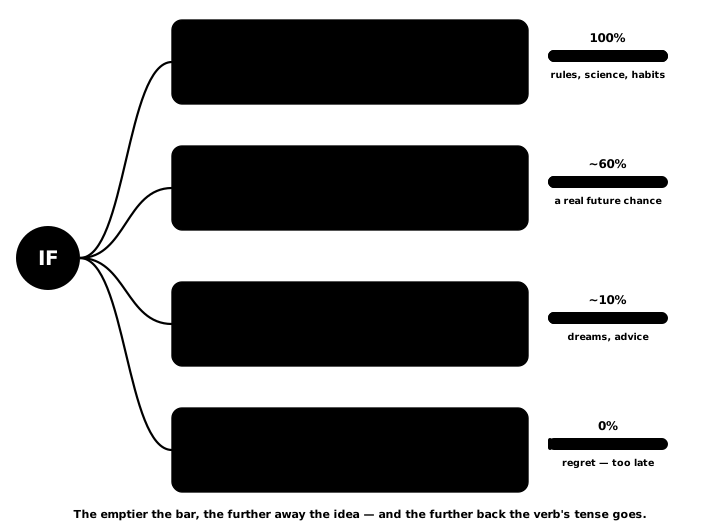
The picture below shows each kind of "if" sentence with its likelihood. The fuller the bar, the more likely the idea.
23.2 Zero conditional — what always happens
Here "if" means almost the same as "when". This is the form for rules, science, machines and habits. Both sides use the present simple.
- If you heat water to 100 °C, it boils. It always happens — no doubt about it.
- If the light turns red, the traffic stops. It is a rule. "When" would work here too.
23.3 First conditional — a real possibility
A real thing about the future. It may happen, or it may not. This is the form used most in speech — plans, promises, threats and warnings all use it.
| Use | Example |
|---|---|
| Plan | If the train is on time, we will reach by eight. |
| Promise | If you help me today, I will help you tomorrow. |
| Warning | If you touch that wire, you will get a shock. |
| Condition / deal | If you finish the work, you can go early. |
The golden rule — no 'will' after 'if'
- Wrong: If it will rain, we will cancel the match.
- Right: If it rains, we will cancel the match.
- Why: "Will" appears only once in a sentence, and it goes in the result part. The condition part stays in the present simple, even if the idea is about tomorrow.
The same rule holds with when, after, before, until, as soon as, unless.
Other words can replace will
In the result part of a first conditional you can also use can, may, should, must or a command:
If you are tired, you should rest.
If he calls, tell him I am busy.
23.4 Second conditional — imagination and advice
For things that are unlikely or imaginary in the present situation. See how the verb goes into the past, yet the idea is not about the past — it is about now. That is why it is also called the "unreal present".
- If I won a lottery, I would buy a house for my parents. Winning a lottery is unlikely — so the past form, but the idea is about today.
- If I were you, I would speak to the manager. The most polite and natural way to give advice.
'If I were' — not 'was' here
In the second conditional the form of "be" is were — with every subject.
If I were rich… · If he were here… · If she were in charge… You will hear "If I was you" in casual talk, but the correct form, and the one that sounds better, is "If I were you" — and it is the standard sentence for giving advice all over the world.
23.5 Third conditional — what could not happen
Time that has passed and cannot be changed. It is used for regret, blame, or "if only it had been so". Each side steps one more tense back: had + V3 and would have + V3.
- If I had left earlier, I would not have missed the train. I didn't leave early, and I missed the train. Nothing can be done now.
- If she had told me, I could have helped her. Could / might can replace "would" — the shade of possibility changes.
23.6 Mixed conditional — two times in one sentence
Sometimes the condition is in the past and the result is today, or the other way round. Then the forms of both sides are mixed. It is advanced, but very useful — because real life works like this.
| Type | Formula | Example | Meaning |
|---|---|---|---|
| Past condition → result today | If + had + V3 , would + V1 | If I had studied engineering, I would be an engineer today. | I didn't study it, so I'm not an engineer today. |
| Situation today → result in the past | If + past simple , would have + V3 | If I were braver, I would have told him the truth. | I'm not a brave person, so I didn't tell the truth at that time. |
23.7 Other forms of "if"
| Word | Meaning | Example |
|---|---|---|
| unless | if not | You will fail unless you work hard. |
| as long as | for as long as | You can stay as long as you keep quiet. |
| provided that | only on the condition that | I will sign it provided that you read it first. |
| in case | because it might happen | Take an umbrella in case it rains. |
| even if | no matter whether | Even if you apologise, he will not forgive you. |
| otherwise | or else | Hurry up, otherwise we will be late. |
No second 'not' with 'unless'
- Wrong: Unless you do not hurry, you will miss the bus.
- Right: Unless you hurry, you will miss the bus.
- Why: "Unless" already has a "not" hidden inside it (= if you do not hurry). Adding another "not" reverses the meaning.
23.8 The mistakes we really make
Top conditional mistakes
- Wrong: If I will go to Delhi, I will meet you.
- Right: If I go to Delhi, I will meet you.
-
Why: No will in the condition part — use the present simple. Will appears only once in a sentence.
-
Wrong: If he would come, I would be happy.
- Right: If he came, I would be happy.
-
Why: In the second conditional the "if" part takes the past simple, not would. Would belongs only in the result.
-
Wrong: If I was you, I would not accept that offer.
- Right: If I were you, I would not accept that offer.
-
Why: Imaginary situations take "were", with every subject. This is the standard sentence for giving advice.
-
Wrong: If she would have told me, I would have helped.
- Right: If she had told me, I would have helped.
-
Why: In the third conditional the condition is "had + V3". "Would have" belongs only in the result part.
-
Wrong: If you would study hard, you will pass.
- Right: If you study hard, you will pass.
-
Why: Mixing two modals makes the sentence confusing. Stick to one plain formula.
-
Wrong: I will tell you if he will come.
- Right: I will tell you if he comes.
- Why: Even when "if" comes second, the rule is the same — present after if.
Four formulas, one line each
Zero: if + present, present
First: if + present, will + V1
Second: if + past, would + V1
Third: if + had + V3, would have + V3 See — will/would never appear in the "if" part. This one point prevents 90% of mistakes.
23.9 Practice — Conditionals
Exercise 1
If it ___ tomorrow, we will cancel the picnic.
- will rain
- rains
- would rain
- rained
Hint: Which form comes after if?
Answer
rains
This is a first conditional — the if part takes the present simple (rains) and the result takes will. 'If it will rain' is the most common mistake.
Exercise 2
If I ___ a bird, I would fly to the mountains.
- am
- was
- were
- will be
Hint: It is imaginary — which form of be?
Answer
were
In the second conditional the form of 'be' is always 'were' — whether the subject is I, he or she. 'If I were a bird' is correct.
Exercise 3
If you had called me, I ___ at the station.
- will come
- would come
- would have come
- came
Hint: What is the result of a third conditional like?
Answer
would have come
Third conditional — about the past. The condition is 'had called', so the result is 'would have come'. It can't happen now; there is only regret.
Exercise 4
Which sentence is a zero conditional?
- If I get time, I will call you.
- If you mix blue and yellow, you get green.
- If I were rich, I would travel.
- If he had tried, he would have won.
Hint: Which one is always true?
Answer
If you mix blue and yellow, you get green.
A zero conditional has the present simple on both sides and is always true — the result of mixing colours never changes.
Exercise 5
If I ___ (have) more time, I would learn the guitar.
Hint: Second conditional — there is no time right now.
Answer
had
The second conditional takes the past simple after if. Writing 'had' doesn't mean the past — it means 'I don't have time now'.
Exercise 6
You will not pass ___ you work hard.
Hint: One word for 'if not'.
Answer
unless
'Unless' means 'if not'. The 'not' is already hidden inside it, so don't add another 'not'.
Exercise 7
If water ___ (freeze), it becomes ice.
Hint: Always true — zero conditional.
Answer
freezes
A zero conditional has the present simple on both sides. 'Water' is singular, so 'freezes' — it takes -s.
Exercise 8
There is one mistake in this sentence — tap the wrong word.
If I will get the job, I shall shift to Pune.
Answer
Wrong word: will.
Corrected: If I get the job, I shall shift to Pune.
Will/shall never appears in the if part. There the present simple stays — 'If I get'.
Exercise 9
Find the wrong word.
If I was the captain, I would change the batting order.
Answer
Wrong word: was.
Corrected: If I were the captain, I would change the batting order.
For an imaginary situation (I am not the captain) we use 'were', not 'was'.
Exercise 10
One word is wrong — catch it.
If she would have asked me, I might have helped her.
Answer
Wrong word: would.
Corrected: If she had asked me, I might have helped her.
In the third conditional the condition is 'had + V3'. 'If she would have' is wrong — it should be 'If she had'. Would/might have belong only in the result part.
Exercise 11
Put the words in order to make a second conditional.
Words: I / job / take / were / you / that / I / If / would
Answer
If I were you I would take that job
The standard form of advice — 'If I were you, I would…'. Remember: 'were' in the if part, 'would + V1' in the result.
Exercise 12
Match each conditional with its meaning.
| A | B |
|---|---|
| If you heat ice, it melts | not true now — imagination |
| If I get leave, I will come | impossible now |
| If I had a car, I would drive | always true |
| If I had known, I would have come | possible |
Answer
If you heat ice, it melts — always true; If I get leave, I will come — possible; If I had a car, I would drive — not true now — imagination; If I had known, I would have come — impossible now
Zero = a rule. First = a real possibility. Second = imagining today. Third = the past, which can no longer be changed.
Exercise 13
Now say this line aloud — the most useful sentence for giving advice.
If I were you I would not worry about it
Answer
Say: If I were you I would not worry about it
When speaking, say 'If I were you' in one breath — it sounds almost like a single phrase. This line is useful every day, at work and with friends.
What to do next
Do one thing today: write four sentences about yourself — one zero ("If I skip breakfast, I get a headache"), one first, one second and one third. Write about real things in your life. A sentence that is your own sticks in memory faster than any formula.