Chapter 46: Advanced vocabulary
Advanced words — the ones educated people really use
Memorising advanced words does not help much — if you learn "Hegemony means dominance", you will never say it properly. A word sticks in your mind through its place: the kind of sentence it appears in, the kind of people who use it, and the words that travel with it. That is why, in this chapter, every word comes with its world — not just a definition.
- 1Eighteen words, one by one
- 2Where do these words live — a map
- 3At a glance — word, partner words, pronunciation
- 4Word traps — words that sound alike
- 5Mistakes people make with these words
- 6One paragraph — five words, each in its place
In one line
A new word is not yours until you can say one real sentence with it without thinking. Remembering the meaning is half the job; remembering where the word lives is the whole job.
46.1 Eighteen words, one by one
nefarious — evil, with a planned, sneaky purpose
This word does not just mean "bad" — it carries hidden, planned wrongdoing. You see it in news, crime stories and films. The fun part: these days people also use it as a joke — "nothing nefarious, I promise". Words that go with it: nefarious scheme, nefarious purpose, nefarious activities.
- The account was being used for something nefarious — fake invoices, mostly. = Someone was using the account for a dishonest purpose, mostly to make false invoices.
myriad — too many to count
It means "a great many", but with the feeling of impossible to count. The biggest mistake is putting a singular noun after "a myriad of". Both forms are fine: myriad reasons (clean and short) or a myriad of reasons. But the noun after it is always plural.
- There are myriad reasons why the launch slipped, but three matter most. = The launch was late for a huge number of reasons, but only three are really important.
bucolic — like the countryside: peaceful and green
Bucolic is a picture of fields, meadows, cows and goats, and slow living — like a village in a painting. It always carries a feeling of love and calm, never poverty or backwardness. When to use it: it is a literary word — travel writing, books, reviews. In speech, peaceful countryside or rural sounds more natural. Words that go with it: bucolic setting, bucolic charm, bucolic landscape. Pronunciation: byoo-KOL-ik.
- The homestay sits in a bucolic valley of tea gardens and slow rivers. = The homestay is in a calm, green country valley with tea gardens and quiet rivers.
guile — cleverness, trickery
Guile is a noun — the cleverness used to fool other people. Note: the adjective guileful is not really used; people say cunning. But guileless (innocent, with no trickery) is a lovely word and is used as praise.
- He won that negotiation with pure guile, not numbers. = He won the talks by being clever and tricky, not because of facts and figures.
onerous — heavy, tiring (a task or a condition)
The work is not necessarily hard — it is like a burden. It is most often used with contract, rules, paperwork, duty. In an office email it complains politely: you are not saying "this is nonsense", only "this is a burden".
- The reporting requirements are onerous for a team of three. = The reporting rules are too heavy a load for a team of only three people.
enigmatic — puzzling, hard to understand
A person, a smile, an answer, or someone's behaviour — when it is not clear what is going on inside. It carries interest, not evil. If someone is simply quiet, they are reserved; an enigmatic person is someone you keep wondering about.
- Her reply was enigmatic — a single line that could mean yes or no. = Her answer was a puzzle: one line that might mean yes or might mean no.
lurid — shocking, sensational
Two meanings, both with a feeling of "too much": (1) a story or news report full of deliberately shocking, dirty or bloody detail; (2) colours that are harsh and glaring. The word always comes with a bit of disapproval. When to use it: news, reviews, criticism — the most common pair is lurid details. It is rare in conversation, but everyone understands it. Pronunciation: LOOR-id.
- The tabloid printed every lurid detail of the case. = The newspaper published every shocking, gossipy detail of the case.
hegemony — one power's total control
A word from politics, history and business analysis. It means: one country, company or group is so dominant that everyone else follows its lead. Do not use this word in everyday talk — it is very heavy. Pronounce it carefully: hi-JEM-uh-nee.
- Two companies share almost complete hegemony over the search market. = Just two companies control almost the whole search market.
felicity — deep happiness; or a perfect, beautiful way of putting something
Felicity is a noun with two meanings: (1) deep, peaceful happiness — in old, written language; (2) the exactly right and beautiful choice of words — felicity of expression. The opposite, infelicitous (awkward, out of place), is often used by editors and critics. When to use it: very literary — wedding cards, speeches, literary criticism. In daily life use happiness or joy. Pronunciation: fuh-LIS-ih-tee.
- Her essays are admired for their felicity of expression. = People admire her essays because her word choices are so exact and beautiful.
- We wish the couple a lifetime of felicity. = We hope the couple will be happy for their whole lives. (Formal and old-fashioned.)
censure — official or formal criticism
This is not ordinary anger — it has an official feeling. A committee, board, parliament or institution censures someone. Be careful: it is a completely different word from censor (to cut out or remove a part); they only sound alike.
- The board voted to censure him, though he kept his seat. = The board voted to formally criticise him, but he stayed in his position.
jettison — throw off a load; give something up
The original picture: throwing cargo off a ship or plane to make it lighter. That gave us today's meaning — to drop a plan, feature or habit because you have to. It carries the feeling of giving something up to survive, so it is very common in business and project talk.
- We had to jettison half the features to ship on time. = We had to drop half the features so we could release on time.
disparate — completely different, not fitting together
Not just "different" — so different that putting them together is hard. That is why it usually appears as disparate sources, disparate systems, disparate groups. Pronunciation: DIS-puh-rut.
- The report pulls together data from three disparate systems. = The report gathers data from three very different systems in one place.
insidious — harming slowly, from the inside
The most important point: it has slow speed. Something you cannot see at first, and by the time you notice it, a lot of damage is done — that is insidious. It goes with disease, habits, rumours and ideas. An explosion is not insidious.
- The most insidious part is how normal it starts to feel. = The most dangerous part is that, slowly, it all begins to seem normal.
keen — very eager; or sharp (eyes, mind)
The most useful word on this list, and the easiest. Two meanings: (1) keen to / keen on = eager about something — great for interviews. (2) a keen eye, a keen sense = sharp eyesight, a sharp understanding. One more useful fact: in British English, "I'm not keen on it" is a very polite way of saying no.
- I'm keen to take on more responsibility this year. = I really want to take on more responsibility this year.
- She has a keen eye for detail — nothing gets past her. = She notices small details very well — she misses nothing.
auspicious — lucky, a good sign
In India this word is used every day — weddings, housewarmings, new ventures. Native English speakers elsewhere use it less, but everyone understands it. Note: a thing is an auspicious occasion / auspicious day; a person is not. The opposite is inauspicious.
- They picked an auspicious date for the opening. = They chose a lucky date for the opening.
ubiquitous — found everywhere
A favourite word for talking about technology and trends: smartphones are ubiquitous. It carries a light feeling of "it is ordinary now". Pronunciation: yoo-BIK-wi-tus.
- QR codes were rare five years ago; now they're ubiquitous. = You hardly saw QR codes five years ago; now you see them everywhere.
ephemeral — lasting a very short time
It has both beauty and a little sadness. A status update, a story, fashion, weather, happiness — anything that came and went. The word is a bit literary, so it fits better in writing. Pronunciation: ih-FEM-er-ul.
- Social media fame is ephemeral — gone in a week. = Fame on social media lasts a very short time — it disappears within a week.
pragmatic — practical; whatever works is fine
The second most useful word on this list. It means: looking at results instead of theory. It is great for describing yourself in an interview — and it is a word of praise.
- Let's be pragmatic — ship the simple version now, improve it later. = Let's be practical: release the simple version now and make it better later.
46.2 Where do these words live — a map
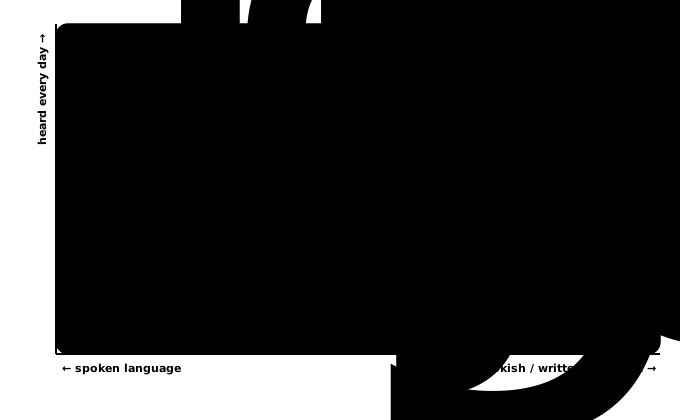
Link each word to its place. The map below shows two things together: how formal a word is (the further right, the more formal), and how often you will hear it (the higher up, the more common). Do not try the words in the bottom-right corner in speech — they are for reading.
46.3 At a glance — word, partner words, pronunciation
"Partner words" (collocations) are the most useful column: they show what comes before and after the word. Native speakers remember words in pairs and groups, not alone.
| Word | Meaning (plain English) | Partner words | Pronunciation |
|---|---|---|---|
| nefarious | wicked, with a planned purpose | scheme, purpose, activities | ni-FAIR-ee-us |
| myriad | too many to count | myriad reasons / ways / forms | MIH-ree-ud |
| bucolic | calm and green, like the countryside | bucolic setting / charm / landscape | byoo-KOL-ik |
| guile | cleverness, trickery (noun) | with guile, without guile, guileless | GY-ul |
| onerous | like a burden, heavy | onerous terms / duty / requirements | OH-nur-us |
| enigmatic | puzzling, mysterious | enigmatic smile / figure / reply | eh-nig-MA-tik |
| lurid | shocking, sensational; glaring (colour) | lurid details / headlines / colours | LOOR-id |
| hegemony | one power's total control | hegemony over, cultural hegemony | hi-JEM-uh-nee |
| felicity | deep happiness; exact, beautiful wording | felicity of expression, infelicitous | fuh-LIS-ih-tee |
| censure | formal, official criticism | vote to censure, public censure | SEN-shur |
| jettison | to give up because you must | jettison a plan / feature / idea | JET-ih-sun |
| disparate | very different, not matching | disparate sources / systems / groups | DIS-puh-rut |
| insidious | harming slowly and unnoticed | insidious effect / spread / habit | in-SID-ee-us |
| keen | eager; or sharp (eyesight) | keen to, keen on, a keen eye | keen |
| auspicious | lucky, a good sign | auspicious day / occasion / start | aw-SPISH-us |
| ubiquitous | found everywhere | ubiquitous in, has become ubiquitous | yoo-BIK-wi-tus |
| ephemeral | lasting a very short time | ephemeral fame / beauty / trend | ih-FEM-er-ul |
| pragmatic | practical | a pragmatic approach, be pragmatic | prag-MA-tik |
46.4 Word traps — words that sound alike
Watch these pairs carefully
censure (to criticise) vs censor (to cut out a part) — completely different jobs.
ephemeral (short-lived) vs ethereal (light, heavenly) — both poetic, but the meanings differ.
disparate (very different) vs desperate (in great need) — the spelling is one letter apart, the meaning is miles apart.
pragmatic (practical) vs dogmatic (stubborn about your own view) — one is praise, the other is a complaint.
46.5 Mistakes people make with these words
Watch out
- Wrong: There are a myriad of reason for this.
- Right: There are myriad reasons for this.
-
Why: After myriad, the noun is always plural. And "myriad reasons" is cleaner — "a myriad of" feels a little heavy.
-
Wrong: The bomb had an insidious effect on the building.
- Right: The bomb had a devastating effect on the building.
-
Why: Insidious needs slow speed. For damage that happens in one blow, use devastating.
-
Wrong: He is a very auspicious person.
- Right: It was an auspicious day to start.
-
Why: Auspicious is for days, chances and beginnings — not for people.
-
Wrong: The committee decided to censor the minister for his remarks.
- Right: The committee decided to censure the minister for his remarks.
-
Why: Censure = to criticise formally. Censor = to cut out and remove a part. One letter, a completely different meaning.
-
Wrong: I am keen for learning new tools.
- Right: I am keen to learn new tools.
-
Why: There are only two patterns: keen to + verb, or keen on + -ing. "Keen for" is not used.
-
Wrong: Our team has hegemony in this office.
- Right: Our team has a lot of influence in this office.
- Why: Hegemony is a word for the scale of countries, markets and cultures. It is far too big for an office.
46.6 One paragraph — five words, each in its place
Read it, then say it aloud
Cheap smartphones are now ubiquitous, and that has created myriad small businesses that did not exist ten years ago. Most are ephemeral — up one month, gone the next. The ones that last are run by pragmatic people who jettison whatever stops working. Notice: these are five heavy words, yet no sentence feels stiff, because each word sits in its right place.
46.7 Practice — Advanced vocabulary
Exercise 1
A habit that stays hidden for years and slowly does damage. Which word?
- insidious
- nefarious
- ephemeral
- onerous
Hint: The speed must be slow.
Answer
insidious
Insidious needs a slow, hidden pace. Nefarious means planned wickedness, and ephemeral means short-lived.
Exercise 2
Which word is best for describing yourself in an interview?
- pragmatic
- enigmatic
- nefarious
- onerous
Answer
pragmatic
Pragmatic is a word of praise — a person who looks at results. Enigmatic would suggest nobody can understand you, which is not good in an interview.
Exercise 3
Which sentence is correct?
- There are myriad reasons for the delay.
- There are a myriad of reason for the delay.
- There is myriad reason for the delay.
- There are myriads reason for the delay.
Answer
There are myriad reasons for the delay.
The noun after myriad is plural. 'Myriad reasons' is the cleanest form.
Exercise 4
To release the project on time, we had to drop half the features. Which verb?
- jettison
- censure
- enhance
- demonstrate
Answer
jettison
Jettison = to throw off a load in order to survive. The picture comes from throwing cargo off a ship.
Exercise 5
I'm ___ to take on more responsibility this year.
Hint: Eager — the interview word.
Answer
keen / eager
Keen to + verb. Remember: 'keen for learning' is wrong; 'keen to learn' or 'keen on learning' is right.
Exercise 6
The report pulls together data from three ___ systems that were never meant to talk to each other.
Hint: So different that they do not fit together.
Answer
disparate
Disparate = completely different in kind. It is stronger than just 'different' — it carries the feeling of 'hard to join'.
Exercise 7
One word has been chosen wrongly — tap it.
The board voted to censor the minister for his remarks.
Answer
Wrong word: censor.
Corrected: The board voted to censure the minister for his remarks.
Censure = formal criticism. Censor = to cut out and remove a part. They sound alike, but the meanings are different.
Exercise 8
This word does not describe a person — find it.
My uncle is a very auspicious man in our town.
Answer
Wrong word: auspicious.
Corrected: My uncle is a well-respected man in our town.
Auspicious is for days, chances and beginnings. For a person, use 'respected' or 'well-regarded'.
Exercise 9
Match each word to its real feeling.
| A | B |
|---|---|
| hegemony | a heavy, burdensome task |
| guile | over in a moment |
| onerous | one power controlling everything |
| ephemeral | getting things done by cleverness |
Answer
hegemony — one power controlling everything; guile — getting things done by cleverness; onerous — a heavy, burdensome task; ephemeral — over in a moment
All four are heavy words — recognise and read them first; speak them later.
Exercise 10
Match each word to its partner words.
| A | B |
|---|---|
| keen | has become ubiquitous |
| nefarious | an enigmatic smile |
| ubiquitous | a keen eye for detail |
| enigmatic | a nefarious scheme |
Answer
keen — a keen eye for detail; nefarious — a nefarious scheme; ubiquitous — has become ubiquitous; enigmatic — an enigmatic smile
Native speakers do not remember a word alone — they remember it in a pair. If you know the pair, the word falls into the right place by itself.
Exercise 11
Build the sentence — about technology.
Words: were / they / five / ago / QR / are / rare / but / years / now / codes / ubiquitous
Answer
QR codes were rare five years ago but now they are ubiquitous
Ubiquitous often comes with 'now' and a before-and-after comparison — that is its natural home.
Exercise 12
You want to describe a calm, green village in a travel blog. Which word?
- bucolic
- lurid
- onerous
- insidious
Hint: Fields, meadows, peace.
Answer
bucolic
Bucolic = calm and beautiful like the countryside. It is a literary word, so it fits a blog or a book. Lurid is the opposite — glaring and sensational.
Exercise 13
One word has been chosen wrongly — tap it.
The tabloid printed every bucolic detail of the murder.
Answer
Wrong word: bucolic.
Corrected: The tabloid printed every lurid detail of the murder.
Shocking, bloody detail = lurid details. Bucolic is for the peace of the countryside.
Exercise 14
Critics praised the poet for the ___ of her expression — every word felt exactly right.
Hint: The exact, beautiful choice of words — a noun.
Answer
felicity
'Felicity of expression' = the exactly right and beautiful choice of words. A very literary word — not for daily talk.
Exercise 15
Match the new words to their meanings.
| A | B |
|---|---|
| bucolic | deep happiness or exact wording |
| lurid | give up because you must |
| felicity | calm like the countryside |
| jettison | shocking, sensational |
Answer
bucolic — calm like the countryside; lurid — shocking, sensational; felicity — deep happiness or exact wording; jettison — give up because you must
Bucolic and felicity are literary; lurid is common in the news. Recognise all three when reading first, then try them in writing.
Exercise 16
When is a new word counted as really yours?
- When you can say one real sentence with it without thinking
- When you remember its spelling
- When you remember the dictionary definition
- When you remember its Hindi meaning
Answer
When you can say one real sentence with it without thinking
Remembering the definition is half the job. A word is yours when you remember its place and its partner words.
Exercise 17
Say this line. Put the stress in the middle of 'pragmatic' — prag-MA-tik.
Let us be pragmatic and ship the simple version now
Answer
Say: Let us be pragmatic and ship the simple version now
This is a real line from office meetings. Saying 'Let's be pragmatic' makes you sound sensible, not stubborn.
What to do next
Do not pick up all eighteen words at once. Look at the map, choose the five orange-dot words — keen, pragmatic, ubiquitous, auspicious, enigmatic — and use them this week. For the blue-dot words, it is enough to recognise them when you read; they will come to your tongue in their own time.