Chapter 54: Easy stories
Short stories — listen, understand, write
You have studied the grammar and learnt the words — but when someone speaks English, it all sounds fast. There is only one cure: listen a little every day. This chapter has six short stories — Priya's first day, a phone lost on a train, the Sunday market, a surprise party, a rainy day and the new neighbours. Listen to each story first, then open the transcript. At the end, in the quiz, you will answer by listening and write by listening (dictation).
- 1How to listen — before, during, after
- 2Story 1 — Priya's first day
- 3Story 2 — The lost phone
- 4Story 3 — Sunday at the market
- 5Story 4 — The birthday surprise
- 6Story 5 — A rainy day
- 7Story 6 — The new neighbour
- 8Getting ready for dictation — five listening mistakes
54.1 How to listen — before, during, after
A good listener does not just press 🔊 and start. They listen in three steps: before listening they make a guess, while listening they catch only what matters, and after listening they check against the transcript.
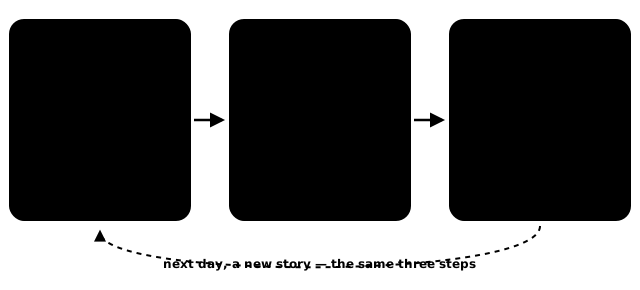
Listen twice, then read
The first time, listen for the gist (roughly what happened); the second time, for the detail (names, times, places). Use the transcript only in the third step. You don't need to understand every word — you need to understand the story.
Keep five questions in mind for every story. This "story map" fits every story — and most quiz questions come from it.

54.2 Story 1 — Priya's first day
Priya lives in Pune, and it is the first day of her new job. The story is in the past simple (woke, wore, took, was). Listen: how was Priya feeling in the morning, and who sat with her at lunch?
| Word | Meaning |
|---|---|
| nervous | worried or a little afraid |
| manager | boss, the person in charge |
| introduced | made people meet each other |
| colleagues | people who work with you |
| wore | had clothes on (past of wear) |
🎧 Listen to the whole story
- Story 1 — Priya's first day First time: what happened? Second time: catch the names and times.
Transcript
Priya is twenty-three years old, and she lives in Pune. Last Monday was her first day at a new job. She woke up at six o'clock and wore her new blue kurta. She took a bus to the office. She was a little nervous. Her manager, Mr Desai, was very kind. He showed her the office and introduced her to the team. At lunch, two colleagues, Neha and Farhan, sat with her. In the evening, Priya called her mother. She said that she loved her new job.
- She was a little nervous. She was slightly worried. "a little" = a small amount — not very.
- He showed her the office and introduced her to the team. He took her around the office and helped her meet the team. In "showed her", "her" is said very softly — "sho-der".
- She said that she loved her new job. She told her mother she really liked her new job. By evening, her nervousness had turned into happiness.
The -ed sound is short
The -ed of the past simple is said in three ways: called (d), walked (t), wanted (id). The sound is soft — listen carefully. This is the sound that gets dropped most often in dictation.
54.3 Story 2 — The lost phone
Arjun takes the Mumbai local train to the office. One day, in the crowd, his phone goes missing. Listen: where was the phone found, and how did Arjun feel when he could not find it?
| Word | Meaning |
|---|---|
| crowded | full of people |
| got off | left a train or bus |
| exit | the way out |
| explained | told someone clearly what happened |
| thanked | said "thank you" |
🎧 Listen to the whole story
- Story 2 — The lost phone Notice: the story starts in the present (takes — a daily habit), then moves into the past.
Transcript
Arjun takes the local train to work every day. On Friday, the train was very crowded. He got off at Dadar station and walked to the exit. Then he put his hand in his pocket. His phone was not there! He felt terrible. He ran back, but the train was gone. A railway policeman asked him what was wrong, and Arjun explained. The policeman called the next station. An hour later, a kind woman brought the phone to the station office. She found it under a seat. Arjun thanked her again and again.
- Arjun takes the local train to work every day. Arjun goes to work by local train daily. "every day" = a daily habit → present simple.
- His phone was not there! He felt terrible. The phone was missing! He felt very bad. "terrible" = very bad — here, fear and worry.
- She found it under a seat. The phone was lying below a seat. "found it" runs together and sounds like "faun-dit".
A listening mistake — words that run together
- Wrong: He gotto fat Dadar station.
- Right: He got off at Dadar station.
- Why: In speech, "got off at" becomes one long sound — "go-to-fat". When you hear a strange word, ask yourself: which two or three short words have joined together?
54.4 Story 3 — Sunday at the market
Every Sunday, Meena goes to the vegetable market with her grandfather. The story has both the present simple (habit) and the past simple (what happened today). Listen: why do they go early, and what did Meena buy today?
| Word | Meaning |
|---|---|
| fresh | new, not old or stale |
| stalls | small open shops, carts |
| expensive | costs a lot of money |
| instead | in place of that |
| heavy | weighs a lot |
🎧 Listen to the whole story
- Story 3 — Sunday at the market Watch the numbers: what time did they leave, and how much were the mangoes?
Transcript
Every Sunday, Meena and her grandfather go to the vegetable market near their house. They leave early, at seven, because the vegetables are fresh in the morning. Grandfather always buys tomatoes, onions and green chillies. Meena likes the fruit stalls. Today she wanted mangoes, but they were very expensive. They cost two hundred rupees a kilo! So she bought bananas instead. Grandfather talked to all the shopkeepers, because he knows everyone. They walked home slowly with two heavy bags.
- They leave early, because the vegetables are fresh in the morning. They set out early since vegetables are fresh in the morning. After "because" you always get the reason — the answer to a "why?" question is right here.
- So she bought bananas instead. So she bought bananas in place of mangoes. When you hear "instead", know that the plan changed.
- Grandfather talked to all the shopkeepers, because he knows everyone. Grandfather chatted with every shopkeeper, since he knows them all. "knows" is present — it is always true.
because = the door to the reason
When the question is "Why…?", wait for because or so in the story. After because comes the reason; after so comes the result. These two little words give you half the answer to "why" on their own.
54.5 Story 4 — The birthday surprise
It is Rahul's birthday, but it seems everyone has forgotten. The story has a twist — pay attention to "but" and "when". Listen: why was Rahul sad in the afternoon, and where was the party?
| Word | Meaning |
|---|---|
| busy | having a lot to do |
| terrace | the flat roof of a house |
| shouted | said something very loudly |
| planned | decided in advance how to do something |
| surprise | something happy you did not expect |
🎧 Listen to the whole story
- Story 4 — The birthday surprise After "but" comes the worry; after "When he opened the door" comes the twist.
Transcript
Saturday was Rahul's birthday, but his wife, Anjali, said she was busy all day. Rahul was a bit sad. In the evening, she asked him to come up to the terrace for some fresh air. When he opened the door, the lights came on. All his friends were there! They shouted happy birthday and laughed. There was a big chocolate cake on the table. Anjali planned the party for two weeks, and Rahul knew nothing about it. He said it was the best birthday of his life.
- His wife said she was busy all day. Rahul was a bit sad. His wife said she would be busy all day, and Rahul felt a little low. The reason and the feeling come one after the other — that is the answer to "why was he sad?"
- When he opened the door, the lights came on. The moment he opened the door, the lights switched on. "came on" = began to work (for lights, TV).
- It was the best birthday of his life. No other birthday in his life had been better. The whole journey of the story: from sadness to joy.
54.6 Story 5 — A rainy day
Heavy rain in Kolkata — schools closed, and a fun day for a little girl. This story is full of time words: on Tuesday morning, in the afternoon, in the evening. Listen: why was Tara at home, and what did the children make?
| Word | Meaning |
|---|---|
| heavily | very strongly, in large amounts |
| closed | shut, not open |
| paper boats | toy boats folded from paper |
| sailed | made a boat move on water |
| the power went off | the electricity stopped |
🎧 Listen to the whole story
- Story 5 — A rainy day The time words make a map: morning → afternoon → evening.
Transcript
On Tuesday morning, it rained very heavily in Kolkata. The streets were full of water, and the schools closed. Ten-year-old Tara was happy. She stayed at home with her little brother, Babu. They made paper boats and sailed them in the water near the gate. Their mother made hot pakoras and tea. In the afternoon, the power went off, so Tara read a story book by the window. In the evening, the rain stopped and the sky turned orange.
- The streets were full of water, and the schools closed. There was water everywhere on the roads, so the schools shut. The reason Tara stayed at home is in this very line.
- Tara read a story book by the window. Tara read a storybook next to the window. Here "read" is past, and it is said "red" — not "reed".
read — spelt the same, said differently
- Wrong: Tara reads a story book. (misheard in dictation)
- Right: Tara read a story book.
- Why: Past "read" sounds like "red". The story is in the past (rained, stayed, made), so it cannot be "reads" here. The tense of the rest of the story is a clue too.
54.7 Story 6 — The new neighbour
In this story "I" is speaking — the storyteller is a character in the story. Listen: who is the new neighbour, what does he do, and what did he bring?
| Word | Meaning |
|---|---|
| neighbour | a person who lives next door or nearby |
| moved into | came to live in a new home |
| doorbell | the bell at the door |
| nurse | a person who cares for sick people |
| invited | asked someone to come |
🎧 Listen to the whole story
- Story 6 — The new neighbour First the past (moved, saw, rang), then the present (is, works, teaches) — today's facts.
Transcript
Last week, a new family moved into the flat next to ours. On the first day, I saw a lot of boxes on the stairs. The next morning, the doorbell rang. It was a young man with a plate of sweets. His name is Joseph, and he is from Kochi. He works at a hospital as a nurse, and his wife teaches music. My mother invited them for dinner on Sunday. Now our children play together every evening.
- It was a young man with a plate of sweets. A young man stood at the door holding a plate of sweets. "a plate of" runs together and sounds like "uh-PLAY-tuv".
- He works at a hospital as a nurse. His job at the hospital is nurse. "as a" = in the role of. This is the most common way to say what job someone does.
- Now our children play together every evening. Now our children play together every evening. The end of the story — the families became friends.
Listen for the small words too — a, the, of
In fast English, a, the, of, to, and are said very softly ("uh", "thuh", "uv"). In dictation, if a sentence feels incomplete, add these. a plate of sweets → "uh PLAY-tuv sweets".
54.8 Getting ready for dictation — five listening mistakes
The quiz has four dictations: you will listen and type the whole sentence. Every word is checked separately. These are the mistakes that Hindi speakers make most often — know them in advance.
Common mistakes in dictation
- Wrong: He walk to the exit.
- Right: He walked to the exit.
-
Why: The final "t" of "walked" blends into the next word "to". Is the story in the past? Then add -ed to the verb.
-
Wrong: They cost two hundred rupee.
- Right: They cost two hundred rupees.
-
Why: More than one = plural -s. When you hear "two hundred", the noun after it will be plural, even if the -s is not clearly heard.
-
Wrong: Mangoes cost fifteen rupees a kilo.
- Right: Mangoes cost fifty rupees a kilo.
-
Why: In fif-TEEN the stress is on the last part and the "n" is long; in FIF-ty the stress is at the start and the final "ty" is short. The same difference applies in 13/30, 14/40, 16/60.
-
Wrong: She took bus to office.
- Right: She took a bus to the office.
-
Why: Hindi has no articles, so the ear "skips" them. In English a noun is often preceded by a / the — after dictation, check in front of every noun.
-
Wrong: The sky turn orange in the evening.
- Right: The sky turned orange in the evening.
- Why: In "turned orange" the -ed and the "o" run together: "tern-DOR-inj". When two vowels or two consonants meet, the end of one word becomes the start of the next.
- Fifteen. Fifty. Fifteen rupees. Fifty rupees. Hear the difference: fif-TEEN vs FIF-ty.
- Thirteen. Thirty. Fourteen. Forty. The same pattern — in -teen the stress is at the back, in -ty at the front.
- He walked to the exit. He called his mother. "walkt" and "cawld" — two sounds of -ed.
The three-step method for dictation
1. Listen to the whole thing; write nothing. 2. Listen again and write. 3. Check with grammar: tense, -s, a/the. Ear + grammar = a correct dictation.
54.9 Practice — Short stories
Exercise 1
What matters most the first time you listen to a story?
- The gist — roughly what happened
- The meaning of every word
- Reading the transcript at the same time
- Memorising the spelling
Hint: Remember Before → While → After.
Answer
The gist — roughly what happened
Gist the first time, detail the second time. The transcript only at the end.
Exercise 2
How did Priya feel in the morning?
Read this aloud or have someone read it to you:
Last Monday was Priya's first day at a new job. She woke up at six o'clock and wore her new blue kurta. She took a bus to the office. She was a little nervous.
- a little nervous
- very angry
- bored
- sick
Answer
a little nervous
Transcript: “Last Monday was Priya's first day at a new job. She woke up at six o'clock and wore her new blue kurta. She took a bus to the office. She was a little nervous.”
'She was a little nervous' — nervous = worried or slightly afraid.
Exercise 3
Who sat with Priya at lunch?
Read this aloud or have someone read it to you:
Her manager, Mr Desai, was very kind. He showed her the office and introduced her to the team. At lunch, two colleagues, Neha and Farhan, sat with her.
- Neha and Farhan
- Mr Desai
- her mother
- nobody
Answer
Neha and Farhan
Transcript: “Her manager, Mr Desai, was very kind. He showed her the office and introduced her to the team. At lunch, two colleagues, Neha and Farhan, sat with her.”
Mr Desai showed her the office, but at lunch 'two colleagues, Neha and Farhan, sat with her'.
Exercise 4
Where did the woman find Arjun's phone?
Read this aloud or have someone read it to you:
The policeman called the next station. An hour later, a kind woman brought the phone to the station office. She found it under a seat.
- under a seat
- in his pocket
- at the exit
- on the platform
Answer
under a seat
Transcript: “The policeman called the next station. An hour later, a kind woman brought the phone to the station office. She found it under a seat.”
'She found it under a seat' — under = below.
Exercise 5
How did Arjun feel when his phone was not in his pocket?
Read this aloud or have someone read it to you:
He got off at Dadar station and walked to the exit. Then he put his hand in his pocket. His phone was not there! He felt terrible.
- terrible
- happy
- sleepy
- calm
Answer
terrible
Transcript: “He got off at Dadar station and walked to the exit. Then he put his hand in his pocket. His phone was not there! He felt terrible.”
'He felt terrible' — he felt very bad. Nobody stays calm when a phone goes missing.
Exercise 6
Why do Meena and her grandfather go to the market early?
Read this aloud or have someone read it to you:
Every Sunday, Meena and her grandfather go to the vegetable market near their house. They leave early, at seven, because the vegetables are fresh in the morning.
- because the vegetables are fresh
- because the market closes at eight
- because it is hot later
- because Meena has school
Answer
because the vegetables are fresh
Transcript: “Every Sunday, Meena and her grandfather go to the vegetable market near their house. They leave early, at seven, because the vegetables are fresh in the morning.”
'because the vegetables are fresh in the morning' — the reason comes after because.
Exercise 7
What did Meena buy?
Read this aloud or have someone read it to you:
Meena likes the fruit stalls. Today she wanted mangoes, but they were very expensive. They cost two hundred rupees a kilo! So she bought bananas instead.
- bananas
- mangoes
- tomatoes
- green chillies
Answer
bananas
Transcript: “Meena likes the fruit stalls. Today she wanted mangoes, but they were very expensive. They cost two hundred rupees a kilo! So she bought bananas instead.”
She wanted mangoes, but they were expensive — 'so she bought bananas instead'.
Exercise 8
Why was Rahul a bit sad?
Read this aloud or have someone read it to you:
Saturday was Rahul's birthday, but his wife, Anjali, said she was busy all day. Rahul was a bit sad.
- His wife said she was busy.
- He was ill.
- He lost his job.
- It was raining.
Answer
His wife said she was busy.
Transcript: “Saturday was Rahul's birthday, but his wife, Anjali, said she was busy all day. Rahul was a bit sad.”
On his birthday his wife said she was busy all day — that is why he was sad.
Exercise 9
Where was the party?
Read this aloud or have someone read it to you:
In the evening, she asked him to come up to the terrace for some fresh air. When he opened the door, the lights came on. All his friends were there!
- on the terrace
- in a restaurant
- at his office
- in the garden
Answer
on the terrace
Transcript: “In the evening, she asked him to come up to the terrace for some fresh air. When he opened the door, the lights came on. All his friends were there!”
'come up to the terrace' — the terrace is the flat roof. His friends were there when he opened the door.
Exercise 10
Why did Tara stay at home?
Read this aloud or have someone read it to you:
On Tuesday morning, it rained very heavily in Kolkata. The streets were full of water, and the schools closed. Ten-year-old Tara was happy. She stayed at home with her little brother.
- The schools closed.
- She was ill.
- It was a holiday.
- Her mother was away.
Answer
The schools closed.
Transcript: “On Tuesday morning, it rained very heavily in Kolkata. The streets were full of water, and the schools closed. Ten-year-old Tara was happy. She stayed at home with her little brother.”
The rain filled the streets with water — 'the schools closed'.
Exercise 11
What did Tara and Babu make?
Read this aloud or have someone read it to you:
She stayed at home with her little brother, Babu. They made paper boats and sailed them in the water near the gate. Their mother made hot pakoras and tea.
- paper boats
- pakoras
- tea
- a kite
Answer
paper boats
Transcript: “She stayed at home with her little brother, Babu. They made paper boats and sailed them in the water near the gate. Their mother made hot pakoras and tea.”
The children made paper boats; their mother made the pakoras and tea.
Exercise 12
What is Joseph's job?
Read this aloud or have someone read it to you:
His name is Joseph, and he is from Kochi. He works at a hospital as a nurse, and his wife teaches music.
- a nurse
- a music teacher
- a doctor
- a shopkeeper
Answer
a nurse
Transcript: “His name is Joseph, and he is from Kochi. He works at a hospital as a nurse, and his wife teaches music.”
'He works at a hospital as a nurse.' It is his wife who teaches music.
Exercise 13
What did the new neighbour bring?
Read this aloud or have someone read it to you:
The next morning, the doorbell rang. It was a young man with a plate of sweets.
- a plate of sweets
- a lot of boxes
- flowers
- a cake
Answer
a plate of sweets
Transcript: “The next morning, the doorbell rang. It was a young man with a plate of sweets.”
'a young man with a plate of sweets' — the boxes were on the stairs on the first day.
Exercise 14
How much do the mangoes cost?
Read this aloud or have someone read it to you:
Those mangoes are very good. They cost fifty rupees a kilo.
- fifty rupees
- fifteen rupees
- five rupees
- five hundred rupees
Answer
fifty rupees
Transcript: “Those mangoes are very good. They cost fifty rupees a kilo.”
FIF-ty — the stress is at the start. In fif-TEEN it would be at the end.
Exercise 15
Match each story word to its meaning.
| A | B |
|---|---|
| nervous | costs a lot of money |
| crowded | lives next door |
| expensive | worried or a little afraid |
| neighbour | full of people |
Answer
nervous — worried or a little afraid; crowded — full of people; expensive — costs a lot of money; neighbour — lives next door
These four words were the keys to the stories — Priya nervous, the train crowded, the mangoes expensive, Joseph the neighbour.
Exercise 16
Listen and write.
Dictation. Have someone read the sentence aloud, then write it down.
She took a bus to the office.
Answer
She took a bus to the office.
Notice 'a bus' and 'the office' — both articles.
Exercise 17
Listen and write.
Dictation. Have someone read the sentence aloud, then write it down.
His phone was not there.
Answer
His phone was not there.
'was not' — past simple; 'was' for one thing.
Exercise 18
Listen and write.
Dictation. Have someone read the sentence aloud, then write it down.
They walked home slowly with two heavy bags.
Answer
They walked home slowly with two heavy bags.
Don't forget the -ed of 'walked' (a t sound) and the -s of 'bags'.
Exercise 19
Listen and write.
Dictation. Have someone read the sentence aloud, then write it down.
The streets were full of water, and the schools closed.
Answer
The streets were full of water, and the schools closed.
'were' (plural streets), 'full of', and the -ed of 'closed'.
Exercise 20
Say this line as Rahul — as if it were your own birthday.
It was the best birthday of my life
Answer
Say: It was the best birthday of my life
Say both b's clearly in 'best birthday'; 'of my' runs together as 'uv-my'.
Next step
Listen to one story three times every day — first with no text, then with the text, then speaking along with it (shadowing). When all this feels easy, move on to Everyday stories: an office meeting, a customer-care call and a friend's voice note.