Chapter 25: Causative, inversion & emphasis
Powerful sentences
Once your grammar is correct, the next step is impact. "I got my car repaired", "I have never seen anything like it", "All I need is a holiday" — English has special ways of saying these things that give your words weight. This chapter has five tools: causative, inversion, cleft sentences, emphatic do and short replies (so do I, I hope not).
- 1Five tools — at a glance
- 2Causative — "karwana" in English
- 3have someone do, get someone to do, make, let, help
- 4Inversion — the "Never have I…" emphasis
- 5"if" without if — Should you…, Had I…, Were I…
- 6Cleft sentences — a spotlight on one part
- 7Emphatic do and fronting — "I really do!"
- 8Short replies — so do I, neither do I, I hope not
- 9In real life — an interview answer
In one line
get it done = have someone else do it · Never have I… = reversed order for emphasis · What I need is… = a spotlight on one part · I do like it = I really do · So do I = me too. The meaning stays the same; you change the shape of the sentence to add emphasis.
25.1 Five tools — at a glance
Look at the whole map first. Each tool takes an ordinary sentence and makes it clearer, more formal or more emotional.
| Tool | Ordinary | Powerful |
|---|---|---|
| Causative | A mechanic repaired my car. | I got my car repaired. |
| Inversion | I have never seen this. | Never have I seen this. |
| Cleft | I need a holiday. | What I need is a holiday. |
| Emphatic do | I like it. | I do like it. |
| Ellipsis | I like tea too. | So do I. |
- Never have I seen such a crowd at Marine Drive. = I have never seen a crowd this big at Marine Drive.
- What I need is a long holiday. = A long holiday is exactly what I need.
25.2 Causative — "karwana" in English
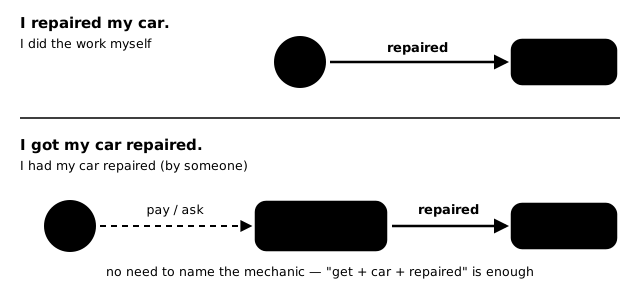
In Hindi, banana → banwana, kaatna → katwana, theek karna → theek karwana — a small "-wa-" shows that the work was done by someone else. In English you use have / get + thing + V3. This matters a lot, because without it an English speaker will think you did the work yourself.
The causative formula
have / get + object + V3 = have something done. get is more common in speech, have is a little more formal. The order is fixed: first the thing, then V3 — got my car repaired.
- I got my car repaired last week. = Last week a mechanic repaired my car for me.
- She had her hair cut short. = She went to a hairdresser, who cut her hair short.
- We're having the house painted before Diwali. = Painters are painting our house before Diwali.
- Where do you get your kurtas stitched? = Which tailor makes your kurtas?
- You need to get your eyes tested. = You should go and have your eyes checked.
- Don't worry, I'll get it done by Friday. = It will be finished by Friday (I'll arrange it or do it).
✗
I cut my hair yesterday. (the barber cut it)
✓
I got my hair cut yesterday.
✗
I got repaired my phone.
✓
I got my phone repaired.
object
When something bad "happens" to you
The same pattern also works when something bad happens to you — here it does not mean you arranged it, only that it happened to you:
- I had my phone stolen on the local train. = Someone stole my phone on the local train.
25.3 have someone do, get someone to do, make, let, help
Sometimes you want to name the person — "I had Ravi send the file", "he made me stop". Here every verb has its own pattern: some are followed directly by V1, some by to + V1. This is where most mistakes happen.
| Verb | Pattern | Meaning / Example |
|---|---|---|
| have | have + person + V1 | hand over a task: I'll have Ravi send it. |
| get | get + person + to V1 | persuade: I got him to sign. |
| make | make + person + V1 | force: She made me wait. |
| let | let + person + V1 | allow: Let me go. |
| help | help + person + (to) V1 | assist: Help me (to) carry this. |
- I'll have my assistant email you the details. = My assistant will email you the details (I'll ask him or her to).
- I finally got the landlord to fix the geyser. = After a lot of effort, I persuaded the landlord to fix the geyser.
- The teacher made us rewrite the essay. = The teacher forced us to write the essay again.
- My parents didn't let me go on the trip. = My parents did not allow me to go on the trip.
- Can you help me move this almirah? = Could you give me a hand to move this cupboard?
✗
He made me to wait for an hour.
✓
He made me wait for an hour.
I was made to wait.
✗
Please let me to explain.
✓
Please let me explain. / Please allow me to explain.
to
Three little words, three different strengths
make = force · let = allow · get … to = persuade. "My boss made me stay" (no choice) vs "My boss let me leave early" (a favour) vs "I got my boss to approve it" (my effort).
25.4 Inversion — the "Never have I…" emphasis
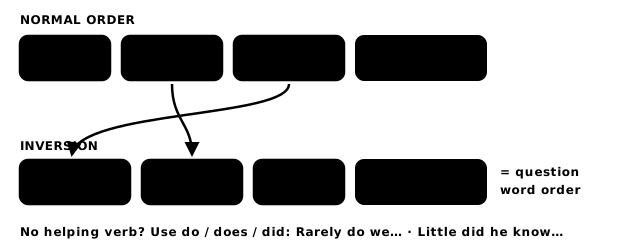
When a sentence starts with a negative or limiting word (never, rarely, not only, hardly, only then…), the subject and the helping verb swap places — exactly like a question. This is formal, written or speech-style English; it adds drama and weight to what you say.
The inversion rule
Negative/limiting word + helping verb + subject + the rest. If there is no helping verb, add do / does / did: Rarely do we eat out.
| Opening | Example | Listen |
|---|---|---|
| Never / Rarely / Seldom | Rarely do we get such rain in April. | |
| Not only … but also | Not only did she top the class, but she also won the debate. | |
| Hardly / Scarcely … when | Hardly had I sat down when the phone rang. | |
| No sooner … than | No sooner had we reached than it started pouring. | |
| Only then / Only after | Only then did I realise my mistake. | |
| Under no circumstances | Under no circumstances should you share your OTP. | |
| Little | Little did he know what was coming. |
- Not only did she top the class, but she also won the debate. = She topped the class, and she won the debate too.
- Hardly had I sat down when the phone rang. = The phone rang the moment I sat down.
- Only after the results came out did he start studying. = He started studying only once the results were out.
✗
Never I have seen such a crowd.
✓
Never have I seen such a crowd.
I have never seen such a crowd.
✗
No sooner had we reached when it started raining.
✓
No sooner had we reached than it started raining.
No sooner … than
Hardly / Scarcely … when
✗
Not only she sings, but she also dances.
✓
Not only does she sing, but she also dances.
Rare in everyday talk
With friends, "Never have I eaten such good pani puri!" sounds a bit theatrical (fine as a joke). Inversion really belongs in essays, speeches, formal emails and IELTS writing. In conversation, "I've never eaten such good pani puri!" is enough.
25.5 "if" without if — Should you…, Had I…, Were I…
In formal English you can drop if and move the helping verb to the front. The meaning stays exactly the same as the conditional — just more sophisticated (the full story of conditionals is in the If sentences chapter).
| With if | Inversion |
|---|---|
| If you need any help, … | Should you need any help, … |
| If I had known, … | Had I known, … |
| If I were you, … | Were I in your place, … |
| If it had not rained, … | Had it not rained, … |
- Should you need any help, please call me. = If you ever need help, call me. (a favourite line in emails)
- Had I known about the strike, I would have taken the metro. = I didn't know about the strike, so I didn't take the metro.
- Were I in your place, I would accept the offer. = If I were you, I would accept the offer.
- Had it not rained, we would have won. = It rained, so we didn't win.
✗
Hadn't I known, I would have gone.
✓
Had I not known, I would have gone.
25.6 Cleft sentences — a spotlight on one part
"Cleft" means "split in two". You break one sentence into two parts to put the light on one particular thing — especially when you are correcting a misunderstanding. In Hindi, the word "hi" does this job: Ravi ne hi todi thi (it was Ravi who broke it).
(a) It is / was … who / that …
- It was Ravi who broke the glass, not Amit. = Ravi broke the glass — not Amit.
- It's the price that worries me, not the quality. = The price is my worry; the quality is not.
- It was in Jaipur that they first met. = They first met in Jaipur, and nowhere else.
(b) What … is / All … is / The reason … is
- What I need is a good night's sleep. = A good night's sleep is exactly what I need.
- What she did was call the police immediately. = The thing she did was to call the police at once.
- All I want is some peace and quiet. = I only want a little peace and quiet — nothing else.
- The reason I called is to ask about Saturday. = I'm calling because I want to ask about Saturday.
Cleft = the 'hi' emphasis
It was X who/that… = it was X, and no one else. What I need is X = X is exactly what I need. All I want is X = only X, nothing else.
✗
All what I want is a holiday.
✓
All I want is a holiday. / What I want is a holiday.
✗
It was my sister which found the keys.
✓
It was my sister who (or that) found the keys.
Clauses
25.7 Emphatic do and fronting — "I really do!"
In a positive sentence, adding do / does / did + V1 (and stressing it) means "really", "truly", "I did do it!". It is useful when someone doubts you, or when you want to say something warmly.
- I do like your new haircut — honestly! = I really like your new haircut!
- I did call you — three times! = I definitely called you — three times!
- She does know a lot about cars. = She really does know a great deal about cars.
- Do sit down, Uncle — make yourself at home. = A warm, polite invitation: please sit down and relax.
✗
I did called you yesterday!
✓
I did call you yesterday!
The stress is in your voice
Emphatic do is more about speaking than writing — say "do / did" long and loud: "I DID call you." See the Rhythm and stress chapter for this.
Fronting — the important thing first
Sometimes you move the object or another part to the start of the sentence to show contrast. The order (subject + verb) stays the same — this is not inversion.
- Tea I can live without. Coffee, never. = I can manage without tea, but never without coffee.
- Strange as it may seem, I enjoy Monday mornings. = It may sound odd, but I enjoy Monday mornings.
25.8 Short replies — so do I, neither do I, I hope not
Native speakers don't repeat the whole sentence. They reply with just the helping verb — this is called ellipsis (leaving words out). In Hindi we say "main bhi" or "main bhi nahi"; in English you have to match the helping verb of the previous sentence.
| The other person said | Same (positive) | Same (negative) |
|---|---|---|
| I love biryani. | So do I. | — |
| I can't swim. | — | Neither can I. |
| I'm tired. | So am I. | — |
| I didn't go. | — | Neither / Nor did I. |
| I've been there. | So have I. | — |
- "I love biryani." — "So do I!" = "I love biryani." — "I love it too!"
- "I didn't sleep well." — "Neither did I." = "I didn't sleep well." — "I didn't either."
- Informal: "Me too." / "Me neither." = The short forms are perfectly fine with friends.
✗
"I don't eat meat." — "Me also not." / "I also don't."
✓
"Neither do I." / "Me neither."
so / not — instead of a whole sentence
After think, hope, guess, be afraid, so (for yes) and not (for no) take the place of the whole clause.
| Question | Reply | Meaning |
|---|---|---|
| Will it rain? | I think so. | I think yes |
| Is the shop open? | I don't think so. | probably not |
| Will we miss the flight? | I hope not. | I hope we won't |
| Is it serious, doctor? | I'm afraid so. | sadly, yes |
| Can you come? | I'd love to. | I'd really like to |
- "Will the match be cancelled?" — "I hope not." = "Will the match be cancelled?" — "I hope it won't be."
- "Are you coming to the wedding?" — "I'd love to, but I can't." = "Are you coming to the wedding?" — "I'd like to come, but I can't."
✗
"Is he coming?" — "I think yes." / "I don't think."
✓
"I think so." / "I don't think so."
so
25.9 In real life — an interview answer
The interviewer asked: "Tell me about a challenge you faced." See how several tools work together in one answer to make it memorable.
| Sentence | Tool | Listen |
|---|---|---|
| Last year our biggest client threatened to leave. | — | |
| What they wanted was a working app in two weeks. | Cleft | |
| I got the whole team to work in two shifts. | get + person + to | |
| Not only did we deliver on time, but we also cut costs. | Inversion | |
| It was that project that taught me to plan backwards. | Cleft |
How much should you use?
One or two tools in an answer are enough. If every sentence is reversed or cleft, it will sound artificial. Like masala — a little, in the right place.
25.10 Practice — Powerful sentences
Exercise 1
My scooter broke down, so I ___ at the garage near my office.
- got it repaired
- got repaired it
- repaired it
- made it repair
Hint: The mechanic fixed it.
Answer
got it repaired
Causative: get + object + V3. The thing (it) goes in the middle, then V3.
Exercise 2
You should get your blood pressure ___ (check) regularly.
Hint: get + object + V3
Answer
checked
get + your blood pressure + checked = have it checked by someone.
Exercise 3
The teacher made us ___ the whole chapter again.
- read
- to read
- reading
- reads
Answer
read
make + person + V1, without 'to'. (In the passive: We were made to read…)
Exercise 4
Tap the extra word.
My father did not let me to go on the school trip.
Answer
Wrong word: to.
Corrected: My father did not let me go on the school trip.
let + person + V1. 'to' only with allow: allow me to go.
Exercise 5
Never ___ such a beautiful sunset.
- have I seen
- I have seen
- I saw
- seen I have
Answer
have I seen
Negative word first = helping verb + subject (question order).
Exercise 6
No sooner had we reached the platform ___ the train left.
Hint: 'sooner' is a comparative.
Answer
than
Fixed pair: No sooner … than.
Exercise 7
Hardly had I opened the laptop ___ the power went off.
- when
- than
- then
- that
Answer
when
Fixed pair: Hardly / Scarcely … when.
Exercise 8
Put the words in order.
Words: not / she / also / only / the / record / she / did / broke / but / win
Answer
not only did she win but she also broke the record
Not only + did + subject + V1, but + subject + also …
Exercise 9
___ I known about the metro strike, I would have left earlier.
Hint: third conditional without if
Answer
Had
Had I known = If I had known (formal inversion).
Exercise 10
___ I need right now is a cup of strong chai.
- What
- That
- Which
- All what
Answer
What
Cleft: What I need is … = a cup of strong chai is exactly what I need.
Exercise 11
Tap the wrong word.
It was my sister which found the lost keys.
Answer
Wrong word: which.
Corrected: It was my sister who found the lost keys.
For people use who / that, not 'which'.
Exercise 12
Match the reply to its meaning.
| A | B |
|---|---|
| So do I. | I hope that doesn't happen |
| Neither do I. | sadly, yes |
| I hope not. | me too (after a positive) |
| I'm afraid so. | me neither |
Answer
So do I. — me too (after a positive); Neither do I. — me neither; I hope not. — I hope that doesn't happen; I'm afraid so. — sadly, yes
In a short reply, a helping verb or so/not takes the place of the whole sentence.
Exercise 13
A: I can't drive. B: Neither ___ I.
Hint: The helping verb of the first sentence.
Answer
can
can't → Neither can I. You have to match the helping verb.
Exercise 14
"Will the flight be on time?" — "I think ___."
- so
- yes
- it
- that
Answer
so
After think / hope / guess, yes = so. 'I think yes' is wrong.
Exercise 15
Who fixed the AC?
Read this aloud or have someone read it to you:
I didn't fix the AC myself. I had a technician come over on Sunday, and he got it working in ten minutes.
- a technician
- the speaker
- the speaker's father
- nobody
Answer
a technician
Transcript: “I didn't fix the AC myself. I had a technician come over on Sunday, and he got it working in ten minutes.”
'I had a technician come over' = have + person + V1. The technician did the work.
Exercise 16
According to the speaker, what saved the project?
Read this aloud or have someone read it to you:
Not only did Ananya finish the report early, but she also found two mistakes in the budget. It was her careful checking that saved the project.
- Ananya's careful checking
- the early deadline
- a bigger budget
- the manager's help
Answer
Ananya's careful checking
Transcript: “Not only did Ananya finish the report early, but she also found two mistakes in the budget. It was her careful checking that saved the project.”
The cleft 'It was her careful checking that…' puts the spotlight on exactly this.
Exercise 17
Write what you hear.
Dictation. Have someone read the sentence aloud, then write it down.
Had I known you were coming, I would have cooked something special.
Answer
Had I known you were coming, I would have cooked something special.
Had I known = If I had known.
Exercise 18
Write what you hear.
Dictation. Have someone read the sentence aloud, then write it down.
What I need is a long holiday.
Answer
What I need is a long holiday.
Cleft: What I need is …
Exercise 19
Say it with stress on 'do'.
I do like your new haircut
Answer
Say: I do like your new haircut
Emphatic do = 'really'. Say 'do' long and loud.
What to do next
Put one Should you need… in your next formal email and one What I need is… in your next conversation. And whenever you visit a salon or a tailor, say in your head: I'm getting my hair cut. To work on speaking, see Rhythm and stress and Native speed English.