Chapter 32: Small talk & opinions
Small talk and giving opinions — starting, keeping going, ending
The office lift, the wedding buffet, the tea break at a conference — these two or three minutes of talk build relationships. Many of us go quiet here, because one question keeps going round in the mind: "What do I say?" The truth is that small talk needs nothing deep — it only needs a frame: how to start, how to keep it going, how to give your opinion, and how to leave gracefully. Every line has a 🔊. Listen, say it along, and try it with someone tomorrow.
- 1The small-talk map — four steps
- 2Starting a conversation — weather, work, and where you both are
- 3Keeping it going — follow-up questions
- 4Giving your opinion — I think, In my view, To be honest
- 5Agreeing and disagreeing — without a fight
- 6Ending the conversation — gracefully
- 7A complete conversation — from start to finish
- 8The mistakes we really make
32.1 The small-talk map — four steps
When the path is clear in your mind, half of the nervousness goes. Every good short conversation passes through these four steps — and the middle two steps go round again and again.
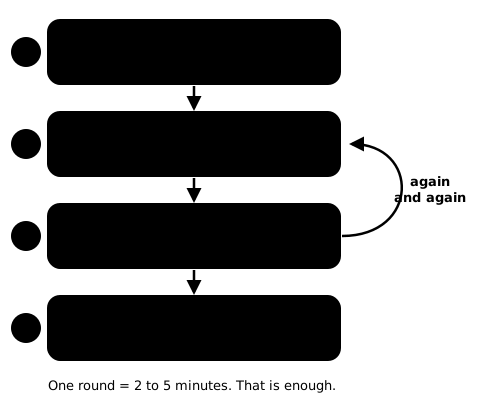
Four steps
Open → Follow up → Share → Close. The middle two steps (a question and your own thought) go round again and again — this is what keeps the conversation alive. The goal of small talk is not to collect information, it is to connect.
Topics to avoid at a first meeting
Safe: weather, traffic, the event you are at, food, work, travel, movies, cricket.
Avoid: salary, "when are you getting married?", weight, religion, politics. Among us these questions are asked with affection, but in an English-speaking setting they feel very personal.
32.2 Starting a conversation — weather, work, and where you both are
The easiest opener is whatever is in front of both of you — the same place, the same weather, the same food. One short statement, then a question. That is all.
| Where | English line | Listen |
|---|---|---|
| Wedding / party | So, how do you know the bride and groom? | |
| Conference | Is this your first time at this conference? | |
| Weather | It's so hot today, isn't it? | |
| Rain | Looks like the rain's finally here. | |
| Work | What kind of work do you do? | |
| Office | How's your week going so far? | |
| Food | Have you tried the paneer? It's really good. | |
| A new face | Hi, I don't think we've met. I'm Kavya. |
The opener formula
Statement + question: "Great music tonight. Do you know the band?" The statement sets the scene; the question gives the other person a chance to speak. A statement alone ("Hot day.") or a question alone ("Your name?") feels unfinished.
Mini-dialogue — the tea break at a conference
Situation: it is the tea break at a conference. You are standing alone, and another person beside you is also alone. Say your lines first, then Meera's lines too.
- You: Hi! Is this your first time at this conference? The opening — a question about the place you are both in.
- Meera: No, second time, actually. Last year's was in Bengaluru. "actually" = in fact. She gave an extra detail — a good sign.
- You: Oh, nice. I'm Rohan, by the way. I work in logistics. "by the way" lets the name slip in easily, in the middle.
- Meera: Nice to meet you, Rohan. I'm Meera. I'm a data analyst. A name and a job — now the way is open for a follow-up.
- You: So what brings you here this year? = Why did you come this year? A very natural follow-up.
- Meera: Mostly the AI sessions. My team wants to try some new tools. Now you can ask: "Oh, which tools?" — and the talk is rolling.
32.3 Keeping it going — follow-up questions
Conversations often die right here: a question comes, a one-word answer goes back, then silence. There are two tools to avoid this — the ping-pong answer, and good follow-up questions.
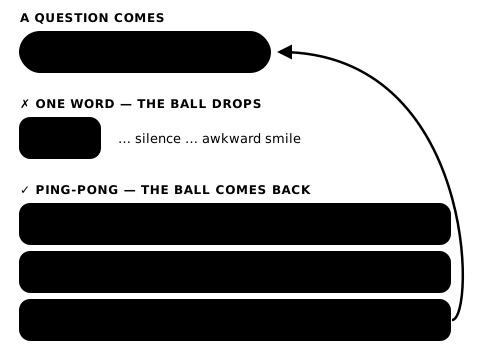
The ping-pong answer
Answer + one extra detail + a question back. "Pune. I moved here for work last year. What about you?" A one-word answer drops the ball on the floor — then both people just stand there.
- Oh, really? How did you get into that? = How did you start that work? The best question about anyone's job.
- What's that like? = What is it like? Use it for a new city, a new job, anything.
- That sounds interesting. What do you enjoy most about it? = What is the best part? People happily talk about what they like.
- How long have you been doing that? = Since when have you done this?
- And what about you? = And you? The shortest line for sending the ball back.
Turn a closed question into an open one
Closed: "Do you like Pune?" → the answer is only yes or no.
Open: "What do you like about Pune?" → the answer brings a story. Questions that start with what, how or why keep the talk going longer.
32.4 Giving your opinion — I think, In my view, To be honest
An opinion brings life to a conversation. But when you translate straight from Hindi, an opinion often sounds too harsh. In English an opinion is usually kept a little soft — and how soft is something you choose with the phrase.
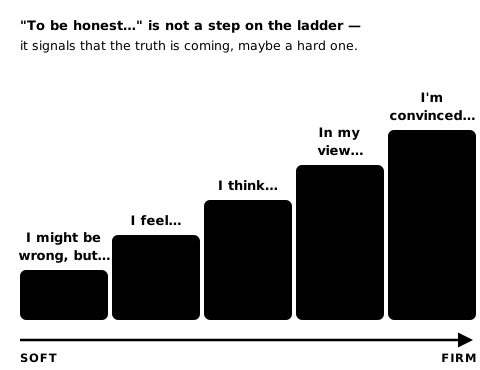
| Line | When | Listen |
|---|---|---|
| I think the new metro has really helped. | An everyday, normal opinion | |
| In my view, the second half of the film was better. | Thoughtful, a little formal | |
| To be honest, I didn't enjoy the food much. | A truth the other person may not like | |
| Personally, I prefer working from the office. | Your own taste — not forcing it on others | |
| I might be wrong, but I think it's going to rain. | Very soft, you are not sure | |
| If you ask me, cricket is more fun in the stadium. | Casual, among friends |
Opinion + reason
An opinion on its own sounds weak — add because: "I think remote work is great because I save two hours a day." And in place of "According to me", say "I think" or "In my view".
32.5 Agreeing and disagreeing — without a fight
Disagreeing is not bad; the way you do it can be. A plain "No, you are wrong" ends the talk right there. English speakers first acknowledge what the other person said, and then give their own view.
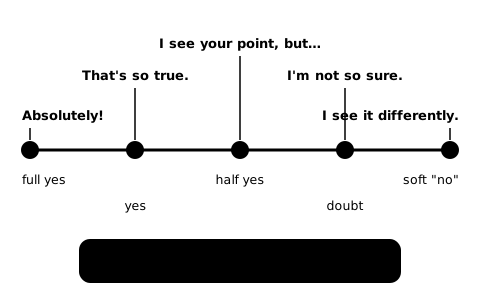
The disagreeing formula
Acknowledge + but + your view. "That's a fair point, but I think traffic is the bigger problem." The first part shows respect, the second gives your opinion. You need both.
Mini-dialogue — a debate about working from home
Situation: at lunch, your colleague Aman says working from home is better. You half agree and half do not.
- Aman: I think working from home is so much better. An opinion — with "I think".
- You: I know what you mean. No traffic, right? Acknowledge first — "I understand you".
- Aman: Exactly! I save almost two hours a day. Opinion + reason.
- You: That's true. But to be honest, I find it harder to focus at home. Acknowledge + but + your view. Disagreeing without a fight.
- Aman: Fair enough. I guess it depends on the person. "Fair enough" = OK, you have a good point.
- You: Yeah, I suppose it does. Both are happy — the argument is over, the friendship stays.
32.6 Ending the conversation — gracefully
A good conversation should have a good ending too. Turning away without a word, or suddenly saying "OK, bye", feels rude. Three small steps — and you leave a good memory behind.
- Well, it was really nice talking to you. "Well…" — the shortest and clearest signal.
- I should let you get back to your friends. = I will not keep you here. The reason is about them — a very polite way.
- I'm going to grab some food before it's all gone. A light, casual reason — useful at parties.
- I need to catch up with a colleague, but let's talk later. "catch up with" = to meet someone and hear their news.
- Let's stay in touch. Are you on LinkedIn? Use it if you want the relationship to continue.
- Enjoy the rest of the evening! The last warm line.
The three-step ending
Signal ("Well…") + reason ("I should go and say hi to my boss") + warm line ("It was lovely meeting you"). Keep the reason short and true. Disappearing without a word, or a flat "OK, bye" — both feel rude.
32.7 A complete conversation — from start to finish
Now everything together — opener, follow-up, ping-pong, opinion, agreement and ending. Say both roles; saying the other person's lines also gets your ear ready.
Mini-dialogue — the wedding buffet
Situation: a long buffet queue at the reception. Priya is standing in front of you, and you do not know her.
- You: This queue is moving so slowly! Everything looks delicious, though. The opener — a statement about what is in front of you.
- Priya: I know! Someone told me the biryani is the best thing here. She picked up the thread and added a detail.
- You: Good to know. So, are you from the bride's side or the groom's? The easiest follow-up at a wedding.
- Priya: The bride's. We went to college together. And you? Ping-pong: answer + detail + a question back.
- You: I work with the groom. I'm Vikram, by the way. The name comes in with "by the way".
- Priya: I'm Priya. Nice to meet you. What do you two work on? An open question — "What are you working on?"
- You: We build apps for hospitals. It's busy, but I really enjoy it. An answer + a feeling. Now Priya has something to talk about.
- Priya: That sounds interesting. I think technology in healthcare is the future. An opinion — with "I think".
- You: I couldn't agree more. Well, I'll let you get your food. It was lovely talking to you. Agreement, then signal + reason + warm line.
- Priya: You too, Vikram. Enjoy the biryani! A good ending — both smile and part.
32.8 The mistakes we really make
These are less grammar mistakes and more translation mistakes — they come from carrying a Hindi pattern into English. The listener understands, but it sounds odd.
Common small-talk mistakes
- Wrong: What is your good name?
- Right: What's your name? / Sorry, I didn't catch your name.
-
Why: "Good name" is a word-for-word copy of "shubh naam". It carries respect for us, but sounds odd in English.
-
Wrong: Myself Rahul, from Pune.
- Right: I'm Rahul. I'm from Pune.
-
Why: An introduction does not start with "Myself". Just "I'm…" — short and natural.
-
Wrong: I am agree with you.
- Right: I agree with you.
-
Why: "Agree" is a verb by itself — it does not need "am". The same for the negative: "I don't agree", not "I am not agree".
-
Wrong: According to me, the film was boring.
- Right: I thought the film was boring. / In my view, it was boring.
-
Why: "According to" is for other people's words — according to the news, according to my doctor. For your own opinion use "I think".
-
Wrong: So, how much do you earn? When are you getting married?
- Right: So, what do you enjoy most about your job?
- Why: Salary and marriage are seen as very personal at a first meeting. Ask about the work, not the earnings.
32.9 Practice — Small talk
Exercise 1
You want to start talking to a stranger at a conference tea break. Which is the most natural opener?
- Is this your first time at this conference?
- What is your good name?
- How much salary do you get?
- Myself Rohan, tell me about you.
Answer
Is this your first time at this conference?
A question about the place you both share — the safest and the most natural. The other three are either translations or too personal.
Exercise 2
What should you add to your opinion to make it stronger?
- a reason with 'because'
- the word 'definitely' twice
- 'according to me' at the start
- a louder voice
Answer
a reason with 'because'
Opinion + reason = a strong opinion. 'I think X because Y' — the listener may disagree, but will not take you lightly.
Exercise 3
You disagree with a colleague. Which reply is the most polite?
- You are wrong.
- That's a fair point, but I see it differently.
- No, no, that is not correct.
- I am not agree.
Answer
That's a fair point, but I see it differently.
The formula: acknowledge + but + your view. The first part shows respect. 'I am not agree' is also wrong grammar.
Exercise 4
I ___ with you. The traffic is terrible these days.
Hint: You do not need 'am'.
Answer
agree / totally agree / completely agree
'Agree' is a verb by itself — 'I agree', not 'I am agree'.
Exercise 5
Well, it was really nice ___ to you.
Hint: A line for ending a talk — verb + ing.
Answer
talking / speaking
'It was nice talking to you' — the warmest line for the end of a conversation.
Exercise 6
One word in this introduction sounds odd — tap it.
Myself Anjali and I work in a bank.
Answer
Wrong word: Myself.
Corrected: I'm Anjali and I work in a bank.
An introduction starts with 'I'm…', not 'Myself…'.
Exercise 7
Put the words in the right order — make an open follow-up question.
Words: do / What / most / job / you / your / about / enjoy
Answer
What do you enjoy most about your job
Wh-word + do + you + verb — this is an open question, and its answer is not just yes or no.
Exercise 8
Match each line to its job.
| A | B |
|---|---|
| How did you get into that? | disagreeing politely |
| To be honest, I didn't like it. | ending the conversation |
| I see your point, but… | follow-up question |
| I'll let you get back to it. | an honest opinion |
Answer
How did you get into that? — follow-up question; To be honest, I didn't like it. — an honest opinion; I see your point, but… — disagreeing politely; I'll let you get back to it. — ending the conversation
Every line has a job — a question, an opinion, a disagreement, an ending. These steps keep small talk moving.
Exercise 9
Say the line for leaving a party — warm and clear.
It was really nice talking to you
Answer
Say: It was really nice talking to you
Join 'talking to you' together — 'tawking-tu-yu'. The voice falls on the last 'you'.
Exercise 10
Now show how to disagree politely.
That's a fair point, but I see it differently
Answer
Say: That's a fair point, but I see it differently
Pause a little after 'but' — it shows you really listened to them.
Exercise 11
Say an opener — with the voice rising at the end of the question.
Is this your first time here
Answer
Say: Is this your first time here
In a yes/no question the voice rises on the last word — 'here?'
What next?
This week, have a four-step conversation with one new person — it could be the society guard or the new intern at the office. The first time will feel odd; by the third time it will be a habit.