Chapter 21: Active & passive voice
Active and Passive — who comes first
In grammar, "voice" has nothing to do with sound. Voice means — whose story the sentence tells. In the active voice the doer comes first ("Ravi ne kaam kiya"), and in the passive voice the one who receives the action comes first ("kaam kiya gaya"). We do this in Hindi every day, so the idea is not new — you just need to learn the English formula, and to know when to use the passive and when not to use it at all.
- 1The swapping diagram
- 2The passive in every tense
- 3The passive of questions and orders
- 4Verbs with two objects — two passives are possible
- 5When to use the passive — four real situations
- 6When not to use the passive
- 7Two useful things
- 8The mistakes we really make
In one line
Passive voice = correct form of "be" + V3 (past participle). That's the whole formula. When the tense changes, only the "be" changes — V3 never changes.
21.1 The swapping diagram
Turning active into passive involves just three things: the subject and object swap places, the verb becomes "be + V3", and the old subject moves behind "by". See the picture —
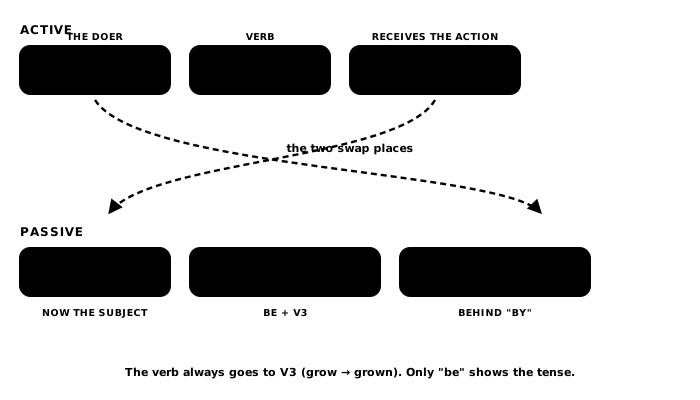
Five steps — active to passive
1. Bring the object to the front (and if it is a pronoun, change it to a subject form: me → I, him → he).
2. Choose the right "be" for the tense.
3. Change the main verb to V3.
4. Put the old subject at the end with "by".
5. If the doer is not important, drop the "by…" part.
21.2 The passive in every tense
Notice that in the right-hand column V3 (eaten) never changes. Only the form of "be" changes. The whole table rests on this one idea.
| Tense | Active | Passive (be + V3) |
|---|---|---|
| Present Simple | She eats the mango. | The mango is eaten by her. |
| Present Continuous | She is eating the mango. | The mango is being eaten by her. |
| Present Perfect | She has eaten the mango. | The mango has been eaten by her. |
| Past Simple | She ate the mango. | The mango was eaten by her. |
| Past Continuous | She was eating the mango. | The mango was being eaten by her. |
| Past Perfect | She had eaten the mango. | The mango had been eaten by her. |
| Future Simple | She will eat the mango. | The mango will be eaten by her. |
| Future Perfect | She will have eaten it. | It will have been eaten by her. |
| Modal | She can eat it. | It can be eaten by her. |
| Infinitive | She wants to eat it. | It wants to be eaten. |
Two kinds of tenses have no passive
The passive of the Future Continuous and the Perfect Continuous tenses (all three) is not used in practical English. A sentence like "The work will be being done" is possible in grammar, but nobody says it. In such cases, just keep the active.
21.3 The passive of questions and orders
| Type | Active | Passive |
|---|---|---|
| Yes/no question | Did he write the letter? | Was the letter written by him? |
| WH question | Who wrote this? | By whom was this written? |
| Order (positive) | Close the door. | Let the door be closed. |
| Order (negative) | Don't touch the wires. | Let the wires not be touched. |
| Advice / rule | You should submit the form. | The form should be submitted. |
21.4 Verbs with two objects — two passives are possible
give, send, teach, offer, tell, show, pay, lend — these verbs have two objects (to whom + what). So two kinds of passive can be made, and both are correct.
- Active: The company gave Ravi a laptop.
- Passive 1: Ravi was given a laptop. The person comes first — this is more natural in speech.
- Passive 2: A laptop was given to Ravi. The thing comes first — the focus is on the laptop.
21.5 When to use the passive — four real situations
| Reason | Example | Why the passive is better |
|---|---|---|
| The doer is unknown | My bike was stolen last night. | You don't know who took it — so there is no need for "by…". |
| The doer is not important | The road is being repaired. | It doesn't matter who is repairing it. The work is what counts. |
| Processes / science | Water is heated to 100 °C and then cooled. | In science and recipes the steps matter, not the people. |
| Being polite or neutral | A mistake has been made in the bill. | It doesn't blame anyone — very useful in offices and emails. |
| Rules and notices | Smoking is not allowed here. | The rule applies to everyone — it is not about one particular person. |
The magic of the passive in offices and emails
"You did not send the report." → sounds like an accusation.
"The report has not been received yet." → the same point, without a quarrel. That is why the passive is an important part of professional English.
21.6 When not to use the passive
There is a big misunderstanding here. At school we think of the passive as "good English", and then we stuff it in everywhere. The truth is the opposite: over 85% of everyday sentences are active. The passive appears when there is a reason for it.
Where the passive sounds heavy and bad
- Wrong: The decision to go to Shimla was taken by us.
- Right: We decided to go to Shimla.
-
Why: The doer is clear and important — so put it first. The active is short, clear and strong.
-
Wrong: Tea is being drunk by me.
- Right: I am drinking tea.
-
Why: In everyday talk, a passive like this sounds artificial. No native speaker would say it.
-
Wrong: The bus was arrived at six.
- Right: The bus arrived at six.
-
Why: Intransitive verbs (verbs with no object — arrive, come, go, sleep, die, happen, laugh) have no passive.
-
Wrong: He was died in 2019.
- Right: He died in 2019.
- Why: "Die" is intransitive. But "born" is the opposite — it always appears in the passive: I was born in Patna.
The deciding question
Before you make a passive, ask yourself one question: "Whose story is it?"
If it is the doer's — active. If it is the receiver's, or the doer is unknown or unimportant — passive. Never use the passive just "to sound formal".
21.7 Two useful things
Leaving out "by" is perfectly fine
In about 80% of passive sentences the "by…" part is never written, because the doer is not important. Exams ask for "by"; real English doesn't.
- English is spoken all over the world. No need to write "by people" — everyone understands.
The "get" passive — very common in speech
| be passive | get passive | Feel |
|---|---|---|
| My phone was repaired. | My phone got repaired. | more conversational |
| He was selected. | He got selected. | it happened suddenly, a happy event |
| The glass was broken. | The glass got broken. | it happened by accident |
21.8 The mistakes we really make
Top passive mistakes
- Wrong: The letter is wrote by him.
- Right: The letter is written by him.
-
Why: The passive always takes V3, not V2. write–wrote–written.
-
Wrong: The work is completed yesterday.
- Right: The work was completed yesterday.
-
Why: The tense shows in "be". For the past you need "was/were".
-
Wrong: The matter is being discussed about.
- Right: The matter is being discussed.
-
Why: "Discuss" doesn't take "about" — neither in the active nor in the passive.
-
Wrong: The thief was caught by the police yesterday by them.
- Right: The thief was caught by the police yesterday.
-
Why: "By" only once. You have named the doer once; that is enough.
-
Wrong: This book is belonged to me.
- Right: This book belongs to me.
-
Why: Some verbs have no passive — belong, resemble, lack, consist, have (to own), suit, fit.
-
Wrong: I born in Lucknow.
- Right: I was born in Lucknow.
- Why: "Born" always appears in the passive — was/were born. This one you just have to remember.
21.9 Practice — Active and Passive
Exercise 1
Make it passive: 'Shakespeare wrote this play.'
- This play is written by Shakespeare.
- This play was wrote by Shakespeare.
- This play was written by Shakespeare.
- This play has written by Shakespeare.
Hint: Which 'be' does the Past Simple passive use?
Answer
This play was written by Shakespeare.
The Past Simple passive = was/were + V3. So 'was written' — never 'was wrote', because the passive takes V3.
Exercise 2
Make it passive: 'They are repairing the road.'
- The road is repaired.
- The road is being repaired.
- The road was being repaired.
- The road has been repaired.
Hint: The continuous passive uses 'being'.
Answer
The road is being repaired.
The Present Continuous passive = am/is/are + being + V3. 'Being' is the sign of the continuous.
Exercise 3
Which of these sentences CANNOT be made passive?
- She sang a song.
- The baby slept quietly.
- He painted the wall.
- They built a bridge.
Hint: Which one has no object?
Answer
The baby slept quietly.
'Sleep' is an intransitive verb — it has no object. A verb with no object has no passive.
Exercise 4
When is the passive best?
- When the doer is unknown
- When you want a shorter sentence
- When you want to sound formal
- When the verb is difficult
Hint: Think about the doer.
Answer
When the doer is unknown
The real job of the passive is for when the doer is unknown, unimportant, or you don't want to name them. Using the passive just to 'sound formal' is a mistake.
Exercise 5
The thieves ___ arrested by the police last night.
Hint: A plural subject, and it happened in the past.
Answer
were
The subject 'thieves' is plural and it is past — so 'were arrested'. A singular subject would take 'was arrested'.
Exercise 6
Rice ___ grown in many parts of India.
Hint: A general fact — which tense?
Answer
is
A general fact uses the Present Simple, and 'rice' is an uncountable singular — so 'is grown'.
Exercise 7
I ___ born in Jaipur.
Hint: This always appears in the passive.
Answer
was
'Born' always takes was/were. 'I born' and 'I am born' are both wrong.
Exercise 8
There is one mistake in this sentence — tap the wrong word.
The homework was did by all the students.
Answer
Wrong word: did.
Corrected: The homework was done by all the students.
The passive takes V3. do–did–done, so 'was done'. Never 'was did'.
Exercise 9
Find the wrong word.
My grandfather was died two years ago.
Answer
Wrong word: was.
Corrected: My grandfather died two years ago.
'Die' is intransitive and has no passive. Just say 'died'.
Exercise 10
One word is wrong — catch it.
This land is belonged to my uncle.
Answer
Wrong word: belonged.
Corrected: This land belongs to my uncle.
'Belong' has no passive. Verbs like belong, resemble, consist, lack always stay in the active.
Exercise 11
Put the words in order to make a passive sentence.
Words: bridge / new / The / next / will / opened / month / be
Answer
The new bridge will be opened next month
The future passive = will + be + V3. 'Will be opened' — the form of 'be' never changes here; 'be' comes straight after 'will'.
Exercise 12
Match each active form with its correct passive.
| A | B |
|---|---|
| She writes letters | Letters have been written by her |
| She wrote letters | Letters are being written by her |
| She has written letters | Letters will be written by her |
| She is writing letters | Letters are written by her |
| She will write letters | Letters were written by her |
Answer
She writes letters — Letters are written by her; She wrote letters — Letters were written by her; She has written letters — Letters have been written by her; She is writing letters — Letters are being written by her; She will write letters — Letters will be written by her
See — the V3 'written' is the same every time. Only the form of 'be' changes: are / were / have been / are being / will be.
Exercise 13
Now say this line aloud — a polite passive that is useful in offices.
The report has not been received yet
Answer
Say: The report has not been received yet
In the active this would be 'You did not send the report', which sounds like an accusation. The passive makes the point without a quarrel — which is why this form is so useful in emails.
What to do next
Try this: open one of your old emails or assignments and turn every passive sentence into an active one. Where the active reads more clearly, the passive was not needed. After doing this two or three times, the right use of the passive becomes clear by itself.