Chapter 22: Imparfait vs passé composé
l’imparfait
Kisi bhi kahani ki do layers hoti hain: scene (baarish ho rahi thi, main thaka hua tha, log intezaar kar rahe the) aur events (achanak darwaza khula, kisi ne chillaya). French har layer ko uska apna tense deti hai. Passé composé events batata hai; imparfait scene banata hai. Pehle French ka sabse aasaan conjugation seekho, phir choose karna seekho.
- 1Imparfait banana: ek stem, ek hi set of endings
- 2Ek hi irregular: être → ét-
- 3Use 1 — description: scene
- 4Use 2 — habits: “used to” aur “would”
- 5Use 3 — chalta hua kaam: “was doing”
- 6Choose karna: imparfait ya passé composé?
- 7Dono tenses se kahani sunana
- 8Abhi-abhi kiya, kar raha tha: venir de aur être en train de
- 9In real life: bachpan ki yaadein
Ek line me
Imparfait = scene, aadat, jo chal raha tha. Passé composé = event, jo ho gaya.
- Il pleuvait et j’étais fatigué. — Baarish ho rahi thi aur main thaka hua tha. (scene) [eel pluh-Vɛ]
- Quand j’étais petit, je jouais au cricket. — Jab main chhota tha, main cricket khelta tha. (aadat) [zhay-Tɛ puh-TEE]
- Je dormais quand le téléphone a sonné. — Main so raha tha jab phone baja. (background + event)
22.1 Imparfait banana: ek stem, ek hi set of endings
Present tense ka nous form lo, usse -ons hata do, aur endings jod do. Ye French ke har verb ke liye kaam karta hai, sirf ek ko chhodkar (être, section 2).
| Infinitive | nous (present) | Imparfait stem |
|---|---|---|
| parler | nous parlons | parl- |
| finir | nous finissons | finiss- |
| faire | nous faisons | fais- [fuh-Z…] |
| avoir | nous avons | av- |
| prendre | nous prenons | pren- |
| boire | nous buvons | buv- |
| aller | nous allons | all- |
| Subject | Ending | parler | avoir |
|---|---|---|---|
| je | -ais | je parlais | j’avais |
| tu | -ais | tu parlais | tu avais |
| il / elle / on | -ait | il parlait | elle avait |
| nous | -ions | nous parlions | nous avions |
| vous | -iez | vous parliez | vous aviez |
| ils / elles | -aient | ils parlaient | elles avaient |
Paanch endings, ek hi awaaz
-ais, -ais, -ait, -aient sab bilkul ek jaise sunai dete hain: [ɛ], jaise “bed” ka “e”. je parlais, il parlait, ils parlaient = [par-Lɛ]. Sirf nous aur vous alag sunai dete hain.
- Nous habitions à Kolkata. — Hum Kolkata me rehte the. [noo‿za-bee-TYÕ]
- Ils faisaient du bruit. — Wo shor kar rahe the. [eel fuh-Zɛ]
- Tu prenais le métro tous les jours ? — Kya tum roz metro lete the?
Spelling me chhote badlaav
-ger wale verbs a se pehle e rakhte hain (je mangeais, lekin nous mangions); -cer wale verbs a se pehle ç lete hain (je commençais, lekin nous commencions). -ier wale verbs me double i aata hai: nous étudiions, vous étudiiez. Isse awaaz regular rehti hai.
22.2 Ek hi irregular: être → ét-
Nous sommes me hatane ke liye -ons hai hi nahi, isliye être ka apna stem hai: ét-. Endings wahi rehti hain.
| Subject | être | Example |
|---|---|---|
| je / j’ | j’étais | J’étais content. |
| tu | tu étais | Tu étais où ? |
| il / elle / on | il était | C’était génial ! |
| nous | nous étions | Nous étions en retard. |
| vous | vous étiez | Vous étiez à la réunion ? |
| ils / elles | ils étaient | Elles étaient sœurs. |
- C’était comment, le concert ? — C’était génial ! — Concert kaisa tha? — Zabardast tha! [say-Tɛ zhay-nyal]
Impersonal verbs jo aap hamesha use karoge
| Present | Imparfait | Matlab |
|---|---|---|
| il y a | il y avait | tha / the (there was / there were) |
| il fait beau | il faisait beau | mausam achha tha |
| il pleut | il pleuvait | baarish ho rahi thi |
| il faut | il fallait | zaroori tha, hume karna padta tha |
| c’est | c’était | ye tha |
- Il y avait beaucoup de monde au marché. — Market me bahut bheed thi. [eel-ya-VɛT]
22.3 Use 1 — description: scene
Imparfait tab use karo jab batana ho ki cheezein kaisi thi: mausam, time, umar, shakal-soorat, feelings, mann ki halat. Kahani me inki koi saaf shuruaat ya ant nahi hoti.
- Il était huit heures du soir. Il faisait froid. — Shaam ke aath baje the. Thand thi.
- J’avais dix-huit ans et je ne connaissais personne à Paris. — Main atharah saal ka tha aur Paris me kisi ko nahi jaanta tha.
- La maison était grande et le jardin sentait les roses. — Ghar bada tha aur bagiche me gulaab ki khushboo aati thi.
- Elle avait les cheveux longs et elle portait un sari bleu. — Uske baal lambe the aur usne neeli saree pehni hui thi.
- J’avais faim, mais je voulais finir mon travail. — Mujhe bhookh lagi thi, lekin main apna kaam khatam karna chahta tha.
Dhyan do
- Galat: Quand j’ai été petit, j’ai habité à Goa.
- Sahi: Quand j’étais petit, j’habitais à Goa.
- Kyun: Bachpan ek background period hai, event nahi. Quand j’étais petit(e) hamesha imparfait hota hai.
22.4 Use 2 — habits: “used to” aur “would”
English me kehte hain “I used to walk to school” ya “every summer we would go to the village”. French me bas imparfait use hota hai. Hindi bhi kuch aisa hi karti hai: “main school paidal jaata tha”.
- Tous les étés, on allait chez ma grand-mère. — Har garmi me hum meri nani/dadi ke ghar jaate the.
- D’habitude, je me levais à cinq heures. — Aam taur par main paanch baje uthta tha.
- Le dimanche, mon père préparait des dosas pour tout le monde. — Sunday ko mere papa sabke liye dosa banate the.
- À l’époque, on n’avait pas de portable. — Un dino hamare paas mobile phone nahi hote the.
Imparfait ke signal words
d’habitude, souvent, toujours, tous les jours, chaque été, le lundi, autrefois, à l’époque, quand j’étais petit(e), pendant que — repetition ya background.
22.5 Use 3 — chalta hua kaam: “was doing”
Imparfait aise kaam ko describe karta hai jo past ke kisi moment par chal raha tha — aksar tab jab koi aur cheez (ek event, passé composé me) use beech me rok deti hai.
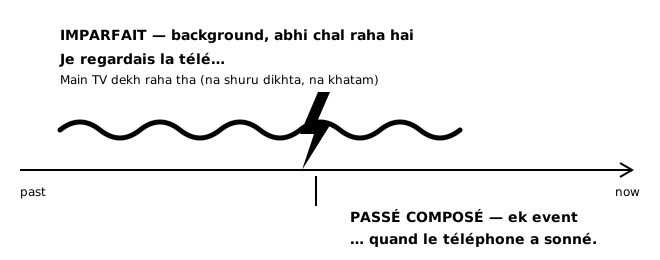
- Je prenais ma douche quand tu as appelé. — Main nahaa raha tha jab tumne phone kiya.
- Pendant que les enfants dormaient, nous préparions la fête. — Jab bachhe so rahe the, hum party ki taiyari kar rahe the. (do backgrounds)
- Il traversait la rue quand il est tombé. — Wo sadak paar kar raha tha jab gir gaya.
Dhyan do
- Galat: Je lisais quand soudain le téléphone sonnait.
- Sahi: Je lisais quand soudain le téléphone a sonné.
- Kyun: Soudain ek single event ka ailaan karta hai jo beech me aa jaata hai: passé composé.
22.6 Choose karna: imparfait ya passé composé?
Har verb ke baare me khud se ek sawaal pucho: kya ye ek event hai jo kahani ko aage badhata hai, ya situation ka description?
Band (closed) period
Jis duration ki saaf limit ho, wo passé composé leta hai, chahe wo lamba hi kyun na ho: J’ai habité à Delhi pendant cinq ans. Limit ke bina wo background hai: J’habitais à Delhi.
Same verb, alag meaning
Kuch verbs ka meaning dono tenses me thoda badal jaata hai — imparfait ek state deta hai, passé composé badlaav ka ek moment.
| Imparfait (state) | Passé composé (moment) |
|---|---|
| J’avais peur. Mujhe dar lag raha tha. |
J’ai eu peur. Main achanak dar gaya. |
| Je savais la vérité. Mujhe sach pata tha. |
J’ai su la vérité. Mujhe sach pata chala. |
| Je connaissais Paul. Main Paul ko jaanta tha. |
J’ai connu Paul en 2015. Main Paul se 2015 me mila. |
| Il devait venir. Use aana tha. |
Il a dû partir. Use jaana pada (aur wo gaya). |
| Je pouvais le faire. Main ye kar sakta tha (aam taur par). |
J’ai pu le faire. Main ye kar paya. |
Wo choices jo aksar galat ho jaati hain
- Galat: L’année dernière, j’allais en France trois fois.
- Sahi: L’année dernière, je suis allé en France trois fois.
-
Kyun: Gine-chune baar = events ki ek series → passé composé. (Souvent, bina ginti ke, imparfait deta.)
-
Galat: Hier il a fait beau, alors on se promenait au parc.
- Sahi: Hier il faisait beau, alors on s’est promené au parc.
-
Kyun: Mausam scene hai (imparfait); walk wo hai jo aapne kiya (passé composé).
-
Galat: Le film a été long, mais je l’aimais beaucoup.
- Sahi: Le film était long, mais il m’a beaucoup plu.
- Kyun: Film ko describe karna = imparfait. Khatam ho chuki film par aapka overall reaction = passé composé.
22.7 Dono tenses se kahani sunana
Ye chhoti si kahani padho. Imparfait wale verbs (italics me) scene banate hain; passé composé wale verbs (bold me) events hain. Sirf passé composé wale verbs padho — plot mil jaata hai. Sirf imparfait wale verbs padho — tasveer mil jaati hai.
- C’était un samedi de juillet. Il faisait très chaud et la plage était pleine. — July ka ek Saturday tha. Bahut garmi thi aur beach bhara hua tha. (scene)
- Les enfants jouaient dans l’eau et je lisais sous un parasol. — Bachhe paani me khel rahe the aur main chhatri ke neeche padh raha tha. (scene)
- Tout à coup, un chien est arrivé en courant. Il a pris mon sandwich et il est reparti. — Achanak ek kutta daudta hua aaya. Usne mera sandwich liya aur bhaag gaya. (events)
- Tout le monde a ri. Moi, j’avais encore faim, mais l’histoire était trop drôle. — Sab hans pade. Mujhe abhi bhi bhookh thi, lekin kahani bahut mazedar thi.
Film test
Socho aap apni kahani ki film bana rahe ho. Set aur background action (dhoop, bheed, khelte bachhe) imparfait hain. Har naya shot jisme kuch hota hai wo passé composé hai.
22.8 Abhi-abhi kiya, kar raha tha: venir de aur être en train de
venir de + infinitive: recent past
Venir de + infinitive ka matlab hai “abhi-abhi (just) kuch kiya hai”. Present me ye baatcheet me bahut common hai; imparfait me iska matlab hota hai “abhi-abhi kiya tha”.
- Je viens de manger, merci. — Maine abhi khana khaya hai, thanks. [zhuh vyɛ̃ duh mã-ZHAY]
- Le train vient de partir ! — Train abhi-abhi chhooti hai!
- Je venais de rentrer quand il a appelé. — Main abhi-abhi ghar pahuncha hi tha jab usne phone kiya.
Dhyan do
- Galat: J’ai juste mangé. (matlab “maine abhi khaya hai”)
- Sahi: Je viens de manger.
- Kyun: J’ai juste mangé ka sense “maine sirf khaya” jaisa lagta hai. “Abhi-abhi” ke liye French venir de use karti hai.
être en train de + infinitive: beech me hona
Ye zor dene ke liye ki kaam chal raha hai, être en train de use karo — present ya imparfait me.
- Je ne peux pas parler, je suis en train de conduire. — Main baat nahi kar sakta, gaadi chala raha hoon. [ã trɛ̃ duh]
- On était en train de dîner quand la lumière s’est éteinte. — Hum dinner kar hi rahe the ki light chali gayi.
Do polite bonus
- Si on allait au cinéma ce soir ? — Aaj shaam cinema chalein to? (si + imparfait = suggestion)
- Bonjour, je voulais savoir si vous aviez des chambres libres. — Hello, main jaanna chahta tha ki kya aapke paas koi room khali hai. (“je veux” se zyada naram)
22.9 In real life: bachpan ki yaadein
- — Tu habitais où quand tu étais petite ? — — Jab tum chhoti thi to kahan rehti thi?
- — À Jaipur. On avait une grande maison avec une terrasse. Le soir, on y dormait quand il faisait trop chaud. — — Jaipur me. Hamara bada ghar tha jisme chhat thi. Shaam ko, jab bahut garmi hoti thi, hum wahin sote the.
- — Et pourquoi tu es partie ? — — Aur tum wahan se kyun gayi?
- — Mon père a trouvé un travail à Bangalore. J’avais douze ans. Au début, j’étais triste, mais je me suis vite fait des amis. — — Papa ko Bangalore me job mil gayi. Main baarah saal ki thi. Shuru me main udaas thi, lekin jaldi hi dost ban gaye.
Events: a trouvé, es partie, me suis fait. Scene aur habits: habitais, avait, dormait, faisait, avais, étais.
À retenir: yaad rakho
- Imparfait = scene, aadat, jo chal raha tha. Passé composé = event, jo ho gaya.
- -ais, -ais, -ait, -aient sab bilkul ek jaise sunai dete hain: [ɛ], jaise “bed” ka “e”. je parlais, il parlait, ils parlaient = [par-Lɛ]. Sirf nous aur vous alag sunai dete hain.
- d’habitude, souvent, toujours, tous les jours, chaque été, le lundi, autrefois, à l’époque, quand j’étais petit(e), pendant que — repetition ya background.
- Jis duration ki saaf limit ho, wo passé composé leta hai, chahe wo lamba hi kyun na ho: J’ai habité à Delhi pendant cinq ans. Limit ke bina wo background hai: J’habitais à Delhi.
- Socho aap apni kahani ki film bana rahe ho. Set aur background action (dhoop, bheed, khelte bachhe) imparfait hain. Har naya shot jisme kuch hota hai wo passé composé hai.
- Apne saath hui kisi baat par paanch sentences ki kahani sunao: scene ke liye do imparfait sentences, events ke liye teen passé composé sentences. Phir The future par jao.
22.10 Practice — Imparfait vs passé composé
Exercise 1
nous finissons ka imparfait → je ___
- finis
- finissais
- finirais
- finissai
Jawaab
finissais
Stem finiss- (nous finissons se) + -ais.
Exercise 2
être ka imparfait, ils:
- ils étaient
- ils êtaient
- ils sontaient
- ils étiont
Jawaab
ils étaient
être ka irregular stem ét- + -aient hota hai.
Exercise 3
Quand j'___ petit, j'habitais à Goa.
- ai été
- étais
- suis
- serai
Jawaab
étais
Bachpan background hai: quand j'étais petit.
Exercise 4
Je regardais la télé quand mon frère ___.
- arrivait
- est arrivé
- arrive
- arrivera
Jawaab
est arrivé
Background ko beech me rokne wala event → passé composé.
Exercise 5
L'année dernière, je ___ à Paris trois fois.
- allais
- suis allé
- vais
- allait
Jawaab
suis allé
Gine-chune baar → passé composé.
Exercise 6
J'ai connu ma femme en 2010 ka matlab:
- Main 2010 me apni patni ko jaanta tha.
- Main apni patni se 2010 me mila.
- Main apni patni ko jaanta hota tha.
- Main apni patni ko 2010 se jaanta hoon.
Jawaab
Main apni patni se 2010 me mila.
Passé composé me connaître = pehli baar milna.
Exercise 7
Il ___ (faire) très beau ce jour-là.
Hint: mausam = scene
Jawaab
faisait
Mausam ka description → imparfait: il faisait.
Exercise 8
Tous les dimanches, nous ___ (manger) chez mes grands-parents.
Hint: nous, aadat
Jawaab
mangions
Aadat → imparfait; -ger verb: nous mangions (i se pehle e nahi).
Exercise 9
Le train ___ de partir ! (abhi-abhi chhooti hai)
Jawaab
vient
venir de + infinitive = abhi-abhi kiya hai.
Exercise 10
Il y ___ beaucoup de monde. (bahut bheed thi)
Jawaab
avait
il y a → imparfait me il y avait.
Exercise 11
Galat word par tap karo.
Je lisais quand soudain le téléphone sonnait.
Jawaab
Galat shabd: sonnait.
Sahi roop: Je lisais quand soudain le téléphone a sonné.
soudain ek single event laata hai → passé composé.
Exercise 12
Galat word par tap karo.
Quand j'ai été jeune, je jouais au foot.
Jawaab
Galat shabd: été.
Sahi roop: Quand j'étais jeune, je jouais au foot.
quand j'étais jeune: background → imparfait.
Exercise 13
Words ko sahi order me lagao: Main so raha tha jab tumne phone kiya.
Shabd: appelé / Je / quand / dormais / as / tu
Jawaab
Je dormais quand tu as appelé
Background (imparfait) + beech me aane wala event (passé composé).
Exercise 14
Har sentence ko uske use se milao.
| A | B |
|---|---|
| Il pleuvait. | event |
| Je jouais au tennis le samedi. | abhi-abhi kiya tha |
| Soudain, il est parti. | description |
| Je venais de rentrer. | aadat (habit) |
Jawaab
Il pleuvait. — description; Je jouais au tennis le samedi. — aadat (habit); Soudain, il est parti. — event; Je venais de rentrer. — abhi-abhi kiya tha
Scene aur habit ke liye imparfait; event ke liye passé composé; recent past ke liye venir de.
Exercise 15
Zor se bolo.
Quand j'étais petit je jouais au cricket
Jawaab
Bolo: Quand j'étais petit je jouais au cricket
étais aur jouais ek hi awaaz par khatam hote hain: ɛ.
Exercise 16
Zor se bolo.
C'était génial
Jawaab
Bolo: C'était génial
Kisi bhi achhi yaad ke liye phrase: say-Tɛ zhay-NYAL.
Exercise 17
Zor se bolo.
Je viens de manger merci
Jawaab
Bolo: Je viens de manger merci
venir de = abhi-abhi kiya hai.
Next step
Apne saath hui kisi baat par paanch sentences ki kahani sunao: scene ke liye do imparfait sentences, events ke liye teen passé composé sentences. Phir The future par jao.