Chapter 30: Advanced compound tenses
Plus-que-parfait, futur antérieur…
I had done, I will have done, I would have done: these tenses let you place one action before another, in the past, the future or the imagination. They sound advanced, but they are all built with one rule you already know from the passé composé. Learn the rule, see the timeline, and you can tell any story in the right order.
- 1The auxiliary decides the tense
- 2The plus-que-parfait — "had done"
- 3The futur antérieur — "will have done"
- 4The conditionnel passé — "would have done"
- 5Passé antérieur and passé surcomposé
- 6The full timeline
- 7Sequencing a story
- 8Mistakes to avoid
One rule builds them all
Compound tense = avoir / être in a simple tense + past participle. The auxiliary’s tense decides the name, and the result always means "one step before" that simple tense.
30.1 The auxiliary decides the tense
Everything you learned in The past: passé composé still applies: the same verbs take être, the same agreement rules apply. Only the tense of the auxiliary changes.
| Auxiliary in the… | Compound tense | Example |
|---|---|---|
| présent | passé composé | j’ai fini · je suis parti |
| imparfait | plus-que-parfait | j’avais fini · j’étais parti |
| futur | futur antérieur | j’aurai fini · je serai parti |
| conditionnel | conditionnel passé | j’aurais fini · je serais parti |
| passé simple | passé antérieur | j’eus fini · je fus parti |
| subjonctif présent | subjonctif passé | que j’aie fini · que je sois parti |
- Elle était déjà partie. — She had already left. (être → agreement: partie)
- Nous nous serions perdus sans GPS. — We would have got lost without GPS. (reflexive → être)
- Ils auront fini avant ce soir. — They will have finished before this evening.
- Je suis heureux que vous ayez aimé le spectacle. — I’m happy you liked the show. (subjonctif passé — see The subjunctive)
30.2 The plus-que-parfait — "had done"
imparfait of avoir/être + past participle. It describes an action completed before another past moment. Think of it as the past of the past.
| manger (avoir) | arriver (être) | |
|---|---|---|
| je / j’ | avais mangé | étais arrivé(e) |
| tu | avais mangé | étais arrivé(e) |
| il / elle | avait mangé | était arrivé / arrivée |
| nous | avions mangé | étions arrivé(e)s |
| vous | aviez mangé | étiez arrivé(e)(s) |
| ils / elles | avaient mangé | étaient arrivés / arrivées |
- Quand je suis arrivé, le film avait déjà commencé. — When I arrived, the film had already started.
- Il était épuisé : il n’avait pas dormi de la nuit. — He was exhausted: he hadn’t slept all night. (the cause, further back)
- J’ai perdu les clés qu’il m’avait données. — I lost the keys he had given me.
- Si seulement j’avais su ! — If only I had known! (regret)
- Elle s’était levée à cinq heures pour prendre le train. — She had got up at five to catch the train.
You will also meet it after si in the third conditional pattern (si j’avais su, je serais venu — see Conditional & si clauses) and in reported speech (il a dit qu’il avait fini — see Passive & reported speech).
Careful
- Wrong: Quand je suis arrivé à la gare, le train est déjà parti.
- Right: Quand je suis arrivé à la gare, le train était déjà parti.
- Why: The train left before I arrived — that earlier action needs the plus-que-parfait. déjà is a strong signal.
30.3 The futur antérieur — "will have done"
future of avoir/être + past participle. It describes an action that will be finished before another future moment.
| finir (avoir) | partir (être) | |
|---|---|---|
| je / j’ | aurai fini | serai parti(e) |
| tu | auras fini | seras parti(e) |
| il / elle | aura fini | sera parti / partie |
| nous | aurons fini | serons parti(e)s |
| vous | aurez fini | serez parti(e)(s) |
| ils / elles | auront fini | seront partis / parties |
Use 1 — after quand, dès que, une fois que…
This is where English and French differ most. English says "when you have finished" (present perfect). French, logically, says "when you will have finished" — because it is in the future.
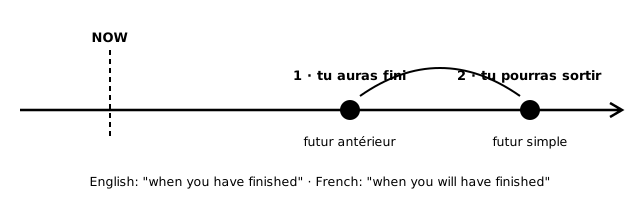
- Quand tu auras fini, tu pourras sortir. — When you have finished, you can go out.
- Dès que j’aurai reçu ton message, je t’appellerai. — As soon as I’ve received your message, I’ll call you.
- Une fois que les invités seront partis, on rangera. — Once the guests have left, we’ll tidy up.
Use 2 — deadlines
- D’ici vendredi, j’aurai terminé le rapport. — By Friday, I will have finished the report.
- Dans dix ans, nous aurons remboursé la maison. — In ten years, we will have paid off the house.
Use 3 — a guess about the past
A very French use: the futur antérieur can express a probable explanation of something that already happened — English "must have".
- Paul n’est pas là ? Il aura raté son bus. — Paul isn’t here? He must have missed his bus.
- Je ne trouve plus mes lunettes. Je les aurai laissées au bureau. — I can’t find my glasses. I must have left them at the office.
The English trap
"When / as soon as / once I have done" (future meaning) = quand / dès que / une fois que + futur antérieur. Never the passé composé.
Careful
- Wrong: Quand j’ai fini mes études, je voyagerai.
- Right: Quand j’aurai fini mes études, je voyagerai.
- Why: Both actions are in the future; finishing comes first → futur antérieur.
30.4 The conditionnel passé — "would have done"
conditional of avoir/être + past participle. It talks about a past that did not happen: regrets, reproaches, missed chances.
| faire (avoir) | venir (être) | |
|---|---|---|
| je / j’ | aurais fait | serais venu(e) |
| tu | aurais fait | serais venu(e) |
| il / elle | aurait fait | serait venu / venue |
| nous | aurions fait | serions venu(e)s |
| vous | auriez fait | seriez venu(e)(s) |
| ils / elles | auraient fait | seraient venus / venues |
The four regret phrases
| French | English | Example |
|---|---|---|
| j’aurais dû + inf. | I should have | J’aurais dû accepter. |
| j’aurais pu + inf. | I could have | J’aurais pu gagner. |
| j’aurais aimé / voulu + inf. | I would have liked | J’aurais aimé te voir. |
| il aurait fallu + inf. | we should have; it was necessary | Il aurait fallu partir plus tôt. |
- J’aurais dû t’écouter. — I should have listened to you.
- Tu aurais pu me prévenir ! — You could have warned me! (a reproach)
- Sans ton aide, je ne serais jamais arrivé jusqu’ici. — Without your help, I would never have got this far.
- Si tu m’avais demandé, je t’aurais aidé. — If you had asked me, I would have helped you.
- Selon les médias, l’avion aurait décollé avec deux heures de retard. — According to the media, the plane reportedly took off two hours late.
It also works as a "future perfect seen from the past": Il a promis qu’il aurait fini avant midi. (He promised he would have finished before noon.)
Careful
- Wrong: J’aurais dû de venir.
- Right: J’aurais dû venir.
- Why: devoir and pouvoir take a bare infinitive — no de. Note also: it is j’aurais dû, never "j’aurais devoir".
30.5 Passé antérieur and passé surcomposé
The passé antérieur — recognise it
passé simple of avoir/être + past participle: il eut fini, elle fut partie. It lives only in written narratives that use the passé simple (novels, history books, fairy tales), almost always after quand, lorsque, dès que, aussitôt que, après que or à peine… que. It marks an action finished just before the next one. You need to recognise it, not to use it.
| avoir verbs | être verbs | |
|---|---|---|
| je / j’ | eus fini | fus parti(e) |
| il / elle | eut fini | fut parti / partie |
| nous | eûmes fini | fûmes parti(e)s |
| ils / elles | eurent fini | furent partis / parties |
- Dès qu’il eut fini son repas, il sortit. — As soon as he had finished his meal, he went out.
- Lorsqu’elle fut partie, le silence retomba sur la maison. — When she had gone, silence fell over the house again.
The passé surcomposé — the spoken cousin
Speech has no passé simple, so to say the same thing out loud some speakers use a "double" compound: avoir in the passé composé + past participle — il a eu fini. It is especially common in the south of France and in Switzerland. Understand it; in standard French you can simply say quand il a fini or après avoir fini.
- Quand il a eu fini de manger, il est parti. — When he had finished eating, he left.
Same idea, three registers
Literary: Dès qu’il eut fini, il partit.
Spoken (regional): Dès qu’il a eu fini, il est parti.
Neutral: Après avoir fini, il est parti. — see Gérondif & participles.
30.6 The full timeline
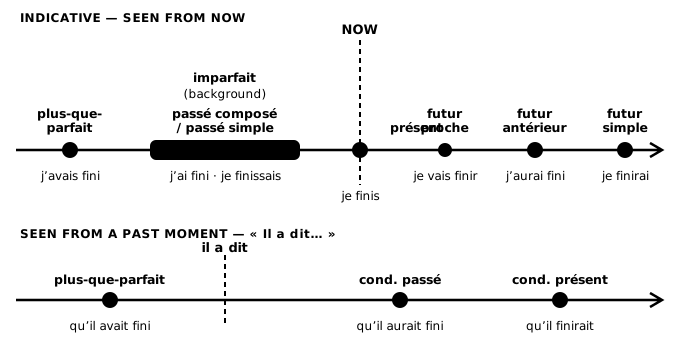
Here is every indicative tense on one line. The compound tenses always sit just before the simple tense whose auxiliary they borrow.
Read the timeline in pairs
plus-que-parfait comes before the passé composé; futur antérieur before the futur simple; conditionnel passé before the conditionnel présent. Each compound is the "earlier" partner of its simple tense.
30.7 Sequencing a story
In a real story the tenses work as a team. The passé composé moves the plot forward, the imparfait paints the scene, and the plus-que-parfait flashes back. Read this short story and look at the tense of each verb.
- Ce matin-là, il pleuvait et j’étais en retard. — That morning it was raining and I was late. (imparfait: the scene)
- La veille, j’avais oublié de régler mon réveil. — The night before, I had forgotten to set my alarm. (plus-que-parfait: flashback)
- J’ai couru jusqu’à la gare, mais le train était déjà parti. — I ran to the station, but the train had already left. (event + earlier event)
- Si j’avais pris un taxi, je l’aurais eu. — If I had taken a taxi, I would have caught it. (unreal past)
- Maintenant, j’ai une règle : quand j’aurai réglé mon réveil, j’irai me coucher. — Now I have a rule: once I’ve set my alarm, I’ll go to bed. (futur antérieur → futur)
Narrative roles
passé composé = what happened next · imparfait = the scene · plus-que-parfait = what had happened before · conditionnel passé = what could have happened.
30.8 Mistakes to avoid
Careful
- Wrong: Elle avait parti avant midi.
- Right: Elle était partie avant midi.
- Why: The auxiliary choice never changes between tenses: partir takes être in every compound tense, with agreement.
Careful
- Wrong: Je te rendrai ton livre quand je l’ai lu.
- Right: Je te rendrai ton livre quand je l’aurai lu.
- Why: Reading will be finished before giving back, and both are in the future → futur antérieur after quand.
Careful
- Wrong: Je serais venu si tu m’aurais invité.
- Right: Je serais venu si tu m’avais invité.
- Why: The conditionnel passé goes in the result; after si use the plus-que-parfait.
- À ta place, j’aurais tout de suite dit oui. — In your place, I would have said yes straight away.
- Ils auront sûrement oublié le rendez-vous. — They must surely have forgotten the appointment.
À retenir
- Compound tense = avoir / être in a simple tense + past participle. The auxiliary’s tense decides the name, and the result always means "one step before" that simple tense.
- "When / as soon as / once I have done" (future meaning) = quand / dès que / une fois que + futur antérieur. Never the passé composé.
- plus-que-parfait comes before the passé composé; futur antérieur before the futur simple; conditionnel passé before the conditionnel présent. Each compound is the "earlier" partner of its simple tense.
- passé composé = what happened next · imparfait = the scene · plus-que-parfait = what had happened before · conditionnel passé = what could have happened.
- Tell the story of your worst journey in six sentences, using at least one plus-que-parfait and one conditionnel passé. Then continue with Passive & reported speech, where these tenses shift.
30.9 Practice — Compound tenses
Exercise 1
Quand nous sommes arrivés, ils ___ déjà dîné.
- ont
- avaient
- auront
- auraient
Hint: Before a past moment
Answer
avaient
An action before another past action → plus-que-parfait: ils avaient dîné.
Exercise 2
Appelle-moi dès que tu ___ ton examen.
- as passé
- passes
- auras passé
- avais passé
Hint: Finished before a future/command
Answer
auras passé
dès que + futur antérieur for a future action completed first.
Exercise 3
J'___ dû te le dire plus tôt.
- avais
- aurais
- aurai
- ai
Hint: I should have…
Answer
aurais
Regret: j'aurais dû = I should have.
Exercise 4
Elle n'est pas encore là ? Elle ___ le train.
- aura raté
- rate
- raterait
- avait raté
Hint: A guess about the past
Answer
aura raté
The futur antérieur can express a probable explanation: she must have missed it.
Exercise 5
Which tense is « il eut fini »?
- passé antérieur
- plus-que-parfait
- passé surcomposé
- futur antérieur
Answer
passé antérieur
passé simple of avoir (eut) + participle = passé antérieur, a literary tense.
Exercise 6
D'ici 2030, nous ___ (finir) les travaux.
Hint: futur antérieur, nous
Answer
aurons fini
Deadline in the future → futur antérieur: nous aurons fini.
Exercise 7
Si tu étais venue, tu ___ (s'amuser).
Hint: conditionnel passé, être
Answer
te serais amusée / te serais amusé
Reflexive verb → être: tu te serais amusée.
Exercise 8
Il m'a rendu le livre que je lui ___ (prêter) l'an dernier.
Answer
avais prêté
Lending came before giving back → plus-que-parfait.
Exercise 9
Elles ___ (partir) quand le téléphone a sonné.
Hint: plus-que-parfait, être
Answer
étaient parties
partir takes être; feminine plural agreement: étaient parties.
Exercise 10
Tap the wrong word.
Quand j'ai fini ce livre demain, je te le prêterai.
Answer
Wrong word: j'ai.
Corrected: Quand j'aurai fini ce livre demain, je te le prêterai.
Future action finished first → futur antérieur: j'aurai fini.
Exercise 11
Tap the wrong word.
Elle avait arrivé avant nous.
Answer
Wrong word: avait.
Corrected: Elle était arrivée avant nous.
arriver takes être in every compound tense.
Exercise 12
Tap the wrong word.
Le bus est déjà parti quand je suis arrivé.
Answer
Wrong word: est.
Corrected: Le bus était déjà parti quand je suis arrivé.
The earlier past action needs the plus-que-parfait: était parti.
Exercise 13
Match the tense to its meaning.
| A | B |
|---|---|
| j'avais fait | I would have done |
| j'aurai fait | I had done (literary) |
| j'aurais fait | I had done |
| j'eus fait | I will have done |
Answer
j'avais fait — I had done; j'aurai fait — I will have done; j'aurais fait — I would have done; j'eus fait — I had done (literary)
imparfait / futur / conditionnel / passé simple of avoir + participle.
Exercise 14
Match the regret phrase.
| A | B |
|---|---|
| j'aurais dû | I could have |
| j'aurais pu | we should have / it was necessary |
| il aurait fallu | I should have |
Answer
j'aurais dû — I should have; j'aurais pu — I could have; il aurait fallu — we should have / it was necessary
devoir, pouvoir and falloir in the conditionnel passé.
Exercise 15
Put the words in order: When you have finished, call me.
Words: auras / fini / appelle-moi / tu / Quand
Answer
Quand tu auras fini appelle-moi
quand + futur antérieur, then the imperative.
Exercise 16
Put the words in order: I should have listened to you.
Words: dû / J'aurais / t'écouter
Answer
J'aurais dû t'écouter
j'aurais dû + bare infinitive.
Exercise 17
Say it aloud.
Si j'avais su je serais venu
Answer
Say: Si j'avais su je serais venu
si + plus-que-parfait → conditionnel passé.
Exercise 18
Say it aloud.
Le film avait déjà commencé
Answer
Say: Le film avait déjà commencé
plus-que-parfait: avait + commencé.
Next step
Tell the story of your worst journey in six sentences, using at least one plus-que-parfait and one conditionnel passé. Then continue with Passive & reported speech, where these tenses shift.