Chapter 47: Idioms & expressions
Les expressions idiomatiques
French people don’t say “I’m tired and can’t be bothered” — they say j’ai la flemme. They don’t get stood up — someone “puts a rabbit” on them. Idioms are where French is most colourful and most impossible to guess. Here are sixty that you will really hear, sorted by theme, each with its literal picture, its real meaning and an example.
- 1How idioms work
- 2À table ! Food idioms
- 3Animal idioms
- 4The body: head, eyes, hands and feet
- 5Weather and nature
- 6Feelings and moods
- 7Love, money, time and work
- 8Proverbs everyone quotes
- 9Never translate an English idiom word for word
How to read this chapter
Each idiom has three layers: Lit. (the word-for-word picture) → real meaning → an example. Remember the picture; it is what makes the idiom stick.
47.1 How idioms work
An idiom is a fixed group of words whose meaning is not the sum of its parts. You cannot change the words (il pleut des cordes, never des ficelles), but you do conjugate the verb and change the possessives: je me creuse la tête, elle se creuse la tête.
Watch the register
Many idioms are familier (marked fam.): perfect with friends, wrong in a job interview or an essay. For the full scale of registers and slang, see Registers & slang.
Don’t overdo it
One well-placed idiom makes you sound natural; five in one sentence sounds like a textbook. Use them when the situation calls for them.
47.2 À table ! Food idioms
French is a food culture, and its idioms prove it: apples, beans, onions, cheese and bread everywhere.
- avoir la pêche (fam.) — Ce matin, j’ai la pêche ! — Lit. to have the peach → to be full of energy. — This morning I feel great!
- tomber dans les pommes — Avec la chaleur, elle est tombée dans les pommes. — Lit. to fall into the apples → to faint. — With the heat, she fainted.
- raconter des salades (fam.) — Arrête de me raconter des salades. — Lit. to tell salads → to tell fibs. — Stop telling me stories.
- c’est la fin des haricots — Plus de café au bureau ? C’est la fin des haricots ! — Lit. it’s the end of the beans → all is lost (usually joking). — No more coffee at the office? It’s the end of the world!
- mettre son grain de sel — Il faut toujours qu’il mette son grain de sel. — Lit. to put in one’s grain of salt → to butt in with an opinion. — He always has to stick his oar in.
- avoir du pain sur la planche — Cette semaine, j’ai du pain sur la planche. — Lit. to have bread on the board → to have a lot of work ahead. — This week I’ve got my work cut out.
- occupe-toi de tes oignons (fam.) — Ma vie privée ? Occupe-toi de tes oignons ! — Lit. look after your onions → mind your own business. — My private life? Mind your own business!
- en faire tout un fromage (fam.) — C’est une petite tache, n’en fais pas tout un fromage ! — Lit. to make a whole cheese of it → to make a fuss about nothing. — It’s a tiny stain, don’t make a mountain out of a molehill!
- les carottes sont cuites — On perd 3-0 à la 85e minute : les carottes sont cuites. — Lit. the carrots are cooked → it’s all over. — We’re losing 3–0 in the 85th minute: it’s game over.
- c’est du gâteau (fam.) — Cet exercice ? C’est du gâteau. — Lit. it’s cake → it’s a piece of cake. — This exercise? Easy. (And ce n’est pas du gâteau = it’s no picnic.)
47.3 Animal idioms
Cats are the stars of French idioms — and rabbits, hens, sheep and wolves are not far behind.
- poser un lapin à quelqu’un — Elle m’a posé un lapin : je l’ai attendue une heure ! — Lit. to put a rabbit on someone → to stand someone up. — She stood me up: I waited an hour for her!
- avoir d’autres chats à fouetter — Désolé, j’ai d’autres chats à fouetter. — Lit. to have other cats to whip → to have bigger fish to fry. — Sorry, I’ve got more important things to do.
- appeler un chat un chat — Appelons un chat un chat : c’est un échec. — Lit. to call a cat a cat → to call a spade a spade. — Let’s be honest: it’s a failure.
- avoir un chat dans la gorge — Pardon, j’ai un chat dans la gorge. — Lit. to have a cat in the throat → to have a frog in one’s throat. — Sorry, I’ve got a frog in my throat.
- donner sa langue au chat — Je ne trouve pas la réponse, je donne ma langue au chat. — Lit. to give one’s tongue to the cat → to give up guessing. — I can’t find the answer, I give up — tell me.
- quand les poules auront des dents — Il rangera sa chambre quand les poules auront des dents. — Lit. when hens have teeth → never; when pigs fly. — He’ll tidy his room when pigs fly.
- avoir la chair de poule — Cette musique me donne la chair de poule. — Lit. to have hen’s flesh → to have goosebumps. — This music gives me goosebumps.
- revenons à nos moutons — Bon, revenons à nos moutons : le budget. — Lit. let’s get back to our sheep → let’s get back to the point. — Right, back to the subject: the budget.
- avoir une faim de loup — Après le match, j’ai une faim de loup. — Lit. to have a wolf’s hunger → to be starving. — After the match I’m ravenous.
- quand on parle du loup… — Tiens, voilà Karim ! Quand on parle du loup… — Lit. when you talk about the wolf (you see its tail) → speak of the devil. — Look, here’s Karim! Speak of the devil…
47.4 The body: head, eyes, hands and feet
Almost every part of the body has an idiom. The map below gathers the most common ones.
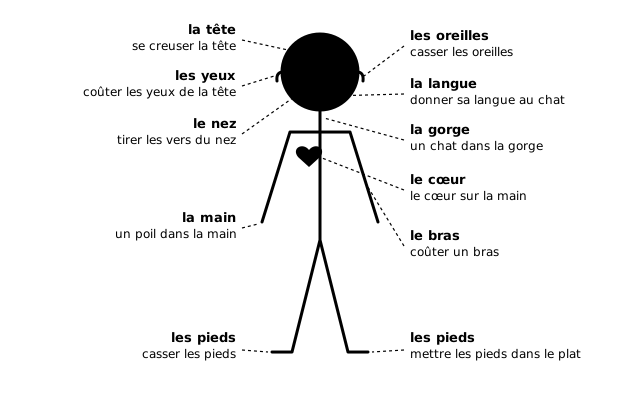
- casser les pieds à quelqu’un (fam.) — Ces réunions me cassent les pieds. — Lit. to break someone’s feet → to annoy, to bore stiff. — These meetings drive me mad. (A casse-pieds = a pain in the neck.)
- casser les oreilles — Baisse la musique, tu me casses les oreilles ! — Lit. to break the ears → to be deafeningly loud. — Turn the music down, you’re deafening me!
- mettre les pieds dans le plat — Il a mis les pieds dans le plat en parlant de son ex. — Lit. to put one’s feet in the dish → to put one’s foot in it; to raise an awkward subject bluntly. — He put his foot in it by mentioning her ex.
- avoir le cœur sur la main — Ma grand-mère a le cœur sur la main. — Lit. to have the heart on the hand → to be very generous. — My grandmother would give you anything.
- tirer les vers du nez à quelqu’un — Il ne voulait rien dire, mais je lui ai tiré les vers du nez. — Lit. to pull the worms out of someone’s nose → to worm information out of someone. — He didn’t want to say anything, but I got it out of him.
- se creuser la tête — Je me suis creusé la tête pendant une heure. — Lit. to dig one’s head → to rack one’s brains. — I racked my brains for an hour.
- avoir la grosse tête (fam.) — Depuis sa promotion, il a la grosse tête. — Lit. to have the big head → to be big-headed. — Since his promotion he’s been full of himself.
- mon œil ! (fam.) — Tu as fini tes devoirs ? Mon œil ! — Lit. my eye! → yeah, right! — You’ve finished your homework? Yeah, right!
- avoir quelque chose sur le bout de la langue — Son nom ? Je l’ai sur le bout de la langue. — Lit. on the tip of the tongue → same as English. — His name? It’s on the tip of my tongue.
- ne pas avoir froid aux yeux — Elle a traversé l’Afrique seule : elle n’a pas froid aux yeux ! — Lit. not to have cold eyes → to be fearless, daring. — She crossed Africa alone: she’s got guts!
- les doigts dans le nez (fam.) — Il a gagné la course les doigts dans le nez. — Lit. with fingers in the nose → effortlessly, hands down. — He won the race without even trying.
47.5 Weather and nature
- il pleut des cordes — Prends un parapluie, il pleut des cordes ! — Lit. it’s raining ropes → it’s raining cats and dogs. — Take an umbrella, it’s pouring! (also: il pleut à verse)
- il fait un froid de canard — Couvre-toi, il fait un froid de canard. — Lit. it’s duck cold (probably from winter duck-hunting) → it’s freezing. — Wrap up, it’s bitterly cold.
- un temps de chien — Quel temps de chien aujourd’hui ! — Lit. dog’s weather → awful weather. — What foul weather today!
- être dans la lune — Pardon, tu disais ? J’étais dans la lune. — Lit. to be in the moon → to be daydreaming, miles away. — Sorry, what were you saying? I was miles away.
- ce n’est pas la mer à boire — Trois pages à lire, ce n’est pas la mer à boire. — Lit. it’s not the sea to drink → it’s not that hard. — Three pages to read — it’s hardly the end of the world.
- ne pas être né de la dernière pluie — Je ne suis pas né de la dernière pluie ! — Lit. not to be born from the last rain → not to be born yesterday. — I wasn’t born yesterday!
- tomber à l’eau — Notre projet de voyage est tombé à l’eau. — Lit. to fall into the water → to fall through. — Our travel plans fell through.
47.6 Feelings and moods
- avoir le cafard — Le dimanche soir, j’ai souvent le cafard. — Lit. to have the cockroach → to feel down, to have the blues. — On Sunday evenings I often feel low.
- en avoir marre (fam.) — J’en ai marre de ce bruit ! — Marre* has no meaning alone; ≈ to have had enough of it → to be fed up*. — I’m sick of this noise!
- ne pas être dans son assiette — Je ne suis pas dans mon assiette aujourd’hui. — Lit. not to be in one’s plate → to feel under the weather, not oneself. — I’m not feeling myself today.
- être aux anges — Elle a eu son bac : elle est aux anges. — Lit. to be with the angels → to be over the moon. — She passed her baccalauréat: she’s thrilled.
- être sur un petit nuage — Depuis leur mariage, ils sont sur un petit nuage. — Lit. to be on a little cloud → to be on cloud nine. — Since their wedding they’ve been walking on air.
- faire la tête — Pourquoi tu fais la tête ? J’ai dit quelque chose ? — Lit. to make the head → to sulk. — Why are you sulking? Did I say something?
- péter les plombs (fam.) — Avec tout ce stress, il a fini par péter les plombs. — Lit. to blow the fuses → to lose it, to snap. — With all that stress, he finally flipped.
47.7 Love, money, time and work
Love and talking
- avoir un coup de foudre — Quand ils se sont rencontrés, ça a été le coup de foudre. — Lit. a lightning strike → love at first sight. — When they met, it was love at first sight. (Also for things: j’ai eu un coup de foudre pour cette maison.)
- tourner autour du pot — Arrête de tourner autour du pot et dis-moi la vérité. — Lit. to turn around the pot → to beat around the bush. — Stop beating around the bush and tell me the truth.
Money
- coûter les yeux de la tête — Ce sac coûte les yeux de la tête. — Lit. to cost the eyes of the head → to cost an arm and a leg. — This bag costs a fortune.
- coûter un bras (fam.) — Ce téléphone m’a coûté un bras. — Lit. to cost an arm → to be very expensive. — This phone cost me an arm and a leg. (Only one arm — and no leg!)
- jeter l’argent par les fenêtres — Un troisième vélo ? Tu jettes l’argent par les fenêtres. — Lit. to throw money out of the windows → to waste money. — A third bike? You’re throwing money down the drain.
- être fauché comme les blés (fam.) — Je ne sors pas ce soir, je suis fauché comme les blés. — Lit. to be mown like wheat → to be flat broke. — I’m not going out tonight, I’m skint.
Time, work and laziness
- avoir la flemme (fam.) — J’ai la flemme de faire la vaisselle. — Lit. to have the laziness → can’t be bothered. — I can’t be bothered to do the dishes.
- faire la grasse matinée — Dimanche, je fais la grasse matinée. — Lit. to do the fat morning → to sleep in, have a lie-in. — On Sunday I’m sleeping in. (fam.: la grasse mat’)
- avoir un poil dans la main — Ton frère ne fait rien : il a un poil dans la main ! — Lit. to have a hair in the palm of one’s hand → to be bone idle. — Your brother does nothing: he’s bone idle!
- se tourner les pouces — Au bureau, il se tourne les pouces toute la journée. — Lit. to turn one’s thumbs → to twiddle one’s thumbs. — At the office he does nothing all day.
- mettre la main à la pâte — Pour la fête, tout le monde a mis la main à la pâte. — Lit. to put one’s hand in the dough → to pitch in, lend a hand. — For the party, everyone pitched in.
- en un clin d’œil — Elle a réparé l’ordinateur en un clin d’œil. — Lit. in a wink → in the blink of an eye. — She fixed the computer in no time.
47.8 Proverbs everyone quotes
- L’habit ne fait pas le moine. — Lit. the habit doesn’t make the monk → don’t judge a book by its cover.
- Petit à petit, l’oiseau fait son nid. — Lit. little by little the bird builds its nest → slowly but surely — a perfect motto for learning French.
- Après la pluie, le beau temps. — Lit. after the rain, fine weather → every cloud has a silver lining; things will get better.
- Les murs ont des oreilles. — Lit. and real: the walls have ears — be careful what you say.
- Il ne faut pas vendre la peau de l’ours avant de l’avoir tué. — Lit. don’t sell the bear’s skin before killing it → don’t count your chickens before they hatch.
- L’appétit vient en mangeant. — Lit. appetite comes while eating → the more you have, the more you want; once you start, you get into it.
Proverbs are often cut short
French speakers often say only the first half and let you finish it: Quand on parle du loup… · Petit à petit… Knowing the whole proverb lets you catch the allusion.
47.9 Never translate an English idiom word for word
An English idiom translated literally is either nonsense or, worse, means something else. Find the French equivalent, not the translation. These are the classics.
Careful
- Wrong: Il pleut des chats et des chiens.
- Right: Il pleut des cordes. / Il pleut à verse.
- Why: French rain is made of ropes, not pets.
Careful
- Wrong: C’est un morceau de gâteau.
- Right: C’est du gâteau. / C’est simple comme bonjour.
- Why: The French idiom uses the partitive: du gâteau. “Un morceau de gâteau” is just a slice of cake.
Careful
- Wrong: Je suis sous le temps aujourd’hui.
- Right: Je ne suis pas dans mon assiette aujourd’hui.
- Why: “Under the weather” = not in your plate. Sous le temps means nothing.
Careful
- Wrong: Ça coûte un bras et une jambe.
- Right: Ça coûte les yeux de la tête. / Ça coûte un bras.
- Why: French charges your eyes — or, informally, a single arm.
Careful
- Wrong: J’ai une grenouille dans la gorge.
- Right: J’ai un chat dans la gorge.
- Why: In French throats, the frog becomes a cat.
Careful
- Wrong: Tuer deux oiseaux avec une pierre.
- Right: Faire d’une pierre deux coups.
- Why: Lit. “to make two hits with one stone” — no birds are harmed in French.
Careful
- Wrong: Je suis sur le nuage neuf !
- Right: Je suis sur un petit nuage ! / Je suis aux anges !
- Why: The French cloud has no number; it is just “little”.
Careful
- Wrong: (to an actor) Casse une jambe !
- Right: Bonne chance ! — in the theatre, actors say Merde !
- Why: French theatre people wish luck with a rude word (and you don’t say thank you). Outside the theatre, keep to bonne chance.
In real life: idioms in conversation
- — Alors, ton rendez-vous d’hier ? — — So, how was your date yesterday?
- — Ne m’en parle pas ! Il m’a posé un lapin, et il pleuvait des cordes. — — Don’t talk to me about it! He stood me up, and it was pouring.
- — Oh non… Tu as le cafard ? — — Oh no… Are you feeling down?
- — Un peu. Mais bon, ce n’est pas la fin des haricots. Après la pluie, le beau temps ! — — A bit. But hey, it’s not the end of the world. Things will get better!
Learn three a week
Pick three idioms, picture them, and use each one in a real sentence this week. Petit à petit, l’oiseau fait son nid.
À retenir
- Each idiom has three layers: Lit. (the word-for-word picture) → real meaning → an example. Remember the picture; it is what makes the idiom stick.
- One well-placed idiom makes you sound natural; five in one sentence sounds like a textbook. Use them when the situation calls for them.
- French speakers often say only the first half and let you finish it: Quand on parle du loup… · Petit à petit… Knowing the whole proverb lets you catch the allusion.
- Pick three idioms, picture them, and use each one in a real sentence this week. Petit à petit, l’oiseau fait son nid.
- Many of these idioms are familier. Learn exactly where each register belongs — and the slang and verlan young French people use — in Registers & slang.
47.10 Practice — idioms & expressions
Exercise 1
'Elle m'a posé un lapin' means…
- She gave me a rabbit.
- She stood me up.
- She cooked me rabbit.
- She told me a lie.
Answer
She stood me up.
Poser un lapin à quelqu'un = not turn up to a date.
Exercise 2
'It's raining cats and dogs' in French:
- Il pleut des chats et des chiens.
- Il pleut des cordes.
- Il fait un froid de canard.
- Il fait la tête.
Answer
Il pleut des cordes.
French rain falls in ropes: il pleut des cordes (or à verse).
Exercise 3
'J'ai la flemme' means…
- I'm on fire.
- I can't be bothered.
- I'm in love.
- I'm starving.
Answer
I can't be bothered.
Avoir la flemme (fam.) = to feel too lazy to do something.
Exercise 4
Which idiom means 'to faint'?
- tomber dans les pommes
- avoir la pêche
- raconter des salades
- mettre son grain de sel
Answer
tomber dans les pommes
Lit. to fall into the apples.
Exercise 5
Ce sac coûte ___ de la tête.
- les yeux
- les bras
- les pieds
- les oreilles
Answer
les yeux
Coûter les yeux de la tête = to cost a fortune.
Exercise 6
Il ne fait rien, il a un ___ dans la main.
Answer
poil
Avoir un poil dans la main = to be very lazy.
Exercise 7
Je ne trouve pas la réponse, je donne ma langue au ___.
Answer
chat
Donner sa langue au chat = to give up guessing.
Exercise 8
Il rangera sa chambre quand les poules auront des ___.
Answer
dents
Quand les poules auront des dents = never (when pigs fly).
Exercise 9
Quand ils se sont vus, ça a été le coup de ___.
Answer
foudre
Le coup de foudre = love at first sight.
Exercise 10
Tap the word that turns this into a literal translation.
J'ai une grenouille dans la gorge.
Answer
Wrong word: grenouille.
Corrected: J'ai un chat dans la gorge.
The English frog becomes a French cat.
Exercise 11
Tap the wrong word.
Ça coûte les oreilles de la tête.
Answer
Wrong word: oreilles.
Corrected: Ça coûte les yeux de la tête.
It's the eyes, not the ears.
Exercise 12
Tap the wrong word.
Bon, revenons à nos chèvres.
Answer
Wrong word: chèvres.
Corrected: Bon, revenons à nos moutons.
Revenons à nos moutons = let's get back to the point.
Exercise 13
Match the mood idiom to its meaning.
| A | B |
|---|---|
| avoir le cafard | to sulk |
| être aux anges | to be fed up |
| faire la tête | to be full of energy |
| en avoir marre | to feel down |
| avoir la pêche | to be over the moon |
Answer
avoir le cafard — to feel down; être aux anges — to be over the moon; faire la tête — to sulk; en avoir marre — to be fed up; avoir la pêche — to be full of energy
Feelings idioms are the most frequent in daily talk.
Exercise 14
Match each French idiom to its English equivalent.
| A | B |
|---|---|
| tourner autour du pot | to have bigger fish to fry |
| appeler un chat un chat | to kill two birds with one stone |
| avoir d'autres chats à fouetter | to beat around the bush |
| faire d'une pierre deux coups | to call a spade a spade |
Answer
tourner autour du pot — to beat around the bush; appeler un chat un chat — to call a spade a spade; avoir d'autres chats à fouetter — to have bigger fish to fry; faire d'une pierre deux coups — to kill two birds with one stone
Equivalents, not translations.
Exercise 15
Put the words in order: 'I'm feeling under the weather.'
Words: mon / dans / pas / suis / ne / assiette / Je
Answer
Je ne suis pas dans mon assiette
ne… pas around the verb, then dans mon assiette.
Exercise 16
Put the words in order: 'It's freezing cold.'
Words: de / Il / fait / un / froid / canard
Answer
Il fait un froid de canard
Weather uses il fait.
Exercise 17
Say it aloud.
Ce n'est pas la mer à boire
Answer
Say: Ce n'est pas la mer à boire
It's not that hard.
Exercise 18
Say it aloud.
Arrête de tourner autour du pot
Answer
Say: Arrête de tourner autour du pot
Stop beating around the bush.
Next step
Many of these idioms are familier. Learn exactly where each register belongs — and the slang and verlan young French people use — in Registers & slang.