Chapter 57: Culture & the francophone world
Culture et francophonie
Perfect grammar is only half of speaking French. The other half is knowing what people expect: the bonjour at the bakery, the vous at the office, two kisses — or four. And French is not only France: more than 320 million people speak it on five continents, from Montréal to Dakar, and even in a corner of India.
- 1Bonjour first — la politesse
- 2Tu or vous? — le vouvoiement
- 3La bise — how many kisses?
- 4At the table — à table !
- 5The French year — fêtes et rythmes
- 6The Republic — symboles et institutions
- 7La francophonie — French on five continents
- 8Québec, Belgium, Switzerland — same language, other words
- 9Pondichéry — France’s link with India
In one line
Greet before you ask (Bonjour, madame), use vous until you are invited to switch, and remember that French sounds different — and uses different words — in Paris, Montréal, Brussels, Dakar and Pondichéry.
- Bonjour, madame. Une baguette, s’il vous plaît. — Hello (madam). A baguette, please.
- On peut se tutoyer ? — Shall we say “tu” to each other?
- Au Québec, on dîne à midi. — In Québec, people have “dîner” (lunch) at noon.
57.1 Bonjour first — la politesse
In France, bonjour is not just “hello”. It is a small ritual that says “I see you as a person”. You say it when you walk into a small shop, a pharmacy, a doctor’s waiting room, a lift, and when you get on a bus and pass the driver. Asking a question without it feels rude — even if your French is perfect.
The shop rule
Enter: Bonjour, madame / monsieur. Leave: Merci, au revoir, bonne journée ! No name needed — madame or monsieur alone is polite.
- Bonjour, monsieur. Je voudrais deux croissants, s’il vous plaît. — Hello. I’d like two croissants, please.
- Excusez-moi de vous déranger, vous savez où est la poste ? — Sorry to bother you, do you know where the post office is?
- Merci, au revoir ! Bonne journée ! — Thanks, goodbye! Have a nice day!
| Situation | Say | Meaning |
|---|---|---|
| Arriving (day / after about 6 p.m.) | Bonjour / Bonsoir | Hello / Good evening |
| Asking for something | S’il vous plaît | Please |
| Answering “merci” (formal / casual) | Je vous en prie / De rien | You’re welcome |
| Leaving | Au revoir, bonne journée | Goodbye, have a good day |
Careful
- Wrong: (walking in) Une baguette, s’il vous plaît.
- Right: Bonjour, madame ! Une baguette, s’il vous plaît.
- Why: Skipping bonjour sounds cold and demanding. Many French people will reply with a pointed “Bonjour…” first.
57.2 Tu or vous? — le vouvoiement
French has two ways to say “you”. Vous is polite and keeps a respectful distance; tu is close and friendly. Indian readers already know the idea: vous ≈ Hindi aap, tu ≈ tum. French simply has no third, very intimate level like Hindi tu. The verbs are vouvoyer (to say vous) and tutoyer (to say tu). Vous is also always the plural “you”, even among friends.
| Vous — by default | Tu — normally |
|---|---|
| Strangers, shop and office staff | Family, friends, partners |
| Older people you don’t know well | Children and teenagers |
| Your boss, clients, teachers (from lycée on) | Classmates, people your age at a party |
| Your partner’s parents — until they invite you | Animals — and God, in prayers |
Who decides to switch? Usually the older or more senior person offers. Young people and many start-ups use tu almost at once; banks, law firms and the civil service keep vous much longer. In Québec, tu is far more common, even with strangers.
- On peut se tutoyer, si vous voulez. — We can say “tu”, if you like. (said in vous — the switch hasn’t happened yet)
- Vous êtes prêts, les enfants ? — Are you ready, kids? (plural vous — not formal at all)
Careful
- Wrong: (to a stranger in the street) Tu sais où est la gare ?
- Right: Excusez-moi, vous savez où est la gare ?
- Why: “Do you know where the station is?” With an adult stranger, tu sounds rude or oddly familiar. When in doubt, use vous — nobody is offended by it.
Once tu, always tu
After you switch to tu, going back to vous sounds like a cold message: “we are no longer close”.
57.3 La bise — how many kisses?
Friends and family in France greet with la bise: you touch cheeks lightly and make a small kiss sound in the air. Lips do not really touch the skin. Women greet women and men this way; men give each other the bise mostly in the family or among close friends (more often in the south). At work, a handshake — une poignée de main — is safer.
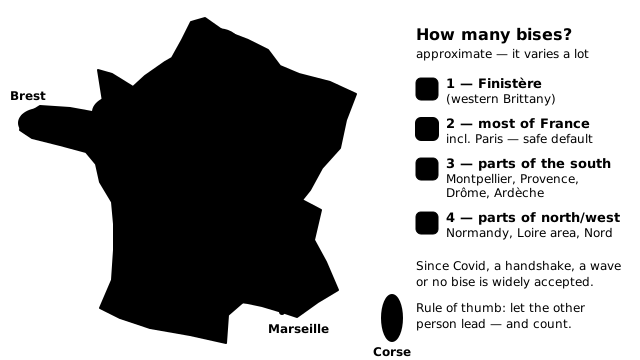
The famous question is how many. The answer depends on the region, the town, the family and the age group. The map below is a rough sketch, not a rule.
- On se fait la bise ? — Shall we do the bise? (a perfectly normal question today)
- Chez toi, c’est combien de bises ? — Where you’re from, how many kisses is it? (a classic small-talk topic)
Careful
- Wrong: En France, on fait toujours deux bises.
- Right: En France, on fait souvent deux bises, mais ça dépend de la région.
- Why: “In France people often do two kisses, but it depends on the region.” Anything from one to four is normal. Pulling away after two in Montpellier leaves the other person hanging.
57.4 At the table — à table !
Meals are a big part of French life — long, social and fairly regular. Lunch (le déjeuner) is usually between noon and 2 p.m., and many restaurant kitchens close after that. Dinner (le dîner) is around 7.30–9 p.m., later in the south. Children have le goûter, an afternoon snack, around 4.30. Before dinner with friends comes l’apéro: a drink and nibbles, sometimes so big it replaces dinner (un apéro dînatoire).
Table manners in four lines
Bread goes on the table beside your plate, and you tear it by hand. Keep both hands visible on the table (wrists on the edge), not on your lap. Let the host pour the wine. Wait for « Bon appétit ! » before you start.
- Bon appétit ! — Merci, à vous aussi. — Enjoy your meal! — Thanks, you too.
- On prend l’apéro ? — Shall we have a pre-dinner drink?
- C’était délicieux. Je reprendrais bien un peu de fromage ! — That was delicious. I’d gladly have a little more cheese!
The bill: traditionally, one person invites and pays — « C’est moi qui invite. » Splitting a restaurant bill item by item used to be frowned upon, and some places still dislike it; today friends often split it evenly or pay each other back by app. Service is included in French prices (service compris), so a tip is small and optional.
- Non, non, c’est moi qui invite ! — No, no, it’s my treat!
Careful
- Wrong: Je suis plein, merci.
- Right: Merci, je n’ai plus faim. C’était délicieux.
- Why: For “I’m full”, say “I’m not hungry any more”. In France je suis plein sounds odd or jokey (plein can mean drunk; pleine is used for pregnant animals). In Québec, je suis plein is fine.
The bon appétit nuance
Everyday French says « Bon appétit ! » all the time — at home, at work, even to strangers eating lunch. Only in very formal, old-school etiquette is it seen as unrefined. As a learner, say it: it is warm and expected.
In real life — invited to dinner
Arrive about ten to fifteen minutes after the time given — never early. Bring flowers, chocolates or a bottle of wine (but never chrysanthemums: they are for graves).
- Bonsoir ! Entrez, entrez ! — Good evening! Come in, come in!
- Merci de m’avoir invitée. Je vous ai apporté des fleurs. — Thank you for inviting me. I’ve brought you some flowers. (a woman speaking: invitée; a man says invité)
57.5 The French year — fêtes et rythmes
Holidays, food traditions, a long summer break, a big restart in September: knowing the French year helps you follow small talk and the news.
| Date | Fête | What happens |
|---|---|---|
| 6 January (or 1st Sunday) | l’Épiphanie | la galette des rois: whoever finds the fève (charm) is king or queen and wears the paper crown |
| 2 February | la Chandeleur | crêpes for everyone |
| 1 April | le poisson d’avril | jokes; children stick paper fish on people’s backs |
| 1 May | la fête du Travail | holiday, marches; people offer du muguet (lily of the valley) for luck |
| 14 July | la fête nationale | military parade on the Champs-Élysées, fireworks, bals |
| 1 November | la Toussaint | families put chrysanthemums on graves |
| 11 November | l’Armistice | remembrance of 1918, ceremonies at war memorials |
| 24–25 December | Noël | le réveillon (big Christmas Eve meal), la bûche de Noël |
- Poisson d’avril ! — April fool!
Three words for the French rhythm
Faire le pont — “to make the bridge”: when a holiday falls on a Thursday, many people also take Friday off. May, with several holidays, is full of ponts. Les grandes vacances — the long summer holidays (July–August); Paris empties in August. La rentrée — early September, when school, work, politics and even new novels (la rentrée littéraire) start again.
- Cette année, le 1er mai tombe un jeudi : on fait le pont ! — This year, 1 May falls on a Thursday: we’re taking the Friday off too!
- Tu pars où pendant les grandes vacances ? — Where are you going for the summer holidays?
57.6 The Republic — symboles et institutions
France calls itself la République, and its symbols are everywhere. The motto Liberté, Égalité, Fraternité is carved on town halls (mairies) and schools. Marianne, a woman in a red Phrygian cap, stands for the Republic: her bust is in every mairie, and her face is on stamps and French euro coins. Add the drapeau tricolore (blue, white, red), the anthem La Marseillaise and the cockerel (le coq) of sports teams.
| Word | What it is | Why it comes up |
|---|---|---|
| l’Assemblée nationale | the lower house: 577 députés | votes laws, with the Sénat |
| l’Académie française | 40 writers and scholars, founded in 1635 | gives (advisory!) opinions on “good French” |
| la Sécu | la Sécurité sociale, public health insurance | you show your carte Vitale at the doctor’s |
| le bac | the end-of-school exam, around age 18 | job ads say bac +3, bac +5 = years of study after it |
| les grandes écoles | very selective schools: Polytechnique, ENS, HEC… | entered after two years of prépa — a bit like the IIT/IIM race |
La laïcité
La laïcité is French secularism, based on a 1905 law separating the Churches and the State. The State favours no religion, and since 2004 pupils in state schools may not wear conspicuous religious signs. Indian secularism is closer to “equal respect for all religions”; laïcité means “religion stays out of public institutions”. It is a sensitive topic.
- La France est une république laïque. — France is a secular republic.
- Elle a un bac +5 en informatique. — She has a master’s-level degree (five years after the bac) in computer science.
57.7 La francophonie — French on five continents
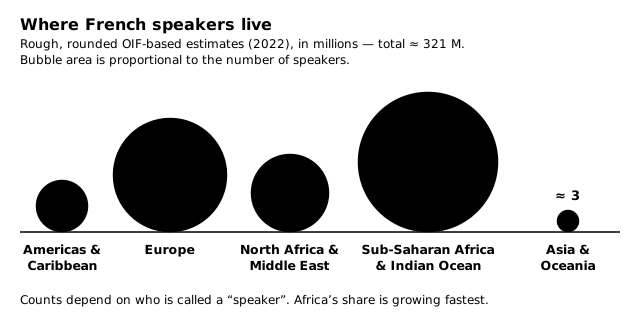
About 321 million people speak French (estimate of the Organisation internationale de la Francophonie, OIF, 2022), which makes it one of the most spoken languages in the world. The OIF brings together nearly 90 states and governments, and 20 March is the Journée internationale de la Francophonie. The surprise for many learners: most people who use French every day live in Africa, not in Europe.
West and Central Africa
In Senegal, Côte d’Ivoire, Mali, Cameroon or the DR Congo, French is the language of school, government and media, next to local languages (Wolof, Bambara, Lingala…). Kinshasa is often called the largest French-speaking city in the world. Abidjan’s street slang, nouchi, has spread far beyond Côte d’Ivoire.
- Ne t’inquiète pas, ça va aller. — Don’t worry, it’s going to be OK. (heard everywhere in West Africa)
- Ce soir, on va s’enjailler au maquis avec ma go. — Tonight we’re going to have fun at the open-air restaurant with my girlfriend. (nouchi: s’enjailler from English “enjoy”, une go = a girl / girlfriend)
The Maghreb
In Algeria, Morocco and Tunisia, French is widely used in business, universities and the press. Everyday speech switches freely between Arabic (often local darija), Tamazight and French — sometimes inside one sentence. Some of these words have entered French slang in France.
- Wesh, ça va ? Yalla, on y va ! — Hey, how’s it going? Come on, let’s go! (wesh and yalla come from Arabic)
The Caribbean and overseas France
Martinique, Guadeloupe, French Guiana (la Guyane), La Réunion and Mayotte are full French départements: part of France and of the EU, with the euro. Many people there also speak a creole — a full language whose vocabulary comes mostly from French but whose grammar is its own. La Réunion, in the Indian Ocean, has a large community of Tamil origin, with Hindu temples and festivals. Haiti, independent since 1804, has two official languages: French and Haitian Creole.
- Sak pase ? — N ap boule ! — Haitian Creole: What’s up? — Doing fine! (the French voice will read it imperfectly)
Careful
- Wrong: Le créole, c’est du français mal parlé.
- Right: Le créole est une langue à part entière.
- Why: “Creole is a language in its own right.” A French speaker cannot simply understand it: it has its own grammar, sounds and literature.
57.8 Québec, Belgium, Switzerland — same language, other words
About eight million people speak French in Québec, around four and a half million in Belgium (Wallonia and Brussels) and around two million in western Switzerland (la Suisse romande). Grammar is the same; accents, numbers and some everyday words differ. All three call the meals déjeuner – dîner – souper (breakfast – lunch – dinner), the older French system.
| English | France | Québec | Belgium / Switzerland |
|---|---|---|---|
| breakfast | le petit-déjeuner | le déjeuner | le déjeuner |
| lunch | le déjeuner | le dîner | le dîner |
| dinner | le dîner | le souper | le souper |
| 70 / 90 | soixante-dix / quatre-vingt-dix | soixante-dix / quatre-vingt-dix | septante / nonante |
| 80 | quatre-vingts | quatre-vingts | quatre-vingts (BE); huitante (Vaud, Valais, Fribourg) |
| mobile phone | un portable | un cellulaire, un cell | un GSM (BE); un natel (CH) |
| un mail, un e-mail | un courriel | un mail, un e-mail | |
| weekend | le week-end | la fin de semaine | le week-end |
| to go shopping | faire du shopping | magasiner | faire du shopping |
| car | une voiture | un char (informal), une auto | une voiture |
Québec
Québec protects French by law (the Charte de la langue française, 1977) and prefers French-made words to English ones: courriel, magasiner, fin de semaine. The accent is distinctive, and tu is used much more.
- Je vais magasiner en fin de semaine avec ma blonde. — I’m going shopping this weekend with my girlfriend. (mon chum = my boyfriend, or my buddy)
- Il fait frette, mets ta tuque ! — It’s freezing, put your wool hat on! (frette = very cold, Québec)
- Mon char est encore au garage, c’est plate ! — My car is still at the garage, what a drag! (c’est plate = it’s boring / too bad)
- Merci ! — Bienvenue ! — Thanks! — You’re welcome! (Québec; in France: de rien)
Québec swear words — recognise, don’t use
Québec’s strongest swear words (les sacres) come from Catholic church vocabulary: tabarnak (from tabernacle), câlisse, hostie. They are far more offensive than they look to a learner. Understand them in films; leave them out of your own French.
Careful
- Wrong: (in Montréal) « Viens dîner samedi » = come on Saturday evening.
- Right: Au Québec, le dîner = lunch ; le souper = the evening meal.
- Why: An invitation à dîner in Québec, Belgium or Switzerland is usually for lunch. Turn up at 8 p.m. and you are seven hours late.
Belgium and Switzerland
Belgians and Swiss count in tens: septante (70), nonante (90) — much simpler than soixante-dix. Belgium keeps quatre-vingts for 80; the Swiss cantons of Vaud, Valais and Fribourg say huitante. Everyone in France understands them — they just mark where you are from.
- Ça fait septante-cinq euros. — That’s 75 euros. (Belgium, Switzerland)
- Votre café, s’il vous plaît ! — Here’s your coffee! (Belgium: s’il vous plaît when handing something over = France’s voilà)
- Viens une fois ici ! — Come here a sec! (Brussels: une fois softens a request — and is a favourite joke about Belgians)
- Je t’envoie un message sur ton natel, ça joue ? — I’ll text your mobile, is that OK? (Swiss: natel = mobile, ça joue ? = does that work?)
57.9 Pondichéry — France’s link with India
From the 17th century, the French East India Company held a few trading posts (comptoirs) in India: Pondichéry, Karikal and Yanaon on the east coast, Mahé on the Malabar coast, and Chandernagor near Kolkata. Chandernagor joined India first (in the early 1950s). The other four were handed over in practice in 1954, and the transfer became legally complete (de jure) in 1962. Today they form the Union Territory of Puducherry (Puducherry, Karaikal, Mahé, Yanam).
Pondichéry in one line
A French comptoir until 1954 (legally until 1962), Pondichéry still has a French quarter, French schools and institutes, and a Tamil–French community.
In the old town, the Ville Blanche (the former French quarter) by the sea is separated by a canal from the Ville tamoule. Streets keep French names (rue Suffren, rue Romain-Rolland, rue Dumas) and police officers wear red képis. The Lycée français international, the Alliance française and the Institut français de Pondichéry keep French alive, and a French consulate serves several thousand French citizens, many from Tamil families. On 14 July a ceremony is held at the seafront war memorial.
- Pondichéry était un comptoir français jusqu’en 1954. — Pondicherry was a French trading post until 1954.
- Certains habitants de Pondichéry ont la nationalité française. — Some residents of Pondicherry have French nationality.
For learners in India
The Alliance française network (Delhi, Mumbai, Chennai, Pondichéry and many more cities) runs courses and the official DELF and DALF exams — see DELF, DALF & your level.
À retenir
- Greet before you ask (Bonjour, madame), use vous until you are invited to switch, and remember that French sounds different — and uses different words — in Paris, Montréal, Brussels, Dakar and Pondichéry.
- Enter: Bonjour, madame / monsieur. Leave: Merci, au revoir, bonne journée ! No name needed — madame or monsieur alone is polite.
- After you switch to tu, going back to vous sounds like a cold message: “we are no longer close”.
- Bread goes on the table beside your plate, and you tear it by hand. Keep both hands visible on the table (wrists on the edge), not on your lap. Let the host pour the wine. Wait for « Bon appétit ! » before you start.
- Everyday French says « Bon appétit ! » all the time — at home, at work, even to strangers eating lunch. Only in very formal, old-school etiquette is it seen as unrefined. As a learner, say it: it is warm and expected.
- A French comptoir until 1954 (legally until 1962), Pondichéry still has a French quarter, French schools and institutes, and a Tamil–French community.
57.10 Practice — culture and francophonie
Exercise 1
You walk into a small bakery in Lyon. What do you say first?
- Bonjour, madame !
- Salut !
- Une baguette !
- Coucou !
Hint: The shop rule
Answer
Bonjour, madame !
Always greet first: Bonjour + madame / monsieur.
Exercise 2
In Québec, « le dîner » is…
- breakfast
- lunch
- the evening meal
- an afternoon snack
Answer
lunch
Québec, Belgium and Switzerland: déjeuner (breakfast), dîner (lunch), souper (dinner).
Exercise 3
How do people in Belgium usually say 90?
- quatre-vingt-dix
- nonante
- huitante
- septante
Answer
nonante
Belgium and Switzerland say septante (70) and nonante (90).
Exercise 4
On peut se ___ ? (= shall we say tu to each other?)
Hint: the verb for saying tu
Answer
tutoyer
tutoyer = to say tu; vouvoyer = to say vous.
Exercise 5
Le 1er mai, on offre du ___ pour porter bonheur.
Hint: lily of the valley
Answer
muguet
On 1 May people give sprigs of muguet (lily of the valley) for luck.
Exercise 6
Le 14 juillet tombe un jeudi : beaucoup de gens font le ___.
Hint: a 'bridge' to the weekend
Answer
pont
faire le pont = take the extra day off between a holiday and the weekend.
Exercise 7
Tap the word that sounds odd at a French dinner table.
Merci, je suis plein.
Answer
Wrong word: plein.
Corrected: Merci, je n'ai plus faim.
In France say je n'ai plus faim; je suis plein sounds odd (plein can mean drunk). It is fine in Québec.
Exercise 8
Tap the wrong word (you are talking to a shopkeeper).
Bonjour, une baguette, s'il te plaît.
Answer
Wrong word: te.
Corrected: Bonjour, une baguette, s'il vous plaît.
With staff and strangers use vous: s'il vous plaît.
Exercise 9
Tap the wrong number word.
Dans le canton de Vaud, 80 se dit souvent septante.
Answer
Wrong word: septante.
Corrected: Dans le canton de Vaud, 80 se dit souvent huitante.
septante = 70. In Vaud, Valais and Fribourg, 80 is huitante.
Exercise 10
Match the Québec word to its meaning.
| A | B |
|---|---|
| un char | my girlfriend |
| une tuque | to go shopping |
| ma blonde | a car |
| magasiner | a wool hat |
Answer
un char — a car; une tuque — a wool hat; ma blonde — my girlfriend; magasiner — to go shopping
Québec French: char, tuque, blonde, magasiner.
Exercise 11
Match the fête to its tradition.
| A | B |
|---|---|
| l'Épiphanie | le muguet |
| la Chandeleur | chrysanthemums on graves |
| le 1er mai | la galette des rois |
| la Toussaint | les crêpes |
Answer
l'Épiphanie — la galette des rois; la Chandeleur — les crêpes; le 1er mai — le muguet; la Toussaint — chrysanthemums on graves
Each fête has its food or flower.
Exercise 12
French « laïcité » means that…
- the State is neutral and stays out of religion
- everyone must belong to a religion
- the State funds all religions equally
- religion is banned in private life
Answer
the State is neutral and stays out of religion
Law of 1905: separation of the Churches and the State; private belief is free.
Exercise 13
Pondichéry was handed to India in practice in 1954. When did the transfer become legally complete?
- 1947
- 1954
- 1962
- 1975
Answer
1962
De facto transfer 1954, de jure 1962.
Exercise 14
A French job ad asks for « bac +5 ». It means…
- five years of study after the bac
- a grade of 5 out of 20
- five years of work experience
- five foreign languages
Answer
five years of study after the bac
bac +3 ≈ bachelor's level, bac +5 ≈ master's level.
Exercise 15
Put the words in order: 'It's my treat.'
Words: invite / qui / C'est / moi
Answer
C'est moi qui invite
C'est moi qui + verb agreeing with moi: invite.
Exercise 16
Put the words in order: 'Thank you for inviting me.'
Words: de / m'avoir / invité / Merci
Answer
Merci de m'avoir invité
merci de + past infinitive: avoir invité (invitée for a woman).
Exercise 17
Say it aloud, as you walk into the bakery.
Bonjour madame, une baguette, s'il vous plaît
Answer
Say: Bonjour madame, une baguette, s'il vous plaît
Greeting first, then the order, then s'il vous plaît.
Exercise 18
Say it aloud: suggest switching to tu.
On peut se tutoyer
Answer
Say: On peut se tutoyer
A friendly, common way to offer tu.
Next step
Culture lives in the details. Next, clean up the errors that most often give a learner away in The 50 most common mistakes — and practise your greetings out loud with Everyday French.