Chapter 19: Y, en & pronoun order
y, en et l’ordre des pronoms
Two tiny words do a huge amount of work in French: y (“there”, “about it”) and en (“some”, “of it”, “from there”). You hear them in almost every conversation — on y va, j’en veux deux, il y en a. This chapter teaches what each one replaces, the idioms built on them, and the fixed order when several pronouns meet before a verb.
- 1Y for places: “there”
- 2Y for things after à: “about it, to it”
- 3En for things after de: “of it, about it, from there”
- 4En with quantities and the partitive
- 5Idioms built on y and en
- 6Two pronouns together: the fixed order
- 7Pronoun order in commands
- 8In real life: at the market
In one line
y replaces à + a place or a thing; en replaces de + a thing, or a quantity. Both go before the verb.
- Tu vas à la plage ? — Oui, j’y vais. — Are you going to the beach? — Yes, I’m going (there). [zhee VAY]
- Tu veux du café ? — Oui, j’en veux bien. — Do you want some coffee? — Yes, I’d like some. [zhã vuh BYɛ̃]
- Il y en a encore ? — Is there any left? [eel-yã-na ã-KOR]
19.1 Y for places: “there”
Y replaces a place introduced by à, en, chez, dans, sur, sous, devant… — any place you go to or are at/in. English often drops “there”; French does not drop y.
- Tu habites en Inde ? — Oui, j’y habite depuis toujours. — Do you live in India? — Yes, I’ve always lived there.
- Elle est chez le médecin ? — Oui, elle y est. — Is she at the doctor’s? — Yes, she’s there.
- Les clés sont dans le tiroir ? — Non, elles n’y sont pas. — Are the keys in the drawer? — No, they aren’t (there).
- On y retourne l’année prochaine. — We’re going back there next year.
Careful
- Wrong: Tu vas au marché ? — Oui, je vais.
- Right: Oui, j’y vais.
- Why: Aller needs a destination. If you don’t repeat it, y must stand in for it. “Je vais” alone sounds unfinished.
The one place where y disappears
Before the future and conditional of aller (irai, iras, irait…) French drops y to avoid “y i”: Tu iras à Lyon ? — Oui, j’irai (not *j’y irai).
19.2 Y for things after à: “about it, to it”
Many verbs are followed by à: penser à, réfléchir à, répondre à, s’intéresser à, jouer à, croire à, tenir à, s’habituer à, participer à. When the thing after à is a thing or an idea, replace it with y.
- Tu penses à ton entretien ? — Oui, j’y pense tout le temps. — Are you thinking about your interview? — Yes, I think about it all the time.
- Tu joues au cricket ? — Oui, j’y joue le dimanche. — Do you play cricket? — Yes, I play (it) on Sundays.
- Tu as répondu à son e-mail ? — Pas encore, j’y réponds ce soir. — Have you answered his email? — Not yet, I’ll answer it tonight.
- Ce cadeau, j’y tiens beaucoup. — This present means a lot to me.
- Le froid ? Je ne m’y habitue pas. — The cold? I can’t get used to it.
Person or thing? Two different answers
| Verb | à + thing | à + person |
|---|---|---|
| répondre à | j’y réponds | je lui réponds |
| penser à | j’y pense | je pense à elle |
| s’intéresser à | je m’y intéresse | je m’intéresse à lui |
| faire confiance à | — | je lui fais confiance |
For people, use lui/leur or à + stressed pronoun, as explained in Object pronouns. Y is for things.
Careful
- Wrong: Ta grand-mère ? J’y pense souvent.
- Right: Ta grand-mère ? Je pense souvent à elle.
- Why: Y replaces things and ideas. For a person after penser à, keep à + stressed pronoun.
19.3 En for things after de: “of it, about it, from there”
En is the partner of y: it replaces de + a thing (or du, de la, des). Common verbs and phrases with de: parler de, avoir besoin de, avoir envie de, avoir peur de, s’occuper de, se souvenir de, être sûr de, être content de, revenir de.
- Tu as besoin de la voiture ? — Non, je n’en ai pas besoin. — Do you need the car? — No, I don’t need it.
- Ils parlent du match ? — Oui, ils en parlent depuis une heure. — Are they talking about the match? — Yes, they’ve been talking about it for an hour.
- Ton voyage ? Je m’en souviens très bien. — Your trip? I remember it very well.
- Tu es sûr de ça ? — Oui, j’en suis sûr. — Are you sure about that? — Yes, I’m sure (of it).
- Tu reviens de la gare ? — Oui, j’en reviens. — Are you coming back from the station? — Yes, I’ve just come from there.
à → y, de → en
Find the little preposition the verb needs. à + thing → y. de + thing → en. That single check solves most cases.
For people after de, careful French uses de + stressed pronoun: Tu parles de Paul ? — Oui, je parle de lui. In relaxed speech you will also hear j’en parle for people — understandable, but avoid it in writing.
19.4 En with quantities and the partitive
This is the use you will need most. Whenever a noun comes with du, de la, des, de or a number or quantity, replace the noun with en — and keep the quantity at the end.

- Tu as des frères ? — Oui, j’en ai deux. — Do you have brothers? — Yes, I have two.
- Vous avez une voiture ? — Oui, j’en ai une. / Non, je n’en ai pas. — Do you have a car? — Yes, I have one. / No, I don’t have one.
- Je voudrais des tomates. — Vous en voulez combien ? — I’d like some tomatoes. — How many would you like?
- J’en prends un kilo, s’il vous plaît. — I’ll take a kilo (of them), please.
- De l’eau ? Il n’y en a plus. — Water? There’s none left.
Careful
- Wrong: Tu as des enfants ? — Oui, j’ai deux.
- Right: Oui, j’en ai deux.
- Why: English says “I have two”, but French cannot leave a number hanging alone. En is compulsory: “I have two of them”.
Careful
- Wrong: Du fromage ? Je le veux bien.
- Right: Du fromage ? J’en veux bien.
- Why: Du fromage = some cheese (a part) → en. Le would mean “the” cheese, a specific one: Le fromage de Marie ? Je le goûte.
le or en?
A noun with le/la/les (the specific one) → le, la, les. A noun with du, de la, des, a number or a quantity → en (+ the quantity).
In compound tenses, the participle does not agree with en: Des fraises ? J’en ai mangé trois. (not *mangées)
19.5 Idioms built on y and en
Many of the most frequent French expressions contain y or en with no clear “it” behind them. Learn them as whole chunks.
| Expression | Meaning | Example |
|---|---|---|
| il y a | there is / there are; ago | Il y a un problème. · Il y a deux ans. |
| il y en a | there is/are some (of it) | Il y en a trois. |
| on y va / allons-y | let’s go | Allez, on y va ! |
| vas-y / allez-y | go ahead | Vas-y, je t’écoute. |
| ça y est | that’s it, done, finally | Ça y est, j’ai fini ! |
| je n’y peux rien | I can’t help it | Désolé, je n’y peux rien. |
| s’en aller | to leave, go away | Je m’en vais. · Va-t’en ! |
| en avoir marre / assez | to be fed up | J’en ai marre ! |
| s’en ficher (informal) | not to care | Je m’en fiche. |
| en vouloir à qqn | to hold it against sb | Tu m’en veux ? |
| s’en sortir | to manage, to cope | Je m’en sors bien. |
| où en es-tu ? | how far have you got? | Tu en es où, avec ton projet ? |
- Bon, il est tard. Je m’en vais. — Right, it’s late. I’m off. [zhuh mã VAY]
- Allez, tout le monde est prêt ? On y va ! — Come on, is everyone ready? Let’s go! [õ-nee VA]
- Ça y est, il a enfin trouvé un appart ! — That’s it, he’s finally found a flat!
- J’en ai marre de ce bruit. — I’m fed up with this noise.
- Je ne t’en veux pas, ce n’est pas grave. — I’m not angry with you, it doesn’t matter.
“I don’t care” — get the pronouns right
- Wrong: Ça m’en fiche.
- Right: Je m’en fiche. / Ça m’est égal.
-
Why: The verb is se ficher de (to not care about), so the subject is the person: je m’en fiche, il s’en fiche. Ça m’est égal (“it’s all the same to me”) is the polite version — use it with your boss.
-
Wrong: Je vais. (meaning “I’m leaving”)
- Right: Je m’en vais. / J’y vais.
- Why: S’en aller = to leave. J’y vais = I’m going (there), also used as “I’m off”.
19.6 Two pronouns together: the fixed order
When two pronouns stand before the verb, they always appear in the same order. Learn the five slots once and you can build any combination.
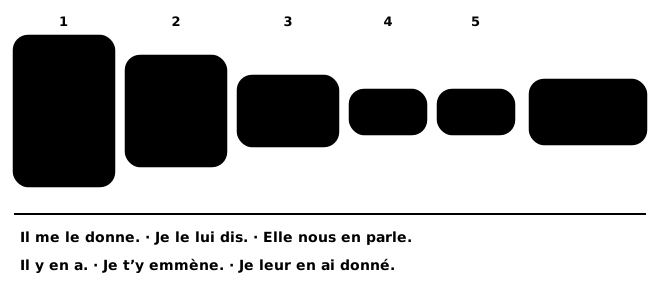
- Ton vélo ? Tu me le prêtes ? — Your bike? Will you lend it to me?
- La nouvelle ? Je la leur annonce demain. — The news? I’m telling them tomorrow.
- Des photos ? Il nous en a envoyé plein. — Photos? He sent us loads.
- Je ne le lui ai pas dit. — I didn’t tell him/her (it). [zhuhn luh lwee ay pa DEE]
- Des places ? Il n’y en a plus. — Seats? There are none left.
The donkey trick
A French donkey says “hi-han” — which sounds exactly like y en. So y always comes before en: il y en a, never *il en y a.
Combinations that never happen
Slots 1 and 3 never meet: you cannot say *il me lui présente. Put the second person after à as a stressed pronoun instead: Il me présente à elle. Also, le/la/les rarely combine with en. Speakers simply rephrase.
Careful
- Wrong: Je lui le donne.
- Right: Je le lui donne.
- Why: Slot 2 (le, la, les) comes before slot 3 (lui, leur). Note: with me, te, nous, vous it is the reverse — il me le donne.
19.7 Pronoun order in commands
In a positive command the pronouns jump after the verb, joined with hyphens, and the order changes slightly: direct first, then indirect, then y, then en. Me and te become moi and toi.
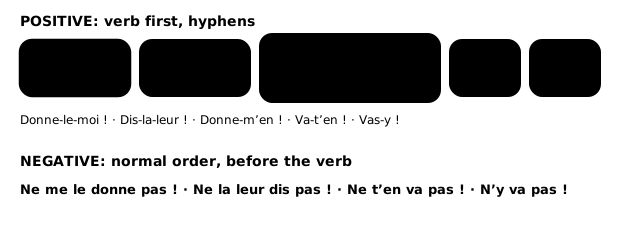
- Le sel ? Passe-le-moi, s’il te plaît. — The salt? Pass it to me, please.
- Ne me le passe pas, je n’en veux pas. — Don’t pass it to me, I don’t want any.
- Des bonbons ? Donne-m’en deux. — Sweets? Give me two. [don-MÃ duh]
- Tu as des doutes ? Parles-en à ton prof. — You have doubts? Talk to your teacher about it.
- Le musée est super. Allez-y ! — The museum is great. Go!
The -s that comes back
The tu command of -er verbs (and va) has no -s — except before y or en, for the liaison: va → vas-y, mange → manges-en, parle → parles-en.
Careful
- Wrong: Donne-moi-z-en !
- Right: Donne-m’en !
- Why: Moi + en contracts to m’en. The “z” version is very common among children but is considered incorrect.
More on commands — forms, irregulars and polite alternatives — in Giving instructions.
19.8 In real life: at the market
- — Bonjour ! Vous avez des mangues aujourd’hui ? — — Hello! Do you have mangoes today?
- — Oui, il y en a, elles sont superbes. Vous en voulez combien ? — — Yes, we have some, they’re gorgeous. How many would you like?
- — J’en prends quatre. Et des citrons verts ? — — I’ll take four. And limes?
- — Ah, désolé, je n’en ai plus. Revenez demain, j’en aurai. — — Ah, sorry, I’ve run out. Come back tomorrow, I’ll have some.
- — D’accord, j’y penserai. Vous êtes là le samedi aussi ? — — OK, I’ll remember (lit. think about it). Are you here on Saturdays too?
- — Oui, j’y suis tous les samedis. Bonne journée ! — — Yes, I’m here every Saturday. Have a good day!
Choosing in four seconds
Person after à? → lui/leur. Thing or place after à? → y. De + thing, or a quantity? → en. Specific “the” thing, no preposition? → le/la/les.
À retenir
- y replaces à + a place or a thing; en replaces de + a thing, or a quantity. Both go before the verb.
- Find the little preposition the verb needs. à + thing → y. de + thing → en. That single check solves most cases.
- A noun with le/la/les (the specific one) → le, la, les. A noun with du, de la, des, a number or a quantity → en (+ the quantity).
- A French donkey says “hi-han” — which sounds exactly like y en. So y always comes before en: il y en a, never *il en y a.
- The tu command of -er verbs (and va) has no -s — except before y or en, for the liaison: va → vas-y, mange → manges-en, parle → parles-en.
- Each time you hear y or en today, ask: what does it replace? Then continue with Reflexive verbs, where se — slot 1 in the order — gets a chapter of its own.
19.9 Practice — Y, en & pronoun order
Exercise 1
Tu vas souvent à Mumbai ? — Oui, j'___ vais chaque année.
- y
- en
- le
- lui
Answer
y
à + place → y.
Exercise 2
Tu as des cousins ? — Oui, j'___ ai cinq.
- les
- en
- y
- leur
Answer
en
A number is kept; the noun becomes en.
Exercise 3
Tu penses à tes vacances ? — Oui, j'___ pense.
- en
- lui
- y
- leur
Answer
y
penser à + a thing → y.
Exercise 4
Tu as besoin de mon stylo ? — Non, je n'___ ai pas besoin.
- y
- le
- en
- lui
Answer
en
avoir besoin de + thing → en.
Exercise 5
Which order is correct?
- Je lui le donne.
- Je le lui donne.
- Je donne le lui.
- Je le donne lui.
Answer
Je le lui donne.
Slot 2 (le) comes before slot 3 (lui).
Exercise 6
The polite way to say 'I don't mind / it's all the same to me':
- Ça m'en fiche.
- Ça m'est égal.
- Je m'y fiche.
- Je me fiche.
Answer
Ça m'est égal.
Ça m'est égal is neutral and polite; je m'en fiche is informal.
Exercise 7
Il ___ en a beaucoup. (There are a lot.)
Hint: the donkey
Answer
y
il y en a: y before en.
Exercise 8
Du pain ? Oui, j'___ veux bien.
Answer
en
Partitive du pain → en.
Exercise 9
Va ! → Va + y = ___ !
Hint: the -s comes back
Answer
Vas-y / vas-y
Before y and en the tu command takes -s: vas-y.
Exercise 10
Bon, il est tard, je m'___ vais.
Answer
en
s'en aller: je m'en vais = I'm leaving.
Exercise 11
Tap the wrong word.
Tu as deux sœurs ? Oui, j'ai deux.
Answer
Wrong word: j'ai.
Corrected: Oui, j'en ai deux.
A number cannot stand alone: j'en ai deux.
Exercise 12
Tap the wrong word.
Ça m'en fiche complètement.
Answer
Wrong word: Ça.
Corrected: Je m'en fiche complètement.
The verb is se ficher de: the subject is the person — je m'en fiche.
Exercise 13
Tap the wrong word.
Ta mère ? J'y pense souvent.
Answer
Wrong word: J'y.
Corrected: Je pense souvent à elle.
y is for things; for a person keep à + stressed pronoun.
Exercise 14
Put the words in order: Give it to me!
Words: Donne-le-moi
Answer
Donne-le-moi
Positive command: verb, direct (le), then indirect (moi).
Exercise 15
Put the words in order: I didn't tell him.
Words: pas / ai / lui / le / ne / dit / Je
Answer
Je ne le lui ai pas dit
ne + le + lui + auxiliary + pas + participle.
Exercise 16
Match the idiom to its meaning.
| A | B |
|---|---|
| Ça y est ! | I can't help it. |
| J'en ai marre. | Are you angry with me? |
| Je n'y peux rien. | That's it / done! |
| Tu m'en veux ? | I'm fed up. |
Answer
Ça y est ! — That's it / done!; J'en ai marre. — I'm fed up.; Je n'y peux rien. — I can't help it.; Tu m'en veux ? — Are you angry with me?
Idioms with y and en are learned as whole chunks.
Exercise 17
Say it aloud.
Il y en a encore
Answer
Say: Il y en a encore
il y en a: four syllables run together — eel-yã-na.
Exercise 18
Say it aloud.
Allez on y va
Answer
Say: Allez on y va
on y va: the n links to y — õ-nee-VA.
Next step
Each time you hear y or en today, ask: what does it replace? Then continue with Reflexive verbs, where se — slot 1 in the order — gets a chapter of its own.