Chapter 1: How to use this book
Le mode d’emploi
This book takes you from your very first bonjour to confident, natural French at C2, the top level. It is not a book you only read. You will listen, speak and test yourself on every page. This short chapter shows you the path, the daily routine, and how to get the most from each button.
- 1The path: from A1 to C2
- 2How each chapter works
- 3The 20-minute daily routine
- 4The buttons: 🔊, 🎤 and the quiz
- 5Spaced review: beat the forgetting curve
- 6How long will it take?
- 7Tips for Indian and English-speaking learners
- 8Your first French words
masculinefeminineplural
The whole method in one line
20 minutes a day, out loud, every day — read, listen, repeat, quiz, review. Speaking aloud is not optional: it is how French moves from your eyes to your mouth.
- Bonjour ! — Hello! / Good morning! [bõ-ZHOOR]
- On commence ? — Shall we start? [õ ko-MÃSS]
1.1 The path: from A1 to C2
Language levels in Europe, and in most French exams, follow the CEFR (Common European Framework of Reference). It has six levels in three pairs: A = basic user, B = independent user, C = proficient user.
| Level | Name | What you can do |
|---|---|---|
| A1 | Beginner | Greet people, introduce yourself, ask simple questions, understand slow, clear speech. |
| A2 | Elementary | Shop, order food, talk about your family, job and past weekend in simple sentences. |
| B1 | Threshold | Travel alone, tell a story, give a simple opinion, follow the main points of the news. |
| B2 | Vantage | Discuss and argue, watch most films without subtitles, work in French. |
| C1 | Advanced | Speak fluently and precisely, write structured essays, understand implicit meaning. |
| C2 | Mastery | Understand almost everything, play with style and register, sound educated and natural. |
The book has seven parts. The order is the learning path: you cannot read French aloud until the silent letters and nasal sounds make sense, so Part 1 starts there. The parts on speaking, vocabulary and writing climb in level inside each part, so you can dip into their early chapters while you work through the grammar.
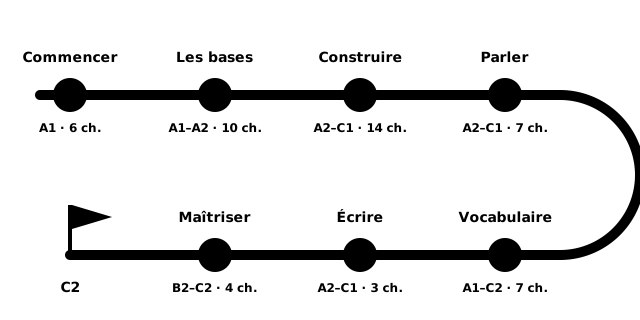
Where to start
Total beginner? Go in order. Already know some French? Still do Part 1 — pronunciation habits are hard to fix later — then use the quizzes to skip what you already know.
1.2 How each chapter works
Every chapter opens as a set of swipeable pages. You always meet the same steps, so you always know where you are.
| Step | What it does |
|---|---|
| Cover | Title, level and time. |
| Map | The sections of the chapter. Tap one to jump to it. |
| Content pages | Rules, examples with sound, tables, figures and typical mistakes. |
| À retenir | “To remember”: the key rules on one page. |
| Practice | A quiz of 12–20 questions, including speaking. |
| Finish | Your score and the next chapter. |
The colour code
French nouns are masculine or feminine, and that choice changes the words around them. So the book colours them everywhere, from page one to the last chapter.
- le livre — the book — blue = masculine** [luh LEEVR]
- la table — the table — pink = feminine** [la TABL]
- les amis — the friends — violet = plural** [lay-za-MEE]
- Je parle français. — I speak French. — the verb has its own colour [zhuh parl frã-SEH]
Two more marks help you read aloud. A greyed, struck letter is silent: petit, ils parlent. A tie mark shows that two words are linked in speech (a liaison): les‿amis. You will learn both in Silent letters & liaison.
The pronunciation hints
Under new words you will see a hint in square brackets, written for English readers: [bõ-ZHOOR]. CAPITALS mark the last syllable, which is slightly longer in French. The symbols ã õ ɛ̃ are the nasal vowels, and ew is the French u. They are explained, mouth by mouth, in The sounds of French. The hints are a bridge only: always trust the 🔊 button over the spelling.
1.3 The 20-minute daily routine
Short, daily practice beats a long session once a week. Your brain stores language during sleep, so seven small sessions give you seven nights of consolidation instead of one. Here is the routine that the whole book is built for.
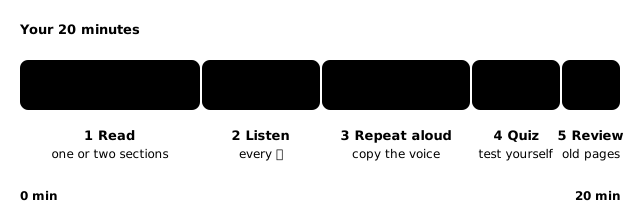
| Step | How to do it well |
|---|---|
| 1. Read (6 min) | One or two sections only. Understand the rule; do not try to memorise every example. |
| 2. Listen (4 min) | Press every 🔊 in those sections. Look at the French while you listen. |
| 3. Repeat aloud (5 min) | Press 🔊, pause, say it yourself — at full voice, not in your head. Copy the melody, not just the words. |
| 4. Quiz (3 min) | Do part of the chapter quiz, or all of it at the end of the chapter. |
| 5. Review (2 min) | Open the “À retenir” page of an older chapter and say its examples aloud. |
The routine in French — say these as you do each step:
- Je lis. — I read. [zhuh LEE]
- J’écoute. — I listen. [zhay-KOOT]
- Je répète à voix haute. — I repeat out loud. [zhuh ray-PET a vwa OHT]
- Je révise tous les jours. — I review every day. [zhuh ray-VEEZ too lay ZHOOR]
Shadowing
The best repeating technique: press 🔊 and speak with the voice, half a second behind it, like an echo. Do it three times per sentence.
1.4 The buttons: 🔊, 🎤 and the quiz
🔊 Listen
Every 🔊 button reads the French aloud with a French voice from your device. Press it as often as you like. Try it now:
- Je m’appelle Priya. — My name is Priya. [zhuh ma-pel pree-YA]
- J’apprends le français. — I am learning French. [zha-prã luh frã-SEH]
- Je parle un peu français. — I speak a little French. [zhuh parl ɛ̃ pö frã-SEH]
No sound, or an English accent?
Your device needs a French voice. On Android: Settings → Text-to-speech → install French. On iPhone: Settings → Accessibility → Spoken Content → Voices → French. On Windows: Settings → Time & language → Speech → add French. Chrome, Edge and Safari work best.
🎤 Speak
Speaking questions show a sentence and a 🎤 button. Press it, say the sentence, and the browser checks what it heard. If your browser has no speech recognition, simply listen, repeat aloud, and tap I said it ✓. Be honest with yourself: the point is the speaking, not the score.
The first time, the browser asks permission to use the microphone. Allow it. If the mic does not start later, check the permission in the browser’s site settings.
The six kinds of quiz question
| Type | What you do |
|---|---|
| Choose | Pick the right answer from up to four options. |
| Fill | Type the missing word. Small typos and missing accents are forgiven. |
| Spot | Tap the one wrong word in a sentence. |
| Reorder | Tap the words in the correct order. |
| Match | Join French words to their meanings. |
| Speak | Say a sentence aloud into the mic. |
Every answer comes with a short why. Read it even when you are right — it is often the most useful line on the page.
1.5 Spaced review: beat the forgetting curve
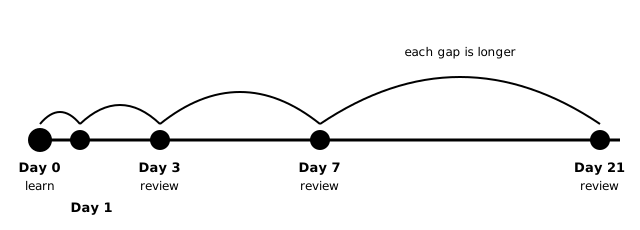
You forget most of a new word within a day or two — unless you meet it again. Each time you review it just before you forget, the memory gets stronger and lasts longer. This is called spaced repetition.
The review rule
Review each chapter after 1 day, 3 days, 1 week and 3 weeks — just the “À retenir” page and the quiz. A second quiz attempt the next day fixes it in memory.
Keep a small notebook (or a notes app) with one line per day: the date and the chapter. Then each morning you can see which chapters are due. Write new words with their article — une pomme, not just pomme — so you learn the gender at the same time.
1.6 How long will it take?
Honest numbers help you plan. The figures below are the usual estimates of total guided study hours to reach each level, as quoted by language schools such as the Alliance Française. They vary a lot from person to person; extra listening (films, podcasts, music) makes everything faster.
| Level | Total hours (approx.) | At 20 min/day | At 1 hour/day |
|---|---|---|---|
| A1 | 60–100 h | 6–10 months | 2–3 months |
| A2 | 160–200 h | about 1.5 years | about 6 months |
| B1 | 350–400 h | about 3 years | about 1 year |
| B2 | 550–650 h | about 5 years | 1.5–2 years |
| C1 | 800–1000 h | — | 2.5–3 years |
| C2 | 1000–1200 h+ | — | 3–4 years |
So 20 minutes a day is the minimum that keeps you moving, not the fastest road. A good plan: the 20-minute routine with this book, plus 20–40 minutes of French you enjoy — a series with French subtitles, a podcast for learners, songs. English speakers have a head start: the US Foreign Service Institute puts French in its easiest group of languages for English speakers.
Measure, don’t guess
The official French exams are the DELF (A1–B2) and DALF (C1–C2), offered in India by the Alliance Française centres. See DELF, DALF & your level in Part 7.
1.7 Tips for Indian and English-speaking learners
You already know far more French than you think. A large part of English vocabulary comes from French. Many words are almost the same — only the pronunciation changes.
- la nation, l’information, la question — nation, information, question — same words, French sound [na-SYÕ, ɛ̃-for-ma-SYÕ, kes-TYÕ]
- le restaurant, le train, le chocolat — restaurant, train, chocolate [res-to-RÃ, trɛ̃, sho-ko-LA]
- l’hôtel, le taxi, le bus — hotel, taxi, bus [lo-TEL, tak-SEE, BEWSS]
- la police, la banque, la pharmacie — police, bank, pharmacy [po-LEESS, BÃK, far-ma-SEE]
- C’est possible ? C’est important ! — Is it possible? It's important! [seh po-SEEBL … seh-tɛ̃-por-TÃ]
Same spelling, French sound
A shared word is only free if you say it the French way: hôtel is [o-TEL], not “HO-tel”; important ends in a nasal, with no t. Some look-alikes are traps (false friends) — see Cognates & false friends.
What Hindi gives you
| Hindi helps with… | Why |
|---|---|
| Gender | Hindi nouns are masculine or feminine too (kitaab is feminine). The idea is familiar — but the genders do not match the French ones, so learn each word with its article. |
| Nasal vowels | The nasal sound in maan (माँ) or haan (हाँ) is very close to French an in enfant. |
| t, d, p, k | French t and d are dental, like Hindi त and द, not like English t and d. French p, t, k have no puff of air, like Hindi प, त, क. |
| tu / vous | Like tum / aap: vous is the polite form. See Hello, please, thank you. |
| The French R | It is made in the throat, close to the Urdu sound ग़ in ghazal — not the tapped Hindi र. |
Traps for English speakers
Careful
- Wrong: Reading Paris as “PA-ris”, with the s.
- Right: Paris = [pa-REE]: the s is silent and the last syllable is stressed.
- Why: French final consonants are usually silent, and French stresses the end of the word, not the beginning.
Careful
- Wrong: Learning “pomme = apple”.
- Right: Learning “une pomme = an apple”.
- Why: Gender is part of every noun. Learn it with the word from day one — later it is much harder.
Careful
- Wrong: Reading silently, in your head.
- Right: Reading every example aloud, at normal volume.
- Why: Your mouth needs practice as much as your memory. Silent study gives you a reading French, not a speaking French.
Careful
- Wrong: Waiting to speak until you are “ready”.
- Right: Speaking from the first day, with mistakes.
- Why: Mistakes are how you learn. French people are usually happy you try — start every exchange with bonjour.
1.8 Your first French words
Before the next chapter, here are six words you will use every single day. Press 🔊, then say each one three times.
- oui — yes [WEE]
- non — no [NÕ]
- merci — thank you [mehr-SEE]
- s’il vous plaît — please (polite) [seel voo PLEH]
- d’accord — OK, agreed [da-KOR]
- au revoir — goodbye [oh ruh-VWAR]
A first mini-dialogue
- — Bonjour, Madame ! — — Hello, madam! [bõ-zhoor ma-DAM]
- — Bonjour ! Un café, s’il vous plaît ? — — Hello! A coffee, please? [ɛ̃ ka-FAY seel voo PLEH]
- — Oui, d’accord. — — Yes, OK.
- — Merci ! Au revoir ! — — Thank you! Goodbye!
Notice Madame after bonjour: in France it is polite to add Monsieur or Madame when you greet someone you do not know. More in Hello, please, thank you.
À retenir
- 20 minutes a day, out loud, every day — read, listen, repeat, quiz, review. Speaking aloud is not optional: it is how French moves from your eyes to your mouth.
- Total beginner? Go in order. Already know some French? Still do Part 1 — pronunciation habits are hard to fix later — then use the quizzes to skip what you already know.
- The best repeating technique: press 🔊 and speak with the voice, half a second behind it, like an echo. Do it three times per sentence.
- Review each chapter after 1 day, 3 days, 1 week and 3 weeks — just the “À retenir” page and the quiz. A second quiz attempt the next day fixes it in memory.
- The official French exams are the DELF (A1–B2) and DALF (C1–C2), offered in India by the Alliance Française centres. See DELF, DALF & your level in Part 7.
- Go on to Alphabet & accents. Before you do, press every 🔊 in section 8 once more and say the words aloud. That is your first day of French — bravo !
1.9 Practice — The method
Exercise 1
How many CEFR levels are there?
- 4
- 5
- 6
- 8
Answer
6
A1, A2, B1, B2, C1, C2 — three pairs: basic, independent, proficient.
Exercise 2
What is the top CEFR level?
- A1
- B2
- C1
- C2
Answer
C2
C2 = mastery. This book aims to take you all the way there.
Exercise 3
What does the daily routine ask you to do with every example?
- Copy it into a notebook
- Say it aloud
- Translate it into Hindi
- Skip it
Answer
Say it aloud
Speaking aloud moves French from your eyes to your mouth. Silent reading is not enough.
Exercise 4
How long is the core daily routine?
- 5 minutes
- 20 minutes
- 1 hour
- 2 hours
Answer
20 minutes
20 minutes every day: read, listen, repeat aloud, quiz, review.
Exercise 5
In this book, a noun in blue is…
- masculine
- feminine
- plural
- a verb
Hint: le livre
Answer
masculine
Blue = masculine, pink = feminine, violet = plural.
Exercise 6
In the hint [bõ-ZHOOR], what do the capitals show?
- A loud shout
- The last, slightly longer syllable
- A silent part
- An English word
Answer
The last, slightly longer syllable
French stresses the end of a word or group: bon-JOUR.
Exercise 7
Review a chapter after 1 day, 3 days, 1 week and ___ weeks.
Hint: a number
Answer
3 / three / trois
1 – 3 – 7 – 21 days: each gap is longer than the one before.
Exercise 8
Tap the bad study habit.
Learn every noun silently with its article.
Answer
Wrong word: silently.
Corrected: Learn every noun aloud with its article.
Always say words aloud — and yes, always with the article.
Exercise 9
Match the exam to its levels.
| A | B |
|---|---|
| DELF | C1 to C2 |
| DALF | the six-level scale |
| CEFR | A1 to B2 |
Answer
DELF — A1 to B2; DALF — C1 to C2; CEFR — the six-level scale
DELF covers A1–B2, DALF covers C1–C2; the CEFR is the scale they use.
Exercise 10
Match the French to the English.
| A | B |
|---|---|
| oui | thank you |
| non | goodbye |
| merci | yes |
| au revoir | no |
Answer
oui — yes; non — no; merci — thank you; au revoir — goodbye
Four words you will use every day.
Exercise 11
Which sound is closest to the French R?
- र as in raja
- ग़ as in ghazal
- ड as in dal
- the English r in red
Answer
ग़ as in ghazal
The French R is made at the back of the throat, like ग़ — not tapped like र, not curled like English r.
Exercise 12
"S'il vous plaît" means…
- thank you
- please
- hello
- sorry
Answer
please
s'il vous plaît = please (literally 'if it pleases you').
Exercise 13
Un café, s'il vous ___ .
Hint: please = s'il vous …
Answer
plaît / plait
s'il vous plaît — the t is silent: [seel voo PLEH].
Exercise 14
Put the words in order: 'I speak a little French.'
Words: français / parle / Je / un / peu
Answer
Je parle un peu français
Je (I) + parle (speak) + un peu (a little) + français.
Exercise 15
Say it aloud.
Bonjour Madame
Answer
Say: Bonjour Madame
bon-JOUR ma-DAME: add Monsieur or Madame when greeting a stranger.
Exercise 16
Say it aloud.
J'apprends le français
Answer
Say: J'apprends le français
zha-PRAN luh fran-SEH — the final s of français is silent.
Next step
Go on to Alphabet & accents. Before you do, press every 🔊 in section 8 once more and say the words aloud. That is your first day of French — bravo !