Chapter 54: First stories
Premières histoires
Six short stories, read slowly, about real everyday moments: buying bread, a first day at work, a rainy weekend, a family, a phone call from mum and a trip to the market. You listen first, without the text. Then you check the key words, open the transcript, and finally write a classic French dictée. This is how your ear learns French — one small story at a time.
- 1How to use these stories
- 2Histoire 1 — Léa à la boulangerie
- 3Histoire 2 — Le premier jour de Raj à Lyon
- 4Histoire 3 — Un week-end à la mer
- 5Histoire 4 — La famille de Sophie
- 6Histoire 5 — Un appel de maman
- 7Histoire 6 — Au marché
- 8La dictée — from sound to spelling
masculinefeminineplural
Listen first, read last
Play each story twice before you open the transcript. Your brain only learns to decode sounds when it has to try. Reading first turns listening into reading.
54.1 How to use these stories
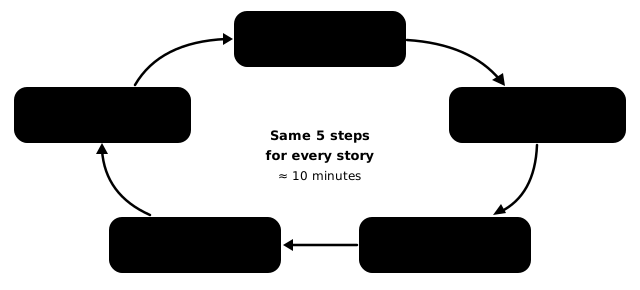
Every story follows the same five steps. One story takes about ten minutes. Do one a day rather than all six in one evening — your ear improves with repetition, not with long sessions.
You don’t need every word
At A1–A2, understanding 60–70% of a story is a success. Catch the names, numbers, places and times first — they carry most of the meaning.
In the key-word tables, the colours show gender, as everywhere in this book: masculine, feminine, plural. The story button reads slowly; tap the small 🔊 buttons in the notes to hear single sentences, and use 🎤 to repeat them.
- Pardon, vous pouvez répéter ? — Sorry, can you repeat? — the most useful listening sentence in French. [par-DÕ, voo poo-VAY ray-pay-TAY]
- Plus lentement, s’il vous plaît. — More slowly, please. [plew lãt-MÃ, seel voo PLAY]
54.2 Histoire 1 — Léa à la boulangerie
It is Saturday morning. Léa goes to buy bread, like many French people do every day. Listen for: what does she buy, and how much does it cost?
| Français | English | Sound |
|---|---|---|
| la boulangerie | bakery | [la boo-lãzh-REE] |
| la boulangère | the (woman) baker | [la boo-lã-ZHEHR] |
| une baguette | a baguette | [ewn ba-GET] |
| un croissant | a croissant | [ɛ̃ krwa-SÃ] |
| Ça fait combien ? | How much is it? | [sa fay kõ-BYɛ̃] |
| payer (elle paie) | to pay (she pays) | [pay-YAY, el PAY] |
| le petit-déjeuner | breakfast | [luh puh-tee day-zhuh-NAY] |
| encore | still / again | [ã-KOR] |
- ▶ Toute l’histoire (slow) — Listen twice. Then answer in your head: what? how much? who is still asleep?
Transcript
Le samedi matin, Léa va à la boulangerie. Elle entre et dit : « Bonjour, madame ! » La boulangère sourit : « Bonjour, Léa ! Qu’est-ce que je vous sers ? » Léa veut une baguette et deux croissants. « Ça fait combien ? » demande-t-elle. « Trois euros quarante, s’il vous plaît. » Léa paie, dit merci et rentre à la maison. Son petit frère dort encore. Elle prépare le petit-déjeuner pour toute la famille.
English translation
On Saturday mornings, Léa goes to the bakery. She goes in and says: “Hello, madam!” The baker smiles: “Hello, Léa! What can I get you?” Léa wants a baguette and two croissants. “How much is it?” she asks. “Three euros forty, please.” Léa pays, says thank you and goes back home. Her little brother is still asleep. She makes breakfast for the whole family.
Notes
- Qu’est-ce que je vous sers ? — What can I get you? (literally “What do I serve you?”) — you hear it in every shop and café. [kess-kuh zhuh voo SEHR]
- Trois euros quarante. — €3.40 — prices are said “euros” first, then the cents, with no “and”. [trwa-zuh-ROH ka-RÃT]
- Son petit frère dort encore. — Her little brother is still sleeping — French uses the simple present for “is sleeping”. [sõ puh-tee FREHR dor ã-KOR]
le samedi = every Saturday
Samedi, je vais au marché = this Saturday. Le samedi, je vais au marché = every Saturday. One little le turns a day into a habit.
54.3 Histoire 2 — Le premier jour de Raj à Lyon
Raj comes from Pune. He has just moved to Lyon for a job in IT. The story is in the passé composé (the past). Listen for: what time did he arrive, and what did he eat for the first time?
| Français | English | Sound |
|---|---|---|
| une entreprise | a company | [ewn ã-truh-PREEZ] |
| l’informatique | IT, computing | [lɛ̃-for-ma-TEEK] |
| le bureau | office, desk | [luh bew-ROH] |
| les collègues | colleagues | [lay ko-LEG] |
| la cantine | staff canteen | [la kã-TEEN] |
| goûter (il a goûté) | to taste (he tasted) | [goo-TAY] |
| depuis une semaine | for a week (and still) | [duh-PWEE ewn suh-MEN] |
| fatigué / content | tired / happy | [fa-tee-GAY / kõ-TÃ] |
- ▶ Toute l’histoire (slow) — Listen twice. Count the times you hear a past verb (il a…, il est…).
Transcript
Raj est indien. Il habite à Lyon depuis une semaine. Lundi, il a commencé son nouveau travail dans une entreprise d’informatique. Il s’est levé à six heures et il a pris le métro. Il est arrivé au bureau à huit heures et demie. Ses collègues ont été très gentils. À midi, ils ont mangé ensemble à la cantine et Raj a goûté une quiche lorraine pour la première fois. Le soir, il a téléphoné à sa mère, à Pune : « Maman, je suis fatigué, mais je suis content ! »
English translation
Raj is Indian. He has been living in Lyon for a week. On Monday, he started his new job in an IT company. He got up at six o’clock and took the metro. He arrived at the office at half past eight. His colleagues were very kind. At noon, they ate together in the canteen and Raj tasted a quiche lorraine for the first time. In the evening, he phoned his mother in Pune: “Mum, I’m tired, but I’m happy!”
Notes
- Il habite à Lyon depuis une semaine. — He has been living in Lyon for a week. French uses the present with depuis — exactly like Hindi: “woh ek hafte se Lyon mein rehta hai”.
- Il a pris le métro. — He took the metro. prendre → pris (the s is silent). [ee-la PREE luh may-TROH]
- Il est arrivé au bureau. — He arrived at the office. arriver uses être in the past. [ee-lay-ta-ree-VAY oh bew-ROH]
How to hear the past
Listen for a little helper before the verb: j’ai, il a, ils ont or je suis, il est + a verb ending in the sound “ay” (mangé, arrivé). je mange = now; j’ai mangé = past.
Careful
- Wrong: Il a arrivé à huit heures.
- Right: Il est arrivé à huit heures.
- Why: Verbs of movement like arriver, aller, partir, rentrer take être (see The past: passé composé).
54.4 Histoire 3 — Un week-end à la mer
Paul and Camille spend a weekend in Brittany, in the north-west of France. The weather changes a lot there! Listen for: what was the weather like each day, and what did they do?
| Français | English | Sound |
|---|---|---|
| la mer | the sea | [la MEHR] |
| la plage | the beach | [la PLAZH] |
| nager (ils ont nagé) | to swim (they swam) | [na-ZHAY] |
| il a fait beau | the weather was nice | [ee-la fay BOH] |
| il a plu | it rained | [ee-la PLEW] |
| un musée | a museum | [ɛ̃ mew-ZAY] |
| des cartes postales | postcards | [day kart pos-TAL] |
| heureux | happy | [uh-RUH] |
- ▶ Toute l’histoire (slow) — Listen twice. Draw two little weather icons: Saturday and Sunday.
Transcript
Le week-end dernier, Paul et Camille sont allés à la mer, en Bretagne. Ils sont partis vendredi soir en train. Samedi, il a fait très beau. Ils ont nagé, ils ont joué au volley sur la plage et, le soir, ils ont mangé des crêpes. Dimanche, il a plu toute la journée ! Alors, ils ont visité un petit musée et ils ont acheté des cartes postales. Ils sont rentrés à Paris dimanche soir, fatigués mais heureux.
English translation
Last weekend, Paul and Camille went to the seaside, in Brittany. They left on Friday evening by train. On Saturday, the weather was lovely. They swam, they played volleyball on the beach and, in the evening, they ate crêpes. On Sunday, it rained all day! So they visited a small museum and bought postcards. They came back to Paris on Sunday evening, tired but happy.
Notes
- Ils ont nagé. — They swam. Hear the z: ils‿ont = [eel-ZÕ]. [eel-zõ na-ZHAY]
- Ils sont partis. — They left. Hear the s: ils sont = [eel SÕ]. [eel sõ par-TEE]
- Il a plu toute la journée. — It rained all day. pleuvoir → il a plu. (Don’t confuse with plus, “more”.) [ee-la PLEW toot la zhoor-NAY]
- fatigués mais heureux — tired but happy — the -s of fatigués is silent; you only see the plural on paper.
ils ont [z] or ils sont [s]?
A buzzing z = ils‿ont (they have). A hissing s = ils sont (they are). It is the only difference — train your ear on it.
54.5 Histoire 4 — La famille de Sophie
Sophie introduces her family. This is a classic first-conversation topic, so you will hear these sentences again and again. Listen for: the ages of the children and where her brother lives.
| Français | English | Sound |
|---|---|---|
| le mari | husband | [luh ma-REE] |
| les enfants | children | [lay-zã-FÃ] |
| le fils | son | [luh FEESS] |
| la fille | daughter | [la FEE-y] |
| la campagne | the countryside | [la kã-PAN-yuh] |
| à la retraite | retired | [a la ruh-TRET] |
| célibataire | single | [say-lee-ba-TEHR] |
| une fois par an | once a year | [ewn fwa pa-RÃ] |
- ▶ Toute l’histoire (slow) — Listen twice. Note every number you hear: 32, 2, 7, 4…
Transcript
Je m’appelle Sophie. J’ai trente-deux ans et j’habite à Bordeaux avec mon mari, Thomas, et nos deux enfants. Notre fils, Hugo, a sept ans. Il adore le football. Notre fille, Inès, a quatre ans. Elle aime dessiner et chanter. Mes parents habitent à la campagne, près de Toulouse. Ma mère est professeure de musique et mon père est à la retraite. J’ai aussi un frère, Julien. Il est célibataire et il travaille à Montréal. Nous le voyons une fois par an, à Noël.
English translation
My name is Sophie. I’m thirty-two and I live in Bordeaux with my husband, Thomas, and our two children. Our son, Hugo, is seven. He loves football. Our daughter, Inès, is four. She likes drawing and singing. My parents live in the countryside, near Toulouse. My mother is a music teacher and my father is retired. I also have a brother, Julien. He is single and he works in Montreal. We see him once a year, at Christmas.
Notes
- Notre fils a sept ans. — Our son is seven. Age uses avoir: he “has” seven years. [no-truh FEESS a set-TÃ]
- Ma mère est professeure de musique. — My mother is a music teacher — no une before a job after être.
- Nous le voyons une fois par an. — We see him once a year. le = him, placed before the verb. [noo luh vwa-YÕ ewn fwa pa-RÃ]
Careful
- Wrong: Ma mère est une professeure.
- Right: Ma mère est professeure.
- Why: After être, a job or nationality has no article: il est ingénieur, elle est indienne.
Careful
- Wrong: Notre fils est sept ans.
- Right: Notre fils a sept ans.
- Why: Age = avoir + number + ans. Listen for the liaison: sept‿ans [set-TÃ].
54.6 Histoire 5 — Un appel de maman
A short phone call between a mother and her daughter. There are two voices but one reader, so follow the questions and answers. Listen for: the day, the time, and what the daughter forgot.
| Français | English | Sound |
|---|---|---|
| Allô ? | Hello? (phone only) | [a-LOH] |
| ma chérie | darling, sweetheart | [ma shay-REE] |
| déjeuner | to have lunch | [day-zhuh-NAY] |
| apporter | to bring | [a-por-TAY] |
| l’anniversaire | birthday | [la-nee-vehr-SEHR] |
| la grand-mère | grandmother | [la grã-MEHR] |
| des fleurs | flowers | [day FLUHR] |
| Bisous ! | Kisses! (bye, informal) | [bee-ZOO] |
- ▶ Toute l’histoire (slow) — Listen twice. Who invites whom? Who is cooking?
Transcript
— Allô, maman ?
— Bonjour, ma chérie ! Tu vas bien ?
— Oui, ça va, et toi ?
— Très bien. Dis, tu viens déjeuner dimanche ? Ton père fait un couscous.
— Avec plaisir ! À quelle heure ?
— Vers midi et demi. Tu peux apporter du pain ?
— Bien sûr. Je viens avec Marc, d’accord ?
— Oui, bien sûr ! Ah, et n’oublie pas : dimanche, c’est l’anniversaire de ta grand-mère.
— Oh là là, j’ai complètement oublié ! Je vais acheter des fleurs.
— Parfait. À dimanche, ma chérie. Bisous !
— Bisous, maman !
English translation
— Hello, Mum? — Hello, sweetheart! Are you well? — Yes, fine, and you? — Very well. Say, are you coming for lunch on Sunday? Your dad is making couscous. — With pleasure! What time? — Around half past twelve. Can you bring some bread? — Of course. I’m coming with Marc, OK? — Yes, of course! Oh, and don’t forget: on Sunday it’s your grandmother’s birthday. — Oh dear, I completely forgot! I’ll buy some flowers. — Perfect. See you Sunday, sweetheart. Kisses! — Kisses, Mum!
Notes
- Tu viens déjeuner dimanche ? — Are you coming for lunch on Sunday? venir + infinitive, no word for “for”. A question only by rising voice.
- N’oublie pas ! — Don’t forget! (the tu imperative) [noo-BLEE PA]
- À dimanche ! — See you on Sunday! à + day/time = see you then: à demain, à ce soir, à lundi.
déjeuner or dîner?
In France, le déjeuner = lunch (around 12–2 pm) and le dîner = dinner (evening). In Belgium, Switzerland and Québec, dîner often means lunch! And ma chérie is the kind of word an Indian parent would say as “beta”.
54.7 Histoire 6 — Au marché
Karim goes to an open-air market to buy food for a dinner with friends. Listen for: what he buys, from whom, and the total price.
| Français | English | Sound |
|---|---|---|
| le marché | market | [luh mar-SHAY] |
| un kilo de tomates | a kilo of tomatoes | [ɛ̃ kee-LOH duh to-MAT] |
| le marchand | stallholder, seller | [luh mar-SHÃ] |
| une fraise | a strawberry | [ewn FREZ] |
| une barquette | a punnet, small tray | [ewn bar-KET] |
| le fromager | cheese seller | [luh fro-ma-ZHAY] |
| un morceau | a piece | [ɛ̃ mor-SOH] |
| délicieux / délicieuse | delicious (m / f) | [day-lee-SYUH / -SYUHZ] |
- ▶ Toute l’histoire (slow) — Listen twice. Make a shopping list in English as you listen.
Transcript
Ce matin, Karim est allé au marché avec sa liste. Il a acheté un kilo de tomates, des pommes et un melon. Le marchand de fruits lui a dit : « Goûtez cette fraise, elle est délicieuse ! » Karim a goûté et il a pris une barquette de fraises. Ensuite, il est passé chez le fromager. Il a choisi un morceau de comté et un camembert. Au total, il a payé vingt-deux euros. Ce soir, il invite des amis : il va préparer une grande salade et une tarte aux fraises.
English translation
This morning, Karim went to the market with his list. He bought a kilo of tomatoes, some apples and a melon. The fruit seller said to him: “Taste this strawberry, it’s delicious!” Karim tasted it and took a punnet of strawberries. Then he stopped at the cheese seller’s. He chose a piece of Comté and a Camembert. In total, he paid twenty-two euros. Tonight he is having friends over: he is going to make a big salad and a strawberry tart.
Notes
- Goûtez cette fraise ! — Taste this strawberry! (vous imperative — sellers love to offer a taste) [goo-TAY set FREZ]
- un kilo de tomates, une barquette de fraises — After a quantity, just de — never “de les”.
- Il va préparer une tarte. — He is going to make a tart. aller + infinitive = the near future.
Careful
- Wrong: un kilo des tomates
- Right: un kilo de tomates
- Why: Quantity words (un kilo, une barquette, beaucoup, un peu) are followed by plain de.
54.8 La dictée — from sound to spelling
French children do a dictée at school every week: the teacher reads, they write. It is the best test of listening and spelling, because French writes many letters that you never hear. Here is the method:
- 1. Listen to the whole sentence once. Don’t write. — Understand the meaning first — meaning tells you the spelling.
- 2. Listen again and write it, group of words by group of words. — Use 🐢 slow mode as many times as you need.
- 3. Check: verbs, plurals, accents, être + participle. — Most mistakes are silent letters, not wrong words.
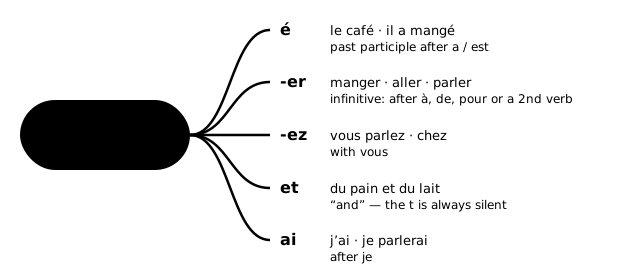
-é or -er? The vendre trick
Replace the verb with vendre. If vendu fits, write -é (il a mangé → il a vendu). If vendre fits, write -er (je vais manger → je vais vendre).
- Il a mangé. Il va manger. — He ate. He is going to eat. — same sound at the end, two spellings.
- Léa est à la boulangerie et elle a faim. — Léa is at the bakery and she is hungry. est (is) / et (and) · a (has) / à (at).
- Ils parlent avec leurs amis. — They talk with their friends. parlent sounds exactly like parle: -ent is silent.
- Elles sont parties à huit heures. — They (women) left at eight. You hear “par-tee”; you write -ies.
Careful
- Wrong: Il a manger une crêpe.
- Right: Il a mangé une crêpe.
- Why: After a, the vendre test gives “il a vendu” → write the participle -é.
Careful
- Wrong: Léa et à la plage.
- Right: Léa est à la plage.
- Why: Same sound. If you can say “était” (was), write est; if you can say “et puis” (and then), write et.
Careful
- Wrong: Ils parle français.
- Right: Ils parlent français.
- Why: ils/elles → always -ent in the present, even though you don’t hear it.
Accents are not decoration
a (has) ≠ à (at, to) · ou (or) ≠ où (where) · du (some) ≠ dû (had to). In a dictée, a missing accent is a mistake. More in Spelling & punctuation.
À retenir
- Play each story twice before you open the transcript. Your brain only learns to decode sounds when it has to try. Reading first turns listening into reading.
- At A1–A2, understanding 60–70% of a story is a success. Catch the names, numbers, places and times first — they carry most of the meaning.
- Samedi, je vais au marché = this Saturday. Le samedi, je vais au marché = every Saturday. One little le turns a day into a habit.
- Listen for a little helper before the verb: j’ai, il a, ils ont or je suis, il est + a verb ending in the sound “ay” (mangé, arrivé). je mange = now; j’ai mangé = past.
- A buzzing z = ils‿ont (they have). A hissing s = ils sont (they are). It is the only difference — train your ear on it.
- Replace the verb with vendre. If vendu fits, write -é (il a mangé → il a vendu). If vendre fits, write -er (je vais manger → je vais vendre).
54.9 Practice — First stories
Exercise 1
What does Léa buy?
Read this aloud or have someone read it to you:
Le samedi matin, Léa va à la boulangerie. Elle achète une baguette et deux croissants.
- a baguette and two croissants
- two baguettes and a croissant
- a cake and a baguette
- bread and milk
Answer
a baguette and two croissants
Transcript: “Le samedi matin, Léa va à la boulangerie. Elle achète une baguette et deux croissants.”
une baguette et deux croissants.
Exercise 2
How much does she pay?
Read this aloud or have someone read it to you:
Léa demande : ça fait combien ? La boulangère répond : trois euros quarante, s'il vous plaît.
- €3.40
- €2.40
- €3.14
- €13.40
Answer
€3.40
Transcript: “Léa demande : ça fait combien ? La boulangère répond : trois euros quarante, s'il vous plaît.”
trois euros quarante = €3.40.
Exercise 3
What time did Raj arrive at the office?
Read this aloud or have someone read it to you:
Raj s'est levé à six heures. Il a pris le métro et il est arrivé au bureau à huit heures et demie.
- 8:30
- 6:00
- 8:15
- 9:30
Answer
8:30
Transcript: “Raj s'est levé à six heures. Il a pris le métro et il est arrivé au bureau à huit heures et demie.”
huit heures et demie = half past eight. Six heures is when he got up.
Exercise 4
What was new for Raj?
Read this aloud or have someone read it to you:
À midi, Raj et ses collègues ont mangé ensemble à la cantine. Raj a goûté une quiche lorraine pour la première fois.
- tasting quiche lorraine
- eating in a restaurant
- taking the metro
- meeting his boss
Answer
tasting quiche lorraine
Transcript: “À midi, Raj et ses collègues ont mangé ensemble à la cantine. Raj a goûté une quiche lorraine pour la première fois.”
pour la première fois = for the first time.
Exercise 5
What was the weather like on Sunday?
Read this aloud or have someone read it to you:
Samedi, il a fait beau. Ils ont nagé et ils ont joué au volley sur la plage. Dimanche, il a plu toute la journée.
- It rained all day
- It was sunny
- It was windy
- It snowed
Answer
It rained all day
Transcript: “Samedi, il a fait beau. Ils ont nagé et ils ont joué au volley sur la plage. Dimanche, il a plu toute la journée.”
il a plu = it rained (pleuvoir).
Exercise 6
What did they do because of the rain?
Read this aloud or have someone read it to you:
Dimanche, il a plu. Alors, ils ont visité un petit musée et ils ont acheté des cartes postales.
- They visited a museum
- They went swimming
- They ate crêpes
- They went home on Saturday
Answer
They visited a museum
Transcript: “Dimanche, il a plu. Alors, ils ont visité un petit musée et ils ont acheté des cartes postales.”
alors = so: ils ont visité un petit musée.
Exercise 7
How old is Inès?
Read this aloud or have someone read it to you:
Notre fils, Hugo, a sept ans. Il adore le football. Notre fille, Inès, a quatre ans. Elle aime dessiner et chanter.
- 4
- 7
- 14
- 2
Answer
4
Transcript: “Notre fils, Hugo, a sept ans. Il adore le football. Notre fille, Inès, a quatre ans. Elle aime dessiner et chanter.”
Inès a quatre ans. Hugo is the one who is seven.
Exercise 8
How often does Sophie see her brother?
Read this aloud or have someone read it to you:
J'ai aussi un frère, Julien. Il est célibataire et il travaille à Montréal. Nous le voyons une fois par an, à Noël.
- once a year
- twice a year
- once a month
- every weekend
Answer
once a year
Transcript: “J'ai aussi un frère, Julien. Il est célibataire et il travaille à Montréal. Nous le voyons une fois par an, à Noël.”
une fois par an = once a year, at Christmas.
Exercise 9
What is the mother's invitation?
Read this aloud or have someone read it to you:
Dis, tu viens déjeuner dimanche ? Ton père fait un couscous. On mange vers midi et demi.
- Sunday lunch at 12:30
- Sunday dinner at 7:30
- Saturday lunch at noon
- a party on Monday
Answer
Sunday lunch at 12:30
Transcript: “Dis, tu viens déjeuner dimanche ? Ton père fait un couscous. On mange vers midi et demi.”
déjeuner dimanche, vers midi et demi.
Exercise 10
What had the daughter forgotten?
Read this aloud or have someone read it to you:
Et n'oublie pas : dimanche, c'est l'anniversaire de ta grand-mère. Oh là là, j'ai complètement oublié ! Je vais acheter des fleurs.
- her grandmother's birthday
- the bread
- the time of lunch
- her father's couscous
Answer
her grandmother's birthday
Transcript: “Et n'oublie pas : dimanche, c'est l'anniversaire de ta grand-mère. Oh là là, j'ai complètement oublié ! Je vais acheter des fleurs.”
l'anniversaire de ta grand-mère.
Exercise 11
Which fruit did Karim NOT buy?
Read this aloud or have someone read it to you:
Karim a acheté un kilo de tomates, des pommes et un melon. Ensuite, il a pris une barquette de fraises.
- bananas
- apples
- a melon
- strawberries
Answer
bananas
Transcript: “Karim a acheté un kilo de tomates, des pommes et un melon. Ensuite, il a pris une barquette de fraises.”
He bought pommes, un melon and fraises — no bananes.
Exercise 12
Why is Karim doing his shopping?
Read this aloud or have someone read it to you:
Au total, Karim a payé vingt-deux euros. Ce soir, il invite des amis : il va préparer une grande salade.
- He has friends coming tonight
- His fridge is empty
- It is his birthday
- He sells vegetables
Answer
He has friends coming tonight
Transcript: “Au total, Karim a payé vingt-deux euros. Ce soir, il invite des amis : il va préparer une grande salade.”
Ce soir, il invite des amis.
Exercise 13
You hear a buzzing z sound: [eel-ZÕ]. What was said?
- ils ont
- ils sont
- ils font
- il a
Answer
ils ont
The liaison z = ils‿ont (they have). ils sont starts with a hissing s.
Exercise 14
Match the key words.
| A | B |
|---|---|
| la boulangerie | cheese seller |
| la plage | retired |
| le fromager | birthday |
| à la retraite | bakery |
| l'anniversaire | beach |
Answer
la boulangerie — bakery; la plage — beach; le fromager — cheese seller; à la retraite — retired; l'anniversaire — birthday
All from the six stories.
Exercise 15
Dictée 1 — write what you hear.
Dictation. Have someone read the sentence aloud, then write it down.
Léa achète une baguette et deux croissants.
Answer
Léa achète une baguette et deux croissants.
achète has a grave accent; croissants ends in a silent -s.
Exercise 16
Dictée 2 — write what you hear.
Dictation. Have someone read the sentence aloud, then write it down.
Raj est arrivé au bureau à huit heures.
Answer
Raj est arrivé au bureau à huit heures.
est arrivé (être + -é); à with an accent = at.
Exercise 17
Dictée 3 — write what you hear.
Dictation. Have someone read the sentence aloud, then write it down.
Nous sommes allés à la mer en train.
Answer
Nous sommes allés à la mer en train.
allés takes -s: it agrees with nous (être verb).
Exercise 18
Dictée 4 — write what you hear.
Dictation. Have someone read the sentence aloud, then write it down.
Ma mère est professeure et mon père est à la retraite.
Answer
Ma mère est professeure et mon père est à la retraite.
est (is) vs et (and) — you need both here.
Exercise 19
Dictée 5 — write what you hear.
Dictation. Have someone read the sentence aloud, then write it down.
Ils ont acheté des fraises au marché.
Answer
Ils ont acheté des fraises au marché.
ils‿ont (z sound) + acheté; fraises has a silent plural -s.
Exercise 20
Ask for a baguette politely.
Je voudrais une baguette, s'il vous plaît
Answer
Say: Je voudrais une baguette, s'il vous plaît
Je voudrais = I would like — the polite way to order.
Next step
Replay one story a day this week, then try shadowing: play a sentence and speak with the voice. When the six stories feel easy, move on to Everyday listening — voicemails, announcements and dialogues at normal speed.