Chapter 40: Arguing & presenting
Argumenter et présenter
At B2 and above, people judge you less on grammar and more on how you build an argument. French culture loves a clear plan, announced in advance, with linked arguments, honest concessions and a firm conclusion. This chapter gives you that toolkit — and ends with a full model for the DELF B2 oral exam.
- 1The shape of a French presentation
- 2Linking arguments
- 3Nuance and hedging
- 4Conceding — the "yes, but" of good arguers
- 5Persuading — making it land
- 6Handling questions and objections
- 7The DELF B2 oral — a full model
Announce, develop, conclude
Tell the audience what you will say (l’annonce du plan), say it in clearly signposted parts, then tell them what you said. French listeners expect the map before the journey.
40.1 The shape of a French presentation
A French exposé has a fixed skeleton. The introduction alone has three steps: a hook (l’accroche), the question you will answer (la problématique), and the plan (l’annonce du plan).
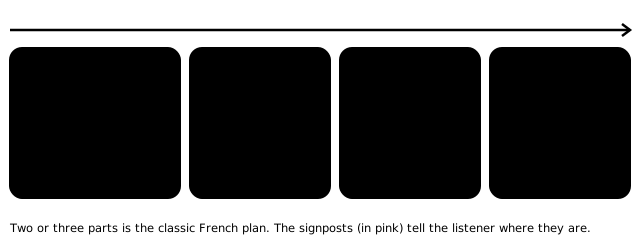
| Step | Signpost |
|---|---|
| Hook | Qui n’a jamais perdu une heure sur son téléphone sans s’en rendre compte ? |
| Problem | On peut donc se demander si… |
| Plan | Dans un premier temps, je montrerai…, puis, dans un second temps, j’examinerai… |
| Part 1 | Tout d’abord, … / En premier lieu, … |
| Next point | Ensuite, … / En second lieu, … |
| Transition | Passons maintenant à… / Venons-en à… |
| Last point | Enfin, … / Pour finir, … |
| Conclusion | Pour conclure, … / En définitive, … |
Careful
- Wrong: Finalement, je voudrais parler du coût. (meaning "lastly")
- Right: Enfin, je voudrais parler du coût.
- Why: Finalement means "in the end / after all" (a result). To introduce your last point, use enfin or pour finir.
40.2 Linking arguments
An argument without connectors is a list. Connectors show the logic: adding, giving a cause, drawing a consequence, illustrating, opposing. (The full family is in Linking words; here are the ones that work best out loud.)
| Job | Spoken connectors |
|---|---|
| Add | de plus · en outre · par ailleurs · qui plus est |
| Cause | car · puisque · étant donné que · en effet |
| Consequence | donc · par conséquent · c’est pourquoi · si bien que |
| Example | par exemple · notamment · prenons le cas de |
| Contrast | en revanche · pourtant · alors que · or |
- Le télétravail fait gagner du temps. En effet, il supprime les trajets quotidiens. — Remote work saves time. Indeed, it removes the daily commute. (en effet = "indeed, that’s because" — it confirms, it does not mean "in effect")
- Les loyers ont beaucoup augmenté, si bien que les jeunes quittent le centre-ville. — Rents have risen a lot, so much so that young people are leaving the city centre.
- Les villes investissent dans le vélo ; prenons le cas d’Amsterdam. — Cities are investing in cycling; take the case of Amsterdam.
40.3 Nuance and hedging
Strong claims are easy to attack. Nuanced claims are hard to attack and sound more educated. French has a rich set of softeners — but watch which mood each one takes.
| Hedge | Meaning |
|---|---|
| Il semblerait que les jeunes lisent moins. | It would seem that young people read less. |
| Il me semble que c’est une erreur. | It seems to me that it’s a mistake. (+ indicative) |
| Dans une certaine mesure, c’est vrai. | To a certain extent, it’s true. |
| Il se peut que la situation change. | The situation may change. (+ subjunctive) |
| C’est plutôt une bonne nouvelle. | It’s rather good news. |
| A priori, rien ne s’y oppose. | On the face of it, nothing prevents it. |
| Dans la plupart des cas, … | In most cases, … |
| Il est sans doute trop tôt pour juger. | It’s probably too early to judge. |
sans doute = probably
A classic false friend: sans doute means "probably", not "without doubt". For certainty, say sans aucun doute or certainement.
il semble que vs il me semble que
Il semble que (it seems) usually takes the subjunctive; il me semble que (it seems to me) takes the indicative. Adding me turns doubt into a personal opinion.
- Il semble que le projet soit trop coûteux. — It seems that the project is too costly. (soit — subjunctive)
- Il me semble que le projet est trop coûteux. — It seems to me that the project is too costly. (est — indicative)
40.4 Conceding — the "yes, but" of good arguers
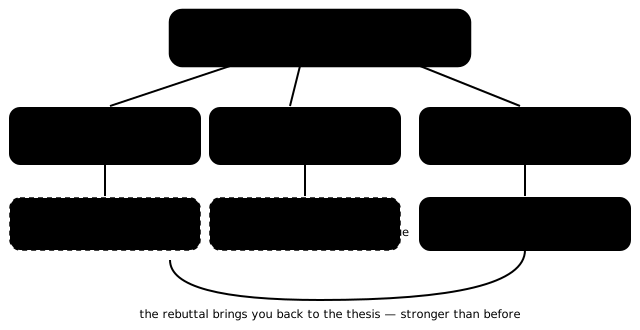
To concede is to admit part of the other side before answering it. It shows fairness and makes your rebuttal stronger. Each frame has two halves: the concession, then the counter-point.
- Certes, la voiture est pratique, mais elle pollue énormément. — Admittedly, the car is practical, but it pollutes enormously.
- Il est vrai que les réseaux sociaux nous rapprochent ; néanmoins, ils favorisent la désinformation. — It’s true that social networks bring us closer; nevertheless, they encourage misinformation.
- Bien que cette mesure soit impopulaire, elle est nécessaire. — Although this measure is unpopular, it is necessary. (bien que + subjunctive)
- Même si c’est cher, c’est un investissement rentable. — Even if it’s expensive, it’s a worthwhile investment. (même si + indicative)
- Je vous l’accorde, le risque existe. Il n’en reste pas moins que les avantages l’emportent. — I grant you, the risk exists. The fact remains that the advantages outweigh it.
- On pourrait m’objecter que cela coûte cher. Pourtant, … — One could object that it’s expensive. And yet, … (you raise the objection yourself)
Mood traps in concession
- Wrong: Bien que ce est difficile, …
- Right: Bien que ce soit difficile, …
-
Why: Bien que and quoique always take the subjunctive. See The subjunctive.
-
Wrong: Même si ce soit difficile, …
- Right: Même si c’est difficile, …
-
Why: Même si works like si: indicative, never subjunctive.
-
Wrong: Certes c’est vrai. (and nothing after)
- Right: Certes, c’est vrai, mais…
- Why: Certes announces a "but". Without the second half, you have simply agreed with the other side.
40.5 Persuading — making it land
Logic convinces; rhetoric persuades. A few classic devices make a French audience lean in. Use one or two per talk — not all of them.
- Rhetorical question: Qui d’entre nous n’a jamais eu peur de parler en public ? — Which of us has never been afraid of speaking in public?
- Imagine: Imaginez un instant une ville sans voitures. — Imagine for a moment a city without cars.
- Urgency: Il est grand temps d’agir. — It is high time to act.
- Necessity: Il est indispensable que chacun fasse un effort. — It is essential that everyone makes an effort. (+ subjunctive)
- Rule of three: C’est plus simple, plus rapide et moins cher. — It’s simpler, faster and cheaper. (three items sound complete)
- Include the audience: Vous l’avez sans doute remarqué vous-mêmes. — You have probably noticed it yourselves.
- Personal story: Je me souviens de mon premier jour à Paris… — I remember my first day in Paris… (a short anecdote makes an idea concrete)
Facts beat adjectives
"C’est très, très important" persuades nobody. A precise example, a date, a source (selon un rapport de l’OCDE…) does. Only quote figures you are sure of — an examiner will ask.
40.6 Handling questions and objections
The hardest part of any talk is the questions. These lines buy you time, show respect, and let you answer on your terms.
| Line | Use it to… |
|---|---|
| C’est une excellente question. | buy two seconds |
| Si je comprends bien, vous me demandez si… | reformulate and check |
| Vous soulevez un point important. | acknowledge an objection |
| Permettez-moi de nuancer. | disagree politely |
| Je n’avais pas envisagé les choses sous cet angle. | accept a new idea gracefully |
| Je n’ai pas les chiffres exacts en tête, mais… | admit a gap honestly |
| Si vous me permettez de terminer… | stop an interruption |
| Pour revenir à votre question, … | return to the point |
Careful
- Wrong: Je ne sais pas. (silence)
- Right: Je ne connais pas tous les détails, mais je dirais que…
- Why: In an exam or a meeting, "I don’t know" ends the exchange. Admit the limit, then still give a reasoned view.
40.7 The DELF B2 oral — a full model
In the DELF B2 production orale, you draw a short document (an article or opinion piece) raising a debate. You have about 30 minutes to prepare, then about 20 minutes with the examiners: you present and defend your point of view, then you debate with them. It is marked out of 25. (Formats are updated from time to time — check the official France Éducation international site before your exam.)
Topic: Faut-il interdire le téléphone portable au lycée ? Should mobile phones be banned in secondary school?
Model monologue — introduction
- Le document que j’ai choisi traite de la place du téléphone portable à l’école. — The document I chose deals with the place of mobile phones at school. (present the document)
- Il pose une question simple, mais délicate : faut-il interdire le portable au lycée ? — It raises a simple but delicate question: should phones be banned at secondary school? (problématique)
- Dans un premier temps, je montrerai les risques du portable en classe ; dans un second temps, j’expliquerai pourquoi une interdiction totale ne me semble pas la meilleure solution. — First I will show the risks of phones in class; then I will explain why a total ban doesn’t seem the best solution to me. (plan)
Model monologue — development and conclusion
- Tout d’abord, il est évident que les notifications perturbent l’attention des élèves. — First of all, it is obvious that notifications disrupt pupils’ attention. (argument 1)
- De plus, le portable peut favoriser le harcèlement, notamment sur les réseaux sociaux. — Moreover, phones can encourage bullying, especially on social media. (argument 2)
- Certes, ces risques sont réels. Néanmoins, le téléphone est aussi un outil pédagogique : dictionnaires, applications, recherches. — Admittedly, these risks are real. Nevertheless, the phone is also a learning tool: dictionaries, apps, research. (concession + counter-point)
- C’est pourquoi je suis favorable à un usage encadré plutôt qu’à une interdiction totale. — That is why I favour supervised use rather than a total ban. (your position)
- Pour conclure, la question n’est pas d’interdire, mais d’apprendre aux jeunes à bien utiliser cet outil. — To conclude, the question is not whether to ban, but how to teach young people to use this tool well. (conclusion + opening)
The debate with the examiner
- Examinateur : Mais un usage encadré, n’est-ce pas difficile à contrôler pour les enseignants ? — But isn’t supervised use hard for teachers to control?
- Vous : Vous soulevez un point important. Je vous l’accorde, cela demande des règles claires. — You raise an important point. I grant you, it requires clear rules.
- Vous : Par exemple, les téléphones pourraient rester dans un casier, sauf pendant certaines activités. — For example, phones could stay in a locker, except during certain activities.
- Examinateur : Et dans votre pays, comment ça se passe ? — And in your country, how does it work?
- Vous : En Inde, cela dépend des écoles ; il me semble que de plus en plus d’établissements limitent les portables. — In India it depends on the school; it seems to me that more and more schools restrict phones. (hedged — you are not sure of figures)
What B2 examiners reward
A clear position, an announced plan, at least two developed arguments with examples, a concession, varied connectors, and real interaction in the debate — reacting to what the examiner says, not reciting.
À retenir
- Tell the audience what you will say (l’annonce du plan), say it in clearly signposted parts, then tell them what you said. French listeners expect the map before the journey.
- Il semble que (it seems) usually takes the subjunctive; il me semble que (it seems to me) takes the indicative. Adding me turns doubt into a personal opinion.
- "C’est très, très important" persuades nobody. A precise example, a date, a source (selon un rapport de l’OCDE…) does. Only quote figures you are sure of — an examiner will ask.
- A clear position, an announced plan, at least two developed arguments with examples, a concession, varied connectors, and real interaction in the debate — reacting to what the examiner says, not reciting.
- You have finished Parler. Record yourself giving the DELF model above, then make your own on a new topic. Next, build the words you argue with in the Vocabulaire part — starting with Core vocabulary by theme.
40.8 Practice — Arguing & presenting
Exercise 1
Which phrase announces your plan?
- Pour conclure,
- Dans un premier temps…, dans un second temps…
- Certes,
- Il se peut que
Answer
Dans un premier temps…, dans un second temps…
L'annonce du plan uses ordinal signposts.
Exercise 2
'Il est sans doute trop tôt.' means…
- It is without doubt too early.
- It is probably too early.
- It is never too early.
- It is not too early.
Answer
It is probably too early.
sans doute = probably. For certainty: sans aucun doute.
Exercise 3
Bien que cette solution ___ chère, elle est efficace.
- est
- soit
- sera
- serait
Answer
soit
bien que + subjunctive.
Exercise 4
To introduce your LAST point, use…
- Finalement
- Enfin
- En fait
- Bref
Answer
Enfin
Finalement = in the end (a result). Enfin / pour finir = lastly.
Exercise 5
Même si c'___ difficile, il faut essayer.
Hint: même si + indicative
Answer
est
même si takes the indicative: même si c'est.
Exercise 6
Il me semble que c'___ une bonne idée.
Hint: il me semble que + ?
Answer
est
il me semble que takes the indicative.
Exercise 7
Tap the wrong word.
Bien que ce est cher, je l'achète.
Answer
Wrong word: est.
Corrected: Bien que ce soit cher, je l'achète.
bien que + subjunctive: soit.
Exercise 8
Tap the wrong word.
Même si ce soit difficile, nous continuerons.
Answer
Wrong word: soit.
Corrected: Même si c'est difficile, nous continuerons.
même si + indicative.
Exercise 9
Match the connector to its job.
| A | B |
|---|---|
| en outre | example |
| par conséquent | contrast |
| notamment | adding |
| en revanche | consequence |
Answer
en outre — adding; par conséquent — consequence; notamment — example; en revanche — contrast
Connectors show the logic between your ideas.
Exercise 10
Match the parts of the introduction.
| A | B |
|---|---|
| l'accroche | the outline |
| la problématique | summary and opening |
| l'annonce du plan | the hook |
| la conclusion | the question you will answer |
Answer
l'accroche — the hook; la problématique — the question you will answer; l'annonce du plan — the outline; la conclusion — summary and opening
The French introduction has three fixed steps.
Exercise 11
Put the words in order.
Words: voiture / la / Certes / elle / est / mais / pollue / pratique
Answer
Certes la voiture est pratique mais elle pollue
certes… mais = concession then counter-point.
Exercise 12
Put the words in order.
Words: à / encadré / pourquoi / un / usage / je / favorable / C'est / suis
Answer
C'est pourquoi je suis favorable à un usage encadré
c'est pourquoi introduces your conclusion or position.
Exercise 13
Concede a point.
Je vous l'accorde le risque existe
Answer
Say: Je vous l'accorde le risque existe
Je vous l'accorde = I grant you.
Exercise 14
Buy time when asked a question.
C'est une excellente question
Answer
Say: C'est une excellente question
Then reformulate: Si je comprends bien…
Exercise 15
Disagree politely with an examiner.
Permettez-moi de nuancer
Answer
Say: Permettez-moi de nuancer
A respectful way to disagree.
Exercise 16
Hedge your claim.
Dans une certaine mesure c'est vrai
Answer
Say: Dans une certaine mesure c'est vrai
dans une certaine mesure = to a certain extent.
Exercise 17
Create urgency.
Il est grand temps d'agir
Answer
Say: Il est grand temps d'agir
il est grand temps de + infinitive = it is high time to.
Exercise 18
Conclude your presentation.
Pour conclure la question n'est pas d'interdire
Answer
Say: Pour conclure la question n'est pas d'interdire
Pour conclure + your final position.
Next step
You have finished Parler. Record yourself giving the DELF model above, then make your own on a new topic. Next, build the words you argue with in the Vocabulaire part — starting with Core vocabulary by theme.