Chapter 58: The 50 most common mistakes
Les 50 erreurs les plus fréquentes
Some errors are harmless. Others make a French speaker blink — or misunderstand you completely: je suis fini does not mean “I’ve finished”. Here are the fifty mistakes that learners (English and Hindi speakers above all) make most often, grouped by type. Each one has the wrong form, the right form and a one-line reason.
- 1English in disguise — les calques (1–10)
- 2Gender & agreement — genre et accord (11–15)
- 3Articles — les articles (16–21)
- 4Prepositions — les prépositions (22–29)
- 5Tenses & moods — temps et modes (30–38)
- 6Pronouns — les pronoms (39–44)
- 7False friends — les faux amis (45–47)
- 8Word order — l’ordre des mots (48–50)
- 9Your red-flag check — la vérification finale
masculinefeminineplural
How to use this chapter
Don’t read the wrong line twice. Read the right line aloud three times (tap 🔊), so the correct form becomes the one your mouth knows.
58.1 English in disguise — les calques (1–10)
A calque is an English phrase translated word for word. The result is French words in an English shape. Several of them use être where French uses avoir (see Être & avoir).
Careful 1
- Wrong: Je suis 20 ans.
- Right: J’ai 20 ans.
- Why: “I’m 20.” In French you have your years: avoir + âge.
Careful 2
- Wrong: Je suis fini.
- Right: J’ai fini.
- Why: “I’ve finished.” Je suis fini means “I’m done for / ruined”.
Careful 3
- Wrong: Je suis chaud. Je suis froid.
- Right: J’ai chaud. J’ai froid.
- Why: “I’m hot. I’m cold.” Je suis chaud = “I’m up for it” (slang, can be sexual); il est froid = he is a cold person.
Careful 4
- Wrong: Il faut faire une décision.
- Right: Il faut prendre une décision.
- Why: “We must make a decision.” French takes decisions.
Careful 5
- Wrong: Ça fait du sens.
- Right: Ça a du sens. / C’est logique.
- Why: “That makes sense.” A calque of English, common in Québec and spreading in France, but still criticised.
Careful 6
- Wrong: J’ai appliqué pour ce job.
- Right: J’ai postulé à ce poste.
- Why: “I applied for this job.” Appliquer = to apply a rule or a cream. For jobs: postuler.
Careful 7
- Wrong: J’ai réalisé que j’avais oublié mes clés.
- Right: Je me suis rendu compte que j’avais oublié mes clés.
- Why: “I realised I’d forgotten my keys.” Réaliser traditionally means “to make real” (réaliser un rêve). The “realise” sense is spreading but is still frowned on in careful French.
Careful 8
- Wrong: Je supporte toujours mes amis.
- Right: Je soutiens toujours mes amis.
- Why: “I always support my friends.” Supporter = to put up with (je ne supporte pas le bruit). For sports fans supporter une équipe is common, but for people use soutenir.
Careful 9
- Wrong: La réunion va prendre place à 10 h.
- Right: La réunion va avoir lieu à 10 h.
- Why: “The meeting will take place at 10.” Prendre place = to take a seat.
Careful 10
- Wrong: Je vous introduis mon collègue.
- Right: Je vous présente mon collègue.
- Why: “Let me introduce my colleague.” Introduire = to insert (a card, a key) or to bring in.
The avoir reflex
Age, hunger, thirst, heat, cold, fear, being right: French uses avoir — j’ai 20 ans, j’ai faim, j’ai chaud, j’ai peur, j’ai raison.
58.2 Gender & agreement — genre et accord (11–15)
Every noun has a gender, and adjectives and some past participles follow it. Hindi speakers have an advantage here — Hindi also has gender — but French genders rarely match Hindi ones. See Nouns, gender & plurals and Adjectives.
Careful 11
- Wrong: C’est une grande problème.
- Right: C’est un grand problème.
- Why: “It’s a big problem.” Greek words in -ème are masculine: le problème, le système, le thème.
Careful 12
- Wrong: Ma sœur est très content.
- Right: Ma sœur est très contente.
- Why: “My sister is very happy.” The adjective agrees with the person: add -e — and here you hear the final t.
Careful 13
- Wrong: Les filles sont allé au cinéma.
- Right: Les filles sont allées au cinéma.
- Why: “The girls went to the cinema.” With être, the past participle agrees with the subject (see The past: passé composé).
Careful 14
- Wrong: Mon père est un personne très gentil.
- Right: Mon père est une personne très gentille.
- Why: “My father is a very kind person.” Une personne is always feminine — even for a man. Same for une victime, une star.
Careful 15
- Wrong: Je te présente ma amie Léa.
- Right: Je te présente mon amie Léa.
- Why: “This is my friend Léa.” Before a vowel, ma, ta, sa become mon, ton, son — for sound, not gender.
58.3 Articles — les articles (16–21)
English can drop the article (I love apples); French almost never can. The rules are in Articles; here are the slips that survive the longest.
Careful 16
- Wrong: J’aime pommes.
- Right: J’aime les pommes.
- Why: “I like apples.” Likes and dislikes take le, la, les (things in general).
Careful 17
- Wrong: Je n’ai pas des frères.
- Right: Je n’ai pas de frères.
- Why: “I have no brothers.” After a negation, un, une, des, du, de la become de / d’ (except with être: ce n’est pas un problème).
Careful 18
- Wrong: Je bois eau à chaque repas.
- Right: Je bois de l’eau à chaque repas.
- Why: “I drink water with every meal.” An unknown quantity needs the partitive: du pain, de la soupe, de l’eau.
Careful 19
- Wrong: Je pars le 3 de mai.
- Right: Je pars le 3 mai.
- Why: “I’m leaving on 3 May.” French dates: le + number + month, no de, no “on”. The 1st is le 1er (premier) mai.
Careful 20
- Wrong: Il est un médecin.
- Right: Il est médecin. / C’est un médecin.
- Why: “He is a doctor.” Jobs after il/elle est take no article; with c’est, keep the article.
Careful 21
- Wrong: Il y a beaucoup des gens.
- Right: Il y a beaucoup de gens.
- Why: “There are lots of people.” Quantity words — beaucoup, peu, trop, assez — take plain de.
58.4 Prepositions — les prépositions (22–29)
The biggest group in the ranking. Prepositions rarely translate one-to-one — from English or from Hindi mein / par / se. Full rules in Prepositions & places.
Careful 22
- Wrong: J’habite en Paris.
- Right: J’habite à Paris.
- Why: “I live in Paris.” Cities: à for both “in” and “to”.
Careful 23
- Wrong: Je vais à France, puis à Canada.
- Right: Je vais en France, puis au Canada.
- Why: “I’m going to France, then Canada.” Feminine countries: en; masculine: au; plural: aux États-Unis.
Careful 24
- Wrong: Je vais à le marché.
- Right: Je vais au marché.
- Why: “I’m going to the market.” à + le = au, à + les = aux, de + le = du, de + les = des — always.
Careful 25
- Wrong: Je viens au travail en pied.
- Right: Je viens au travail à pied.
- Why: “I walk to work.” Inside a vehicle: en voiture, en train, en bus; on top of it or on your feet: à pied, à vélo, à cheval.
Careful 26
- Wrong: Je pense de toi.
- Right: Je pense à toi.
- Why: “I’m thinking of you.” Penser à = to think about; penser de = to have an opinion: Qu’est-ce que tu penses de ce film ?
Careful 27
- Wrong: Ça dépend sur toi.
- Right: Ça dépend de toi.
- Why: “It depends on you.” Dépendre de — never sur.
Careful 28
- Wrong: Je vais au médecin.
- Right: Je vais chez le médecin.
- Why: “I’m going to the doctor’s.” Going to a person (or their place): chez — chez moi, chez le coiffeur.
Careful 29
- Wrong: J’attends pour le bus.
- Right: J’attends le bus.
- Why: “I’m waiting for the bus.” Attendre, chercher, écouter, regarder take a direct object: no pour, no à.
Learn the verb with its preposition
Never learn “penser” alone: learn penser à, dépendre de, attendre qqch. The preposition is part of the verb.
58.5 Tenses & moods — temps et modes (30–38)
English and French cut time differently. These nine errors come from copying the English tense. See Imparfait vs passé composé, Conditional & si clauses and The subjunctive.
Careful 30
- Wrong: J’ai été ici depuis trois ans.
- Right: Je suis ici depuis trois ans.
- Why: “I’ve been here for three years.” Still true now → present + depuis.
Careful 31
- Wrong: Si j’aurai le temps, je viendrai.
- Right: Si j’ai le temps, je viendrai.
- Why: “If I have time, I’ll come.” Never the future right after si (“if”): si + present.
Careful 32
- Wrong: Si j’aurais de l’argent, j’achèterais une maison.
- Right: Si j’avais de l’argent, j’achèterais une maison.
- Why: “If I had money, I’d buy a house.” Si + imparfait, then the conditional. “Les si n’aiment pas les -rais.”
Careful 33
- Wrong: Quand je suis riche, j’achèterai une maison.
- Right: Quand je serai riche, j’achèterai une maison.
- Why: “When I’m rich, I’ll buy a house.” Unlike si, quand about the future takes the future.
Careful 34
- Wrong: Je t’appellerai après qu’il soit parti.
- Right: Je t’appellerai après qu’il sera parti.
- Why: “I’ll call you after he’s left.” Après que + indicative (it is a fact); avant que + subjunctive. Many natives say soit, but it is still criticised.
Careful 35
- Wrong: Quand j’étais petit, je suis allé à l’école à pied tous les jours.
- Right: Quand j’étais petit, j’allais à l’école à pied tous les jours.
- Why: “When I was little, I walked to school every day.” A repeated habit in the past → imparfait.
Careful 36
- Wrong: J’ai lu quand le téléphone sonnait.
- Right: Je lisais quand le téléphone a sonné.
- Why: “I was reading when the phone rang.” The background scene → imparfait; the event that interrupts → passé composé.
Careful 37
- Wrong: J’ai allé au marché hier.
- Right: Je suis allé au marché hier.
- Why: “I went to the market yesterday.” Aller is a “house of être” verb (a woman writes allée).
Careful 38
- Wrong: Il faut que tu viens demain.
- Right: Il faut que tu viennes demain.
- Why: “You have to come tomorrow.” Il faut que always triggers the subjunctive.
Si vs quand
Si + present → future (si j’ai le temps, je viendrai), but quand + future → future (quand j’aurai le temps, je viendrai).
58.6 Pronouns — les pronoms (39–44)
French pronouns depend on the verb’s construction (with or without à) and follow a fixed order. See Object pronouns and Y, en & pronoun order.
Careful 39
- Wrong: Marc ? Je le parle souvent.
- Right: Marc ? Je lui parle souvent.
- Why: “Marc? I often talk to him.” Parler à quelqu’un → indirect pronoun lui.
Careful 40
- Wrong: Ma mère ? Je lui aide tous les jours.
- Right: Ma mère ? Je l’aide tous les jours.
- Why: “My mother? I help her every day.” Aider quelqu’un is direct in French → la / l’.
Careful 41
- Wrong: Tu as des frères ? — Oui, j’ai trois.
- Right: Oui, j’en ai trois.
- Why: “Yes, I have three (of them).” A number or quantity with no noun after it needs en.
Careful 42
- Wrong: Tu vas à Lyon ? — Oui, je vais demain.
- Right: Oui, j’y vais demain.
- Why: “Yes, I’m going (there) tomorrow.” Aller needs a place: y replaces it.
Careful 43
- Wrong: Le livre ? Je lui le donne ce soir.
- Right: Je le lui donne ce soir.
- Why: “I’m giving it to him tonight.” Order: me/te/se/nous/vous → le/la/les → lui/leur → y → en.
Careful 44
- Wrong: C’est moi qui est responsable.
- Right: C’est moi qui suis responsable.
- Why: “I’m the one who is responsible.” After moi qui the verb agrees with moi → je suis; toi qui es, nous qui sommes.
58.7 False friends — les faux amis (45–47)
Words that look English but mean something else. Only three here — the full list is in Cognates & false friends.
Careful 45
- Wrong: Actuellement, ce n’est pas vrai. (= actually)
- Right: En fait, ce n’est pas vrai.
- Why: “Actually, it isn’t true.” Actuellement = currently: actuellement, je travaille à Lyon.
Careful 46
- Wrong: Éventuellement, il a accepté. (= eventually)
- Right: Finalement, il a accepté.
- Why: “Eventually, he accepted.” Éventuellement = possibly, if need be.
Careful 47
- Wrong: J’emprunte des livres à la librairie.
- Right: J’emprunte des livres à la bibliothèque.
- Why: “I borrow books from the library.” Une librairie = a bookshop (you buy there).
58.8 Word order — l’ordre des mots (48–50)
Mostly French word order is close to English. These three are the exceptions people forget. See Adjectives, Saying no and Asking questions.
Careful 48
- Wrong: J’ai une rouge voiture.
- Right: J’ai une voiture rouge.
- Why: “I have a red car.” Most adjectives go after the noun; only the short BAGS ones (beauty, age, goodness, size) go before: une belle voiture.
Careful 49
- Wrong: Je n’ai mangé pas.
- Right: Je n’ai pas mangé.
- Why: “I haven’t eaten.” In compound tenses, ne…pas wraps the auxiliary, not the participle.
Careful 50
- Wrong: Est-ce que viens-tu ce soir ?
- Right: Est-ce que tu viens ce soir ? / Viens-tu ce soir ?
- Why: “Are you coming tonight?” Choose one question form: est-ce que + normal order, or inversion — never both.
58.9 Your red-flag check — la vérification finale
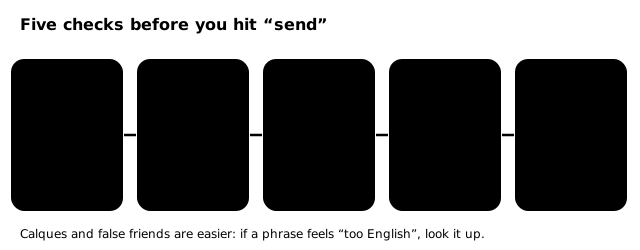
Before you send an email or speak in an exam, run these five quick checks. Together they catch most of the fifty mistakes above.
The same sentence, before and after the check:
- ✗ Je suis 25 ans et j’ai été en France depuis deux ans. — (learner version — two calques: être for age, past tense with depuis)
- J’ai 25 ans et je suis en France depuis deux ans. — I’m 25 and I’ve been in France for two years.
- ✗ Hier, ma amie et moi, on a allé à le restaurant et on a fait une décision. — (learner version — four mistakes)
- Hier, mon amie et moi, on est allées au restaurant et on a pris une décision. — Yesterday my friend and I went to the restaurant and made a decision. (two women: on est allées — informal agreement with on = “we”)
Keep your own top five
Everyone has a few personal mistakes that keep coming back. Write your top five on a card, with the right version, and read it aloud before every class or exam.
À retenir
- Don’t read the wrong line twice. Read the right line aloud three times (tap 🔊), so the correct form becomes the one your mouth knows.
- Age, hunger, thirst, heat, cold, fear, being right: French uses avoir — j’ai 20 ans, j’ai faim, j’ai chaud, j’ai peur, j’ai raison.
- Never learn “penser” alone: learn penser à, dépendre de, attendre qqch. The preposition is part of the verb.
- Si + present → future (si j’ai le temps, je viendrai), but quand + future → future (quand j’aurai le temps, je viendrai).
- Everyone has a few personal mistakes that keep coming back. Write your top five on a card, with the right version, and read it aloud before every class or exam.
- Now measure yourself: DELF, DALF & your level explains what each level means — and examiners notice exactly these fifty mistakes.
58.10 Practice — the 50 mistakes
Exercise 1
Tap the wrong word.
Je suis vingt-cinq ans.
Answer
Wrong word: suis.
Corrected: J'ai vingt-cinq ans.
Age uses avoir: j'ai 25 ans.
Exercise 2
Tap the wrong word.
Il faut faire une décision rapidement.
Answer
Wrong word: faire.
Corrected: Il faut prendre une décision rapidement.
French says prendre une décision.
Exercise 3
Tap the wrong word.
Je n'ai pas des enfants.
Answer
Wrong word: des.
Corrected: Je n'ai pas d'enfants.
After a negation, des becomes de / d'.
Exercise 4
Tap the wrong word.
Cet été, je vais à France.
Answer
Wrong word: à.
Corrected: Cet été, je vais en France.
Feminine country → en France.
Exercise 5
Tap the wrong word.
Si j'aurais le temps, je viendrais.
Answer
Wrong word: j'aurais.
Corrected: Si j'avais le temps, je viendrais.
Never the conditional right after si: si + imparfait.
Exercise 6
Tap the wrong word.
Elle est allé au marché ce matin.
Answer
Wrong word: allé.
Corrected: Elle est allée au marché ce matin.
With être, the participle agrees: elle est allée.
Exercise 7
Tap the wrong word.
Ma mère ? Je lui aide tous les jours.
Answer
Wrong word: lui.
Corrected: Ma mère ? Je l'aide tous les jours.
aider quelqu'un is direct → l'aide.
Exercise 8
Tap the wrong word.
C'est moi qui est le chef.
Answer
Wrong word: est.
Corrected: C'est moi qui suis le chef.
moi qui → je: c'est moi qui suis.
Exercise 9
Tap the wrong word.
J'attends pour le bus depuis vingt minutes.
Answer
Wrong word: pour.
Corrected: J'attends le bus depuis vingt minutes.
attendre takes a direct object: no pour.
Exercise 10
Ça ___ du sens. (careful French)
- fait
- a
- prend
- donne
Answer
a
Ça a du sens; ça fait du sens is an English calque.
Exercise 11
Best French for: 'I realised I had forgotten my keys.'
- J'ai réalisé que j'avais oublié mes clés.
- Je me suis rendu compte que j'avais oublié mes clés.
- J'ai réalisé que j'ai oublié mes clés.
- Je suis réalisé que j'avais oublié mes clés.
Answer
Je me suis rendu compte que j'avais oublié mes clés.
se rendre compte = to realise; réaliser in this sense is still criticised.
Exercise 12
« Éventuellement » means…
- eventually
- possibly
- actually
- currently
Answer
possibly
éventuellement = possibly; eventually = finalement.
Exercise 13
J'habite ici ___ 2020.
- depuis
- pendant
- il y a
- pour
Answer
depuis
Still true now → present + depuis.
Exercise 14
Hier, je ___ (aller, passé composé) au cinéma.
Hint: house of être
Answer
suis allé / suis allée
aller takes être: je suis allé(e).
Exercise 15
Quand je ___ (être) riche, j'achèterai une maison.
Hint: quand + future
Answer
serai
quand about the future → future: je serai.
Exercise 16
Tu vas à Lyon ? — Oui, j'___ vais demain.
Hint: replaces the place
Answer
y
y replaces à + place: j'y vais.
Exercise 17
Match the false friend to its real meaning.
| A | B |
|---|---|
| actuellement | a bookshop |
| éventuellement | a library |
| une librairie | currently |
| une bibliothèque | possibly |
Answer
actuellement — currently; éventuellement — possibly; une librairie — a bookshop; une bibliothèque — a library
Look-alike words with different meanings.
Exercise 18
Put the words in order: 'I haven't seen him.'
Words: ne / vu / pas / Je / l'ai
Answer
Je ne l'ai pas vu
ne + pronoun + auxiliary + pas + participle.
Exercise 19
Put the words in order: 'I'm giving it to him tomorrow.'
Words: lui / demain / le / donne / Je
Answer
Je le lui donne demain
le comes before lui.
Exercise 20
Say it aloud.
J'ai vingt ans et je suis ici depuis un an
Answer
Say: J'ai vingt ans et je suis ici depuis un an
avoir for age, present + depuis for something still true.
Next step
Now measure yourself: DELF, DALF & your level explains what each level means — and examiners notice exactly these fifty mistakes.