Chapter 59: DELF, DALF & your level
DELF, DALF et autoévaluation
"What is my level?" is the question every learner asks. This chapter answers it in three ways: what each CEFR level (A1 to C2) lets you do, how the official exams — DELF, DALF, TCF and TEF — test it paper by paper, and which chapters of this book carry you from one level to the next. At the end you get a checklist for each level, so you can test yourself honestly before you pay for an exam.
- 1The six levels in one picture
- 2What you can do at each level
- 3DELF and DALF — the diplomas
- 4Paper by paper: DELF A1 → DALF C2
- 5TCF and TEF — the tests
- 6How long it takes — and a 12-week exam plan
- 7Exam French: instructions and lifesaving phrases
- 8Self-assessment checklists
- 9Your route through this book, level by level
In one line
A level is not a number of words you know — it is a list of things you can do in French: order a coffee (A1), tell a story (B1), defend an opinion (B2), summarise a report (C1).
59.1 The six levels in one picture
The CEFR (Common European Framework of Reference — in French le CECRL) divides language ability into six levels. A = basic user, B = independent user, C = proficient user. Every serious French exam, school and employer in the world uses these six labels.
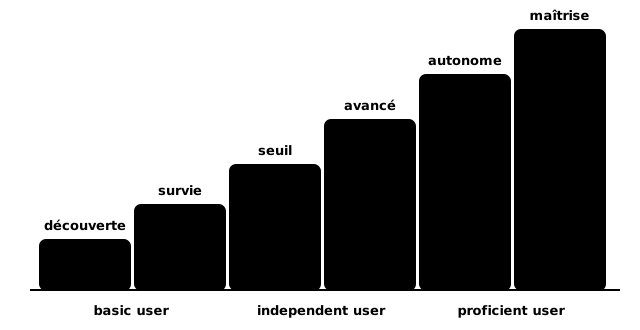
The hours are estimates commonly given by French teaching centres such as the Alliance française. They assume regular homework on top. Your real number depends on your other languages: English already gives you thousands of French-looking words (see Cognates & false friends), and Hindi speakers already know grammatical gender and the polite/familiar split of aap / tum — which is exactly vous / tu.
The rule of thumb
Twenty minutes a day, out loud, every day, beats three hours on Sunday. At about one hour a day, most English speakers reach a solid B1 in one year and B2 in about two.
59.2 What you can do at each level
Here are the levels described as real abilities (a simplified version of the official CEFR descriptions), each with one sentence that is typical of that level.
| Level | You can… | Typical exam |
|---|---|---|
| A1 | Introduce yourself, ask and answer very simple personal questions, understand slow, clear speech about basic needs. | DELF A1 |
| A2 | Handle routine tasks (shopping, transport, simple work), describe your family, your past weekend and your plans in simple sentences. | DELF A2 |
| B1 | Follow the main points of clear speech on familiar topics, cope with most travel situations, tell a story and give short reasons for an opinion. | DELF B1 |
| B2 | Understand the main ideas of complex texts, talk with native speakers without strain on both sides, argue for and against a point of view. | DELF B2 |
| C1 | Understand long, demanding texts and implicit meaning, speak fluently without searching for words, write well-structured texts on complex subjects. | DALF C1 |
| C2 | Understand virtually everything, summarise sources and rebuild their arguments, express fine shades of meaning precisely and naturally. | DALF C2 |
One sentence per level
- A1 — Je m’appelle Priya et j’habite à Pune. — My name is Priya and I live in Pune.
- A2 — Le week-end dernier, je suis allée au marché avec ma sœur. — Last weekend I went to the market with my sister.
- B1 — Si j’avais plus de temps, je ferais du sport tous les jours. — If I had more time, I would do sport every day.
- B2 — Bien que le télétravail soit pratique, il peut isoler les salariés. — Although working from home is convenient, it can isolate employees.
- C1 — Force est de constater que les mesures prises n’ont pas suffi. — One has to admit that the measures taken were not enough.
- C2 — Loin d’être anodine, cette réforme risque de bouleverser l’équilibre du système. — Far from being harmless, this reform could upset the balance of the whole system.
Levels are per skill
You can be B2 in reading and A2 in speaking. Exams test four skills separately: listening, reading, writing, speaking. Your weakest skill decides whether you pass.
59.3 DELF and DALF — the diplomas
The DELF (Diplôme d’études en langue française) covers A1 to B2; the DALF (Diplôme approfondi de langue française) covers C1 and C2. They are official diplomas of the French Ministry of Education, run by France Éducation international and taken at Alliances françaises and French institutes around the world — in India, at the Alliances françaises of Delhi, Mumbai, Chennai, Pondichéry, Bangalore and many other cities.
How DELF/DALF are scored
Four papers, each out of 25, total out of 100. You pass with 50/100 and at least 5/25 in every paper. The diploma is valid for life.
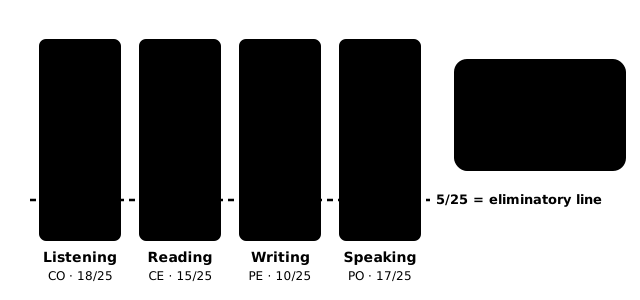
The four papers have French abbreviations you will see on every exam document:
| Code | French | English |
|---|---|---|
| CO | compréhension de l’oral | listening |
| CE | compréhension des écrits | reading |
| PE | production écrite | writing |
| PO | production orale (and interaction) | speaking, face to face with two examiners |
Check before you register
Formats are revised from time to time (recent versions added new task types to B1 and B2). The tables below give the standard structure; always check the current sample papers on the France Éducation international website or with your exam centre.
59.4 Paper by paper: DELF A1 → DALF C2
The listening, reading and writing papers are taken together in one sitting ("collective" papers). The speaking paper is a separate appointment, often the same day.
DELF A1 and A2
| Paper | A1 | A2 |
|---|---|---|
| CO | ~20 min · short recordings: announcements, messages, numbers, times | ~25 min · announcements, short dialogues, radio snippets |
| CE | 30 min · signs, notices, a simple email, a timetable | 30 min · ads, instructions, short articles |
| PE | 30 min · fill in a form + a short message or postcard | 45 min · two short texts (~60 words each): tell, describe, invite, reply |
| PO | 5–7 min, 10 min prep · answer about yourself, ask questions, a role-play (buying something) | 6–8 min, 10 min prep · about yourself, a short monologue, a role-play |
DELF B1 and B2
| Paper | B1 | B2 |
|---|---|---|
| CO | ~25 min · interviews, radio, conversations | ~30 min · longer interviews, reports, lectures |
| CE | 45 min · articles, letters, finding useful information | 1 h · argued articles, opinion pieces |
| PE | 45 min · essay, letter or forum post, 160 words minimum, giving your opinion | 1 h · argued text (letter, article, essay), 250 words minimum |
| PO | ~15 min · talk about yourself, a role-play, then give your view on a short text | ~20 min, 30 min prep · present a short document and defend a point of view, then debate with the examiner |
DALF C1 and C2
| Paper | C1 | C2 |
|---|---|---|
| Listening + reading | CO ~40 min (a long interview + short documents); CE 50 min (a long text) | Two combined papers, each /50: oral (listen, then present and debate — 30 min, 1 h prep); written (a 3 h 30 paper: read a file of documents and write a structured text of about 700 words) |
| Writing | 2 h 30 · a synthèse of two documents (~220 words) + an argued essay (~250 words) | |
| Speaking | 30 min, 1 h prep · an exposé built from a file of documents, then a discussion | Pass: 50/100 with at least 10/50 per paper |
At C1 and C2 you choose a domain: lettres et sciences humaines (humanities) or sciences. The synthèse — summarising two or more documents with no personal opinion — surprises many learners; it is taught step by step in Essays & structured writing.
59.5 TCF and TEF — the tests
A test is different from a diploma: you cannot fail it. You get a score that is converted into a CEFR level, and the result is usually valid for two years. Tests are what governments and universities ask for.
| Test | Run by | Format | Used for |
|---|---|---|---|
| TCF Tout public | France Éducation international | 3 compulsory MCQ papers (listening, language structures, reading; about 1 h 30); optional writing and speaking | job applications, personal record |
| TCF Canada | France Éducation international | listening, reading (MCQ), writing (1 h, 3 tasks), speaking (about 12 min) | Canadian immigration |
| TCF IRN / TCF DAP | France Éducation international | adapted versions | French residence and citizenship / admission to a French university |
| TEF (TEF Canada, TEFAQ, TEF IRN…) | CCI Paris Île-de-France | reading, listening, writing, speaking | Canada, Québec, French residence and citizenship |
- Pour l’immigration au Canada, on peut passer le TEF Canada ou le TCF Canada. — For immigration to Canada, you can take the TEF Canada or the TCF Canada.
- Les résultats du TCF sont valables deux ans. — TCF results are valid for two years.
- Le DELF et le DALF sont valables à vie. — The DELF and DALF are valid for life.
Which one should I take?
For a permanent qualification and your CV: DELF/DALF. For a visa, citizenship or Canadian points: the TCF or TEF version that the authority names. Requirements change (France has recently raised the levels needed for residence and citizenship), so read the official page before booking.
59.6 How long it takes — and a 12-week exam plan
Use the staircase in section 1 to estimate. If you are A2 today and want B1, you need roughly 200 more guided hours — about six months at an hour a day. Plan backwards from your exam date.
| Weeks | Focus | Every day (≈ 1 h) |
|---|---|---|
| 1–2 | Diagnosis | Do one full sample paper under exam conditions; list your three weakest points. |
| 3–6 | Repair grammar and vocabulary | One chapter of this book linked to your level (section 9); its quiz twice, one day apart. |
| 7–9 | Skills, one per day | Mon listening · Tue reading · Wed writing · Thu speaking · Fri your weakest · weekend a podcast or film. |
| 10–11 | Timed papers | A full paper every other day; correct your writing with the official grading grid. |
| 12 | Rest and rehearse | Light review, your prepared opening phrases, sleep. No new grammar. |
Train with the grid
Writing and speaking are marked with a public grille d’évaluation (task, coherence, vocabulary, grammar). Mark your own work with it — you will see exactly where your points go.
59.7 Exam French: instructions and lifesaving phrases
Exam instructions (les consignes) are always in French, even at A1. Learn them now so they never cost you time on the day.
| Consigne | Meaning |
|---|---|
| Cochez la bonne réponse. | Tick the right answer. |
| Entourez / Soulignez… | Circle / Underline… |
| Justifiez votre réponse. | Give evidence (quote the text) for your answer. |
| Vrai ou faux ? On ne sait pas. | True or false? Not stated. |
| Rédigez un texte de 250 mots minimum. | Write a text of at least 250 words. |
| Vous dégagerez le thème du document. | Identify the main theme of the document. |
In the speaking room
- Pourriez-vous répéter la question, s’il vous plaît ? — Could you repeat the question, please?
- Excusez-moi, je n’ai pas bien compris le mot « … ». — Sorry, I didn’t quite understand the word "…".
- Si j’ai bien compris, vous voulez savoir pourquoi… — If I have understood correctly, you want to know why…
- Je vais vous présenter le document, puis je donnerai mon avis. — I am going to present the document to you, then I will give my opinion.
- Ce document traite de la place du numérique à l’école. — This document deals with the role of digital technology at school.
- C’est une bonne question. Laissez-moi réfléchir un instant. — That’s a good question. Let me think for a moment.
- Je comprends votre point de vue, mais je ne le partage pas entièrement. — I understand your point of view, but I don’t fully share it.
- Pour conclure, je dirais que les avantages l’emportent sur les inconvénients. — To conclude, I would say that the advantages outweigh the drawbacks.
At the desk — what candidates say before and after
- Je voudrais m’inscrire au DELF B2 de juin. — I would like to register for the June DELF B2.
- Je passe le DALF C1 la semaine prochaine. — I am taking the DALF C1 next week.
- J’ai réussi mon DELF B1 avec 78 sur 100 ! — I passed my DELF B1 with 78 out of 100!
- Il a raté l’oral de deux points, il le repassera en décembre. — He failed the oral by two points; he will retake it in December.
Exam-day mistakes
- Wrong: (meaning "I passed") J’ai passé le DELF B2 !
- Right: J’ai réussi le DELF B2 ! / J’ai eu mon DELF B2 !
-
Why: passer un examen = to take it. To pass = réussir; to fail = rater or échouer à.
-
Wrong: Je ne comprends pas. (then silence)
- Right: Excusez-moi, pourriez-vous reformuler la question ?
-
Why: Asking politely is part of interaction — it earns points. Silence earns nothing.
-
Wrong: Je ne partage pas ton avis.
- Right: Je ne partage pas votre avis.
-
Why: The examiner is a stranger: vous from the first word to the last, unless the task is a role-play with a friend.
-
Wrong: Je suis prêt pour passer le DELF.
- Right: Je suis prêt à passer le DELF.
-
Why: prêt à + infinitive; prêt pour + noun: prêt pour l’examen.
-
Wrong: Dans le document, il dit que…
- Right: Dans cet article, l’auteur affirme que…
-
Why: Name your source (l’auteur, la journaliste, le sondage) and use a precise verb: affirmer, souligner, dénoncer.
-
Wrong: Je suis B2.
- Right: J’ai le niveau B2. / J’ai un niveau B2 en français.
- Why: You have a level in French — the same logic as j’ai 20 ans (see Être & avoir).
59.8 Self-assessment checklists
Read each list aloud. If you can honestly tick every line of a level — out loud, without notes — you are ready to sit that exam. If two or more lines are shaky, work on the chapters in section 9 first.
A1 — Je peux…
- ☐ me présenter — introduce myself (name, age, city, job).
- ☐ dire les nombres, la date et l’heure — say numbers, the date and the time.
- ☐ commander dans un café — order in a café, politely, with vous.
- ☐ poser des questions simples — ask where, when, how much.
A2 — Je peux…
- ☐ raconter mon week-end au passé composé — tell my weekend in the past.
- ☐ décrire ma famille, ma maison, ma ville — describe my family, home and town.
- ☐ acheter un billet, demander mon chemin — buy a ticket, ask the way.
- ☐ écrire un court message pour inviter ou m’excuser — write a short invitation or apology.
B1 — Je peux…
- ☐ raconter une histoire avec l’imparfait et le passé composé — tell a story with both past tenses.
- ☐ donner mon avis et le justifier — give and justify an opinion.
- ☐ comprendre l’essentiel d’un podcast sur un sujet familier — follow the main points of a podcast.
- ☐ écrire 160 mots clairs sur mon expérience — write 160 clear words about an experience.
B2 — Je peux…
- ☐ défendre un point de vue pendant dix minutes — defend a view for ten minutes.
- ☐ utiliser le subjonctif et le conditionnel sans y penser — use the subjunctive and conditional naturally.
- ☐ suivre un débat à la radio — follow a radio debate.
- ☐ écrire un texte argumenté de 250 mots — write a 250-word argued text.
C1 — Je peux…
- ☐ synthétiser deux documents sans donner mon avis — synthesise two documents neutrally.
- ☐ comprendre l’implicite et l’ironie — understand implied meaning and irony.
- ☐ changer de registre selon la situation — switch register to suit the situation.
- ☐ lire un roman contemporain avec plaisir — read a contemporary novel for pleasure.
C2 — Je peux…
- ☐ reformuler finement une idée complexe — rephrase a complex idea with precision.
- ☐ comprendre l’humour, les jeux de mots et les accents régionaux — get humour, puns and regional accents.
- ☐ rédiger 700 mots structurés à partir d’un dossier — write 700 structured words from a file of documents.
59.9 Your route through this book, level by level
Every chapter of the book belongs to a step. Finish all the chapters of a level (and their quizzes) before you book that level’s exam.
| Level | Chapters to master | Exam |
|---|---|---|
| A1 | How to use this book · Alphabet & accents · The sounds of French · Silent letters & liaison · Hello, please, thank you · Numbers, dates & time · Nouns, gender & plurals · Articles · Être & avoir · Present tense: -er verbs · Saying no · Asking questions · Core vocabulary by theme | DELF A1 |
| A2 | Present tense: the rest · Adjectives · My, your, this, that · Prepositions & places · Object pronouns · Reflexive verbs · The past: passé composé · The future · Giving instructions · Everyday French · The 100 essential verbs · Spelling & punctuation | DELF A2 |
| B1 | Y, en & pronoun order · Imparfait vs passé composé · Comparing · Relative pronouns · Conditional & si clauses · Pronunciation clinic · Travel & emergencies · Conversation & opinions · Cognates & false friends · Linking words · Messages, letters & emails | DELF B1 |
| B2 | The subjunctive · Advanced compound tenses · Passive & reported speech · Gérondif & participles · Real spoken French · Work, phone & interviews · Idioms & expressions · Registers & slang · Essays & structured writing · Culture & the francophone world · The 50 most common mistakes | DELF B2 |
| C1 | Literary & formal French · Arguing & presenting · Word building & advanced words · DELF, DALF & your level (this chapter) | DALF C1 |
| C2 | The whole book again, faster, plus real books, films and newspapers every day — then the Final test as a check-up. | DALF C2 |
Not sure where you are?
Take the Final test. Its "reopen this chapter" table sends each wrong answer back to the right page, and its score bands map onto the levels above.
À retenir
- A level is not a number of words you know — it is a list of things you can do in French: order a coffee (A1), tell a story (B1), defend an opinion (B2), summarise a report (C1).
- Twenty minutes a day, out loud, every day, beats three hours on Sunday. At about one hour a day, most English speakers reach a solid B1 in one year and B2 in about two.
- You can be B2 in reading and A2 in speaking. Exams test four skills separately: listening, reading, writing, speaking. Your weakest skill decides whether you pass.
- Four papers, each out of 25, total out of 100. You pass with 50/100 and at least 5/25 in every paper. The diploma is valid for life.
- For a permanent qualification and your CV: DELF/DALF. For a visa, citizenship or Canadian points: the TCF or TEF version that the authority names. Requirements change (France has recently raised the levels needed for…
- Writing and speaking are marked with a public grille d’évaluation (task, coherence, vocabulary, grammar). Mark your own work with it — you will see exactly where your points go.
59.10 Practice — DELF, DALF & your level
Exercise 1
To pass a DELF or DALF C1 exam you need…
- 50/100 and at least 5/25 in each paper
- 60/100 overall
- 50/100, even with 0 in one paper
- full marks in speaking
Hint: Two conditions
Answer
50/100 and at least 5/25 in each paper
The pass mark is 50/100, and any paper under 5/25 is eliminatory.
Exercise 2
Which of these is valid for life?
- DELF / DALF
- TCF
- TEF
- TCF Canada
Answer
DELF / DALF
DELF and DALF are diplomas, valid for life. TCF and TEF results are usually valid for two years.
Exercise 3
Match each level to its official French name.
| A | B |
|---|---|
| A1 | autonome |
| B1 | maîtrise |
| C1 | découverte |
| C2 | seuil |
Answer
A1 — découverte; B1 — seuil; C1 — autonome; C2 — maîtrise
A1 découverte, A2 survie, B1 seuil, B2 avancé, C1 autonome, C2 maîtrise.
Exercise 4
The DALF C1 writing paper asks for…
- a synthèse of documents and an argued essay
- a postcard
- a form to fill in
- a 700-word text only
Answer
a synthèse of documents and an argued essay
C1: synthèse (~220 words, no opinion) + essai argumenté (~250 words). The 700-word text is C2.
Exercise 5
Minimum length of the DELF B2 written text?
- 60 words
- 160 words
- 250 words
- 700 words
Answer
250 words
B1 asks for 160 words, B2 for 250 words.
Exercise 6
Pourriez-vous ___ la question, s'il vous plaît ? (repeat)
Hint: répéter = to repeat
Answer
répéter / repeter
Pourriez-vous répéter… ? is the polite way to ask an examiner to repeat.
Exercise 7
Tap the word that is wrong when speaking to an examiner.
Je ne partage pas ton avis, Madame.
Answer
Wrong word: ton.
Corrected: Je ne partage pas votre avis, Madame.
An examiner is a stranger: use vous, so votre avis.
Exercise 8
« J'ai passé l'examen hier » means…
- I took the exam yesterday
- I passed the exam yesterday
- I skipped the exam yesterday
- I failed the exam yesterday
Hint: A famous false friend
Answer
I took the exam yesterday
passer un examen = to take it. To pass = réussir un examen.
Exercise 9
Put the words in order.
Words: B2 / voudrais / Je / DELF / au / m'inscrire
Answer
Je voudrais m'inscrire au DELF B2
Je voudrais + infinitive: polite request. s'inscrire à = to register for.
Exercise 10
You need a French test for Canadian immigration. Which one?
- TEF Canada or TCF Canada
- DELF A1
- the French bac
- any diploma at all
Answer
TEF Canada or TCF Canada
Canada asks for the TEF Canada or TCF Canada.
Exercise 11
Roughly how many guided hours (cumulative) does it take to reach B2?
- about 50
- about 600
- about 3,000
- about 10
Answer
about 600
Common estimates: ~550–650 guided hours for B2, plus homework.
Exercise 12
Match each exam instruction to its meaning.
| A | B |
|---|---|
| Cochez | write |
| Justifiez | circle |
| Rédigez | tick |
| Entourez | give evidence |
Answer
Cochez — tick; Justifiez — give evidence; Rédigez — write; Entourez — circle
Exam instructions are always in French — learn them before the day.
Exercise 13
Force est de ___ que les mesures n'ont pas suffi. (to note)
Hint: A C1 phrase: one has to admit…
Answer
constater
Force est de constater que… = one has to admit that… — a classic C1 phrase.
Exercise 14
In the DELF B2 speaking paper you…
- present a short document and defend a point of view
- spell your name
- read a poem aloud
- fill in a form
Answer
present a short document and defend a point of view
B2 oral: 30 min preparation, then an exposé and a debate with the examiner.
Exercise 15
Tap the wrong word.
Je suis prêt pour passer le DELF.
Answer
Wrong word: pour.
Corrected: Je suis prêt à passer le DELF.
prêt à + infinitive; prêt pour + noun.
Exercise 16
Say it aloud — your lifeline in the oral exam.
Si j'ai bien compris, vous voulez savoir pourquoi
Answer
Say: Si j'ai bien compris, vous voulez savoir pourquoi
Reformulating the question buys you time and shows interaction skills.
Exercise 17
Say your goal aloud.
Je souhaiterais passer le DALF C1 l'année prochaine
Answer
Say: Je souhaiterais passer le DALF C1 l'année prochaine
souhaiterais = would like (polite conditional); passer = to take an exam.
Next step
Pick a target level and a date, write both on paper, and book the exam — a date makes you study. Then check where you stand with the Final test.