Chapter 6: Numbers, dates & time
Les nombres, la date, l’heure
Numbers are everywhere: prices, phone numbers, your age, the train time. French numbers are regular up to 69 — then they start counting in twenties: 80 is quatre-vingts, “four twenties”. Good news for Hindi speakers: you already memorised a hundred different number words as a child. French needs far fewer.
- 1From 0 to 20
- 2From 21 to 69
- 3From 70 to 99: counting in twenties
- 4Hundreds, thousands, millions
- 5Ordinals: premier, deuxième, troisième…
- 6Days, months and dates
- 7Telling the time
- 8Prices and money
masculinefeminine
The whole system in one line
Learn 0–16 by heart, then build: tens + units up to 69, and 60 + 10…19 and 4 × 20 + 0…19 for 70–99.
6.1 From 0 to 20
| No. | French | Sounds like |
|---|---|---|
| 0 | zéro | [zay-RO] |
| 1 | un / une | [Ɛ̃] / [EWN] |
| 2 | deux | [DÖ] |
| 3 | trois | [TRWA] |
| 4 | quatre | [KATR] |
| 5 | cinq | [SƐ̃K] |
| 6 | six | [SEESS] |
| 7 | sept | [SET] |
| 8 | huit | [WEET] |
| 9 | neuf | [NÖF] |
| 10 | dix | [DEESS] |
| 11 | onze | [ÕZ] |
| 12 | douze | [DOOZ] |
| 13 | treize | [TREZ] |
| 14 | quatorze | [ka-TORZ] |
| 15 | quinze | [KƐ̃Z] |
| 16 | seize | [SEZ] |
| 17 | dix-sept | [dee-SET] |
| 18 | dix-huit | [dee-ZWEET] |
| 19 | dix-neuf | [deez-NÖF] |
| 20 | vingt | [VƐ̃] |
From 17 on, French simply adds: dix-sept = 10-7. The number one agrees with the noun: un livre, une pomme, vingt et une pages.
Numbers that change before a noun
Several numbers drop or change their final consonant depending on the next word — the rules of Silent letters & liaison in action.
| Number | Alone | + consonant | + vowel |
|---|---|---|---|
| six | [SEESS] | six livres [see] | six‿ans [see-ZÃ] |
| dix | [DEESS] | dix livres [dee] | dix‿ans [dee-ZÃ] |
| huit | [WEET] | huit livres [wee] | huit‿ans [wee-TÃ] |
| cinq | [SƐ̃K] | cinq livres [sɛ̃] or [sɛ̃k] | cinq‿ans [sɛ̃-KÃ] |
| neuf | [NÖF] | neuf livres [nöf] | neuf‿ans [nö-VÃ] |
- J’ai six ans. J’ai six livres. — I am six. I have six books. [see-ZÃ / see LEEVR]
- Il a dix-huit ans. Elle a neuf ans. — He is 18. She is 9. [dee-zwee-TÃ / nö-VÃ]
6.2 From 21 to 69
Learn the tens, then join them to the units with a hyphen. For 1, use et (and) instead: vingt et un.
| Tens | French | Examples |
|---|---|---|
| 20 | vingt [VƐ̃] | 21 vingt et un · 22 vingt-deux [vɛ̃t-DÖ] |
| 30 | trente [TRÃT] | 31 trente et un · 35 trente-cinq |
| 40 | quarante [ka-RÃT] | 41 quarante et un · 48 quarante-huit |
| 50 | cinquante [sɛ̃-KÃT] | 51 cinquante et un · 56 cinquante-six |
| 60 | soixante [swa-SÃT] | 61 soixante et un · 69 soixante-neuf |
Two sound traps
In soixante the x sounds [s]: [swa-SÃT], never “soks-ant”. And the t of vingt is heard from 21 to 29: vingt-trois [vɛ̃t-TRWA].
Careful
- Wrong: vingt-un, trente-un
- Right: vingt et un, trente et un
- Why: 21, 31, 41, 51, 61 (and 71) use et. All other combinations use a hyphen. (Since the 1990 spelling reform you may also write vingt-et-un.)
6.3 From 70 to 99: counting in twenties
Here France does something unusual. There is no single word for 70, 80 or 90. Instead, French builds them from 60 and from 20.
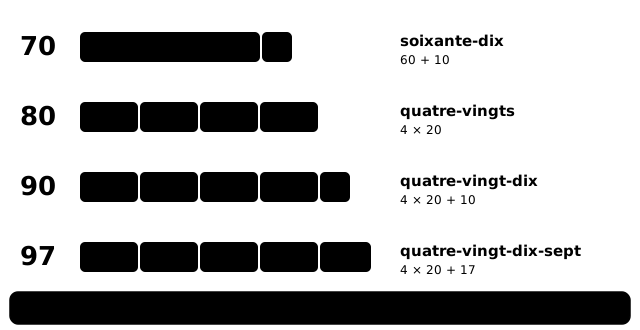
| No. | French | Built as |
|---|---|---|
| 70 | soixante-dix | 60 + 10 |
| 71 | soixante et onze | 60 + 11 |
| 72 | soixante-douze | 60 + 12 |
| 79 | soixante-dix-neuf | 60 + 19 |
| 80 | quatre-vingts | 4 × 20 |
| 81 | quatre-vingt-un | 4 × 20 + 1 (no et!) |
| 85 | quatre-vingt-cinq | 4 × 20 + 5 |
| 90 | quatre-vingt-dix | 4 × 20 + 10 |
| 91 | quatre-vingt-onze | 4 × 20 + 11 |
| 99 | quatre-vingt-dix-neuf | 4 × 20 + 19 |
The s of quatre-vingts
quatre-vingts (80) takes an s; as soon as a number follows, the s goes: quatre-vingt-un, quatre-vingt-dix. The t of vingt is silent in 81–99: [ka-truh-vɛ̃-Ɛ̃].
Careful
- Wrong: quatre-vingt et un
- Right: quatre-vingt-un
- Why: The et appears in 21, 31, 41, 51, 61 and 71 only — never in 81 or 91.
Belgium and Switzerland
French speakers in Belgium and Switzerland use simpler words: septante (70) and nonante (90). For 80, Belgium says quatre-vingts like France; the Swiss cantons of Vaud, Valais and Fribourg say huitante. Québec uses the France system. Everyone understands both — but in France, use soixante-dix.
- septante-cinq, nonante-neuf — 75, 99 (Belgium, Switzerland) [sep-tãt-SƐ̃K, no-nãt-NÖF]
6.4 Hundreds, thousands, millions
| Number | French |
|---|---|
| 100 | cent [SÃ] (not “un cent”) |
| 101 | cent un |
| 200 | deux cents |
| 250 | deux cent cinquante |
| 1 000 | mille [MEEL] (not “un mille”) |
| 3 000 | trois mille |
| 1 000 000 | un million |
| 1 000 000 000 | un milliard |
cent, mille, million
cents takes s only when multiplied and last (deux cents, but deux cent trois). mille never takes s. million, milliard are nouns: deux millions d’habitants.
- L’Inde a plus d’un milliard d’habitants. — India has more than a billion inhabitants. [… plew dɛ̃ mee-LYAR da-bee-TÃ]
- Paris a environ deux millions d’habitants. — Paris has about two million inhabitants.
- Ce téléphone coûte trois cent quatre-vingt-dix-neuf euros. — This phone costs €399.
Lakh and crore in French
| Indian | Figure | French |
|---|---|---|
| 1 lakh | 100 000 | cent mille |
| 10 lakh | 1 000 000 | un million |
| 1 crore | 10 000 000 | dix millions |
| 100 crore | 1 000 000 000 | un milliard |
Writing numbers the French way
French groups thousands with a space and uses a comma for decimals: 1 500 000 (not 15,00,000 or 1,500,000) and 2,5 = deux virgule cinq.
Years and phone numbers
- en 2026 — en deux mille vingt-six — in 2026
- L’Inde est indépendante depuis 1947. — India has been independent since 1947. — mille neuf cent quarante-sept
- en 1999 — mille neuf cent quatre-vingt-dix-neuf — in 1999 (you may also hear dix-neuf cent…, “nineteen hundred…”)
- 06 12 34 56 78 — Phone numbers are read in pairs: zéro six, douze, trente-quatre, cinquante-six, soixante-dix-huit.
6.5 Ordinals: premier, deuxième, troisième…
To say “first, second, third”, add -ième to the number (drop a final e). Only “first” is irregular.
| Ordinal | Written | Note |
|---|---|---|
| premier / première | 1er / 1re | irregular, agrees |
| deuxième (second·e) | 2e | second = formal, often “of two” |
| troisième | 3e | |
| quatrième | 4e | quatre − e |
| cinquième | 5e | add u |
| neuvième | 9e | f → v |
| vingt et unième | 21e | no “premier” in compounds |
| centième | 100e |
- J’habite au premier étage. — I live on the first floor (one floor up). The ground floor is le rez-de-chaussée — as in India. [pruh-myeh-ray-TAZH]
- C’est la première fois. — It's the first time.
- Louis XIV, au XXIe siècle — Louis the Fourteenth (kings use plain numbers: Louis quatorze), in the 21st century
Careful
- Wrong: le 2ème étage
- Right: le 2e étage
- Why: The standard abbreviation is just e: 2e, 3e. “2ème” is common but not correct in careful writing.
6.6 Days, months and dates
The days of the week
- lundi, mardi, mercredi, jeudi — Monday, Tuesday, Wednesday, Thursday [lɛ̃-DEE, mar-DEE, mehr-kruh-DEE, zhö-DEE]
- vendredi, samedi, dimanche — Friday, Saturday, Sunday [vã-druh-DEE, sam-DEE, dee-MÃSH]
lundi vs le lundi
Lundi, je travaille = this Monday. Le lundi, je travaille = on Mondays (every Monday). Days and months are masculine and take no capital.
The months and seasons
- janvier, février, mars, avril, mai, juin — January to June — the s of mars is heard [zhã-VYAY, fay-vree-AY, MARSS, a-VREEL, MEH, ZHWƐ̃]
- juillet, août, septembre, octobre, novembre, décembre — July to December — août is [OO] or [OOT] [zhwee-YEH, OO(T), sep-TÃBR, ok-TOBR, no-VÃBR, day-SÃBR]
- au printemps, en été, en automne, en hiver — in spring, in summer, in autumn, in winter [oh prɛ̃-TÃ, ã-nay-TAY, ã-no-TON, ã-nee-VEHR]
- en janvier / au mois de janvier — in January
Saying the date
The date formula
le + number + month: le 14 juillet. Use the ordinal only for the 1st: le 1er mai (le premier mai).
- Le 14 juillet, c’est la fête nationale française. — The 14th of July is the French national day.
- Le 15 août, c’est la fête de l’Indépendance en Inde. — The 15th of August is Independence Day in India.
- le 1er janvier, le 2 octobre, le 26 janvier — 1st January, 2nd October, 26th January
- — On est le combien ? — On est le 17 octobre. — — What's the date? — It's the 17th of October.
- Aujourd’hui, nous sommes samedi 17 octobre 2026. — Today is Saturday, 17 October 2026. — day, number, month, year
- Mon anniversaire, c’est le 3 avril. Je suis née en 1999. — My birthday is on 3 April. I was born in 1999. (a woman: née; a man: né)
Careful
- Wrong: le deuxième mai · Mai 2
- Right: le deux mai
- Why: Dates use normal numbers (except 1er), the day comes first, and the month has no capital. Written: 02/05 = 2 May — day first, as in India, not the American way.
6.7 Telling the time
- Quelle heure est-il ? — What time is it? [kel ö-reh-TEEL]
- Il est une heure. Il est deux heures. — It is one o'clock. It is two o'clock. — always say heure(s) [ee-leh-tew-NÖR, ee-leh dö-ZÖR]
- Il est midi. Il est minuit. — It is noon. It is midnight. [mee-DEE, mee-NWEE]
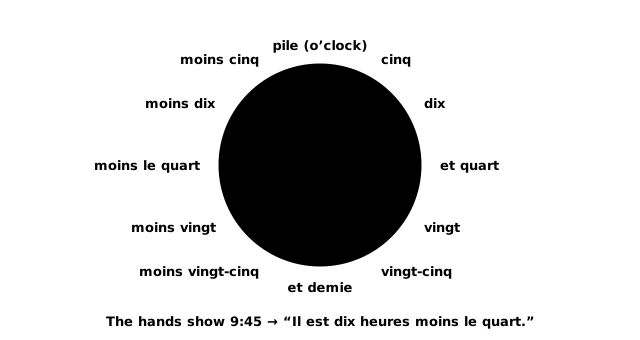
| Time | Everyday (12 h) |
|---|---|
| 3:05 | trois heures cinq |
| 3:15 | trois heures et quart |
| 3:30 | trois heures et demie |
| 3:40 | quatre heures moins vingt |
| 3:45 | quatre heures moins le quart |
| 12:30 | midi et demi |
Demie has an e after heure (feminine), but not after midi and minuit (masculine): une heure et demie, midi et demi. To make the 12-hour clock clear, add du matin (am), de l’après-midi, du soir.
The 24-hour clock
Timetables, cinemas, appointments and the news use the 24-hour clock. Then you just read the numbers — no quart, no moins. It is written 14 h 30 (or 14h30).
- Le train part à 18 h 45. — The train leaves at 6:45 pm. — dix-huit heures quarante-cinq
- Le film commence à 21 h. — The film starts at 9 pm. — vingt et une heures (feminine: une heure)
- — À quelle heure ? — À huit heures du soir. — — At what time? — At eight in the evening.
Careful
- Wrong: Il est cinq. / C’est 5 heures.
- Right: Il est cinq heures.
- Why: Always Il est… + heure(s). Leaving out heures sounds like an unfinished number.
Careful
- Wrong: quatorze heures et quart
- Right: quatorze heures quinze / deux heures et quart
- Why: Do not mix systems: quart and demie belong to the 12-hour clock.
6.8 Prices and money
France uses the euro (€), divided into 100 centimes. Prices are written with a comma and the € sign after: 3,50 €. You say the euros, then just the cents.
- 3,50 € — trois euros cinquante — €3.50 [trwa-zö-RO sɛ̃-KÃT]
- 0,80 € — quatre-vingts centimes — 80 cents
- — C’est combien ? — Ça fait douze euros quatre-vingt-dix. — — How much is it? — That comes to €12.90.
- Ça coûte combien, ce sac ? — How much does this bag cost? [sa koot kõ-BYƐ̃]
- En Inde, ça coûte cinq cents roupies. — In India, it costs 500 rupees. — la roupie
Liaison with euros
Euro starts with a vowel, so numbers link to it. This is where the liaison rules pay off every day:
| Price | Sounds like |
|---|---|
| un‿euro | [ɛ̃-nö-RO] |
| deux‿euros, trois‿euros | [dö-zö-RO], [trwa-zö-RO] |
| six‿euros, dix‿euros | [see-zö-RO], [dee-zö-RO] |
| huit‿euros, vingt‿euros | [wee-tö-RO], [vɛ̃-tö-RO] |
| cent‿euros | [sã-tö-RO] |
| neuf euros | [nö-fö-RO] — f stays f! |
neuf: v only with ans and heures
neuf‿ans [nö-VÃ] and neuf‿heures [nö-VÖR] use [v]; everything else keeps [f]: neuf euros, neuf amis.
In real life — at the bakery
- — Bonjour ! Deux croissants et une baguette, s’il vous plaît. — — Hello! Two croissants and a baguette, please.
- — Voilà. Ça fait quatre euros trente. — — Here you are. That's €4.30.
- — Tenez. Merci, bonne journée ! — — Here you go. Thank you, have a nice day!
À retenir
- Learn 0–16 by heart, then build: tens + units up to 69, and 60 + 10…19 and 4 × 20 + 0…19 for 70–99.
- quatre-vingts (80) takes an s; as soon as a number follows, the s goes: quatre-vingt-un, quatre-vingt-dix. The t of vingt is silent in 81–99: [ka-truh-vɛ̃-Ɛ̃].
- cents takes s only when multiplied and last (deux cents, but deux cent trois). mille never takes s. million, milliard are nouns: deux millions d’habitants.
- Lundi, je travaille = this Monday. Le lundi, je travaille = on Mondays (every Monday). Days and months are masculine and take no capital.
- le + number + month: le 14 juillet. Use the ordinal only for the 1st: le 1er mai (le premier mai).
- neuf‿ans [nö-VÃ] and neuf‿heures [nö-VÖR] use [v]; everything else keeps [f]: neuf euros, neuf amis.
6.9 Practice — Numbers, dates & time
Exercise 1
70 in French (France):
- septante
- soixante-dix
- sept-dix
- soixante et dix
Answer
soixante-dix
70 = 60 + 10 = soixante-dix. Septante is Belgian/Swiss.
Exercise 2
80 in French (France):
- huitante
- octante
- quatre-vingts
- huit-dix
Answer
quatre-vingts
80 = 4 × 20 = quatre-vingts, with an s.
Exercise 3
90 in French (France):
- nonante
- quatre-vingt-dix
- neuf-dix
- quatre-vingts-dix
Answer
quatre-vingt-dix
90 = 4 × 20 + 10. The s of vingts goes when a number follows.
Exercise 4
21 = vingt ___ un
Hint: a little word, not a hyphen
Answer
et
21, 31, 41, 51, 61, 71 use et: vingt et un.
Exercise 5
Where do people say 'septante' and 'nonante'?
- Paris
- Québec
- Belgium and Switzerland
- Nowhere
Answer
Belgium and Switzerland
Belgian and Swiss French: septante (70), nonante (90).
Exercise 6
1 lakh (100 000) in French is…
- un million
- cent mille
- dix mille
- un milliard
Answer
cent mille
100 000 = cent mille. 1 crore = dix millions.
Exercise 7
Which is correct for 203?
- deux cents trois
- deux cent trois
- deux centre trois
- deux cents et trois
Answer
deux cent trois
cents loses its s when another number follows.
Exercise 8
Il est trois heures et ___ . (3:30)
Hint: half
Answer
demie
et demie after heure (feminine); midi et demi without e.
Exercise 9
2:45 in everyday French:
- deux heures moins le quart
- trois heures moins le quart
- deux heures et quart
- trois heures et demie
Answer
trois heures moins le quart
Before the hour: next hour + moins: three minus a quarter.
Exercise 10
'Le 14 juillet' is…
- Christmas
- the French national day
- India's Independence Day
- New Year
Answer
the French national day
Le 14 juillet = la fête nationale. India's is le 15 août.
Exercise 11
Tap the wrong word.
Aujourd'hui, c'est le deuxième mai.
Answer
Wrong word: deuxième.
Corrected: Aujourd'hui, c'est le deux mai.
Dates use normal numbers, except le premier (1er).
Exercise 12
Tap the word with a spelling mistake.
Mon anniversaire est en Janvier.
Answer
Wrong word: Janvier.
Corrected: Mon anniversaire est en janvier.
Months and days take no capital letter in French.
Exercise 13
Match the days.
| A | B |
|---|---|
| lundi | Saturday |
| mercredi | Sunday |
| samedi | Monday |
| dimanche | Wednesday |
Answer
lundi — Monday; mercredi — Wednesday; samedi — Saturday; dimanche — Sunday
Days are masculine and lowercase.
Exercise 14
Match the ordinals.
| A | B |
|---|---|
| premier | 5th |
| deuxième | 9th |
| cinquième | 1st |
| neuvième | 2nd |
Answer
premier — 1st; deuxième — 2nd; cinquième — 5th; neuvième — 9th
cinq → cinquième (add u), neuf → neuvième (f → v).
Exercise 15
How do you say €3.50?
- trois virgule cinquante euros
- trois euros cinquante
- trois cinquante centimes
- trois et demi euros
Answer
trois euros cinquante
Euros first, then the cents alone: trois euros cinquante.
Exercise 16
'six ans' is pronounced…
- [seess ã]
- [see-ZÃ]
- [see-TÃ]
- [sex-ã]
Answer
[see-ZÃ]
Before a vowel, six links with a [z].
Exercise 17
Put the words in order: 'It is eight in the evening.'
Words: Il / du / est / soir / huit / heures
Answer
Il est huit heures du soir
Il est + number + heures + du soir.
Exercise 18
Say the price aloud.
Ça coûte quatre-vingt-dix-neuf euros
Answer
Say: Ça coûte quatre-vingt-dix-neuf euros
quatre-vingt-dix-neuf: 4 × 20 + 19. The t of vingt is silent here; neuf euros keeps [f].
Exercise 19
Say your birthday (or this one).
Mon anniversaire c'est le trois avril
Answer
Say: Mon anniversaire c'est le trois avril
le + number + month: le trois avril. Only the 1st uses premier.
Next step
Practise daily: read every price, car number and clock you see in French for one week. You have finished Part 1 — félicitations ! Next, Nouns, gender & plurals opens Part 2.