Chapter 10: Present tense: -er verbs
Le présent des verbes en -er
Around nine French verbs out of ten end in -er: parler, aimer, habiter, travailler… They all follow one pattern, and every new verb French invents (googler, liker) joins this family. Learn this one table and you can use thousands of verbs today. Even better: most of the endings are silent.
- 1Stem + ending
- 2Six spellings, only three sounds
- 3Thirty -er verbs to start with
- 4Spelling-change verbs: the “boot”
- 5What the present tense means
- 6Mistakes learners really make
- 7In real life — a typical day
In one line
Remove -er and add -e, -es, -e, -ons, -ez, -ent: je parle, tu parles, il parle, nous parlons, vous parlez, ils parlent.
10.1 Stem + ending
Every French verb has an infinitive (the dictionary form): parler = to speak. To conjugate, cut off -er to get the stem (parl-), then add the ending that matches the subject.
| Subject | Ending | Parler | Sounds like |
|---|---|---|---|
| je | -e | je parle | [zhuh PARL] |
| tu | -es | tu parles | [tew PARL] |
| il / elle / on | -e | il parle | [eel PARL] |
| nous | -ons | nous parlons | [noo par-LÕ] |
| vous | -ez | vous parlez | [voo par-LAY] |
| ils / elles | -ent | ils parlent | [eel PARL] |
- Je parle hindi et anglais. — I speak Hindi and English. [zhuh parl een-DEE ay ã-GLEH]
- Tu parles français ? — Do you speak French? [tew parl frã-SEH]
- Nous parlons avec le directeur. — We are talking with the director. [noo par-LÕ a-vek luh dee-rek-TUHR]
- Vous parlez trop vite ! — You speak too fast! [voo par-LAY troh VEET]
- Elles parlent au téléphone. — They are talking on the phone. [el PARL oh tay-lay-FON]
10.2 Six spellings, only three sounds
Here is the great secret of French verbs: the endings -e, -es, -e, -ent are all silent. So je parle, tu parles, il parle, ils parlent sound exactly the same — and so do elle parle, on parle, elles parlent. Of all the persons, only nous and vous have an ending you can hear.
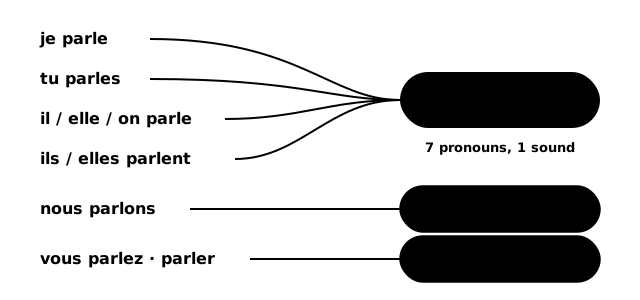
Speaking is easier than writing
To speak, you only need three sounds per verb: the stem [parl], nous [-õ] and vous [-ay]. The silent letters matter only when you write.
Verbs that start with a vowel
With aimer, habiter, écouter, arriver…, je becomes j’, and you get a liaison with nous, vous, ils, elles. Here the plural is audible: il aime [ee-LEM] vs ils‿aiment [eel-ZEM].
- J’habite à Delhi. — I live in Delhi. [zha-BEET a deh-LEE]
- Nous‿aimons le cinéma. — We love cinema. [noo-zeh-MÕ luh see-nay-MA]
- Ils‿écoutent de la musique. — They are listening to music. [eel-zay-KOOT duh la mew-ZEEK]
- Elle arrive ce soir. — She arrives this evening. [eh-la-REEV suh SWAR]
10.3 Thirty -er verbs to start with
| Verb | English | Verb | English |
|---|---|---|---|
| parler | to speak | aimer | to like, love |
| habiter | to live (in) | travailler | to work |
| regarder | to watch, look at | écouter | to listen to |
| chercher | to look for | trouver | to find |
| donner | to give | demander | to ask |
| penser | to think | oublier | to forget |
| arriver | to arrive | rester | to stay |
| entrer | to go in | rentrer | to go home |
| jouer | to play | étudier | to study |
| cuisiner | to cook | marcher | to walk, to work (a machine) |
| fermer | to close | commander | to order |
| aider | to help | visiter | to visit (a place) |
| téléphoner (à) | to phone | coûter | to cost |
| porter | to wear, carry | laver | to wash |
| danser | to dance | chanter | to sing |
Only one -er verb is irregular: aller (to go) — see Present tense: the rest.
- Je cherche la gare. — I’m looking for the station. (chercher — no “for” in French) [zhuh SHERSH la GAR]
- Tu regardes la télé ? — Are you watching TV? [tew ruh-GARD la tay-LAY]
- Mon frère travaille dans une banque. — My brother works in a bank. [mõ FREHR tra-VAÏ dã-zewn BÃK]
- Les enfants jouent au cricket. — The children play cricket. (jouer à + sport) [lay-zã-FÃ ZHOO oh kree-KET]
- Vous étudiez le français depuis quand ? — How long have you been studying French? [voo-zay-tew-DYAY … duh-pwee KÃ]
- Ça coûte combien ? — How much does it cost? [sa KOOT kõ-BYɛ̃]
No extra preposition
chercher = look for, écouter = listen to, regarder = look at, attendre = wait for: the English preposition is already inside the French verb. J’écoute la radio, not “j’écoute à la radio”.
10.4 Spelling-change verbs: the “boot”
Some -er verbs are regular in sound but change their spelling to keep the pronunciation right. Most changes happen in the four silent-ending forms — je, tu, il, ils — the shape of a boot. Nous and vous stay outside.
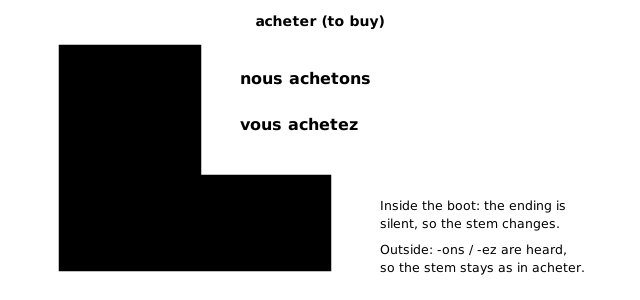
Type 1: -ger and -cer — only nous changes
These are the exception to the boot. Before -ons, a g would sound hard [g] and a c would sound like [k]. So French adds an e after g and turns c into ç — only in the nous form.
| Verb | je / il / ils | nous | Also |
|---|---|---|---|
| manger (eat) | je mange | nous mangeons | nager, voyager, changer, partager |
| commencer (begin) | je commence | nous commençons | lancer, placer, avancer |
- Nous mangeons à midi. — We eat at noon. [noo mã-ZHÕ a mee-DEE]
- Nous commençons à neuf heures. — We start at nine o’clock. [noo ko-mã-SÕ a nuh-VUHR]
- Nous voyageons en Inde chaque année. — We travel to India every year. [noo vwa-ya-ZHÕ ã-Nɛ̃D]
Type 2: e → è (acheter) and é → è (préférer)
| Verb | Inside the boot | nous / vous | Also |
|---|---|---|---|
| acheter (buy) | j’achète, ils achètent | nous achetons | lever, emmener, se promener |
| préférer (prefer) | je préfère, ils préfèrent | nous préférons | espérer, répéter, compléter |
- J’achète du pain tous les matins. — I buy bread every morning. [zha-SHET dew Pɛ̃]
- Vous achetez les billets ? — Are you buying the tickets? [voo-zash-TAY lay bee-YEH]
- Je préfère le thé, mais nous préférons tous le café. — I prefer tea, but we all prefer coffee. [zhuh pray-FEHR … noo pray-fay-RÕ]
- J’espère que tu vas bien. — I hope you’re well. [zhes-PEHR kuh tew va BYɛ̃]
Type 3: double consonant (appeler, jeter)
| Verb | Inside the boot | nous / vous |
|---|---|---|
| appeler (call) | j’appelle, tu appelles, ils appellent | nous appelons, vous appelez |
| jeter (throw) | je jette, ils jettent | nous jetons, vous jetez |
- Je t’appelle ce soir. — I’ll call you tonight. (present for a near future) [zhuh ta-PEL suh SWAR]
- Comment vous vous appelez ? — Je m’appelle Rohan. — What’s your name? — My name is Rohan. (s’appeler is reflexive — see Reflexive verbs) [voo voo-za-PLAY … zhuh ma-PEL]
Type 4: -yer → -ie (payer, envoyer, nettoyer)
Inside the boot, y becomes i: j’envoie, je nettoie, j’essaie. With -ayer verbs both spellings are correct: je paie or je paye.
- Je paie par carte. — I’m paying by card. [zhuh PEH par KART]
- Nous payons en liquide. — We’re paying in cash. [noo peh-YÕ ã lee-KEED]
- Elle envoie un message à sa mère. — She’s sending a message to her mother. [eh-lã-VWA ɛ̃ meh-SAZH]
The boot rule
Spelling changes (achète, appelle, préfère, paie) happen in je, tu, il, ils; nous and vous keep the infinitive stem — except mangeons, commençons.
10.5 What the present tense means
French has one present tense where English has two. Je mange means both “I eat” and “I am eating”. There is no “-ing” form to add — and you never use être to make one.
| Use | French | English |
|---|---|---|
| right now | Je regarde un film. | I’m watching a film. |
| habit | Je regarde un film le vendredi. | I watch a film on Fridays. |
| general truth | Les Français mangent tard. | The French eat late. |
| near future | Je rentre demain. | I’m coming home tomorrow. |
| since + still true | J’habite ici depuis 2020. | I’ve lived here since 2020. |
- Chut ! Le bébé dort et je travaille. — Shh! The baby is sleeping and I’m working. [SHEWT … zhuh tra-VAÏ]
- Je suis en train de cuisiner. — I’m (busy) cooking right now. — être en train de + infinitive stresses “in the middle of” [zhuh swee-zã TRɛ̃ duh kwee-zee-NAY]
Depuis: present tense for “have been”
For an action that started in the past and is still going on, French uses the present with depuis. English uses “have been … for/since”. Hindi works exactly like French here: main do saal se French seekh raha hoon — present tense + “se”.
- J’étudie le français depuis deux ans. — I have been studying French for two years. [zhay-tew-DEE … duh-PWEE duh-ZÃ]
- Elle habite à Paris depuis 2019. — She has lived in Paris since 2019.
- Tu m’attends depuis longtemps ? — Non, depuis cinq minutes. — Have you been waiting for me long? — No, for five minutes. (attendre is an -re verb)
Depuis + present
Still true now? Use present + depuis: j’habite ici depuis trois ans = I have lived here for three years.
10.6 Mistakes learners really make
The -er traps
- Wrong: Je suis parle au téléphone.
- Right: Je parle au téléphone.
-
Why: French has no “am + -ing”. The simple present already means “I am talking”.
-
Wrong: Nous mangons ensemble.
- Right: Nous mangeons ensemble.
-
Why: Keep the soft g sound before -ons: mangeons, voyageons, nageons.
-
Wrong: Ils parlent [par-LÃ] anglais.
- Right: Ils parlent [PARL] anglais.
-
Why: The verb ending -ent is completely silent. (It is pronounced only in nouns/adverbs like le moment, lentement.)
-
Wrong: J’achete une robe. / Je m’apelle Anil.
- Right: J’achète une robe. / Je m’appelle Anil.
-
Why: Inside the boot: acheter → achète (è), appeler → appelle (ll).
-
Wrong: J’ai habité ici depuis cinq ans. (still living here)
- Right: J’habite ici depuis cinq ans.
-
Why: If it is still true, French uses the present with depuis — not a past tense.
-
Wrong: Je cherche pour mes clés.
- Right: Je cherche mes clés.
-
Why: chercher already means “look for”. No pour.
-
Wrong: Je aime le cricket.
- Right: J’aime le cricket.
- Why: je → j’ before a vowel or silent h: j’aime, j’habite, j’écoute.
10.7 In real life — a typical day
Read it aloud. Every verb is a regular -er verb (except one — can you find it?).
- Le matin, je commence à huit heures. — In the morning, I start at eight.
- Je travaille dans un bureau et je parle souvent anglais. — I work in an office and I often speak English.
- À midi, mes collègues et moi, nous mangeons ensemble. — At noon, my colleagues and I eat together.
- Le soir, je rentre à pied et j’achète des légumes. — In the evening, I walk home and buy vegetables.
- Ma femme cuisine, et moi, je fais la vaisselle. — My wife cooks, and I do the washing-up. (faire is the irregular one!)
- Après, on regarde une série et on appelle nos parents en Inde. — Afterwards, we watch a series and call our parents in India.
À retenir
- Remove -er and add -e, -es, -e, -ons, -ez, -ent: je parle, tu parles, il parle, nous parlons, vous parlez, ils parlent.
- To speak, you only need three sounds per verb: the stem [parl], nous [-õ] and vous [-ay]. The silent letters matter only when you write.
- Spelling changes (achète, appelle, préfère, paie) happen in je, tu, il, ils; nous and vous keep the infinitive stem — except mangeons, commençons.
- Still true now? Use present + depuis: j’habite ici depuis trois ans = I have lived here for three years.
- You have the regular pattern. The other verbs — finir, vendre, aller, faire, prendre and friends — are in Present tense: the rest. Today, describe your day in five -er verbs.
10.8 Practice — -er verbs
Exercise 1
Vous ___ (habiter) à Lyon ?
- habite
- habitez
- habitons
- habitent
Answer
habitez
vous → -ez: vous habitez.
Exercise 2
Which form is NOT pronounced [PARL]?
- je parle
- tu parles
- ils parlent
- vous parlez
Answer
vous parlez
vous parlez = [par-LAY]. The others all sound [PARL].
Exercise 3
Nous ___ (manger) au restaurant.
- mangons
- mangeons
- mangez
- mangent
Answer
mangeons
-ger verbs keep an e before -ons: mangeons.
Exercise 4
Tu ___ (acheter) le pain ?
- acheter
- achetes
- achètes
- achètez
Answer
achètes
Inside the boot (tu), e → è: tu achètes.
Exercise 5
'I have been working here for six months.'
- J'ai travaillé ici depuis six mois.
- Je travaille ici depuis six mois.
- Je suis travaille ici six mois.
- Je travaille ici pour six mois.
Answer
Je travaille ici depuis six mois.
Still true now → present + depuis.
Exercise 6
Nous ___ (commencer) à neuf heures.
Hint: c before -ons
Answer
commençons
c → ç before o: commençons.
Exercise 7
Je m'___ (appeler) Sara.
Hint: double consonant
Answer
appelle
appeler → j'appelle (ll inside the boot).
Exercise 8
Elles ___ (préférer) le train.
Hint: é → è in the boot
Answer
préfèrent / preferent
ils/elles préfèrent — è inside the boot.
Exercise 9
Je ___ (payer) par carte.
Hint: y → i (or keep y)
Answer
paie / paye
Both je paie and je paye are correct.
Exercise 10
Ils ___ (écouter) la radio.
Answer
écoutent / ecoutent
ils → -ent (silent): ils écoutent, with liaison ils‿écoutent.
Exercise 11
Tap the wrong word.
Je suis regarde la télé.
Answer
Wrong word: suis.
Corrected: Je regarde la télé.
No être + verb for '-ing'. The present alone is enough.
Exercise 12
Tap the wrong word.
Nous nagons dans la mer.
Answer
Wrong word: nagons.
Corrected: Nous nageons dans la mer.
-ger verbs: nageons.
Exercise 13
Match the verb to its meaning.
| A | B |
|---|---|
| chercher | to listen to |
| regarder | to find |
| écouter | to look for |
| trouver | to look at, watch |
Answer
chercher — to look for; regarder — to look at, watch; écouter — to listen to; trouver — to find
The English preposition is built into the French verb.
Exercise 14
Put the words in order.
Words: à / ans / depuis / J'habite / Mumbai / dix
Answer
J'habite à Mumbai depuis dix ans
present + depuis + duration.
Exercise 15
Put the words in order.
Words: ensemble / le / dimanche / mangeons / Nous
Answer
Nous mangeons ensemble le dimanche
le dimanche = every Sunday.
Exercise 16
Say it aloud — keep -ent silent.
Ils parlent français et ils aiment Paris
Answer
Say: Ils parlent français et ils aiment Paris
parlent [PARL]; ils‿aiment [eel-ZEM].
Exercise 17
Say it aloud.
J'étudie le français depuis trois mois
Answer
Say: J'étudie le français depuis trois mois
Present + depuis for an action still going on.
Next step
You have the regular pattern. The other verbs — finir, vendre, aller, faire, prendre and friends — are in Present tense: the rest. Today, describe your day in five -er verbs.