Chapter 49: Word building & advanced words
Formation des mots
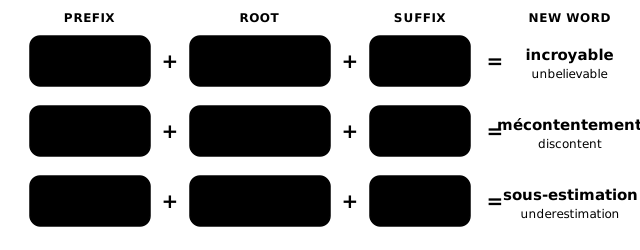
French words are built like Lego: a root, with a prefix in front and a suffix behind. Learn twenty building blocks and one new word gives you five: décider, la décision, décisif, l’indécision, indécis. The second half of the chapter hands you 40 C1 words — enjeu, démarche, s’avérer, néanmoins — that make an essay or a debate sound truly advanced.
- 1How a French word is assembled
- 2Prefixes: changing the meaning
- 3Suffixes: changing the word class
- 4Word families
- 5Compound nouns and their plurals
- 640 C1 words — nouns and verbs
- 740 C1 words — connectors, phrases and adjectives
- 8In real life: a C1 paragraph
masculinefeminine
In one line
prefix + root + suffix: the prefix changes the meaning (in- = not), the suffix usually changes the word class (-tion makes a noun) — and often tells you the gender.
49.1 How a French word is assembled
Most long French words can be taken apart. When you meet mécontentement, do not panic: mé- (badly) + content (happy) + -ement (noun) = "discontent". Reading this way lets you guess meanings in newspapers and exams, and build words you have never seen.
49.2 Prefixes: changing the meaning
A prefix sits in front of the root and changes its meaning. The word class usually stays the same: faire → refaire is still a verb.
| Prefix | Meaning | Examples |
|---|---|---|
| in- / im- / il- / ir- | not | inutile, inconnu, impossible, illégal, irrégulier |
| dé- / dés- | undo, opposite | défaire, démonter, désagréable, déshabiller |
| re- / ré- / r- | again, back | refaire, relire, réécrire, rentrer, rouvrir |
| pré- | before | prévoir, la préhistoire, un préavis |
| sur- | over, too much | surestimer, surpeuplé, une surcharge |
| sous- | under, too little | sous-estimer, un sous-titre, le sous-sol |
| anti- | against | un antivol, un antidouleur, antisocial |
| contre- | counter, against | contredire, une contre-attaque, un contresens |
| mal- / mé- / més- | badly | malheureux, maladroit, mécontent, une mésaventure |
in- changes shape
im- before p, b, m (impossible, imbuvable, immobile) · il- before l (illégal) · ir- before r (irrégulier) · in- everywhere else (inutile, inactif).
- Ce stationnement est illégal. — This parking is illegal.
- Je rentre à la maison vers vingt heures. — I get back home around 8 pm.
- Il ne faut pas sous-estimer ce problème. — This problem must not be underestimated.
Careful
- Wrong: C’est inpossible.
- Right: C’est impossible.
- Why: Before p, b and m, in- becomes im- — exactly as in English. Same with imbuvable (undrinkable).
49.3 Suffixes: changing the word class
A suffix comes at the end. It turns a verb into a noun, a noun into an adjective, a person into a job — and it is your best clue to a noun’s gender.
| Suffix | Makes | Examples |
|---|---|---|
| -age (m.) | action noun | nettoyer → le nettoyage · laver → le lavage |
| -ment (m.) | action/result noun | changer → le changement · développer → le développement |
| -tion / -ation (f.) | action noun | créer → la création · organiser → l’organisation |
| -ité (f.) | quality noun | rapide → la rapidité · curieux → la curiosité |
| -isme (m.) / -iste | idea / follower | le tourisme, un·e touriste · le réalisme, réaliste |
| -eur / -euse | agent (person) | vendre → un vendeur, une vendeuse |
| -teur / -trice | agent (person) | un acteur, une actrice · un directeur, une directrice |
| -able / -ible | "can be …" | faire → faisable · lire → lisible · boire → buvable |
| -ette (f.) | small (diminutive) | une maisonnette, une fillette, une camionnette |
| -ier / -ière | job · tree · container | un pâtissier, une épicière · un pommier, un cerisier · une théière |
| -aine (f.) | "about" a number | une dizaine, une quinzaine, une vingtaine, une centaine |
- Le nettoyage de l’appartement a pris trois heures. — Cleaning the flat took three hours.
- Il y a un cerisier dans le jardin. — There’s a cherry tree in the garden. (une cerise → un cerisier)
- Une vingtaine d’étudiants sont venus. — About twenty students came.
Suffix = gender clue
Masculine: -age, -ment, -isme, -ier. Feminine: -tion, -ité, -ette, -ure, -ance/-ence. The full list and its exceptions (la plage, la page, l’image…) are in Nouns, gender & plurals.
-aine is approximate — except one
une dizaine = about ten, une centaine = about a hundred. But une douzaine = exactly twelve (a dozen: une douzaine d’œufs), and "about a thousand" is masculine: un millier.
49.4 Word families
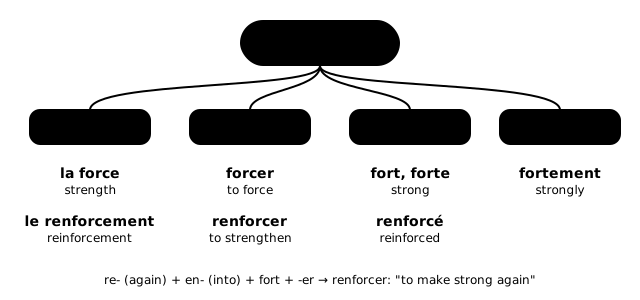
Every useful root has a family: a verb, a noun, an adjective, often an adverb. Learning the family together is the fastest way to grow from B1 to C1 — and it lets you rephrase, which examiners love (on a décidé… → cette décision…).
| Verb | Noun | Adjective |
|---|---|---|
| décider | la décision | décisif, décisive |
| choisir | le choix | choisi |
| vendre | la vente · le vendeur | vendu |
| nourrir | la nourriture | nourrissant |
| produire | la production · le produit | productif |
| croître | la croissance | croissant |
| réussir | la réussite | réussi |
| agir | l’action | actif, active |
- Cette décision a été décisive pour l’économie. — This decision was decisive for the economy.
-ant (it causes) vs -é (you feel it)
Many families have two adjectives from the same verb: the -ant one describes the cause, the -é one describes the person who feels it — like English interesting / interested.
Careful
- Wrong: Je suis très dérangeant par ce bruit.
- Right: Ce bruit me dérange beaucoup. / C’est un bruit dérangeant.
- Why: Dérangeant = disturbing (the noise). For yourself, use the verb: ça me dérange. Careful: je suis dérangé can mean "I am mentally unbalanced"! Same pattern: un poste intéressant but je suis intéressé.
49.5 Compound nouns and their plurals
French often joins words with de, à or a hyphen instead of stacking them like English ("bathroom", "rainbow"). The meaning is often not literal: une pomme de terre is an "apple of the earth" — a potato.
| Pattern | Singular → plural | Rule |
|---|---|---|
| noun + de/à + noun | une pomme de terre → des pommes de terre une salle de bains → des salles de bains un chef-d’œuvre → des chefs-d’œuvre un arc-en-ciel → des arcs-en-ciel |
Only the first noun takes -s. |
| adjective + noun / noun + adjective | un grand-père → des grands-pères un coffre-fort → des coffres-forts |
Both words agree. |
| verb + noun | un tire-bouchon → des tire-bouchons un porte-monnaie → des porte-monnaies (1990) / des porte-monnaie (traditional) |
The verb never changes; the noun takes -s. |
- J’ai acheté un kilo de pommes de terre. — I bought a kilo of potatoes.
- Après la pluie, on a vu deux arcs-en-ciel. — After the rain, we saw two rainbows.
- Le Louvre est plein de chefs-d’œuvre. — The Louvre is full of masterpieces.
Careful
- Wrong: des pomme de terres
- Right: des pommes de terre
- Why: Think "apples of the earth": many apples, one earth. Only the head noun goes plural.
49.6 40 C1 words — nouns and verbs
These words appear in every French newspaper, report and DALF exam. Learn each one inside its example, with its little words (nuire à, s’inscrire dans).
Nouns (1–11)
- un enjeu — Le climat est l’un des grands enjeux du siècle. — what is at stake, a key issue — Climate is one of the great issues of the century.
- une démarche — J’ai commencé les démarches pour obtenir un visa. — a step, a procedure, an approach — I’ve started the procedures to get a visa.
- un atout — Parler trois langues est un véritable atout. — an asset, a trump card — Speaking three languages is a real asset.
- un défi — Apprendre le français à quarante ans, c’est un beau défi. — a challenge — Learning French at forty is quite a challenge.
- un essor — Le télétravail a connu un essor considérable. — a boom, rapid growth — Remote work has boomed.
- une lacune — J’ai encore des lacunes en grammaire. — a gap (in knowledge) — I still have gaps in grammar.
- un bilan — Faisons le bilan de l’année. — an assessment, a review — Let’s take stock of the year.
- une mise en œuvre — La mise en œuvre de la réforme prendra deux ans. — implementation — Implementing the reform will take two years.
- le recul — Avec le recul, c’était la bonne décision. — hindsight, distance; also a decline (un recul du chômage) — With hindsight, it was the right decision.
- une hausse / une baisse — On observe une hausse des prix et une baisse des salaires. — a rise / a fall — We see a rise in prices and a fall in wages.
- un clivage — Ce débat révèle un clivage entre les villes et les campagnes. — a divide, a split — This debate reveals a divide between towns and the countryside.
Verbs (12–25)
- s’avérer — Cette solution s’est avérée efficace. — to turn out (to be) — This solution turned out to be effective.
- susciter — Cette décision a suscité de vives critiques. — to arouse, to give rise to — This decision sparked strong criticism.
- aborder — Nous aborderons ce problème dans la deuxième partie. — to tackle, to address (a topic) — We will address this problem in the second part.
- souligner — Le rapport souligne l’importance de l’éducation. — to stress, to underline — The report stresses the importance of education.
- mettre en évidence — L’étude met en évidence un lien entre sommeil et réussite. — to highlight, to reveal — The study reveals a link between sleep and success.
- remettre en question — Il faut parfois remettre en question ses certitudes. — to question, to challenge — Sometimes you have to question your certainties.
- constater — On constate que les jeunes lisent moins la presse. — to note, to observe — We note that young people read the press less.
- entraîner — Le manque de sommeil peut entraîner des problèmes de santé. — to lead to, to cause (also: to train) — Lack of sleep can cause health problems.
- favoriser — Le sport favorise la concentration. — to encourage, to foster — Sport helps concentration.
- freiner — La hausse des prix freine la consommation. — to slow down, to hold back — Rising prices are holding back spending.
- nuire à — Le tabac nuit gravement à la santé. — to harm — Tobacco seriously harms your health.
- pallier — Pour pallier le manque de médecins, la région recrute. — to make up for, to compensate — To make up for the shortage of doctors, the region is recruiting.
- relever un défi — Notre équipe a relevé le défi. — to take up / meet a challenge — Our team rose to the challenge.
- s’inscrire dans — Cette mesure s’inscrit dans une politique plus large. — to be part of, to fit into — This measure is part of a broader policy.
49.7 40 C1 words — connectors, phrases and adjectives
The basic linkers (donc, pourtant, cependant) are in Linking words. These are the next step up.
Connectors and fixed phrases (26–36)
- néanmoins — Le projet est coûteux ; néanmoins, il est nécessaire. — nevertheless — The project is expensive; nevertheless, it is necessary.
- en revanche — Paris est cher ; en revanche, Lille est plus abordable. — on the other hand — Paris is expensive; Lille, on the other hand, is more affordable.
- il s’agit de — Dans ce roman, il s’agit d’une famille pendant la guerre. — it is about / it is a matter of — This novel is about a family during the war.
- dans la mesure où — Ce choix est logique dans la mesure où il réduit les coûts. — insofar as, since — This choice is logical insofar as it reduces costs.
- à l’égard de — Il est très exigeant à l’égard de ses élèves. — towards, with regard to — He is very demanding towards his pupils.
- désormais — Désormais, les billets s’achètent en ligne. — from now on — From now on, tickets are bought online.
- d’emblée — Précisons d’emblée que le sujet est complexe. — straight away, from the outset — Let us say from the outset that the subject is complex.
- notamment — Plusieurs pays, notamment l’Inde et le Brésil, ont signé l’accord. — notably, in particular — Several countries, notably India and Brazil, signed the agreement.
- voire — La réforme prendra des mois, voire des années. — or even — The reform will take months, or even years.
- ainsi — Ainsi, la ville a réduit sa pollution de vingt pour cent. — thus, in this way — In this way, the city cut its pollution by twenty per cent.
- en outre — Ce logement est bien situé ; en outre, il est peu cher. — moreover, in addition — This flat is well located; moreover, it is cheap.
Adjectives (37–40)
- primordial — Le sommeil joue un rôle primordial dans l’apprentissage. — essential, crucial — Sleep plays a crucial role in learning.
- pertinent — Votre remarque est très pertinente. — relevant, apt — Your remark is very relevant.
- épanouissant — Enseigner est un métier épanouissant. — fulfilling — Teaching is a fulfilling job.
- inéluctable — Ce changement semble inéluctable. — inevitable, unavoidable — This change seems inevitable.
Learn C1 words in pairs
Pair each word with its partner: relever un défi, susciter des critiques, connaître un essor, combler une lacune, faire le bilan, nuire à la santé.
Traps with advanced words
- Wrong: Ce livre s’agit d’une famille pendant la guerre.
- Right: Dans ce livre, il s’agit d’une famille… / Ce livre parle d’une famille…
-
Why: S’agir de is impersonal: its only subject is il. Put the topic in a phrase (dans ce livre), or use parler de / traiter de.
-
Wrong: Pour pallier au manque de médecins…
- Right: Pour pallier le manque de médecins…
-
Why: The traditional norm says pallier qqch (direct object). Pallier à is very common and now tolerated by some dictionaries, but examiners may mark it — write pallier le / la, or remédier à.
-
Wrong: (in a DALF essay) Par contre, les zones rurales manquent de services.
- Right: En revanche, les zones rurales manquent de services.
-
Why: Par contre is correct and normal in speech, but purists criticise it in careful writing. In an essay, en revanche is the safe, elegant choice.
-
Wrong: Il faut reécrire ce paragraphe.
- Right: Il faut réécrire ce paragraphe.
- Why: Before a vowel, re- becomes ré- (or r-): réécrire, réorganiser, rouvrir, rentrer. Some have lost the "again" idea: rentrer mostly means "to go home".
49.8 In real life: a C1 paragraph
Here is a short paragraph of the kind you write in a DALF essay or say in a presentation. Count the words from this chapter.
- Le télétravail a connu un essor considérable depuis 2020. — Remote work has grown enormously since 2020.
- Il s’agit d’un enjeu majeur pour les entreprises : il favorise l’autonomie des salariés ; en revanche, il peut nuire à la cohésion des équipes. — It is a major issue for companies: it encourages employees’ autonomy; on the other hand, it can harm team cohesion.
- Néanmoins, ce mode de travail s’est avéré efficace, voire indispensable, pendant la crise. — Nevertheless, this way of working turned out to be effective, even essential, during the crisis.
- Désormais, il est primordial d’en faire le bilan et de combler ses lacunes. — From now on, it is essential to assess it and to fill its gaps.
À retenir
- prefix + root + suffix: the prefix changes the meaning (in- = not), the suffix usually changes the word class (-tion makes a noun) — and often tells you the gender.
- im- before p, b, m (impossible, imbuvable, immobile) · il- before l (illégal) · ir- before r (irrégulier) · in- everywhere else (inutile, inactif).
- Masculine: -age, -ment, -isme, -ier. Feminine: -tion, -ité, -ette, -ure, -ance/-ence. The full list and its exceptions (la plage, la page, l’image…) are in Nouns, gender & plurals.
- Pair each word with its partner: relever un défi, susciter des critiques, connaître un essor, combler une lacune, faire le bilan, nuire à la santé.
- Now make sure you spell these new words correctly: Spelling & punctuation covers the homophones (a/à, ou/où), the -é / -er trap and French punctuation spacing.
49.9 Practice — Word building
Exercise 1
The opposite of 'légal' is…
- inlégal
- illégal
- imlégal
- délégal
Hint: in- changes before l
Answer
illégal
in- becomes il- before l: illégal.
Exercise 2
'une dizaine de personnes' means…
- exactly ten people
- about ten people
- ten times more people
- a tenth of the people
Answer
about ten people
-aine with a number = approximately: une dizaine, une vingtaine.
Exercise 3
The opposite of 'agréable': ___
Hint: undo prefix before a vowel
Answer
désagréable
dés- before a vowel: désagréable.
Exercise 4
nettoyer → le ___ (the cleaning)
Hint: masculine action suffix -age
Answer
nettoyage
-age makes a masculine action noun: le nettoyage.
Exercise 5
Cette solution s'est ___ efficace. (turned out)
Hint: s'avérer, passé composé, feminine subject
Answer
avérée
s'avérer takes être; the participle agrees with solution: avérée.
Exercise 6
La réforme prendra des mois, ___ des années. (or even)
Hint: five letters, starts with v
Answer
voire
voire = or even, adds a stronger point.
Exercise 7
Match the C1 noun to its meaning.
| A | B |
|---|---|
| un enjeu | a gap |
| un atout | a boom |
| une lacune | an assessment |
| un essor | what is at stake |
| un bilan | an asset |
Answer
un enjeu — what is at stake; un atout — an asset; une lacune — a gap; un essor — a boom; un bilan — an assessment
These five nouns appear in almost every DALF text.
Exercise 8
Match the verb to its noun.
| A | B |
|---|---|
| décider | la vente |
| choisir | la nourriture |
| vendre | la décision |
| nourrir | le choix |
Answer
décider — la décision; choisir — le choix; vendre — la vente; nourrir — la nourriture
Word families: learn verb and noun together.
Exercise 9
Tap the wrong word.
Ce livre s'agit d'une famille pendant la guerre.
Answer
Wrong word: s'agit.
Corrected: Dans ce livre, il s'agit d'une famille pendant la guerre.
s'agir de only takes the subject il.
Exercise 10
Tap the misspelled word.
C'est inpossible de finir ce soir.
Answer
Wrong word: inpossible.
Corrected: C'est impossible de finir ce soir.
in- becomes im- before p: impossible.
Exercise 11
Tap the word with the wrong plural.
J'ai acheté des pomme de terre.
Answer
Wrong word: pomme.
Corrected: J'ai acheté des pommes de terre.
In noun + de + noun, the first noun takes -s.
Exercise 12
The plural of 'un arc-en-ciel' is…
- des arc-en-ciels
- des arcs-en-ciel
- des arcs-en-ciels
- des arc-en-ciel
Answer
des arcs-en-ciel
Only the first noun goes plural: many arcs, one sky.
Exercise 13
Best choice in a formal essay: '___, les zones rurales manquent de services.'
- Par contre
- En revanche
- Mais bon
- Sinon
Answer
En revanche
en revanche is the careful written choice; par contre is more spoken.
Exercise 14
According to the traditional norm, which is correct?
- pallier à un manque
- pallier un manque
- pallier de un manque
- pallier sur un manque
Answer
pallier un manque
pallier takes a direct object: pallier le manque.
Exercise 15
The tree that gives cherries (cerises) is…
- le cerisier
- la cerisette
- le cerisage
- la cerisaine
Answer
le cerisier
-ier names fruit trees: pommier, poirier, cerisier.
Exercise 16
Put the words in order.
Words: s'inscrit / Cette / politique / large / une / dans / mesure / plus
Answer
Cette mesure s'inscrit dans une politique plus large
s'inscrire dans = to be part of.
Exercise 17
Put the words in order.
Words: sport / favorise / la / concentration / Le
Answer
Le sport favorise la concentration
favoriser + direct object = to foster.
Exercise 18
Say it aloud.
Il s'agit d'un enjeu majeur pour notre société
Answer
Say: Il s'agit d'un enjeu majeur pour notre société
il s'agit de + noun: impersonal il.
Exercise 19
Say it aloud.
Notre équipe a relevé le défi
Answer
Say: Notre équipe a relevé le défi
relever un défi = to rise to a challenge.
Next step
Now make sure you spell these new words correctly: Spelling & punctuation covers the homophones (a/à, ou/où), the -é / -er trap and French punctuation spacing.