Chapter 50: Spelling & punctuation
Orthographe et ponctuation
French is full of words that sound the same but are spelled differently: a / à, et / est, son / sont, ces / ses / c’est / s’est. Even French people mix them up — and readers notice instantly. The good news: each pair has a quick substitution test. This chapter gives you those tests, the -é / -er rule, French capital letters, and the French way of spacing punctuation.
- 1Homophones I: a/à, ou/où, et/est, son/sont, on/ont
- 2Homophones II: ces/ses/c’est/s’est, ce/se, la/là/l’a…
- 3-é, -er or -ez? The vendre / vendu test
- 4Capital letters: fewer than in English
- 5Punctuation and spacing, the French way
- 6Quotes, dialogue, apostrophes and capital accents
- 7The 1990 spelling reform
- 8In real life: proofread an email
The master trick
When two spellings sound the same, swap in another word (avait, était, vendu…). If the swap still makes sense, you have found the right spelling.
50.1 Homophones I: a/à, ou/où, et/est, son/sont, on/ont
Most homophone pairs are a verb (avoir or être) against a small grammar word. So the test is always the same: put the verb in the imperfect (avait, était, avaient, étaient). If the sentence still works, write the verb.
| Pair | What each one is | Test |
|---|---|---|
| a / à | a = verb avoir · à = preposition (to, at) | Say avait → a |
| ou / où | ou = or · où = where / when | Say ou bien → ou |
| et / est | et = and · est = verb être | Say était → est; et puis → et |
| son / sont | son = his / her · sont = verb être | Say étaient → sont; mon → son |
| on / ont | on = pronoun · ont = verb avoir | Say avaient → ont; il → on |
- Elle a un rendez-vous à midi. — She has an appointment at noon. (Elle avait un rendez-vous ✓ — but not "avait midi")
- Tu préfères la mer ou la montagne ? — Do you prefer the sea or the mountains? (ou bien ✓)
- Où habites-tu ? — Le jour où je suis arrivé… — Where do you live? — The day (when) I arrived… (où = place or time)
- Paul est grand et sportif. — Paul is tall and sporty. (Paul était grand et puis sportif)
- Ses parents sont venus avec son frère. — His parents came with his brother. (étaient venus ✓ · avec mon frère ✓)
- On pense qu’ils ont raison. — We think they are right. (il pense ✓ · ils avaient raison ✓)
The classic slips
- Wrong: Je vais a Marseille demain.
- Right: Je vais à Marseille demain.
-
Why: "Je vais avait Marseille" makes no sense, so it is the preposition à, with its accent.
-
Wrong: Mes amis son en retard est fatigués.
- Right: Mes amis sont en retard et fatigués.
- Why: Mes amis étaient en retard ✓ → sont. "En retard était fatigués" ✗ → it is et (and).
50.2 Homophones II: ces/ses/c’est/s’est, ce/se, la/là/l’a…
| Spelling | What it is | Test |
|---|---|---|
| ces | these / those (+ plural noun) | Singular: ce, cette livre / maison |
| ses | his / her (+ plural noun) | Swap with mes |
| c’est | it is / this is | Swap with c’était |
| s’est | reflexive verb, past (il s’est…) | Swap with je me suis |
| ce / se | ce = this, it · se = himself / herself (+ verb) | Swap se with me |
| la / là / l’a | the / her · there · has … it | le → la · ici → là · l’avait → l’a |
| quel(le) / qu’elle | which, what · que + elle | Swap with qu’il → qu’elle |
| peu / peux / peut | little · I/you can · he/she can | peu ↔ beaucoup; peux ↔ pouvais; peut ↔ pouvait |
- Ces chaussures sont à toi ? — Non, ce sont ses chaussures. — Are these shoes yours? — No, they are his/her shoes. (mes chaussures ✓)
- C’est vrai : il s’est levé à cinq heures. — It’s true: he got up at five. (c’était vrai ✓ · je me suis levé ✓)
- Ce matin, elle se prépare vite. — This morning she gets ready quickly. (je me prépare ✓)
- La clé ? Il l’a posée là, sur la table. — The key? He put it there, on the table. (il l’avait posée ✓ · ici ✓ · le bureau ✓)
- Quelle surprise ! Je croyais qu’elle était à Rome. — What a surprise! I thought she was in Rome. (qu’il était ✓)
- Je peux t’aider, mais il peut rester un peu. — I can help you, but he can stay a little.
Careful
- Wrong: Elle c’est trompée de train.
- Right: Elle s’est trompée de train.
- Why: "Je me suis trompée" works → reflexive s’est. C’est is followed by a noun or adjective (c’est mon train), not by a past participle. Agreement (trompée) is explained in The past: passé composé.
50.3 -é, -er or -ez? The vendre / vendu test
Parlé, parler, parlez all sound [par-LAY]. This is the most frequent spelling error in French schools. The fix is a test with a verb that sounds different in its two forms: vendre (infinitive) and vendu (past participle). You can also use prendre / pris or mordre / mordu.
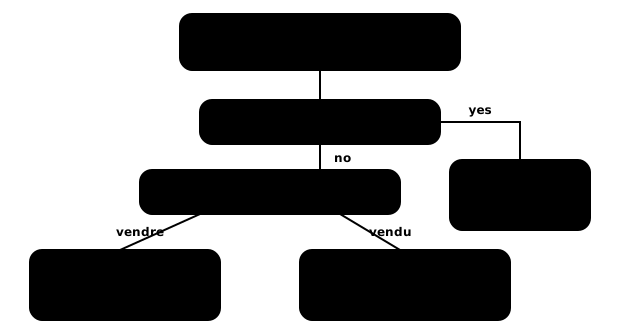
The vendre / vendu test
If vendre fits → write -er (infinitive). If vendu fits → write -é (past participle). With vous → -ez.
- Hier, j’ai mangé une crêpe. — Yesterday I ate a crêpe. (j’ai vendu ✓ → -é)
- Je vais manger une crêpe. — I’m going to eat a crêpe. (je vais vendre ✓ → -er)
- Vous mangez avec nous ? — Are you eating with us? (vous → -ez)
- Il faut appeler le médecin. — We must call the doctor. (il faut vendre ✓ → -er)
- Elles sont arrivées sans nous prévenir. — They arrived without warning us. (sont venues → -ées · sans vendre → infinitive)
Shortcut: after a preposition, infinitive
After à, de, pour, sans, avant de and after most verbs (je veux, il faut, on peut), the verb is in the infinitive -er: pour travailler, sans parler.
Careful
- Wrong: J’ai travailler toute la journée.
- Right: J’ai travaillé toute la journée.
- Why: "J’ai vendu" ✓, "j’ai vendre" ✗ → past participle -é. After avoir or être in a compound tense, it is never -er.
The same sound also hides the imperfect -ais, -ait, -aient (je parlais). Test with vendais / vendait: if it fits, write the imperfect ending.
50.4 Capital letters: fewer than in English
French uses capitals much less than English. The trap for English and Indian learners is nationality and language words: English writes "French" everywhere; French splits it.
| lowercase | Capital |
|---|---|
| days, months, seasons: lundi, janvier, l’été | holidays: Noël, Pâques, Diwali |
| languages: le français, l’hindi, l’anglais | countries, cities: la France, l’Inde, Paris |
| nationality adjectives: un livre français, une actrice indienne | nationality nouns (people): les Français, un Indien, une Indienne |
| the pronoun je (unlike English "I") | start of a sentence; names; l’État |
| religions: le christianisme, l’hindouisme | the opening of a letter: Madame, Monsieur, |
- Les Français adorent la cuisine indienne. — The French love Indian food. (people = capital; adjective = lowercase)
- Je parle français, anglais et hindi. — I speak French, English and Hindi. (languages = lowercase)
- Mon cousin est un Indien qui vit à Lyon. — My cousin is an Indian (man) who lives in Lyon.
- Le cours commence lundi 3 septembre. — The course starts on Monday 3 September.
Capital-letter slips
- Wrong: J’apprends le Français depuis Janvier.
- Right: J’apprends le français depuis janvier.
-
Why: Languages and months are lowercase in French.
-
Wrong: Les indiens et les français aiment le cinéma Italien.
- Right: Les Indiens et les Français aiment le cinéma italien.
- Why: Nouns for people take a capital (les Indiens); adjectives do not (le cinéma italien).
50.5 Punctuation and spacing, the French way
In France, the "tall" punctuation marks — ! ? : ; — take a space before them, and « guillemets » have a space inside. The "low" marks — . and , — stick to the word, as in English. On a computer, use a non-breaking space so the ? never jumps alone onto the next line.
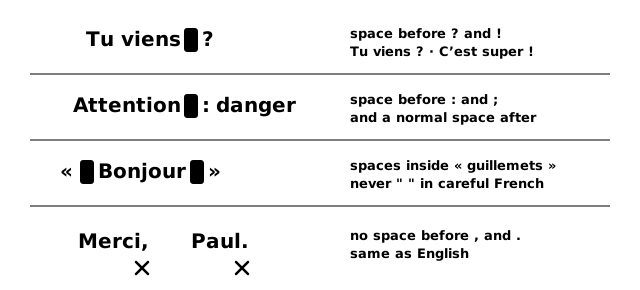
Two-part marks get a space
Space before ; : ! ? and inside « ». No space before . , and none after an apostrophe (l’ami).
- Quelle belle journée ! On va à la plage ? — What a beautiful day! Shall we go to the beach?
- Il faut trois choses : du temps, de l’argent et de la patience. — You need three things: time, money and patience.
- Le prix a augmenté de 20 % : il coûte 12,50 €. — The price rose by 20%: it costs €12.50. (space before %, decimal comma, € after the number)
50.6 Quotes, dialogue, apostrophes and capital accents
Guillemets and the dialogue dash
French quotes with « guillemets ». In novels, a dialogue often opens with «, and each change of speaker starts a new line with a dash (—), without new quotation marks. Short "he said" clauses (dit-il, demanda Marie) use inversion and stay inside.
- Le panneau dit : « Défense de fumer ». — The sign says: "No smoking".
- « Tu viens ce soir ? demande Paul. — "Are you coming tonight?" asks Paul.
- — Non, je suis trop fatiguée. — "No, I’m too tired." (new speaker → dash)
- — Dommage ! » — "What a pity!" (» closes the whole exchange)
The apostrophe in writing
Before a vowel or a silent h, small words drop their vowel and take an apostrophe — with no space after it: le → l’, je → j’, de → d’, que → qu’, ne → n’, me/te/se → m’/t’/s’. Two special cases in writing: si becomes s’ only before il / ils (s’il pleut, but si elle vient), and an h aspiré blocks it (le héros, la honte). How this sounds is in Silent letters & liaison.
- S’il fait beau, j’irai à l’hôpital à pied ; si elle veut, elle m’accompagnera. — If the weather is nice, I’ll walk to the hospital; if she wants, she’ll come with me.
Accents on capital letters
Accents are not optional on capitals, even if many people skip them when typing. Dictionaries, publishers and the Académie française all keep them: they can change the meaning (INTERNE vs INTERNÉ). Long-press E or A on a phone keyboard to get É, È, À. What each accent does is in Alphabet & accents.
- À bientôt ! Écris-moi. — See you soon! Write to me.
- L’État finance les écoles publiques. — The State funds public schools. (l’État = the nation-state; un état = a condition)
Careful
- Wrong: A Paris, il fait froid!
- Right: À Paris, il fait froid !
- Why: The preposition keeps its accent on a capital (À), and the ! takes a space before it.
50.7 The 1990 spelling reform
In 1990 the Conseil supérieur de la langue française published the rectifications orthographiques: small changes to make spelling more regular. French schools have used them in textbooks since 2016, but the old spellings are still correct. In DELF, DALF and French schools, both are accepted — just be consistent.
| Change | Traditional | 1990 spelling |
|---|---|---|
| No circumflex on i and u | paraître, connaître, coût, il plaît | paraitre, connaitre, cout, il plait |
| …except where it changes the meaning | dû (du), mûr (mur), sûr (sur), jeûne (jeune) — and verb endings like nous fûmes keep it | |
| Hyphens in all compound numbers | vingt et un, deux cent trois | vingt-et-un, deux-cent-trois |
| Odd spellings regularised | oignon, nénuphar | ognon, nénufar |
| è where you hear [è] | événement, je céderai | évènement, je cèderai |
| Regular plural of compounds | des après-midi, des porte-monnaie | des après-midis, des porte-monnaies |
- Ce livre va paraître / paraitre en mai. — This book will come out in May. (both spellings correct)
- Tu es sûr ? Le livre est sur la table. — Are you sure? The book is on the table. (sûr keeps its accent in all spellings)
- J’ai vingt-et-un ans. — I’m twenty-one. (traditional: vingt et un)
Which spelling should you learn?
Learn the traditional forms to read older books and the press; use either in your own writing. Never mix both in the same text.
50.8 In real life: proofread an email
A learner wrote this message to a French host family. It contains nine typical errors from this chapter. Read the corrected version and spot each fix.
Careful
- Wrong: Bonjour! Je suis arrivé a Paris Lundi. Ma sœur et mon frère son venu me chercher a la gare, et ont a mangé ensemble. C’est amis sont très gentil.
- Right: Bonjour ! Je suis arrivé à Paris lundi. Ma sœur et mon frère sont venus me chercher à la gare, et on a mangé ensemble. Ses amis sont très gentils.
- Why: Space before ! · à Paris, à la gare (not "avait") · lundi lowercase · sont (étaient) + venus agreement · on a mangé (il a mangé ✓) · Ses amis (mes amis ✓) · gentils plural.
- Je suis arrivé à Paris lundi. — I arrived in Paris on Monday.
- Ma sœur et mon frère sont venus me chercher à la gare. — My sister and my brother came to pick me up at the station.
- Ses amis sont très gentils. — His/her friends are very kind.
A 30-second proofreading routine
Before sending: (1) test every a, et, son, on, ces; (2) test every [é] ending with vendre/vendu; (3) check capitals; (4) add the space before ! ? : ;.
À retenir
- When two spellings sound the same, swap in another word (avait, était, vendu…). If the swap still makes sense, you have found the right spelling.
- If vendre fits → write -er (infinitive). If vendu fits → write -é (past participle). With vous → -ez.
- After à, de, pour, sans, avant de and after most verbs (je veux, il faut, on peut), the verb is in the infinitive -er: pour travailler, sans parler.
- Space before ; : ! ? and inside « ». No space before . , and none after an apostrophe (l’ami).
- Learn the traditional forms to read older books and the press; use either in your own writing. Never mix both in the same text.
- Before sending: (1) test every a, et, son, on, ces; (2) test every [é] ending with vendre/vendu; (3) check capitals; (4) add the space before ! ? : ;.
50.9 Practice — Spelling & punctuation
Exercise 1
Il va ___ Paris demain.
- a
- à
- as
- ah
Hint: Can you say 'avait'?
Answer
à
'Il va avait Paris' makes no sense → preposition à.
Exercise 2
Tu veux du thé ___ du café ?
- ou
- où
- ont
Hint: or, or where?
Answer
ou
ou bien works → ou = or.
Exercise 3
Mes parents ___ partis hier. (son / sont)
Hint: Try 'étaient'.
Answer
sont
Mes parents étaient partis ✓ → sont.
Exercise 4
Hier, nous avons ___ (manger) au restaurant.
Hint: vendre or vendu?
Answer
mangé
nous avons vendu ✓ → past participle mangé.
Exercise 5
Je vais ___ (manger) avec Léa.
Hint: vendre or vendu?
Answer
manger
je vais vendre ✓ → infinitive manger.
Exercise 6
Vous ___ (parler) très bien français !
Hint: subject vous
Answer
parlez
vous → -ez: vous parlez.
Exercise 7
Je pense ___ viendra demain. (quelle / qu'elle)
Hint: Try 'qu'il'.
Answer
qu'elle / qu’elle
Je pense qu'il viendra ✓ → que + elle = qu'elle.
Exercise 8
Tap the wrong word.
Il habite a Lyon depuis deux ans.
Answer
Wrong word: a.
Corrected: Il habite à Lyon depuis deux ans.
'Il habite avait Lyon' ✗ → preposition à.
Exercise 9
Tap the word with the wrong capital.
Je parle Français et hindi.
Answer
Wrong word: Français.
Corrected: Je parle français et hindi.
Languages are lowercase in French.
Exercise 10
Tap the wrong word.
Ils on un chat noir.
Answer
Wrong word: on.
Corrected: Ils ont un chat noir.
Ils avaient un chat ✓ → ont (avoir).
Exercise 11
Tap the wrong word.
Il ces levé à six heures.
Answer
Wrong word: ces.
Corrected: Il s'est levé à six heures.
Je me suis levé ✓ → reflexive s'est.
Exercise 12
Which is punctuated the French (France) way?
- Tu viens ?
- Tu viens?
- Tu viens ,?
Answer
Tu viens ?
A space goes before ? ! : ; in France.
Exercise 13
Which sentence has correct capitals?
- Les Français aiment le fromage français.
- Les français aiment le fromage Français.
- Les Français aiment le Fromage Français.
- les français aiment le fromage français.
Answer
Les Français aiment le fromage français.
People: capital (les Français); adjective: lowercase (français).
Exercise 14
Match each word to its substitution test.
| A | B |
|---|---|
| a | étaient |
| est | avaient |
| sont | pouvait |
| ont | avait |
| peut | était |
Answer
a — avait; est — était; sont — étaient; ont — avaient; peut — pouvait
Verbs can be put in the imperfect; the little grammar words cannot.
Exercise 15
Under the 1990 reform, which is NOT accepted?
- paraitre
- cout
- sur (for sûr = certain)
- ognon
Answer
sur (for sûr = certain)
sûr keeps its circumflex: it distinguishes it from sur (on).
Exercise 16
Put the words in order.
Words: ce / Elle / s'est / levée / tôt / matin
Answer
Elle s'est levée tôt ce matin
s'est = reflexive past (je me suis levée).
Exercise 17
Put the words in order.
Words: Je / gare / vais / lundi / à / la
Answer
Je vais à la gare lundi
à with an accent; lundi in lowercase.
Exercise 18
Say it aloud.
Il a mangé à la maison
Answer
Say: Il a mangé à la maison
a (avait) and à (preposition) sound the same — only spelling shows the difference.
Exercise 19
Say it aloud.
Ses amis sont arrivés à Paris
Answer
Say: Ses amis sont arrivés à Paris
ses / sont / arrivés: three homophone traps in one sentence.
Next step
Put clean spelling to work: Messages, letters & emails shows how to write texts, formal letters and emails — from Salut ! to Veuillez agréer…