Chapter 15: Adverbs
Les adverbes
An adjective describes a thing; an adverb describes an action or a quality: how, when, where, how much, how often. Most French adverbs end in -ment, like English “-ly”. The good news: adverbs never agree. The tricky part: where they go — often not where English puts them.
- 1What an adverb does
- 2Making -ment adverbs
- 3The irregulars, and adverbs that are not -ment
- 4Bien or bon? Mal or mauvais? Mieux or meilleur?
- 5Where the adverb goes
- 6The everyday adverbs: time, place, quantity, frequency
- 7Tout as an adverb: “completely, very”
- 8Mistakes learners really make
- 9In real life — how was the weekend?
masculinefeminineplural
In one line
An adverb tells you how, when, where, how much or how often. It never changes its ending, and in a simple tense it comes right after the verb: Il parle bien.
15.1 What an adverb does
An adverb can describe a verb (she drives carefully), an adjective (very tired), another adverb (too slowly) or a whole sentence (luckily, it stopped raining). Hindi does the same job with words like dheere, bahut, kabhi-kabhi, or with se: dhyaan se = carefully.
- Elle conduit prudemment. — She drives carefully. (describes the verb) [prew-da-MÃ]
- Je suis très fatigué. — I am very tired. (describes the adjective) [treh fa-tee-GAY]
- Tu parles trop vite. — You speak too fast. (trop describes vite) [troh VEET]
- Heureusement, il ne pleut plus. — Luckily, it isn’t raining any more. (describes the whole sentence) [uh-ruhz-MÃ]
Adverbs never agree
Unlike adjectives, adverbs have one form only: il parle lentement, elles parlent lentement. No -e, no -s.
15.2 Making -ment adverbs
English adds -ly to an adjective: slow → slowly. French adds -ment — but to the feminine form of the adjective. Only three questions decide the spelling:
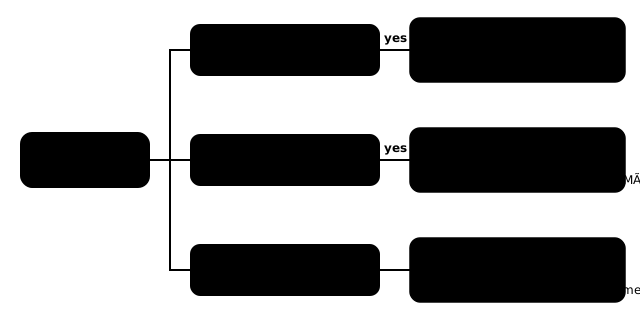
The usual case: feminine + -ment
| Masculine | Feminine | Adverb |
|---|---|---|
| lent (slow) | lente | lentement |
| heureux (happy) | heureuse | heureusement (luckily) |
| doux (gentle) | douce | doucement |
| sérieux | sérieuse | sérieusement |
| complet | complète | complètement |
| franc (frank) | franche | franchement |
| actif · léger | active · légère | activement · légèrement |
| facile · rapide | facile · rapide | facilement · rapidement |
- Parlez plus lentement, s’il vous plaît. — Speak more slowly, please. — the most useful adverb sentence for a learner! [lãt-MÃ]
- Ferme la porte doucement, le bébé dort. — Close the door gently, the baby is sleeping. [doos-MÃ]
- J’ai complètement oublié ! — I completely forgot! [kõ-plet-MÃ oo-blee-AY]
- Franchement, ce film est nul. — Honestly, this film is rubbish. [frãsh-MÃ]
Adjectives ending in a vowel: masculine + -ment
If the masculine already ends in a vowel (-ai, -i, -u, -é), just add -ment to it. No extra -e.
- C’est vraiment délicieux. — It’s really delicious. (vrai → vraiment) [vreh-MÃ day-lee-SYUH]
- Il a répondu poliment. — He answered politely. (poli → poliment) [po-lee-MÃ]
A few in -u take a circumflex: assidu → assidûment, continu → continûment. You will rarely need them.
-ant → -amment, -ent → -emment
Adjectives ending in -ant or -ent drop the -nt and take -mment. The spelling differs (a or e), but the sound is the same: [a-MÃ]. So évidemment sounds like “ay-vee-da-MÔ, never “ay-vee-duh-MÔ.
| -ant → -amment | -ent → -emment |
|---|---|
| constant → constamment | évident → évidemment |
| courant → couramment (fluently) | récent → récemment |
| suffisant → suffisamment | patient → patiemment |
| élégant → élégamment | fréquent → fréquemment |
| bruyant → bruyamment (noisily) | prudent → prudemment |
- Elle parle couramment trois langues. — She speaks three languages fluently. [koo-ra-MÃ]
- — Tu viens ce soir ? — Évidemment ! — Are you coming tonight? — Of course! [ay-vee-da-MÃ]
- Mon voisin se plaint constamment. — My neighbour complains constantly. [kõs-ta-MÃ]
Three spellings
Feminine + -ment (lentement); vowel ending + -ment (vraiment); -ant/-ent → -amment/-emment (constamment, évidemment), both said [a-MÃ].
Careful with lent: it has only one syllable, so it follows the usual rule — lente → lentement, never “lemment”.
15.3 The irregulars, and adverbs that are not -ment
A short list does something unexpected. Learn them as vocabulary:
| Adjective | Adverb | What happens |
|---|---|---|
| gentil (kind) | gentiment | the l disappears |
| bref (brief) | brièvement | new stem briè- |
| précis | précisément | -é- instead of -e- |
| énorme | énormément | -é- instead of -e- |
| profond · intense | profondément · intensément | -é- instead of -e- |
| bon · mauvais | bien · mal | completely different word |
- Il m’a aidé très gentiment. — He helped me very kindly. [zhã-tee-MÃ]
- Expliquez brièvement votre projet. — Explain your project briefly. [bree-ev-MÃ]
- C’est précisément le problème. — That is precisely the problem. [pray-see-zay-MÃ]
- Ça m’a énormément plu. — I liked it enormously. (plaire → plu) [ay-nor-may-MÃ]
Adjectives used as adverbs
In a few fixed pairs, French uses the plain masculine adjective as an adverb. It then never agrees — even with a feminine plural subject.
- Ces chaussures coûtent cher. — These shoes cost a lot. (not “chères” — cher describes coûter) [koot SHEHR]
- Les roses sentent bon. — Roses smell good. (also: sentir mauvais, travailler dur, chanter faux) [sãt BÕ]
- Parle plus fort, je n’entends rien. — Speak louder, I can’t hear anything. (also: parler bas = speak quietly) [ploo FOR]
15.4 Bien or bon? Mal or mauvais? Mieux or meilleur?
This is the number-one adverb mistake. Ask one question: am I describing a thing (noun) or an action (verb)? A thing takes the adjective; an action takes the adverb. English has the same pair: good / well.
| Describes a noun (adjective) | Describes a verb (adverb) |
|---|---|
| bon, bonne — good | bien — well |
| mauvais, mauvaise — bad | mal — badly |
| meilleur, meilleure — better | mieux — better |
- C’est un bon cuisinier. Il cuisine bien. — He’s a good cook. He cooks well. [ɛ̃ BÕ kwee-zee-NYAY · eel kwee-ZEEN BYɛ̃]
- J’ai une mauvaise nouvelle : j’ai mal dormi. — I have bad news: I slept badly. [mo-VEZ … MAL dor-MEE]
- Ce gâteau est meilleur. Tu cuisines mieux que moi. — This cake is better. You cook better than me. [may-YUHR … MYUH]
Thing or action?
A thing is bon / mauvais / meilleur; an action is done bien / mal / mieux: un bon film, il chante bien.
The exception: c’est bien
After être, bien can work like an adjective meaning “good, nice, right”: C’est bien ! (Well done! / That’s good.) Ce quartier est bien. (This area is nice.) C’est bon is about taste or “OK, that’s enough”: C’est bon, ce plat ! The full comparison system (plus vite, le mieux, le meilleur) is in Comparing.
- Tu as fini tes devoirs ? C’est bien ! — You’ve finished your homework? Well done!
- Mmm, c’est bon ! — Mmm, it’s tasty!
15.5 Where the adverb goes
English often puts an adverb before the verb: “I often eat out”. French never puts it between the subject and the verb. The adverb goes after the conjugated verb.
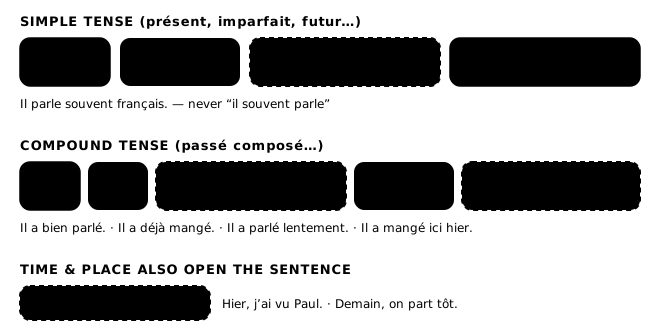
Simple tenses: right after the verb
- Je mange souvent au restaurant. — I often eat at restaurants. [zhuh mãzh soo-VÃ]
- Nous aimons beaucoup ce quartier. — We like this neighbourhood a lot. [boh-KOO]
- Elle ne sort pas souvent. — She doesn’t go out often. (adverb after the ne…pas sandwich)
Compound tenses: short adverbs before the participle
In the passé composé, the conjugated verb is the helper (avoir/être). Short, common adverbs go between the helper and the participle: bien, mal, déjà, encore, toujours, souvent, beaucoup, trop, assez, peu, vite, presque. So do the common -ment words of degree and certainty: vraiment, complètement, probablement, certainement.
- J’ai bien mangé. — I ate well. / I had a good meal. [zhay byɛ̃ mã-ZHAY]
- J’ai déjà fini. — I have already finished. [zhay day-ZHA fee-NEE]
- Il a probablement oublié. — He has probably forgotten.
Long -ment adverbs of manner: after the participle
- Il a parlé lentement. — He spoke slowly.
Time and place: at the start or at the end
Words like hier, aujourd’hui, demain, ici, là-bas, partout never go between the helper and the participle.
- Hier, je suis allé au cinéma. — Yesterday I went to the cinema. [ee-YEHR]
- On a dîné ici hier soir. — We had dinner here last night. [ee-SEE ee-yehr SWAR]
With an infinitive: before it
- Il faut bien réfléchir. — You have to think carefully.
- Essaie de ne pas trop manger. — Try not to eat too much.
Position in three lines
After the conjugated verb (il parle bien); short adverbs before the participle (j’ai bien mangé); long manner adverbs and time/place words at the end (il a parlé lentement hier).
15.6 The everyday adverbs: time, place, quantity, frequency
Time and place
| Time | Place |
|---|---|
| aujourd’hui, hier, demain — today, yesterday, tomorrow | ici, là — here, there |
| maintenant, bientôt — now, soon | là-bas — over there |
| tôt, tard — early, late | partout, ailleurs — everywhere, elsewhere |
| déjà, encore — already, still/again | près, loin — near, far |
| d’abord, ensuite, enfin — first, then, finally | dedans, dehors — inside, outside |
| tout de suite, longtemps — right away, (for) a long time | dessus, dessous — on top, underneath |
- J’arrive tout de suite ! — I’m coming right away! [toot SWEET]
- Il fait beau, on mange dehors ? — The weather’s nice — shall we eat outside? [duh-OR]
- D’abord on visite le musée, ensuite on déjeune. — First we visit the museum, then we have lunch.
Quantity and degree
très (very) goes with adjectives and adverbs; beaucoup (a lot) goes with verbs. With a noun, quantity adverbs take de: beaucoup de, trop de, assez de, peu de (see Articles).
| Adverb | Meaning | Example |
|---|---|---|
| très | very | très chaud, très bien |
| beaucoup (de) | a lot (of) | Il lit beaucoup. · beaucoup de livres |
| trop (de) | too, too much | trop cher · trop de sucre |
| assez (de) | enough, quite | assez grand · assez de temps |
| peu / un peu (de) | little / a little | Il mange peu. · un peu de lait |
| tellement · si | so (very) | C’est tellement beau ! · Il est si gentil. |
| presque | almost | J’ai presque fini. |
- C’est assez loin, mais c’est tellement joli ! — It’s quite far, but it’s so pretty! [a-SAY LWɛ̃ … tel-MÃ zho-LEE]
Frequency: from always to never
| French | English | Sound |
|---|---|---|
| toujours | always (also: still) | [too-ZHOOR] |
| souvent | often | [soo-VÃ] |
| parfois · quelquefois | sometimes | [par-FWA · kel-kuh-FWA] |
| de temps en temps | from time to time | [duh tã-zã-TÃ] |
| rarement | rarely | [rar-MÃ] |
| ne … jamais | never | [zha-MEH] |
- Je prends toujours le métro. — I always take the metro.
- Il habite toujours à Lyon ? — Does he still live in Lyon? (toujours = still)
- On va parfois à la plage, mais on ne va jamais à la montagne. — We sometimes go to the beach, but we never go to the mountains.
Jamais needs ne
jamais is a negative word: je ne mange jamais de viande. The full system of ne… jamais, ne… plus, ne… rien is in Saying no.
15.7 Tout as an adverb: “completely, very”
Before an adjective, tout means “quite, completely, very”: tout petit = tiny. It is an adverb, so normally it does not change. But French has one famous exception, for the ear: before a feminine adjective starting with a consonant (or an aspirated h), tout agrees.
| Before a consonant | Before a vowel / mute h | |
|---|---|---|
| masc. sing. | il est tout petit | il est tout heureux |
| masc. pl. | ils sont tout petits | ils sont tout heureux |
| fem. sing. | elle est toute petite | elle est tout heureuse |
| fem. pl. | elles sont toutes petites | elles sont tout émues |
- Le chaton est tout petit. — The kitten is tiny. [too puh-TEE]
- Sa fille est encore toute petite. — His/her daughter is still very small. [toot puh-TEET]
- Elle est tout heureuse de te voir. — She is so happy to see you. (vowel sound → tout, with liaison [too-tuh-RUHZ])
Useful fixed phrases: tout de suite (right away), tout à fait (exactly, quite), tout à l’heure (in a moment / a moment ago), tout droit (straight on). Tout as “all, every” (tous les jours, toute la journée) is covered in Tout, chaque, quelqu’un….
15.8 Mistakes learners really make
Adverb traps
- Wrong: Je souvent mange des fruits.
- Right: Je mange souvent des fruits.
-
Why: English order (“I often eat”) does not work. The adverb follows the conjugated verb.
-
Wrong: Elle parle français très bon.
- Right: Elle parle très bien français.
-
Why: parler is an action → bien. bon describes nouns: un bon livre.
-
Wrong: Je t’aime très.
- Right: Je t’aime beaucoup.
-
Why: très needs an adjective or adverb after it. With a verb, use beaucoup. And never “très beaucoup”.
-
Wrong: J’ai mangé bien. / J’ai hier mangé.
- Right: J’ai bien mangé. / J’ai mangé hier.
-
Why: Short adverbs go before the participle; time words go at the end (or the start).
-
Wrong: évidentement · constantment
- Right: évidemment · constamment
-
Why: -ent → -emment, -ant → -amment. Both are pronounced [a-MÃ].
-
Wrong: vraiement · poliement
- Right: vraiment · poliment
-
Why: After a vowel, no feminine -e: just add -ment to the masculine.
-
Wrong: Ces robes coûtent chères.
- Right: Ces robes coûtent cher.
- Why: cher here describes the verb coûter, so it is an adverb: no agreement. Compare: ces robes sont chères (adjective).
15.9 In real life — how was the weekend?
- — Alors, ce week-end à Paris, ça s’est bien passé ? — So, did the weekend in Paris go well?
- — Très bien ! On a énormément marché et on a vraiment bien mangé. — Very well! We walked an enormous amount and we ate really well.
- — Et ton français ? Tu as parlé facilement ? — And your French? Did you speak easily?
- — Pas toujours. Les gens parlent tellement vite ! Mais ils répétaient patiemment. — Not always. People speak so fast! But they repeated patiently.
- — Heureusement ! Tu y retournes bientôt ? — Luckily! Are you going back soon?
- — Évidemment ! Probablement en mai. — Of course! Probably in May.
À retenir
- An adverb tells you how, when, where, how much or how often. It never changes its ending, and in a simple tense it comes right after the verb: Il parle bien.
- Unlike adjectives, adverbs have one form only: il parle lentement, elles parlent lentement. No -e, no -s.
- Feminine + -ment (lentement); vowel ending + -ment (vraiment); -ant/-ent → -amment/-emment (constamment, évidemment), both said [a-MÃ].
- A thing is bon / mauvais / meilleur; an action is done bien / mal / mieux: un bon film, il chante bien.
- After the conjugated verb (il parle bien); short adverbs before the participle (j’ai bien mangé); long manner adverbs and time/place words at the end (il a parlé lentement hier).
- jamais is a negative word: je ne mange jamais de viande. The full system of ne… jamais, ne… plus, ne… rien is in Saying no.
15.10 Practice — Adverbs
Exercise 1
lent → ___
- lentement
- lemment
- lentment
- lentamment
Answer
lentement
lent has one syllable: feminine lente + -ment.
Exercise 2
évident → ___
- évidentement
- évidemment
- évidamment
- évidentment
Answer
évidemment
-ent → -emment, pronounced [a-MÃ].
Exercise 3
Il chante très ___.
- bon
- bien
- bonne
- meilleur
Hint: chanter is an action
Answer
bien
An action is done bien; bon describes nouns.
Exercise 4
C'est un très ___ film.
- bien
- bon
- mieux
- bonnement
Answer
bon
film is a noun → the adjective bon.
Exercise 5
Elle est ___ petite.
- tout
- toute
- tous
- toutes
Hint: feminine + consonant
Answer
toute
Adverb tout agrees before a feminine adjective starting with a consonant.
Exercise 6
Ces chaussures coûtent ___.
- cher
- chères
- chers
- chèrement
Answer
cher
cher describes the verb coûter: it is an adverb, so no agreement.
Exercise 7
vrai → ___
Answer
vraiment
Vowel ending: just add -ment.
Exercise 8
constant → ___
Answer
constamment
-ant → -amment.
Exercise 9
heureux → ___
Hint: feminine first
Answer
heureusement
heureuse + -ment.
Exercise 10
Tu cuisines ___ que moi. (better)
Answer
mieux
Describes how you cook (a verb) → mieux, not meilleur.
Exercise 11
Tap the wrong word.
Je souvent mange au restaurant.
Answer
Wrong word: souvent.
Corrected: Je mange souvent au restaurant.
The adverb goes after the conjugated verb.
Exercise 12
Tap the wrong word.
Je t'aime très.
Answer
Wrong word: très.
Corrected: Je t'aime beaucoup.
With a verb, use beaucoup; très needs an adjective or adverb.
Exercise 13
Put the words in order.
Words: J'ai / déjà / devoirs / fini / mes
Answer
J'ai déjà fini mes devoirs
Short adverb between the helper and the participle.
Exercise 14
Put the words in order.
Words: a / Il / parlé / lentement
Answer
Il a parlé lentement
A long -ment adverb of manner goes after the participle.
Exercise 15
Match the adjective to its adverb.
| A | B |
|---|---|
| gentil | précisément |
| bref | énormément |
| précis | gentiment |
| énorme | brièvement |
Answer
gentil — gentiment; bref — brièvement; précis — précisément; énorme — énormément
These four are irregular: learn them by heart.
Exercise 16
How often does the speaker go to the swimming pool?
Read this aloud or have someone read it to you:
Le week-end, je me lève toujours tard. Je vais parfois au cinéma, mais je ne vais jamais à la piscine.
- never
- sometimes
- often
- always
Answer
never
Transcript: “Le week-end, je me lève toujours tard. Je vais parfois au cinéma, mais je ne vais jamais à la piscine.”
ne… jamais = never.
Exercise 17
What does the speaker always do at the weekend?
Read this aloud or have someone read it to you:
Le week-end, je me lève toujours tard. Je vais parfois au cinéma, mais je ne vais jamais à la piscine.
- gets up late
- goes to the cinema
- gets up early
- goes swimming
Answer
gets up late
Transcript: “Le week-end, je me lève toujours tard. Je vais parfois au cinéma, mais je ne vais jamais à la piscine.”
je me lève toujours tard = I always get up late.
Exercise 18
Write what you hear.
Dictation. Have someone read the sentence aloud, then write it down.
Elle parle couramment français et elle conduit prudemment.
Answer
Elle parle couramment français et elle conduit prudemment.
couramment (-ant) and prudemment (-ent): same sound, different spelling.
Exercise 19
Say it aloud — the most useful request for a learner.
Parlez plus lentement, s'il vous plaît
Answer
Say: Parlez plus lentement, s'il vous plaît
lentement [lãt-MÃ]: the middle e is almost silent.
Next step
Now point at things: My, your, this, that covers mon/ma/mes and ce/cette/ces. Today, describe how you did five things yesterday — j’ai bien dormi, j’ai vite mangé… — checking where each adverb goes.