Chapter 34: Pronunciation clinic¶
Atelier de prononciation
In The sounds of French you met every sound once. This chapter is the gym. We drill minimal pairs — two words that differ by one sound only, like dessus (on top) and dessous (underneath). If you mix them up, you say the opposite of what you mean. Then we work on the music of French: stress, melody and rhythm. Keep your microphone on and say everything out loud.
- 1u vs ou — the lip pair
- 2e, é and è — small vowels, big meaning
- 3The nasal triplet — bon, banc, bain
- 4The French R — drills that work
- 5Stress and melody — the end of the group wins
- 6Rhythm groups and linking
- 7Tongue-twisters — virelangues
- 8Accent fixes for English and Hindi speakers
masculinefeminineplural
The clinic method
Listen → say → contrast. Play word A, then word B, then say both, A–B–A–B, until your mouth feels the difference. One pair, five minutes, every day.
34.1 u vs ou — the lip pair¶
This is the pair that matters most. ou [oo] is like English "food". u [ew] has no English equivalent: say "ee", keep your tongue exactly there, and push your lips forward into a tight round "kiss". Tongue front, lips round.
u = 'ee' with kissing lips
For u, the tongue stays forward as for "ee"; only the lips round. For ou, the tongue pulls back. In a mirror the lips look the same — the difference is inside.
| u [ew] | ou [oo] | Meanings |
|---|---|---|
| dessus | dessous | on top / underneath |
| tu | tout | you / all |
| vu | vous | seen / you (formal) |
| la rue | la roue | the street / the wheel |
| pur | pour | pure / for |
| lu | loup | read (past) / wolf |
| su | sous | known / under |
Now the pair inside sentences. Say each one three times, slowly, then at normal speed.
- Le chat est dessus, pas dessous. — The cat is on top, not underneath. [luh sha ay duh-SEW, pa duh-SOO]
- Tu as tout vu ? — Did you see everything? [tew a too VEW]
- Vous avez vu la roue dans la rue ? — Did you see the wheel in the street?
- C’est pour toi, c’est du jus pur. — It’s for you, it’s pure juice.
- Je ne savais pas où tu étais. — I didn’t know where you were.
Careful
- Wrong: Le livre est dessous la table.
- Right: Le livre est sous la table. / Il est dessous.
- Why: Sur and sous come before a noun. Dessus and dessous stand alone, with no noun after them.
Hindi helps here
Hindi "ऊ" (as in phool) is a good French ou. For u, say "ई" (ee) and round your lips without moving the tongue. English "you" is not French u — it slides from "ee" to "oo".
34.2 e, é and è — small vowels, big meaning¶
Three different "e" sounds. e [uh] is short and relaxed, lips slightly round. é [ay] is closed and tight — smile, and do not let it slide into "ay-ee". è / ê [eh] is open, like "e" in English "bed".
e vs é: singular vs plural¶
In speech, the final -s of a plural is silent. Often the only sound that tells you "one" or "many" is the vowel of the little word in front.
| e [uh] | é [ay] | Meanings |
|---|---|---|
| le livre | les livres | the book / the books |
| de | des | of / some (plural) |
| ce sac | ces sacs | this bag / these bags |
| je fais | j’ai fait | I do / I did |
| me | mes | me / my (plural) |
le / les is a meaning switch
le [luh] = one thing; les [lay] = several. The noun sounds the same, so this vowel carries the whole difference. Never blur it.
- Je prends le livre, pas les livres. — I’m taking the book, not the books.
- Je fais mes devoirs ; hier, j’ai fait les courses. — I’m doing my homework; yesterday I did the shopping.
é vs è: closed vs open¶
The open è appears almost always when a consonant is pronounced after the vowel in the same syllable: mère, belle, fête, elle, mer. The closed é appears at the end of a syllable: été, café, parlé.
| é [ay] | è / ai [eh] | Meanings |
|---|---|---|
| les | lait | the (pl.) / milk |
| été | était | been, summer / was |
| une fée | un fait | a fairy / a fact |
| thé | tête | tea / head |
Don’t panic about é/è at the end of words
Many French speakers, especially in Paris and the south, no longer separate j’ai/j’aimais or parlé/parlais at the end of a word. Context does the work. Focus on two things: le/les, and the open è before a consonant (mère, fête).
Careful
- Wrong: café said "ka-FAY-ee", like English "cafe"
- Right: café [ka-FAY] — one pure, tight vowel
- Why: English "ay" glides to "ee". French é is frozen: smile and hold the vowel still until it ends.
34.3 The nasal triplet — bon, banc, bain¶
Standard French has three nasal vowels you must keep apart. Air goes through the nose and the mouth, and the n is not pronounced. The three words below differ only in the vowel — and they mean "good", "bench" and "bath".
| on [õ] | an / en [ã] | in / ain [ɛ̃] |
|---|---|---|
| bon | banc | bain |
| son | sans | saint |
| long | lent | lin |
| ils vont | le vent | le vin |
- Un bon vin blanc. — A good white wine — the classic drill: four nasals in four words. [ɛ̃ bõ vɛ̃ BLÃ]
- Il prend un bain sur un banc ? C’est bon ! — He’s taking a bath on a bench? Fine!
- Le vent est lent, le vin est long. — The wind is slow, the wine is long (has a long finish).
beau vs bon — oral vs nasal¶
Close the nose and you get the oral partner. These pairs train the switch:
| Oral | Nasal | Meanings |
|---|---|---|
| beau | bon | beautiful / good |
| bas | banc | low / bench |
| mot | mon | word / my |
Nasal vs vowel + n: the gender switch¶
Add an -e (or double the n) and the nasal disappears: the vowel becomes oral and you now hear the n. This is how many feminine adjectives sound different.
- bon → bonne — good (m → f) [bõ → BON]
- fin → fine — fine, thin (m → f) [fɛ̃ → FEEN]
- plein → pleine — full (m → f) [plɛ̃ → PLEN]
- un an → Anne — a year / Anne (a name)
Careful
- Wrong: bon said "bonn", with a real n
- Right: bon [bõ] — the n only colours the vowel
- Why: Your tongue must not touch the roof of your mouth. If it does, you are saying bonne.
Hindi already has nasal vowels
The chandrabindu sound in हाँ (hãa) or माँ (mãa) is a nasal vowel with no n — exactly the French idea. an [ã] is very close to that "ãa".
34.4 The French R — drills that work¶
The French R is made at the back of the throat, where you make "g" and "k". The tip of the tongue does nothing: keep it resting behind the bottom teeth. It is a soft friction, like gently clearing the throat — not a rolled "r" and not an English "r".
Tongue tip down, back of the tongue up
Press the tip of your tongue against your lower teeth. Say "g", then let air rub through the narrow gap at the back. That soft rubbing sound is the French R.
Four steps¶
- Step 1 — from "g": ga… gra… ra — "g" puts the tongue in the right place; slide from it into the R.
- Step 2 — between vowels: a-ra, é-ré, o-ro — Easy position: the R is soft between two vowels.
- Step 3 — clusters: gris, grand, très, trois, crêpe — After g, k, t the R almost makes itself.
-
Step 4 — start and end of a word: rouge, rue, Paris, mer, sœur — The hardest: no help from neighbours. Keep it light at the end of a word.
-
Je rentre à Paris mercredi. — I’m going back to Paris on Wednesday. [zhuh RÃTR a pa-REE mer-kruh-DEE]
- La rue est très large. — The street is very wide.
- Mon frère préfère le rouge. — My brother prefers red.
Careful
- Wrong: Paris with a rolled Hindi "र" or an English "r"
- Right: Paris [pa-REE], R from the throat
- Why: A rolled r is understood (some rural regions still use it), but it marks you as foreign. The tongue tip should not move.
Hindi/Urdu shortcut: ग़
If you know the Urdu sound ग़ (as in ग़लत, ग़ज़ल), you already have the French R — it is almost the same sound. Use it, just softer.
34.5 Stress and melody — the end of the group wins¶
English stresses a different syllable in each word (PHOtograph, phoTOgraphy). French does not. In French, the stress falls on the last syllable of a word — or, in a sentence, the last syllable of each group of words. It is a little longer, not much louder.
- université — university [ew-nee-vehr-see-TAY]
- photographie — photography — all syllables even, the last a bit longer [fo-to-gra-FEE]
- restaurant — restaurant — not "RES-trant" [res-to-RÃ]
Intonation: the melody carries the meaning¶
In everyday French, a question is often just a statement with a rising melody. Same words, different music: Tu viens. (You’re coming.) / Tu viens ? (Are you coming?)
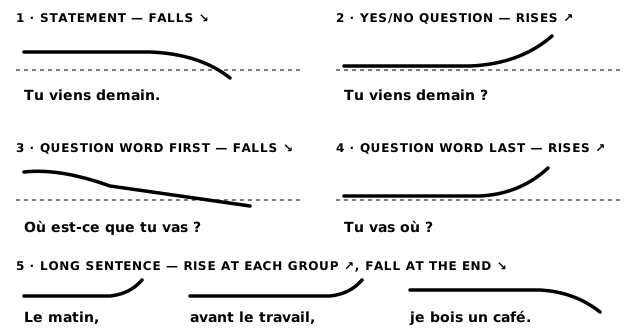
- Tu viens demain. — You’re coming tomorrow. (statement, falls)
- Tu viens demain ? — Are you coming tomorrow? (rises)
- Où est-ce que tu vas ? — Where are you going? (question word first, falls)
- Tu vas où ? — Where are you going? (spoken style, rises on où)
- Le matin, avant le travail, je bois un café. — In the morning, before work, I drink a coffee.
- J’ai acheté du pain, du fromage et des pommes. — I bought bread, cheese and apples. (rise, rise, fall)
Rise = more is coming. Fall = finished.
Yes/no questions rise at the end. Statements fall. Inside a long sentence, each group ends with a small rise. Questions that start with a question word usually fall.
34.6 Rhythm groups and linking¶
French cuts a sentence into rhythm groups (groupes rythmiques) of about 3–7 syllables — usually a noun with its little words, or a verb with its object. Inside a group every syllable is even, like a drum roll: ta-ta-ta-TAAA. Only the last one stretches.
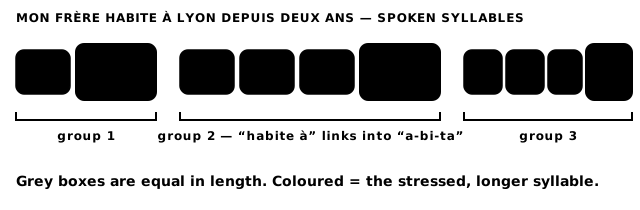
Enchaînement: the consonant jumps forward¶
A pronounced final consonant attaches to the next word if it starts with a vowel. You don’t pause between words — you speak in one smooth line. (For liaison of normally silent letters, see Silent letters & liaison.)
- Il‿arrive à onze heures. — He arrives at eleven. [ee-la-REEV a õ-ZUHR]
- Elle‿habite avec une‿amie. — She lives with a friend. [eh-la-BEET a-veh-kew-na-MEE]
- Pour‿une semaine. — For one week. [poo-rewn suh-MEN]
Careful
- Wrong: Je – voudrais – un – café. (four separate words, each stressed)
- Right: Je voudrais un caFÉ. (one group, one stress)
- Why: Word-by-word French sounds robotic and is harder to understand. Glue the group together and stress only its end.
- Je voudrais un café. — I’d like a coffee. [zhuh-voo-dreh-zɛ̃-ka-FAY]
- Ma sœur travaille / dans une banque / à Bordeaux. — My sister works in a bank in Bordeaux. (three groups)
34.7 Tongue-twisters — virelangues¶
French children train with virelangues. These buttons play slowly. Speed up only when your version is clean. Each one targets a sound.
- Les chaussettes de l’archiduchesse sont-elles sèches ou archi-sèches ? — Are the archduchess’s socks dry or extra-dry? — target: s vs ch
- Un chasseur sachant chasser doit savoir chasser sans son chien. — A hunter who knows how to hunt must be able to hunt without his dog. — s vs ch, nasals
- Trois gros rats gris dans trois gros trous ronds rongent trois gros croûtons ronds. — Three big grey rats in three big round holes gnaw three big round croutons. — the R
- Tu t’entêtes à tout tenter, tu t’uses et tu te tues à tant t’entêter. — You insist on trying everything; you wear yourself out and kill yourself being so stubborn. — u vs ou, t
- Ton thé t’a-t-il ôté ta toux ? — Did your tea get rid of your cough? — t with no puff of air
- Si six scies scient six cyprès, six cents scies scient six cents cyprès. — If six saws saw six cypresses, six hundred saws saw six hundred cypresses. — s and "ee"
- Je veux et j’exige d’exquises excuses. — I want and demand exquisite apologies. — x as [gz] and [ks]
Twister technique
Say it in rhythm groups, not word by word. Whisper it once (whispering shows you the mouth positions), then say it at half speed, then at normal speed. Stop when it breaks.
34.8 Accent fixes for English and Hindi speakers¶
You do not need to lose your accent. You need to remove the few habits that confuse listeners. Here are the most common ones, with the fix.
English-speaker habits
- Wrong: Paris said "PA-ris" (stress on the first syllable)
- Right: [pa-REE] — the last syllable gets the length
-
Why: English pulls stress to the front. French puts it at the end of the group.
-
Wrong: petit with a puff of air on p and t
- Right: [puh-TEE] — p, t, k with no puff
-
Why: Hold a sheet of paper in front of your mouth: it should not move on p. (Hindi speakers: your प, त, क are already right.)
-
Wrong: beaucoup said "boh-KOOP", final p pronounced
- Right: [boh-KOO] — the final consonant is silent
- Why: Most final consonants are silent. Remember CaReFuL: c, r, f, l at the end are often heard; most others are not.
Hindi-speaker habits
- Wrong: je said with ज (as in jaana)
- Right: [zhuh] — like the "s" in English "measure"
-
Why: French j and soft g are a buzzing sound with no "d" at the start — the sound in the middle of "measure" or "television", not ज.
-
Wrong: chat said with च ("chaa")
- Right: [sha] — French ch = श
-
Why: French ch is (almost) always "sh": chocolat = sho-ko-LA.
-
Wrong: station said "is-ta-syõ"
- Right: [sta-SYÕ] — no extra vowel before s
-
Why: Many Hindi speakers add a vowel before st-, sp-, sk- (as in "iskool"). Start directly with the hiss: spécial, structure, stylo.
-
Wrong: table with a retroflex ट
- Right: table with the dental त, tongue touching the teeth
- Why: French t and d are dental, like Hindi त and द — not like English t or Hindi ट/ड.
- Je joue avec le chat de Jean. — I’m playing with Jean’s cat. — j vs ch
- Le stylo spécial est à la station. — The special pen is at the station. — no vowel before st, sp
- Ta tante a des dattes douces. — Your aunt has sweet dates. — dental t and d
| Problem | Quick test | Drill |
|---|---|---|
| u sounds like ou | Do tu and tout sound different? | "ee" + lip kiss, §1 |
| le = les | Can a friend hear singular vs plural? | le/les table, §2 |
| nasals merge | Are bon / banc / bain distinct? | lip shapes, §3 |
| English or rolled r | Does your tongue tip move? | ga–gra–ra, §4 |
| wrong stress | Is the last syllable the longest? | rhythm groups, §6 |
Record yourself
Once a week, record the same short text on your phone and compare with last week. Your ear improves before your mouth — hearing your own mistakes is real progress.
À retenir
- Listen → say → contrast. Play word A, then word B, then say both, A–B–A–B, until your mouth feels the difference. One pair, five minutes, every day.
- For u, the tongue stays forward as for "ee"; only the lips round. For ou, the tongue pulls back. In a mirror the lips look the same — the difference is inside.
- Hindi "ऊ" (as in phool) is a good French ou. For u, say "ई" (ee) and round your lips without moving the tongue. English "you" is not French u — it slides from "ee" to "oo".
- le [luh] = one thing; les [lay] = several. The noun sounds the same, so this vowel carries the whole difference. Never blur it.
- The chandrabindu sound in हाँ (hãa) or माँ (mãa) is a nasal vowel with no n — exactly the French idea. an [ã] is very close to that "ãa".
- Press the tip of your tongue against your lower teeth. Say "g", then let air rub through the narrow gap at the back. That soft rubbing sound is the French R.
34.9 Practice — Pronunciation clinic¶
Exercise 1
Which word has the ou [oo] sound?
- dessus
- dessous
- tu
- vu
Hint: Tongue pulled back.
Answer
dessous
dessous = underneath, with ou [oo]. The others have u [ew].
Exercise 2
In speech, what tells you that 'les livres' is plural?
- the final s of livres
- the vowel of les [lay]
- a longer i in livres
- nothing at all
Hint: The final -s is silent.
Answer
the vowel of les [lay]
livre and livres sound the same; le [luh] vs les [lay] carries the difference.
Exercise 3
Where is the stress in 'université'?
- first syllable
- second syllable
- last syllable
- no syllable
Answer
last syllable
French stress falls on the last syllable: u-ni-ver-si-TÉ.
Exercise 4
The melody of 'Tu viens demain ?' (yes/no question) usually…
- falls at the end
- rises at the end
- stays completely flat
- starts high and falls
Answer
rises at the end
A yes/no question asked by intonation rises at the end.
Exercise 5
Match each word to its meaning.
| A | B |
|---|---|
| bon | bath |
| banc | beautiful |
| bain | good |
| beau | bench |
Answer
bon — good; banc — bench; bain — bath; beau — beautiful
on [õ], an [ã], in/ain [ɛ̃] — and beau is the oral partner of bon.
Exercise 6
Match the minimal pairs to their meanings.
| A | B |
|---|---|
| dessus | the street |
| dessous | the wheel |
| la rue | on top |
| la roue | underneath |
Answer
dessus — on top; dessous — underneath; la rue — the street; la roue — the wheel
u [ew] vs ou [oo] changes the meaning completely.
Exercise 7
Il prend un ___ chaud. (bath)
Hint: The in/ain nasal.
Answer
bain
bain [bɛ̃] = bath. Don't confuse it with banc (bench) or bon (good).
Exercise 8
un bon gâteau → une ___ tarte
Hint: Feminine: the n becomes audible.
Answer
bonne
bon [bõ] → bonne [bon]: the nasal disappears and you hear the n.
Exercise 9
Tap the wrong word.
Le chat dort dessous la table.
Answer
Wrong word: dessous.
Corrected: Le chat dort sous la table.
Before a noun use sous/sur. Dessous/dessus stand alone.
Exercise 10
Tap the wrong word.
Hier, j'ai acheté le livres pour mes enfants.
Answer
Wrong word: le.
Corrected: Hier, j'ai acheté les livres pour mes enfants.
Plural needs les [lay] — and in speech, that vowel is the only plural signal.
Exercise 11
Put the rhythm groups in order.
Words: habite / frère / Mon / deux / à / depuis / ans / Lyon
Answer
Mon frère habite à Lyon depuis deux ans
mon FRÈRE / habite à LYON / depuis deux ANS — three groups, three stresses.
Exercise 12
Put the words in order.
Words: je / un / bois / matin / Le / café
Answer
Le matin je bois un café
Rise on matin (not finished), fall on café (finished).
Exercise 13
Say it aloud — keep u and ou apart.
Le chat est dessus pas dessous
Answer
Say: Le chat est dessus pas dessous
dessus [duh-SEW] with kissing lips; dessous [duh-SOO] with the tongue back.
Exercise 14
Say the nasal drill.
Un bon vin blanc
Answer
Say: Un bon vin blanc
Four nasals: un, bon, vin, blanc. No n is pronounced.
Exercise 15
Say it — u, ou, u.
Tu as tout vu
Answer
Say: Tu as tout vu
tu [tew], tout [too], vu [vew].
Exercise 16
Say it — make le and les clear.
Je prends le livre pas les livres
Answer
Say: Je prends le livre pas les livres
le [luh] vs les [lay]: the only spoken difference.
Exercise 17
Say it with a throat R.
Trois gros rats gris
Answer
Say: Trois gros rats gris
Tongue tip down, back of the tongue up. The R after t and g is the easiest.
Exercise 18
Say the famous tongue-twister.
Les chaussettes de l'archiduchesse sont sèches
Answer
Say: Les chaussettes de l'archiduchesse sont sèches
s vs ch: chaussettes, archiduchesse, sèches.
Exercise 19
Ask the question with a rising melody.
Tu viens demain
Answer
Say: Tu viens demain
Same words as a statement — the rise at the end makes it a question.
Next step
Now put your new sounds to work in real situations: Everyday French gives you the café, the bakery, the shop and the metro — ready-made lines with a 🔊 on every one.