Chapter 44: The 100 essential verbs
Les 100 verbes essentiels
About a hundred verbs carry most of what you say in a day. But knowing the verb is not enough: you must know what comes after it — a direct object, à, or de. English "wait for" is French attendre with nothing; English "phone someone" is téléphoner à quelqu’un. Here are the 100, grouped by meaning, each with its construction.
- 1A verb comes with its construction
- 2Being, having and the modal verbs (1–10)
- 3Coming and going (11–20)
- 4Talking to people (21–30)
- 5Thinking, knowing and remembering (31–40)
- 6Feelings — and the back-to-front verbs (41–50)
- 7Daily life and doing things (51–70)
- 8People, giving, senses and change (71–100)
- 9In real life — a phone call home
44.1 A verb comes with its construction
In the tables, qqn = quelqu’un (someone) and qqch = quelque chose (something) — the abbreviations French dictionaries use. "+ inf" means "+ an infinitive". For the conjugations, see Present tense: -er verbs and Present tense: the rest; this chapter is about meaning and construction.
Learn the little word with the verb
Don’t learn "téléphoner = to phone". Learn téléphoner à qqn, avoir besoin de qqch, attendre qqn.
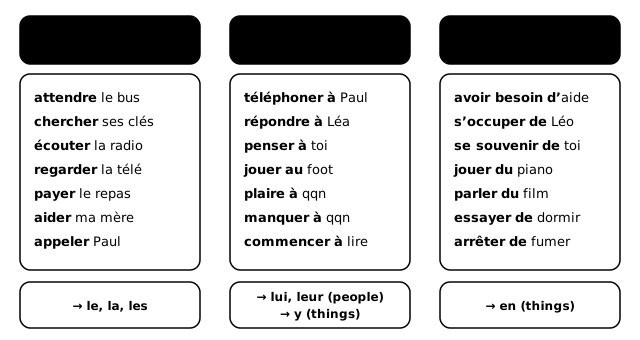
The 'for, at, to' is inside the verb
attendre (wait for), chercher (look for), payer (pay for), regarder (look at), écouter (listen to) take no preposition at all.
Careful
- Wrong: J’attends pour le bus.
- Right: J’attends le bus.
- Why: attendre already means "wait for". Adding pour is translating English word by word.
44.2 Being, having and the modal verbs (1–10)
| Verb | Meaning | Construction · example |
|---|---|---|
| 1 · être | to be | être à qqn = belong: Ce sac est à moi. |
| 2 · avoir | to have | avoir faim, froid, 20 ans (see Être & avoir) |
| 3 · devenir | to become | + job, no article: Il est devenu médecin. |
| 4 · rester | to stay (not "rest") | Je reste à la maison. |
| 5 · sembler | to seem | + adjective: Tu sembles fatigué. |
| 6 · falloir | to be necessary | only il faut + inf: Il faut partir. |
| 7 · pouvoir | can, may | + inf: Je peux entrer ? |
| 8 · devoir | must; to owe | + inf · qqch à qqn |
| 9 · vouloir | to want | qqch · + inf · polite: je voudrais |
| 10 · avoir besoin | to need | de qqch · de + inf |
The modal verbs (pouvoir, devoir, vouloir, il faut) are followed directly by an infinitive — no "to", no à.
- Je dois partir à huit heures. — I have to leave at eight.
- Il faut boire beaucoup d’eau. — You need to drink a lot of water.
- J’ai besoin d’un taxi. — I need a taxi. [zhay buh-ZWɛ̃ dɛ̃ tak-SEE]
Careful
- Wrong: J’ai besoin un taxi.
- Right: J’ai besoin d’un taxi.
- Why: Besoin is a noun ("a need"), so it needs de: "I have need of a taxi".
44.3 Coming and going (11–20)
| Verb | Meaning | Construction · example |
|---|---|---|
| 11 · aller | to go | à/en + place · + inf = "going to" |
| 12 · venir | to come | de + place = from · de + inf = have just |
| 13 · arriver | to arrive; to manage | à + place · à + inf = manage to |
| 14 · partir | to leave, go away | no object: Je pars demain. |
| 15 · quitter | to leave (sth, sb) | + direct object: Je quitte Paris. |
| 16 · sortir | to go out | de: Elle sort du bureau. |
| 17 · entrer | to go in, enter | dans: Il entre dans la salle. |
| 18 · rentrer | to go back home | Je rentre tard ce soir. |
| 19 · monter | to go up; get on | monter dans le bus · monter l’escalier |
| 20 · descendre | to go down; get off | descendre du train |
Also useful: revenir (come back), tomber (fall), marcher (walk), courir (run). Most movement verbs take être in the past — see The past: passé composé.
- Je vais appeler mon père. — I’m going to call my father.
- Je viens de Jaipur. — I come from Jaipur.
- Je viens de manger. — I have just eaten.
- Je n’arrive pas à dormir. — I can’t get to sleep. (I don’t manage to sleep)
- Il quitte le bureau à six heures. — He leaves the office at six.
partir or quitter?
Both mean "leave". Partir stands alone (Je pars.) or takes de; quitter must have an object (Je quitte la maison.). Never "quitter de".
44.4 Talking to people (21–30)
| Verb | Meaning | Construction |
|---|---|---|
| 21 · parler | to speak, talk | à qqn (to) · de qqch (about) |
| 22 · dire | to say, tell | qqch à qqn · à qqn de + inf |
| 23 · demander | to ask | qqch à qqn · à qqn de + inf |
| 24 · répondre | to answer | à qqn · à qqch |
| 25 · téléphoner | to phone | à qqn |
| 26 · appeler | to call | qqn (direct) |
| 27 · expliquer | to explain | qqch à qqn |
| 28 · raconter | to tell (a story) | qqch à qqn |
| 29 · écrire | to write | qqch à qqn |
| 30 · promettre | to promise | qqch à qqn · à qqn de + inf |
The person gets à
With verbs of communication, the person you speak, tell, ask, answer or phone takes à: parler à, dire à, demander à, répondre à, téléphoner à.
- Je parle à Marie de mon voyage. — I’m talking to Marie about my trip.
- Dis à Paul de venir. — Tell Paul to come.
- J’ai demandé à mon frère de m’aider. — I asked my brother to help me.
- Je demande l’heure à un passant. — I ask a passer-by the time.
- Je téléphone à ma mère. = J’appelle ma mère. — I phone my mother. = I call my mother. (So: je lui téléphone, but je l’appelle.)
Careful
- Wrong: Je téléphone ma mère.
- Right: Je téléphone à ma mère.
- Why: English "phone someone" has no preposition; French téléphoner needs à. Only appeler is direct.
Careful: demander means "to ask", not "to demand" (that is exiger). More traps like this in Cognates & false friends.
44.5 Thinking, knowing and remembering (31–40)
| Verb | Meaning | Construction |
|---|---|---|
| 31 · penser | to think | à (about) · de (opinion) · que |
| 32 · croire | to believe | qqn · que · en Dieu |
| 33 · savoir | to know (facts; how to) | + inf · que · si |
| 34 · connaître | to know (people, places) | qqn / qqch |
| 35 · comprendre | to understand | qqn / qqch |
| 36 · apprendre | to learn; to teach | à + inf · qqch à qqn |
| 37 · oublier | to forget | qqch · de + inf |
| 38 · se souvenir | to remember | de qqch / de qqn |
| 39 · se rappeler | to remember | qqch (direct) |
| 40 · décider | to decide | de + inf |
penser à or penser de?
- Je pense à toi. — I’m thinking of you.
- Qu’est-ce que tu penses de ce film ? — What do you think of this film?
penser à ≠ penser de
penser à = to have someone or something in your mind. penser de = to have an opinion of it, mostly in questions: Qu’en penses-tu ?
Careful
- Wrong: Je pense de toi tous les jours.
- Right: Je pense à toi tous les jours.
- Why: Thinking about someone = penser à. Penser de only asks for an opinion.
savoir, connaître, se souvenir
- Je sais nager, mais je ne connais pas cette plage. — I can swim, but I don’t know this beach.
- Je me souviens de ce jour. = Je me rappelle ce jour. — I remember that day. (two verbs, two constructions)
- J’ai oublié de fermer la porte. — I forgot to close the door.
- J’apprends à conduire. — I’m learning to drive.
- Elle apprend le français à ses enfants. — She teaches French to her children.
In careful French, se rappeler takes a direct object. You will hear "je me rappelle de…" in speech, but avoid it in writing. Both verbs are reflexive — see Reflexive verbs.
44.6 Feelings — and the back-to-front verbs (41–50)
| Verb | Meaning | Construction |
|---|---|---|
| 41 · aimer | to like, love | qqch · + inf (no preposition) |
| 42 · adorer | to love, adore | qqch · + inf |
| 43 · détester | to hate | qqch · + inf |
| 44 · préférer | to prefer | A à B · + inf |
| 45 · espérer | to hope | + inf (no de) · que |
| 46 · plaire | to please | à qqn — reversed |
| 47 · manquer | to miss; to lack | à qqn (reversed) · qqch · de |
| 48 · avoir peur | to be afraid | de qqch · de + inf |
| 49 · avoir envie | to feel like | de qqch · de + inf |
| 50 · s’intéresser | to be interested | à qqch |
- J’aime lire, mais je préfère le cinéma au théâtre. — I like reading, but I prefer the cinema to the theatre.
- J’espère te voir bientôt. — I hope to see you soon.
- J’ai peur des chiens. — I’m scared of dogs.
- Je m’intéresse à l’histoire. — I’m interested in history.
manquer à and plaire à: the subject swaps
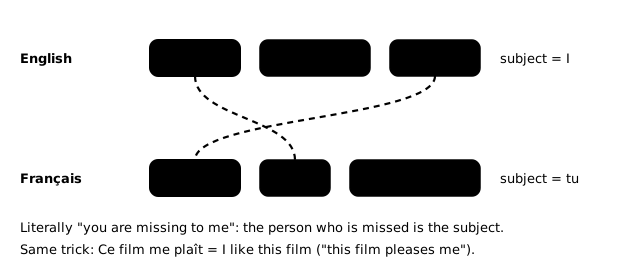
Back-to-front verbs
With manquer à and plaire à, the thing you miss or like is the subject: Tu me manques = I miss you. Ça me plaît = I like it.
- Tu me manques. — I miss you. [tew muh MÃK]
- Mes parents me manquent. — I miss my parents. (parents is the subject, so the verb is plural)
- L’Inde manque à Ravi. — Ravi misses India.
- J’ai manqué le train. — I missed the train. (missing a train is normal and direct)
- Ce film me plaît beaucoup. Et à toi, il te plaît ? — I really like this film. And you, do you like it?
Hindi speakers have an advantage here. Mujhe yeh film pasand hai is built exactly like Ce film me plaît: "to me, this film is pleasing". And mujhe tumhari yaad aati hai also puts "to me" first — just like tu me manques.
Careful
- Wrong: Je manque toi.
- Right: Tu me manques.
- Why: The person missed (tu) is the subject; the person who misses becomes me (= à moi). See Object pronouns.
44.7 Daily life and doing things (51–70)
The daily routine
| Verb | Meaning | Construction · example |
|---|---|---|
| 51 · se lever | to get up | Je me lève tôt. |
| 52 · se coucher | to go to bed | Je me couche à minuit. |
| 53 · s’habiller | to get dressed | Je m’habille vite. |
| 54 · s’appeler | to be called | Je m’appelle Ravi. |
| 55 · manger | to eat | qqch · du, de la… |
| 56 · boire | to drink | qqch · du, de l’… |
| 57 · dormir | to sleep | Tu dors bien ? |
| 58 · habiter | to live (somewhere) | (à) + city · en + country |
| 59 · travailler | to work | dans / chez / comme |
| 60 · attendre | to wait for | qqn / qqch — no "pour" |
- Elle travaille comme infirmière à Pune. — She works as a nurse in Pune.
Doing and making
| Verb | Meaning | Construction |
|---|---|---|
| 61 · faire | to do, make | faire du sport · faire + inf (have sth done) |
| 62 · mettre | to put; put on; take (time) | qqch · J’ai mis une heure. |
| 63 · prendre | to take; to have (food) | prendre le bus · un café |
| 64 · commencer | to begin | à + inf · par qqch |
| 65 · finir | to finish | de + inf · par + inf (end up) |
| 66 · essayer | to try; to try on | de + inf · qqch (clothes) |
| 67 · continuer | to go on | à (or de) + inf |
| 68 · arrêter | to stop | de + inf · qqch / qqn |
| 69 · réussir | to succeed; to pass | à + inf · un examen |
| 70 · jouer | to play | à (games, sport) · de (instruments) |
- Il commence à pleuvoir. — It’s starting to rain.
- J’essaie de comprendre. — I’m trying to understand.
- J’ai mis une heure pour venir. — It took me an hour to get here.
jouer à or jouer de?
- Je joue au cricket et aux échecs. — I play cricket and chess.
- Elle joue du piano et de la guitare. — She plays the piano and the guitar.
jouer à / jouer de
jouer à + a game or sport (au foot, aux cartes). jouer de + an instrument (du piano, de la flûte).
Careful
- Wrong: Je joue le piano.
- Right: Je joue du piano.
- Why: Instruments take jouer de: de + le piano = du piano.
44.8 People, giving, senses and change (71–100)
Dealing with people and things
| Verb | Meaning | Construction |
|---|---|---|
| 71 · s’occuper | to take care of, deal with | de qqn / de qqch |
| 72 · aider | to help | qqn (direct) à + inf |
| 73 · chercher | to look for | qqch — no "pour" |
| 74 · trouver | to find; to think | qqch · que |
| 75 · utiliser | to use | qqch |
| 76 · laisser | to leave; to let | qqch · + inf: Laisse-moi parler. |
| 77 · permettre | to allow | à qqn de + inf |
| 78 · empêcher | to prevent | qqn de + inf |
| 79 · conseiller | to advise | à qqn de + inf |
| 80 · remercier | to thank | qqn de / pour qqch |
- Je m’occupe de ma grand-mère le week-end. — I look after my grandmother at weekends.
- J’aide mon père à faire la cuisine. — I help my father cook.
- Je cherche mes lunettes. — I’m looking for my glasses.
- Le bruit m’empêche de dormir. — The noise stops me from sleeping.
Careful
- Wrong: Je cherche pour mes clés.
- Right: Je cherche mes clés.
- Why: chercher = "look for" in one word. Same family as attendre and payer.
Giving and getting
| Verb | Meaning | Construction |
|---|---|---|
| 81 · donner | to give | qqch à qqn |
| 82 · rendre | to give back; to make | qqch à qqn · + adjective |
| 83 · prêter | to lend | qqch à qqn |
| 84 · emprunter | to borrow | qqch à qqn |
| 85 · acheter | to buy | qqch (à qqn) |
| 86 · vendre | to sell | qqch à qqn |
| 87 · payer | to pay (for) | qqch — no "pour" |
| 88 · envoyer | to send | qqch à qqn |
| 89 · recevoir | to receive, get | qqch |
| 90 · montrer | to show | qqch à qqn |
- J’ai emprunté un livre à Paul. — I borrowed a book from Paul. (French says "to Paul")
- C’est moi qui paie le repas. — I’m paying for the meal.
Visiting people
A place: visiter le Louvre. A person: rendre visite à ses grands-parents. Avoid "visiter mes grands-parents" (heard in Québec, but not standard in France).
Senses and change
| Verb | Meaning | Construction |
|---|---|---|
| 91 · voir | to see | qqn / qqch |
| 92 · regarder | to look at, watch | qqch — no "à" |
| 93 · écouter | to listen to | qqch — no "à" |
| 94 · entendre | to hear | qqn / qqch |
| 95 · sentir | to smell; to feel | ça sent bon · se sentir + adjective |
| 96 · passer | to pass; to spend (time) | du temps à + inf · un examen (= take) |
| 97 · changer | to change | qqch · de + noun, no article |
| 98 · perdre | to lose | qqch |
| 99 · gagner | to win; to earn | un match · de l’argent |
| 100 · ouvrir | to open (fermer = to close) | qqch |
- Le soir, je regarde la télé ou j’écoute de la musique. — In the evening I watch TV or listen to music.
- Je ne me sens pas bien. — I don’t feel well.
- J’ai passé le week-end à lire. — I spent the weekend reading.
- On change de train à Lyon. Il a changé d’avis. — We change trains in Lyon. He changed his mind.
Careful
- Wrong: J’écoute à la musique.
- Right: J’écoute de la musique. · J’écoute la radio.
- Why: écouter = "listen to" in one word. "Some music" takes the partitive de la; a specific thing takes le/la.
44.9 In real life — a phone call home
Ravi studies in Toulouse and calls his mother. Spot the constructions: there are more than ten.
- — Allô, Maman ? C’est Ravi. Tu me manques ! — Hello, Mum? It’s Ravi. I miss you!
- — Toi aussi, tu me manques. Tu t’occupes bien de toi ? — I miss you too. Are you looking after yourself?
- — Oui. J’ai commencé à jouer au tennis, et j’apprends à jouer de la guitare. — Yes. I’ve started playing tennis, and I’m learning to play the guitar.
- — Je pense souvent à mon examen, mais j’essaie de ne pas stresser. — I often think about my exam, but I’m trying not to stress.
- — N’oublie pas de téléphoner à ta grand-mère. Elle attend ton appel. — Don’t forget to phone your grandmother. She’s waiting for your call.
- — D’accord, je l’appelle ce soir. Mon bus arrive, je te laisse ! — OK, I’ll call her tonight. My bus is coming, I have to go! (je te laisse = I’ll leave you)
À retenir
- Don’t learn "téléphoner = to phone". Learn téléphoner à qqn, avoir besoin de qqch, attendre qqn.
- attendre (wait for), chercher (look for), payer (pay for), regarder (look at), écouter (listen to) take no preposition at all.
- With verbs of communication, the person you speak, tell, ask, answer or phone takes à: parler à, dire à, demander à, répondre à, téléphoner à.
- penser à = to have someone or something in your mind. penser de = to have an opinion of it, mostly in questions: Qu’en penses-tu ?
- With manquer à and plaire à, the thing you miss or like is the subject: Tu me manques = I miss you. Ça me plaît = I like it.
- jouer à + a game or sport (au foot, aux cartes). jouer de + an instrument (du piano, de la flûte).
44.10 Practice — The essential verbs
Exercise 1
J'attends ___ bus. (I'm waiting for the bus)
- pour le
- le
- au
- du
Answer
le
attendre takes a direct object: attendre le bus.
Exercise 2
How do you say "I miss you"?
- Je te manque
- Tu me manques
- Je manque toi
- Je manque de toi
Answer
Tu me manques
manquer à is reversed: the person missed (tu) is the subject.
Exercise 3
Elle joue ___ violon.
- du
- au
- le
- à
Answer
du
Instruments: jouer de + le violon = du violon.
Exercise 4
Nous jouons ___ football.
- du
- au
- le
- de
Answer
au
Sports and games: jouer à + le football = au football.
Exercise 5
Tu ___ Marc ? (Do you know Marc?)
- connais
- sais
- comprends
- crois
Answer
connais
People and places: connaître. Facts and skills: savoir.
Exercise 6
Je pense ___ toi. (I'm thinking about you)
Answer
à
Having someone in mind = penser à.
Exercise 7
Qu'est-ce que tu penses ___ mon idée ?
Hint: asking for an opinion
Answer
de
Opinion = penser de.
Exercise 8
Je téléphone ___ ma grand-mère.
Answer
à
téléphoner à qqn.
Exercise 9
J'ai besoin ___ dormir.
Answer
de
avoir besoin de + infinitive.
Exercise 10
Il commence ___ pleuvoir.
Answer
à
commencer à + infinitive.
Exercise 11
Tap the wrong word.
Je cherche pour mon passeport.
Answer
Wrong word: pour.
Corrected: Je cherche mon passeport.
chercher already means look for.
Exercise 12
Tap the wrong word.
J'écoute à la radio.
Answer
Wrong word: à.
Corrected: J'écoute la radio.
écouter takes a direct object.
Exercise 13
Tap the wrong word.
Il a quitté de la maison à sept heures.
Answer
Wrong word: de.
Corrected: Il a quitté la maison à sept heures.
quitter takes a direct object.
Exercise 14
Match the verb to its meaning.
| A | B |
|---|---|
| s'occuper de | to feel like |
| se souvenir de | to borrow from |
| avoir envie de | to take care of |
| emprunter à | to remember |
Answer
s'occuper de — to take care of; se souvenir de — to remember; avoir envie de — to feel like; emprunter à — to borrow from
Each of these comes with its preposition.
Exercise 15
Match the French to the English.
| A | B |
|---|---|
| jouer au tennis | play cards |
| jouer de la guitare | play the piano |
| jouer aux cartes | play tennis |
| jouer du piano | play the guitar |
Answer
jouer au tennis — play tennis; jouer de la guitare — play the guitar; jouer aux cartes — play cards; jouer du piano — play the piano
à for games, de for instruments.
Exercise 16
Put the words in order.
Words: de / Je / demande / à / Paul / m'aider
Answer
Je demande à Paul de m'aider
demander à qqn de faire qqch.
Exercise 17
Put the words in order.
Words: film / me / plaît / beaucoup / Ce
Answer
Ce film me plaît beaucoup
plaire à is reversed: the film is the subject.
Exercise 18
Say it aloud.
Tu me manques beaucoup
Answer
Say: Tu me manques beaucoup
manques ends in a silent -es: [MÃK].
Exercise 19
Say it aloud.
J'aide ma mère à faire la cuisine
Answer
Say: J'aide ma mère à faire la cuisine
aider qqn à faire qqch.
Next step
Many of these verbs look like English ones — and some only pretend to. Go on to Cognates & false friends to collect thousands of free words and avoid the traps.