Chapter 35: Everyday French
La vie quotidienne
This chapter has almost no grammar. It has ready-made lines you can use tomorrow: at the café, the bakery, the market, the restaurant, in a clothes shop, on the metro and in the street. Fluent people do not build every sentence from zero — they pull out ready pieces. Each line has a 🔊. Listen, repeat, and learn one situation a day.
- 1The golden formula — politeness first
- 2At the café and the bakery
- 3At the market and the supermarket
- 4At the restaurant
- 5Clothes shops and sizes
- 6Metro, bus and tickets
- 7Asking the way and understanding the answer
- 8What you will hear from the other side
masculinefeminine
35.1 The golden formula — politeness first
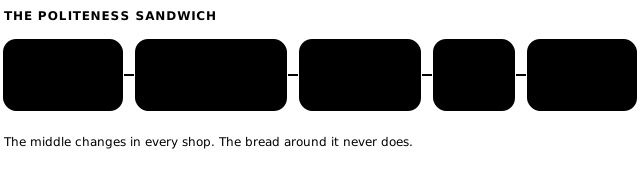
In France, every exchange starts with Bonjour — before your question, before "excuse me", before anything. Walking up to a counter and saying only "Un café" sounds rude. Add the greeting and the polite je voudrais, and people relax.
Always open with Bonjour
Bonjour (or Bonsoir in the evening) comes first, every time — in shops, buses, offices, even lifts. Then ask.
- Bonjour ! Je voudrais un café, s’il vous plaît. — Hello! I’d like a coffee, please. [bõ-ZHOOR. zhuh voo-DREH zɛ̃ ka-FAY, seel voo PLEH]
- Je vais prendre un croissant. — I’ll have a croissant. (very common when ordering) [zhuh veh PRÃDR ɛ̃ krwa-SÃ]
- Pour moi, ce sera un thé. — For me, it’ll be a tea. [poor MWA, suh suh-RA ɛ̃ TAY]
- Merci, bonne journée ! — Thanks, have a nice day! [mehr-SEE, bon zhoor-NAY]
Careful
- Wrong: Je veux un café.
- Right: Je voudrais un café.
- Why: Je veux = "I want" — it sounds like a child’s demand. Je voudrais (I would like) is the normal polite form. See Conditional & si clauses.
35.2 At the café and the bakery
In a French café, un café means a small, strong espresso. Want something bigger or milky? Use the names below. Tap water is free: ask for une carafe d’eau.
| Ask for | What you get |
|---|---|
| un café / un express | an espresso |
| un café allongé | espresso with extra water |
| un crème / un café crème | coffee with hot milk |
| un chocolat chaud | hot chocolate |
| un thé au lait | tea with milk (ask — often served black) |
| une carafe d’eau | a jug of tap water — free |
| un jus d’orange pressé | fresh orange juice |
- Sur place ou à emporter ? — To have here or to take away? [sewr PLAS oo a ã-por-TAY]
- Sur place, s’il vous plaît. / À emporter. — To have here, please. / To take away.
- Je vous dois combien ? — How much do I owe you? [zhuh voo dwa kõ-BYɛ̃]
At the bakery — à la boulangerie
| French | English |
|---|---|
| une baguette | a baguette |
| une tradition | a "tradition" baguette — crustier, often better |
| un pain au chocolat | chocolate pastry (une chocolatine in the south-west) |
| bien cuite / pas trop cuite | well baked / not too baked |
| coupé en tranches | sliced (for a loaf) |
Mini-dialogue — à la boulangerie
Say both sides. The baker’s lines are the ones you must recognise.
- Vous : Bonjour ! Une tradition, s’il vous plaît. — Hello! A tradition baguette, please.
- La boulangère : Bonjour ! Et avec ceci ? — Hello! Anything else? (literally "and with this?") [ay a-vek suh-SEE]
- Vous : Deux croissants et un pain au chocolat. — Two croissants and a pain au chocolat.
- La boulangère : Ce sera tout ? — Will that be all? [suh suh-ra TOO]
- Vous : Oui, c’est tout, merci. — Yes, that’s all, thanks.
- La boulangère : Ça fera cinq euros quarante. — That’ll be €5.40. (prices: "euros" + cents, no "and")
- Vous : Voilà. Merci, bonne journée ! — Here you are. Thanks, have a nice day!
35.3 At the market and the supermarket
At the market (le marché) you buy by weight. Use un kilo de, cinq cents grammes de, or the old market word une livre de (= 500 g). After a quantity, it’s always de, never des.
- Je voudrais un kilo de tomates, s’il vous plaît. — I’d like a kilo of tomatoes, please. [ɛ̃ kee-LOH duh to-MAT]
- Une barquette de fraises et une botte de radis. — A punnet of strawberries and a bunch of radishes.
- Elles sont à combien, les pêches ? — How much are the peaches?
- C’est combien le kilo ? — How much is it per kilo? [say kõ-byɛ̃ luh kee-LOH]
- Un peu plus, s’il vous plaît. / Un peu moins. — A bit more, please. / A bit less.
Careful
- Wrong: un kilo des pommes
- Right: un kilo de pommes
- Why: After any quantity (kilo, litre, bouteille, beaucoup, un peu) use plain de (or d’). See Articles.
At the supermarket checkout — à la caisse
- Excusez-moi, où est le rayon des œufs ? — Excuse me, where’s the egg aisle? [ek-skew-zay MWA, oo eh luh reh-YÕ day ZØ]
- Je peux payer par carte ? — Can I pay by card? [zhuh pø peh-YAY par KART]
- Je paie en espèces. — I’m paying in cash.
- Non merci, j’ai mon sac. — No thanks, I have my bag. (plastic bags are not given free)
- Je peux avoir le ticket, s’il vous plaît ? — Can I have the receipt, please?
35.4 At the restaurant
Two words confuse everyone. La carte is the full menu. Le menu (or la formule) is a fixed set: for example starter + main, or main + dessert, at one price. The meal has three parts: l’entrée (starter — not the main!), le plat (main), le dessert.
| You say | Meaning |
|---|---|
| Une table pour deux, s’il vous plaît. | A table for two, please. |
| J’ai réservé au nom de Sharma. | I booked under the name Sharma. |
| Quel est le plat du jour ? | What’s today’s special? |
| Je suis végétarien / végétarienne. | I’m vegetarian. (m / f) |
| Je suis allergique aux arachides. | I’m allergic to peanuts. |
| Saignant / à point / bien cuit | rare / medium / well done |
| L’addition, s’il vous plaît. | The bill, please. |
| On peut payer séparément ? | Can we pay separately? |
Mini-dialogue — au restaurant
Ordering a fixed menu. Notice en entrée… en plat…
- Le serveur : Vous avez choisi ? — Have you chosen? / Are you ready to order? [voo-za-vay shwa-ZEE]
- Vous : Oui. Je vais prendre le menu à vingt-deux euros. — Yes. I’ll have the €22 set menu.
- Vous : En entrée, la soupe, et en plat, le poulet. — As a starter, the soup, and as a main, the chicken.
- Le serveur : Très bien. Et comme boisson ? — Very good. And to drink?
- Vous : Une carafe d’eau, s’il vous plaît. — A jug of tap water, please.
- Le serveur : Tout s’est bien passé ? — Was everything all right? (at the end)
- Vous : C’était délicieux ! L’addition, s’il vous plaît. — It was delicious! The bill, please. [la-dee-SYÕ]
The bill never comes by itself
In France, bringing the bill early is rude — the table is yours. Ask for l’addition when you are ready. Service is included (service compris); a small tip is a kind extra, not a duty.
35.5 Clothes shops and sizes
A shop assistant will usually greet you with Je peux vous aider ? If you only want to look, say so politely. French sizes are different: clothes use numbers (la taille) and shoes use EU sizes (la pointure).
- Non merci, je regarde seulement. — No thanks, I’m just looking. [zhuh ruh-GARD suhl-MÃ]
- Je cherche une veste noire. — I’m looking for a black jacket.
- Je fais du quarante. / Je fais du M. — I’m a size 40. / I’m a medium. (literally "I do some 40")
- Je chausse du quarante-deux. — I take a size 42 in shoes.
- Je peux l’essayer ? Où sont les cabines ? — Can I try it on? Where are the fitting rooms? [zhuh pø leh-seh-YAY]
- C’est un peu trop grand. Vous l’avez en plus petit ? — It’s a bit too big. Do you have it in a smaller size?
- Vous l’avez dans une autre couleur ? — Do you have it in another colour?
- Je le prends. / Je vais réfléchir. — I’ll take it. / I’ll think about it (a polite no).
| Women’s clothes FR | ≈ UK / India | Shoes EU | ≈ UK / India |
|---|---|---|---|
| 36 | 8 | 38 | 5 |
| 38 | 10 | 40 | 6.5 |
| 40 | 12 | 42 | 8 |
| 42 | 14 | 44 | 9.5 |
Sizes vary by brand — always try on. Men’s shirts often use collar size or S/M/L/XL.
Careful
- Wrong: Ma taille est quarante.
- Right: Je fais du quarante.
- Why: French uses faire du + size for clothes and chausser du for shoes. "Ma taille est…" is understood but not natural.
35.6 Metro, bus and tickets
In most cities you buy a ticket at a machine, in an app or from the driver. In Paris, paper tickets have been replaced by the rechargeable Navigo Easy card or tickets on your phone. Lines are named by number and by their last stop: direction + the end of the line.
- Un ticket, s’il vous plaît. — One ticket, please. [ɛ̃ tee-KEH]
- Un aller simple pour Versailles. / Un aller-retour. — A one-way ticket to Versailles. / A return ticket. [ɛ̃-na-lay Sɛ̃PL · ɛ̃-na-lay ruh-TOOR]
- Quelle ligne pour aller à la tour Eiffel ? — Which line to get to the Eiffel Tower?
- Prenez la ligne six, direction Charles de Gaulle – Étoile. — Take line 6, towards Charles de Gaulle – Étoile.
- Il faut changer à Châtelet. — You have to change at Châtelet. (une correspondance = a connection)
- C’est bien le bus pour la gare ? — Is this the right bus for the station?
- C’est à combien d’arrêts ? — How many stops is it?
- Pardon, je descends au prochain arrêt. — Excuse me, I’m getting off at the next stop. (to pass people)
Validate your ticket
On buses and trams you must valider (tap or stamp) your ticket every time you board. Inspectors (contrôleurs) give on-the-spot fines.
35.7 Asking the way and understanding the answer
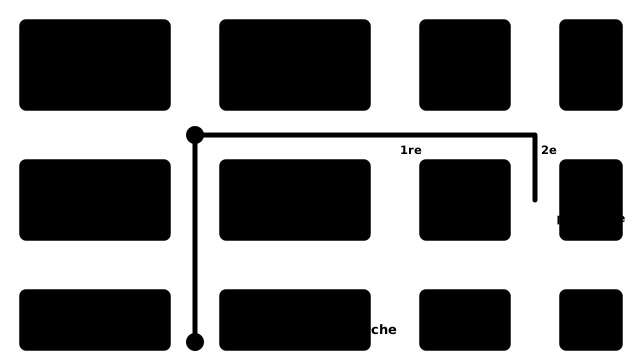
Start with Excusez-moi (or Pardon), then Bonjour. The answer will use a small set of words — learn them with the map.
| Direction words | Meaning |
|---|---|
| tout droit [too DRWA] | straight on |
| à gauche / à droite [a GOHSH · a DRWAT] | on the left / on the right |
| tournez à droite | turn right |
| la deuxième rue à gauche | the second street on the left |
| au feu / au carrefour / au rond-point | at the lights / crossroads / roundabout |
| en face de / à côté de / au coin de | opposite / next to / on the corner of |
| traversez la place | cross the square |
Mini-dialogue — dans la rue
This dialogue follows the map above.
- Vous : Excusez-moi, bonjour. Il y a une pharmacie près d’ici ? — Excuse me, hello. Is there a pharmacy near here?
- Une passante : Oui. Allez tout droit jusqu’au feu. — Yes. Go straight on to the traffic lights.
- Une passante : Au feu, tournez à droite, puis prenez la deuxième à droite. — At the lights, turn right, then take the second on the right.
- Une passante : La pharmacie est sur votre gauche, en face de la poste. — The pharmacy is on your left, opposite the post office.
- Vous : C’est loin ? — Is it far? [say LWɛ̃]
- Une passante : Non, c’est à cinq minutes à pied. — No, it’s five minutes on foot.
- Vous : Merci beaucoup ! — Thank you very much!
Careful
- Wrong: Où est le pharmacie ?
- Right: Où est la pharmacie ? / Il y a une pharmacie près d’ici ?
- Why: Pharmacie is feminine. Use la for a place you know exists, il y a une… to ask if one exists at all.
35.8 What you will hear from the other side
Speaking is only half the job. Here are the lines people will say to you — learn to recognise them so you are never frozen.
| You hear | It means |
|---|---|
| Je vous écoute. | Go ahead, I’m listening (= what would you like?) |
| Qu’est-ce que je vous sers ? | What can I get you? |
| C’est à qui ? / Au suivant ! | Whose turn is it? / Next! |
| Et avec ceci ? / Ce sera tout ? | Anything else? / Is that all? |
| Vous payez comment ? | How are you paying? |
| Vous avez la carte du magasin ? | Do you have the store loyalty card? |
| Vous n’auriez pas de la monnaie ? | You wouldn’t have smaller change? |
| Il n’y en a plus, désolé. | There’s none left, sorry. |
| Je vous en prie. / Avec plaisir. | You’re welcome. |
| Bonne fin de journée ! | Enjoy the rest of your day! |
Your rescue lines
- Pardon, vous pouvez répéter, s’il vous plaît ? — Sorry, can you repeat, please? [voo poo-vay ray-pay-TAY]
- Plus lentement, s’il vous plaît. — More slowly, please. [plew lãt-MÃ]
- Je ne comprends pas. Vous parlez anglais ? — I don’t understand. Do you speak English?
- Comment on dit « bag » en français ? — How do you say "bag" in French?
One situation a day
Day 1: the bakery. Day 2: the café. Day 3: the market… Say each dialogue out loud, both sides, five times. In a week, every situation in this chapter will be automatic.
À retenir
- Bonjour (or Bonsoir in the evening) comes first, every time — in shops, buses, offices, even lifts. Then ask.
- In France, bringing the bill early is rude — the table is yours. Ask for l’addition when you are ready. Service is included (service compris); a small tip is a kind extra, not a duty.
- On buses and trams you must valider (tap or stamp) your ticket every time you board. Inspectors (contrôleurs) give on-the-spot fines.
- Day 1: the bakery. Day 2: the café. Day 3: the market… Say each dialogue out loud, both sides, five times. In a week, every situation in this chapter will be automatic.
- Ready to leave town? Travel & emergencies takes you to the hotel, the train station, the airport, the doctor and the pharmacy — and gives you the lines for when something goes wrong.
35.9 Practice — Everyday French
Exercise 1
You walk into a bakery. What do you say first?
- Une baguette.
- Bonjour !
- Je veux une baguette.
- Excusez-moi.
Answer
Bonjour !
Bonjour always comes first in France — before any request.
Exercise 2
In a French café, 'un café' is…
- a large milky coffee
- a small espresso
- an iced coffee
- a cup of tea
Answer
a small espresso
Un café = an espresso. For milk, ask for un café crème.
Exercise 3
The waiter asks 'Sur place ou à emporter ?'. He wants to know…
- how you will pay
- if you want a table outside
- if you will eat here or take it away
- if you want ice
Answer
if you will eat here or take it away
sur place = here; à emporter = to take away.
Exercise 4
At a restaurant, 'l'entrée' is…
- the main course
- the starter
- the dessert
- the entrance fee
Answer
the starter
In France l'entrée is the starter; le plat is the main course.
Exercise 5
Je voudrais un kilo ___ tomates.
Hint: After a quantity.
Answer
de
After a quantity, always de: un kilo de tomates.
Exercise 6
Allez tout ___ jusqu'au feu. (straight on)
Answer
droit
tout droit = straight on. Not to be confused with à droite = on the right.
Exercise 7
Tap the word that is too blunt.
Bonjour, je veux un croissant, s'il vous plaît.
Answer
Wrong word: veux.
Corrected: Bonjour, je voudrais un croissant, s'il vous plaît.
je voudrais is the polite way to order; je veux sounds demanding.
Exercise 8
Tap the wrong word.
Excusez-moi, où est le pharmacie ?
Answer
Wrong word: le.
Corrected: Excusez-moi, où est la pharmacie ?
pharmacie is feminine: la pharmacie.
Exercise 9
Match the direction to its meaning.
| A | B |
|---|---|
| tout droit | opposite |
| à gauche | at the traffic lights |
| en face de | straight on |
| au feu | on the left |
Answer
tout droit — straight on; à gauche — on the left; en face de — opposite; au feu — at the traffic lights
These few words cover most directions you will hear.
Exercise 10
Match what you hear to its meaning.
| A | B |
|---|---|
| Et avec ceci ? | How are you paying? |
| Ce sera tout ? | Whose turn is it? |
| Vous payez comment ? | Anything else? |
| C'est à qui ? | Is that all? |
Answer
Et avec ceci ? — Anything else?; Ce sera tout ? — Is that all?; Vous payez comment ? — How are you paying?; C'est à qui ? — Whose turn is it?
Recognising the other side's lines is half of every conversation.
Exercise 11
Put the words in order.
Words: payer / peux / Je / par / carte
Answer
Je peux payer par carte
Je peux + infinitive: Je peux payer par carte ? = Can I pay by card?
Exercise 12
Put the words in order.
Words: plus / l'avez / en / Vous / petit
Answer
Vous l'avez en plus petit
Vous l'avez en plus petit ? = Do you have it in a smaller size?
Exercise 13
Order politely.
Je voudrais un café s'il vous plaît
Answer
Say: Je voudrais un café s'il vous plaît
je voudrais + thing + s'il vous plaît — the golden formula.
Exercise 14
Ask for the bill.
L'addition s'il vous plaît
Answer
Say: L'addition s'il vous plaît
l'addition [la-dee-SYÕ] = the bill.
Exercise 15
Tell the baker that's all.
Oui c'est tout merci
Answer
Say: Oui c'est tout merci
Answer to 'Ce sera tout ?'.
Exercise 16
Ask if there's a pharmacy nearby.
Il y a une pharmacie près d'ici
Answer
Say: Il y a une pharmacie près d'ici
Il y a… près d'ici ? = Is there a… near here?
Exercise 17
Say you're just looking.
Non merci je regarde seulement
Answer
Say: Non merci je regarde seulement
The polite answer to 'Je peux vous aider ?'.
Exercise 18
Ask someone to repeat.
Vous pouvez répéter s'il vous plaît
Answer
Say: Vous pouvez répéter s'il vous plaît
Your most useful rescue line.
Next step
Ready to leave town? Travel & emergencies takes you to the hotel, the train station, the airport, the doctor and the pharmacy — and gives you the lines for when something goes wrong.