Chapter 3: The sounds of French
Les sons du français
French has about 36 sounds. Most of them you already make in English or Hindi. A handful are new — the u of tu, the nasal vowels of un bon vin blanc, the R made in the throat. This chapter shows you where to put your lips and tongue for each one, and gives you pairs of words to train your ear. Use your voice on every 🔊.
- 1Four big differences from English
- 2The oral vowels: a map of the mouth
- 3The key pair: u versus ou
- 4The e family: é, è, silent e — and eu
- 5The four nasal vowels
- 6The consonants that need attention
- 7The letter h: muet and aspiré
- 8Rhythm, stress and melody
masculinefeminineplural
The golden rule of French sound
Tense lips, pure vowels, even syllables, stress at the end. French vowels never slide (“no” is not “noh-oo”), and every syllable gets the same short beat.
3.1 Four big differences from English
| English habit | French habit |
|---|---|
| Relaxed mouth | Tense, precise mouth — lips spread or rounded much more. |
| Vowels glide: “day” = [de-ee], “go” = [go-oo] | Pure vowels: des [day] stops dead; beau [bo] does not move. |
| Stress-timed: long and short syllables | Syllable-timed: every syllable gets about the same beat. |
| Stress on one syllable of each word | Stress on the last syllable of a group of words. |
- beau, des, si — beautiful, some, if — hold each vowel still, like a photo [BO, DAY, SEE]
- l’université — university — five even beats, the last a little longer [lew-nee-vehr-see-TAY]
How to read the hints in this book
| Hint | French spelling | Example |
|---|---|---|
| ee | i, y | lit [LEE] |
| ay | é, -er, -ez | thé [TAY] |
| eh | è, ê, ai | mère [MEHR] |
| uh | e (no accent) | le [luh] |
| ö | eu, œu | deux [DÖ] |
| oo | ou | vous [VOO] |
| ew | u | tu [TEW] |
| ã · õ · ɛ̃ | an/en · on · in/ain/un | vent, vont, vin |
| zh · sh · ny | j/ge · ch · gn | je, chat, ligne |
| r | r (always the throat R) | rue [REW] |
3.2 The oral vowels: a map of the mouth
Vowels differ in two ways: how high the tongue is (mouth closed or open) and where it is (front or back), plus whether the lips are rounded. French uses all the combinations — including front + rounded, which English does not have.
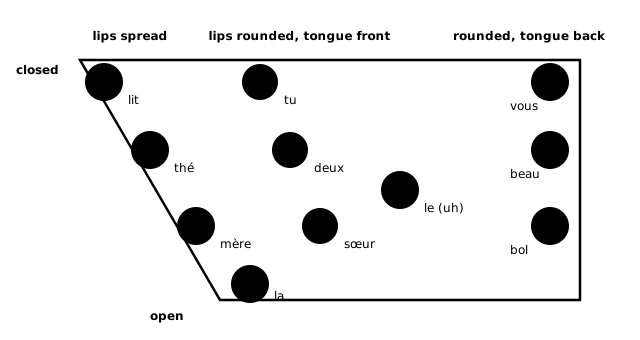
| Sound | Spellings | Examples |
|---|---|---|
| [ee] | i, î, y | ici, la vie, le stylo |
| [ay] | é, -er, -ez, -et | l’été, parler, le nez |
| [eh] | è, ê, ai, ei, e + 2 consonants | très, la fête, le lait, belle |
| [ah] | a, à | le chat, la table, ami |
| [oh] closed | o (end), ô, au, eau | le mot, l’hôtel, chaud, l’eau |
| [o] open | o + pronounced consonant | le bol, la porte, l’homme |
| [oo] | ou, où, oû | rouge, le jour, le goût |
| [ew] | u, û | la rue, la lune, sûr |
| [ö] closed | eu (end of word) | deux, peu, bleu |
| [ö] open | eu, œu + consonant | la peur, la fleur, jeune |
| [uh] | e (no accent) | le, de, petit, demain |
3.3 The key pair: u versus ou
This is the most important sound difference for a beginner, because it changes meaning all the time. English and Hindi have ou [oo] (as in “food”, “phool”) but not French u.
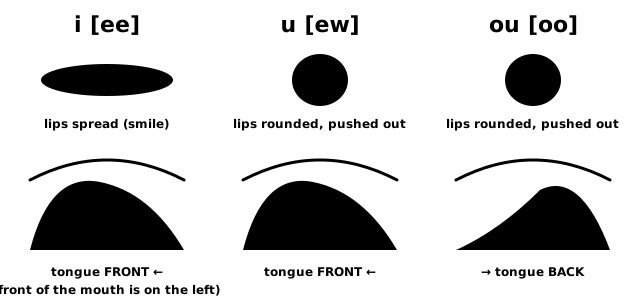
The u trick
Say a long “eeeee”, freeze your tongue, and slowly round your lips. The sound that comes out is French u. Check in a mirror: lips round, tongue tip still touching your lower teeth.
Minimal pairs: u / ou
Each pair differs by one sound only. Listen to the pair, then say it.
- tu / tout — you / all [TEW / TOO]
- vu / vous — seen / you [VEW / VOO]
- la rue / la roue — the street / the wheel [la REW / la ROO]
- dessus / dessous — on top / underneath [duh-SEW / duh-SOO]
- pur / pour — pure / for [PEWR / POOR]
- du / doux — some / soft [DEW / DOO]
- lu / le loup — read (past) / the wolf [LEW / luh LOO]
Minimal pairs: i / u
- la vie / la vue — life / the view [la VEE / la VEW]
- le riz / la rue — rice / the street [luh REE / la REW]
- dit / du — said / some [DEE / DEW]
In sentences
- Tu es où ? — Where are you? (informal) [tew eh OO]
- Vous avez vu la rue ? — Have you seen the street? [voo-za-vay VEW la REW]
- Le livre est dessus, pas dessous. — The book is on top, not underneath.
The glides: oui, huit, lui
When ou or u comes right before another vowel, it becomes a quick glide. oui starts with a [w]; huit and lui start with the same glide made with u-lips.
- oui / huit — yes / eight [WEE / WEET (u-lips)]
- Louis / lui — Louis (name) / him [loo-EE / lew-EE, very fast]
- Je suis là cette nuit. — I am here tonight. [zhuh swee la set NWEE]
Careful
- Wrong: Tu said as “too”.
- Right: Tu [tew]: ee-tongue, rounded lips.
- Why: “too” is tout (all). Saying “too” for tu changes the word.
3.4 The e family: é, è, silent e — and eu
é [ay] and è [eh]
é is a smiling, closed [ay] with no glide at the end. è is more open, like “e” in “bed”. In everyday speech some French speakers blur them at the end of words — but keep them apart and you will always be understood.
- les / le lait — the (plural) / the milk [LAY / luh LEH]
- l’été / il était — summer / he was [lay-TAY / ee-lay-TEH]
- le pré / près — the meadow / near [luh PRAY / PREH]
Careful
- Wrong: café said as “ka-FAY-ee”.
- Right: café [ka-FAY] — the vowel stops dead.
- Why: English “ay” slides into “ee”. French é is one frozen sound — hold your jaw still.
The silent e (e muet) [uh]
An e without an accent is a short, relaxed [uh] with slightly rounded lips — or it disappears completely (you will see when in Silent letters & liaison). The tiny difference between [uh] and [ay] separates singular from plural:
- le livre / les livres — the book / the books — the final s is silent; only the vowel of le/les tells you [luh LEEVR / lay LEEVR]
- de / des — of / some (plural) [duh / DAY]
- ce / ces — this / these [suh / SAY]
- je / j’ai — I / I have [zhuh / ZHAY]
le [uh] vs les [ay]
Plural -s is silent, so the article carries the number: le [luh] = one, les [lay] = many. Get this vowel right and people hear your plurals.
eu and œu: closed and open [ö]
Make an [ay] and round your lips: that is closed eu (deux). Make an [eh] and round your lips: that is open eu (peur). Rule of thumb: closed at the end of a word, open before a pronounced consonant.
- deux, peu, bleu, le jeu — two, little, blue, the game — closed [DÖ, PÖ, BLÖ, luh ZHÖ]
- la peur, la sœur, la fleur, neuf — fear, sister, flower, nine — open [PÖR, SÖR, FLÖR, NÖF]
- de / deux — of / two — deux is tenser and more rounded [duh / DÖ]
- Il est neuf heures, je suis heureux. — It's nine o'clock, I am happy. [ee-leh nö-VÖR, zhuh swee-zö-RÖ]
3.5 The four nasal vowels
In a nasal vowel, air goes out through the mouth and the nose at the same time. The n or m in the spelling is not pronounced — it only tells you the vowel is nasal.
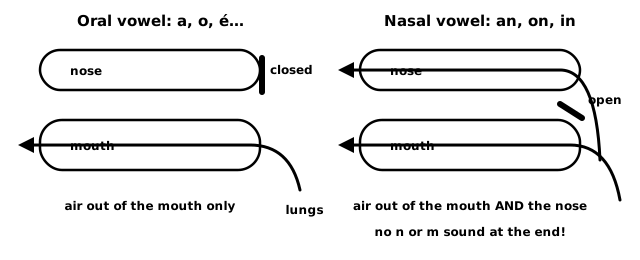
| Sound | Spellings | Examples |
|---|---|---|
| [ã] | an, am, en, em | l’enfant, la chambre, le temps |
| [õ] | on, om | bon, le nom, l’ombre |
| [ɛ̃] | in, im, ain, aim, ein, yn | le vin, simple, le pain, plein |
| [ɛ̃] or [œ̃] | un, um | un, lundi, le parfum |
Most speakers in France now say un exactly like in. Many in Belgium, Switzerland and the south keep a rounder [œ̃]. Both are correct.
Hindi already has these
हाँ (haan) ≈ French [ã]; the end of क्यों (kyon) ≈ [õ]; मैं (main) ≈ [ɛ̃] — it sounds almost exactly like French main (hand)!
When is a vowel + n/m nasal?
The nasal rule
Vowel + n/m + consonant or end of word = nasal (bon, bonbon). Vowel + n/m + vowel, or a double nn/mm = not nasal (une, fine, bonne, l’homme).
This rule is why masculine and feminine often sound different:
- bon / bonne — good (m) / good (f) [BÕ / BON]
- un / une — a (m) / a (f) [Ɛ̃ / EWN]
- indien / indienne — Indian (m) / Indian (f) [ɛ̃-DYƐ̃ / ɛ̃-DYEN]
- plein / pleine — full (m) / full (f) [PLƐ̃ / PLEN]
- un an / un âne — a year / a donkey [ɛ̃-NÃ / ɛ̃-NAN]
The three-way test: ã, õ, ɛ̃
[ã] is the most open (jaw low, like “ah” through the nose); [õ] has rounded lips; [ɛ̃] is flatter, like “eh” through the nose.
- le vent / ils vont / le vin — the wind / they go / the wine [VÃ / VÕ / VƐ̃]
- sans / son / saint — without / his, sound / saint [SÃ / SÕ / SƐ̃]
- le banc / bon / le bain — the bench / good / the bath [BÃ / BÕ / BƐ̃]
- lent / long / le lin — slow / long / linen [LÃ / LÕ / LƐ̃]
- blanc / blond — white / blond [BLÃ / BLÕ]
- Un bon vin blanc. — A good white wine. — the famous four-nasal test [ɛ̃ bõ vɛ̃ BLÃ]
- En France, on mange du pain. — In France, people eat bread. [ã FRÃSS, õ mãzh dew PƐ̃]
Careful
- Wrong: bon said as “bong” or “bonn”.
- Right: bon [bõ]: the vowel goes nasal, the tongue never touches the roof of the mouth.
- Why: An n or ng at the end turns bon into bonne — or into nothing French at all.
3.6 The consonants that need attention
The French R
The French R is made at the back of the mouth, where you make [g] — not with the tongue tip. The tip stays down, behind your lower teeth.
| Step | What to do |
|---|---|
| 1 | Say “ga, ga, ga”. Feel the back of your tongue touch the soft palate. |
| 2 | Now say “ga” but do not let it touch: leave a tiny gap so the air rubs through — a soft, gentle gargle. |
| 3 | That rubbing sound is the French R. It is very close to Urdu/Hindi ग़ in ghazal, ghareeb. |
| 4 | Keep the tongue tip pressed behind the lower teeth for every R. |
- la rue, rouge, rare — the street, red, rare — R at the start [la REW, ROOZH, RAR]
- Paris, merci, Marie — R in the middle [pa-REE, mehr-SEE, ma-REE]
- bonjour, la mer, la porte — hello, the sea, the door — R at the end: always pronounce it, softly
- très, trois, un croissant — very, three, a croissant — after t or k the R is lighter, almost a whisper [TREH, TRWA, ɛ̃ krwa-SÃ]
- Il fait très froid à Rouen. — It is very cold in Rouen. [eel feh treh FRWA a roo-Ã]
Careful
- Wrong: merci with a tapped Hindi र or a curled English r.
- Right: merci with a soft throat R, tongue tip down.
- Why: A rolled r is understood (some singers and older rural speakers use it), but the standard French R is in the throat.
ch, j and g
- Charles cherche son chat. — Charles is looking for his cat. — ch = [sh], always [SHARL SHEHRSH sõ SHA]
- le chocolat, la Chine, dimanche — chocolate, China, Sunday [sho-ko-LA, la SHEEN, dee-MÃSH]
- Je joue à la plage. — I play on the beach. — j and soft g = [zh], the sound in “measure” [zhuh ZHOO a la PLAZH]
- le garage, rouge, la page — garage, red, the page [ga-RAZH, ROOZH, la PAZH]
Careful
- Wrong: chocolat as “tchocolat” (like Hindi च in chai).
- Right: chocolat [sho-ko-LA], with श.
- Why: French ch is श (sh). The “tch” sound only appears in borrowed words, spelled tch: tchèque, le Tchad.
Careful
- Wrong: je as “juh” with ज (a d at the start).
- Right: je [zhuh]: a smooth buzz with no d.
- Why: French j is the middle sound of “measure” or “television”, never the j of “jam” or jaana.
gn [ny]
- la montagne, l’Espagne, la campagne — mountain, Spain, countryside — gn = “ny” in “canyon” [mõ-TANY, les-PANY, kã-PANY]
- gagner, le champagne — to win, champagne [ga-NYAY, shã-PANY]
Careful
- Wrong: montagne as “mon-tag-nuh”.
- Right: montagne [mõ-TANY] — one sound, no g.
- Why: gn is a single sound, made with the middle of the tongue against the palate.
p, t, k, d, l and s
French p, t, k have no puff of air — exactly like Hindi प, त, क (not फ, थ, ख). French t, d touch the teeth, like Hindi त, द. French l is always clear, like Hindi ल, even at the end of a word — never the “dark” l of English “ball”.
- Papa, tu es là ? Le taxi est là. — Dad, are you there? The taxi is here. — no puffs of air
- Elle est belle, la ville. — The town is beautiful. — a clear l every time, even at the end [el eh BEL la VEEL]
A single s between two vowels sounds [z]; ss stays [s]. This changes meaning:
- le poisson / le poison — the fish / the poison [pwa-SÕ / pwa-ZÕ]
- le dessert / le désert — dessert / the desert [day-SEHR / day-ZEHR]
- Le poisson n’est pas du poison ! — Fish is not poison!
3.7 The letter h: muet and aspiré
In French, h is never pronounced. l’hôtel = [lo-TEL], le héros = [luh ay-RO]. But there are two kinds of h, and they behave differently with the word before them:
| Type | Behaves like | Examples |
|---|---|---|
| h muet (most words) | a vowel: l’, liaison | l’homme, l’hôtel, les‿hôtels |
| h aspiré (a list to learn) | a consonant: no l’, no liaison | le héros, les haricots, la honte |
Dictionaries mark h aspiré with an asterisk or an apostrophe (*héros). The rules for linking words are in the next chapter, Silent letters & liaison.
Careful
- Wrong: l’hôtel as “la HO-tel”, with an English h.
- Right: l’hôtel [lo-TEL].
- Why: The h is silent, and the stress goes on the last syllable.
3.8 Rhythm, stress and melody
French sounds “smooth” because every syllable is about the same length and words run into each other. The only stress is a slight lengthening of the last syllable of each group of words — not of each word.
- Bonjour. / Bonjour, Madame. — The stress moves to the end of the group: bon-JOUR / bonjour ma-DAME.
- Je voudrais | un café | avec du lait. — I'd like a coffee with milk. — three groups, three small peaks: -DRAIS, -FÉ, LAIT
Cognates: move the stress to the end
English words borrowed from French stress the start. French stresses the end. Clap the syllables evenly and lengthen the last one.
| English stress | French stress |
|---|---|
| RES-tau-rant | res-tau-RANT [res-to-RÃ] |
| CHO-co-late | cho-co-LAT [sho-ko-LA] |
| CA-na-da | Ca-na-DA [ka-na-DA] |
| im-POR-tant | im-por-TANT [ɛ̃-por-TÃ] |
| pho-TO-gra-phy | pho-to-gra-PHIE [fo-to-gra-FEE] |
Careful
- Wrong: restaurant as “RES-tuh-ront”.
- Right: restaurant [res-to-RÃ]: three even beats, nasal at the end, no t.
- Why: Do not swallow the middle syllables as English does — French gives each one its full vowel.
Melody: the voice rises for questions
In everyday French, the same words can be a statement or a question. Only the melody changes: falling at the end for a statement, rising for a yes/no question.
- Tu viens. ↘ / Tu viens ? ↗ — You're coming. / Are you coming? [tew VYƐ̃]
- Ça va. ↘ / Ça va ? ↗ — I'm fine. / How are you? [sa VA]
- Vous parlez anglais ? ↗ — Do you speak English? [voo par-lay ã-GLEH]
Train your ear daily
Pick two minimal pairs a day (tu/tout, vent/vin) and say each ten times. For mic drills with scoring, see Pronunciation clinic in Part 4.
À retenir
- Tense lips, pure vowels, even syllables, stress at the end. French vowels never slide (“no” is not “noh-oo”), and every syllable gets the same short beat.
- Say a long “eeeee”, freeze your tongue, and slowly round your lips. The sound that comes out is French u. Check in a mirror: lips round, tongue tip still touching your lower teeth.
- Plural -s is silent, so the article carries the number: le [luh] = one, les [lay] = many. Get this vowel right and people hear your plurals.
- हाँ (haan) ≈ French [ã]; the end of क्यों (kyon) ≈ [õ]; मैं (main) ≈ [ɛ̃] — it sounds almost exactly like French main (hand)!
- Vowel + n/m + consonant or end of word = nasal (bon, bonbon). Vowel + n/m + vowel, or a double nn/mm = not nasal (une, fine, bonne, l’homme).
- Pick two minimal pairs a day (tu/tout, vent/vin) and say each ten times. For mic drills with scoring, see Pronunciation clinic in Part 4.
3.9 Practice — The sounds of French
Exercise 1
Which word has the French u sound [ew]?
- tout
- vous
- tu
- sous
Answer
tu
tu = [tew]. The others all have ou = [oo].
Exercise 2
How do you make the French u?
- Say 'oo' and smile
- Say 'ee', then round your lips
- Say 'ah' through the nose
- Say 'uh' quickly
Answer
Say 'ee', then round your lips
u = the tongue of i + the lips of ou.
Exercise 3
'dessous' means 'underneath'. What does 'dessus' mean?
- on top
- inside
- behind
- far
Answer
on top
dessus [duh-SEW] = on top; dessous [duh-SOO] = underneath.
Exercise 4
Match the nasal words to their meanings.
| A | B |
|---|---|
| le vent | they go |
| ils vont | the wine |
| le vin | the wind |
Answer
le vent — the wind; ils vont — they go; le vin — the wine
[ã] vent, [õ] vont, [ɛ̃] vin — three different nasal vowels.
Exercise 5
Which word does NOT have a nasal vowel?
- bon
- bonne
- vin
- un
Answer
bonne
In bonne, nn + vowel: not nasal [bon]. bon, vin and un end in n: nasal.
Exercise 6
Un bon vin ___ (white).
Hint: rhymes with 'an'
Answer
blanc
Un bon vin blanc — all four nasal vowels in one phrase. The c is silent.
Exercise 7
French 'ch', as in 'chat', sounds like…
- English 'ch' in 'chair'
- English 'sh' in 'ship'
- English 'k'
- English 'j'
Answer
English 'sh' in 'ship'
ch = [sh] (श). 'tch' is spelled tch in French.
Exercise 8
'gn' in 'montagne' sounds like…
- g + n
- 'ny' in 'canyon'
- 'ng' in 'sing'
- just n
Answer
'ny' in 'canyon'
gn is one sound: [mõ-TANY].
Exercise 9
The French R is made at the ___ of the mouth, not with the tongue tip.
Hint: front or back?
Answer
back
Back of the tongue near the soft palate, like a soft ग़; the tip stays down.
Exercise 10
Tap the word that means something dangerous instead of 'fish'.
Je mange du poison à midi.
Answer
Wrong word: poison.
Corrected: Je mange du poisson à midi.
poisson (ss = [s]) is fish; poison (single s = [z]) is poison!
Exercise 11
Where is the stress in French 'restaurant'?
- res-
- -tau-
- -rant (last)
- nowhere
Answer
-rant (last)
French stresses the last syllable: res-to-RÃ.
Exercise 12
How is 'les' pronounced?
- [luh]
- [lay]
- [less]
- [lez]
Answer
[lay]
les = [lay] (plural); le = [luh] (singular). The s is silent.
Exercise 13
In speech, what makes 'Tu viens ?' a question?
- A rising voice at the end
- A louder first word
- A longer 'tu'
- Nothing
Answer
A rising voice at the end
Same words, rising melody = yes/no question.
Exercise 14
Which Hindi word ends in a sound close to French 'on' [õ]?
- क्यों (kyon)
- कल (kal)
- दिल (dil)
- राम (raam)
Answer
क्यों (kyon)
The nasal o at the end of क्यों is very close to French [õ].
Exercise 15
Match the u / ou pairs.
| A | B |
|---|---|
| la rue | you |
| la roue | all |
| tu | the street |
| tout | the wheel |
Answer
la rue — the street; la roue — the wheel; tu — you; tout — all
u [ew] vs ou [oo] changes the word.
Exercise 16
Put the words in order: 'A good white wine.'
Words: bon / vin / blanc / Un
Answer
Un bon vin blanc
In French most adjectives follow the noun (vin blanc), but bon goes before.
Exercise 17
Say it aloud — four nasal vowels.
Un bon vin blanc
Answer
Say: Un bon vin blanc
[ɛ̃ bõ vɛ̃ blã] — no n or ng at the end of any word.
Exercise 18
Say it aloud — u then ou.
Vous avez vu la rue
Answer
Say: Vous avez vu la rue
vous [oo], vu [ew], rue [ew] — and link vous‿avez with a z.
Exercise 19
Say it aloud — ss and s.
Le poisson n'est pas du poison
Answer
Say: Le poisson n'est pas du poison
poisson [s], poison [z].
Next step
You can now say every French sound. Next, Silent letters & liaison shows which letters you don’t say — and when a silent letter suddenly comes back to life.